• ABOUT THE AUTHOR
  • Sustainability
  • CSR
  • CSR reporting

In Good Company: Singh on CSR

~ Connecting the dots between Business, Society & the Environment

Tag Archives: transparency

Corporate Social Responsibility at Target: Behind the Red Bullseye

07 Monday Jul 2014

Posted by Aman Singh in CSR, CSR reporting, CSRwire, ESG

≈ Leave a comment

Tags

Business, Consumerism, Corporate Governance, CSR, CSR reporting, CSRwire, education, energy efficiency, environment, ESG, ESG goals, packaging, Stakeholder Engagement, supply chain, Sustainability, sustainability, sustainable design, target, transparency, water reduction goals


Target released four new corporate responsibility goals in 2011:

  • Increase sustainable seafood selection
  • Improve owned-brand packaging sustainability
  • Increase diabetes HbA1c testing compliance
  • Increase reading proficiency

Now, Target’s 2011 CSR Report offers pages of graphs measuring the Minneapolis-based retailer’s progress against these goals. While the graphs look promising and underscore the challenges of operating in a competitive market with multiple layers of stakeholders, I wanted to understand the context behind these goals and what the execution would look like.

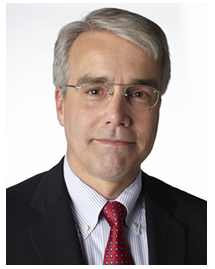
I sat down with Tim Baer, Executive Vice President, General Counsel and Corporate Secretary with Target, for a conversation about the goals and how his team plans to demystify complicated supply chains and motivate its employees and customers toward healthy and sustainable choices.

Aman Singh: While the PDF of goals and progress gave me a sense of exactly that, i.e., progress, it didn’t give me a sense of Target’s mission/values. Can you elaborate?

Tim Baer: At Target, we’re committed to positively impacting the lives of our guests and team members. Since 1946, our legacy of giving and service has been reflected in a commitment that today totals more than $3 million a week to our communities.
Tim_Baer_TargetAnd at the end of the day, by continuing to  serve our team members and communities, we ensure our future success. As a result of our giving model, we benefit from being a workplace and shopping destination of choice for our team members and guests. Not only do our guests value our commitment to communities and giving, but our team members do as well.

To bring our vision of strong, healthy and safe communities to life — which we can’t do alone — we work with community, business and civic partners who inform and share in our approach. We know we can make a meaningful impact, so we set goals to guide our work in three focus areas — helping to put more U.S. children on the path to graduation, reducing our impact on the environment and helping Target team members live healthy, balanced lives.

Why is education such a big goal for Target?

Education, specifically K-3 literacy, is important to Target for three primary reasons. First, we believe that every child deserves the opportunity to reach his or her full potential. And, we’re compelled to do our part to address the education challenge in America, putting more kids on the path to high school graduation.

Second, based on guest surveys, we know that our guests care about education more than any other social issue, and we’re committed to giving to communities in a way that positively impacts our guests and their families.

Third, we know that reading proficiently by the end of third grade is a significant milestone on the path to graduation. This is the time when a child transitions from learning to read, to reading to learn. A child who cannot read proficiently by the end of third grade is four times more likely to drop out of high school when compared with a child who can.

Ultimately, education is critically important to the success of our children and our economy. By supporting education, we are investing in developing an educated workforce that is prepared for today’s and tomorrow’s challenging work environment. At Target, our team is our competitive advantage, and preparing future team members with a quality education today makes good business sense.

CSR_Education_Target

Your data shows that you were not able to achieve your water reduction goals? Can you give us a sense of the challenges and where improvements need to be made?

To recap the report, Target used 3.45 billion gallons of water, representing a 0.3 percent reduction in water use per square foot from our 2009 baseline. Although our absolute water use exceeded our initial baseline, we also increased our total real estate square footage, which led to a decrease in water use per square foot.

The most significant challenges we faced in 2011 were drought-like conditions in some of our mature markets like Texas, Minnesota and Iowa, where we have a relatively high concentration of stores requiring increased irrigation. This negative impact was modestly softened by our rollout of several water-saving initiatives, which we estimate will contribute a reduction of 1.4 percent annually starting this year.

A few examples of our water-saving initiatives include:

  • Expanded installation of smart irrigation controllers that irrigate based on real-time local weather data in lieu of set times,
  • Use of ultra-low flow urinals and water closets, and
  • Elimination of continuously running dipper wells for ice cream and coffee stations at Target Café and Starbucks locations in our stores.

We’re also in the process of installing real-time water submeters in a number of stores to pinpoint the quantity of water a typical store uses for various operations. This will help improve our evaluation of water-saving opportunities moving forward.

Environment_CSR_Target

You have a goal of reducing owned-brand product packaging for at least 50 product designs by 2016. Is that aggressive enough?

While we’ve targeted 50 packaging designs, these changes will be implemented for a much larger number of items that use the same packaging.

We know environmental stewardship is important to Target guests, and our sustainable packaging designs will let them know that Target’s commitment to reducing our environmental impact begins before our products hit shelves.

Over the next five years, Target will be developing sustainable packaging designs that yield at least a 10 percent improvement in one of several attributes of our existing owned-brand packaging. We’ll do this in several ways, including reducing overall packaging, using more recycled or renewable content, and reducing product waste. We’ll also look to use more recyclable materials in our packaging, Sustainable Packaging at Targetcounting these improvements toward our goal only if the updated packaging is 100 percent recyclable.

The goals indicated regarding packaging are limited to your owned-brand products. Are there any plans to push your suppliers and CPG partners into more responsible, transparent and environmentally friendly actions?

We believe in leading by example and hope that by creating more sustainable packaging for our owned brands, we can inspire our suppliers, CPG partners and peers to implement more sustainable packages in their own products.

The report indicates strong progress toward empowering employees to be more health-conscious. Can you discuss some of the challenges behind the numbers?

For us, 2011 was a year of learning in regards to team member wellbeing.

We recognized goals specific to preventive service utilization rates were difficult to measure consistently and accurately, so we adopted HEDIS [National Committee for Quality Assurance’s Health Effectiveness Data and Information Set] measures. By doing so, we can support our wellbeing efforts by comparing our utilization rates to those of other employers or healthcare entities like medical groups or health plans.

The size and geographic distribution of the Target team member population reaches across 49 states, 1,700 stores, 37 distribution centers and nine domestic headquarters locations. We employ more than 365,000 team members and know they have varying degrees of health engagement, variable disease prevalence and differing perspectives on healthcare services. This is an opportunity for us to develop tailored programs that address these differences, more effectively reaching every team member, regardless of where and how they live and work.

Can you summarize the key highlights of the report?

All of Target’s corporate responsibility objectives ladder up to our larger goal of creating a brighter future for our team members, our communities and the world we live in. Target is here for good. Through all of these initiatives, we’re committed to positively impacting the lives of our guests and team members.

Additionally, Target’s 2011 Corporate Responsibility Report is the most transparent corporate responsibility report we’ve ever released. It represents the first time Target declared a GRI Application Level and obtained a GRI Application Level Check. [For more information, Target’s GRI Application Level/Check Statement from GRI were posted on www.Target.com/hereforgood on July 13, 2012.]

Why bother reporting on this set of internal goals? How do you measure the “success” of your CSR report?

Our commitment to our guest extends far beyond our stores, and we believe truly great service includes supporting the communities where we live and work. In business, Target collaborates and innovates to drive results. Key to that collaboration is transparency when it comes to measuring and reporting progress toward goals, allowing us to grow as a company.

Originally written for and published on CSRwire’s Commentary section Talkback on August  6, 2012.

Share this:

  • Tweet
  • Email a link to a friend (Opens in new window) Email
  • Share on Reddit (Opens in new window) Reddit
  • Print (Opens in new window) Print
Like Loading...

Eurosif’s 2012 Procurement Report: Investors Increasingly Auditing Supply Chain Sustainability

07 Monday Jul 2014

Posted by Aman Singh in CSRwire

≈ Leave a comment

Tags

conflict minerals, CSRwire, dodd-frank act, eicc, ESG, eurosif, procurement, supply chain audit, supply chain management, Supply chain management, Sustainability, sustainability, transparency, un guiding principles on business and human rights


An interview with François Passant, Executive Director of Eurosif, the European Sustainable Investment Forum

What are the critical points investors should know about this report?

François Passant: The Eurosif Procurement Report reveals – one of the first such reports – how investors can systematically minimize supply chain François_Passant__Executive_Director_Eurosifrisks against the backdrop of an exponential growth in outsourcing to low-cost regions such as Asia, and recent environmental disasters such as

Fukushima.

Researched by privately held swiss Bank Sarasin, the report illustrates the factors that are considered in a robust sustainable supply chain audit and offers best practices used by multinational companies in the textiles and electronics sectors in monitoring different tiers of suppliers. We focused on these two industries primarily because they have particularly long and complex supply chains, though there are variations even in these sectors.

It also helps practitioners frame the business case for responsible supply chain management.

What are the main contributing policies and standards highlighted by the report?

Responsible supply chain management requires recognition of the relationship between environmental, social, legal and reputational risks and financial performance.

There is a range of legal and quasi-legal measures, international and self-regulatory codes of conduct and standards aimed at improving the sustainability of supply chains. Examples include:

 1. The Electronics Industry Citizen Coalition [EICC] Code of Conduct

Many more large textiles brands now require compliance with minimum labor standards and therefore conduct supplier audits. According to the Eurosif report, this has led to an improvement in issues such as child labor, forced labor, occupational health and safety.

Most leading electronics companies have a Code of Conduct that is based upon the Electronics Industry Citizen Coalition (EICC) code, an industry initiative which is supporting positive changes on social and environmental issues.

 2. The Dodd-Frank Act

Legal restrictions such as the Dodd-Frank Act in the U.S. will demand that companies reveal the source of their minerals’ procurement to reduce the use of raw materials mined under primitive and hazardous conditions.

 3. Guiding Principles on Business and Human Rights

The UN Human Rights Council endorsed the Guiding Principles on Business and Human Rights in June 2011, which define the responsibilities of companies to protect human rights in their operations and supply chains. Although it is not legally binding, the principles offer a clear direction for the future.

4. EU Directive 2002/95/EC 

Eurosif_NALegal and quasi-legal pressures also affect environmental risks. Some substances are regulated and phased out by the EU Directive 2002/95/EC on the Restriction of the use of certain Hazardous Substances in Electrical and Electronic Equipment (RoHS). Similarly certain substances are under observation for future regulation in the frame of the EU regulation on Registration, Evaluation, Authorisation and Restriction of Chemicals (REACH).

5. European Commission’s Roadmap to a Resource Efficient Europe

In 2011, the European Commission published the Roadmap to a Resource Efficient Europe, as one of the flagships of the Europe 2020 Strategy. A key element of the roadmap is the promotion of sustainable production by setting appropriate price signals and defining a common methodological approach to measure environmental performance (environmental footprints) of products and services.

Consumer pressure is also a driver for positive change. The market for green, ethical and organic — organic cotton sales tripled in the last six years (Textilexchange, 2011) – products has grown rapidly in recent years and is projected to continue at this fast pace.

What are some best practices on capacity building and supply chain monitoring standards revealed by the report?

One of the biggest challenges is getting improvements along the supply chain from direct suppliers to raw material producers.

Eurosif_Cisco_Supply_Chain

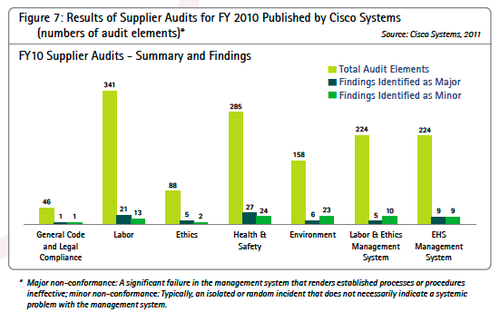
Leading companies have a multi-stage process, starting with risk assessment to identify suppliers with a high exposure to labor and environmental issues, followed by self-assessments, and finally regular on-site audits at key supplier factories carried out by internal staff or external auditors. In the case of non-compliance findings, corrective action plans are defined. Some electronics companies like Hewlett-Packard or Cisco Systems publish the results of their audits.

However, in general, transparency in the apparel and textile industry is more advanced than the electronics sector.

There is an upward trend in companies reporting on audit results including non-compliance cases; some even disclose their suppliers. Leading sporting goods and retail companies have supplier performance measurement mechanisms that have been fully integrated into their supplier assessment and their order placements. Puma and Adidas Group are cited in the report as companies which are relatively transparent about their sustainable supply chain auditing.

Collaborative and capacity building efforts are included in the sustainable supply chain audit. Leading apparel brands have been working together to improve labor standards in their supply chains. Examples include the Better Work partnership between the International Labor Organization (ILO) and the IFC and cooperation with the Fair Labor Association.

Environmental projects are more focused on materials. Examples include the Leather Working Group and Better Cotton Initiatives.

Other highlights that link sustainability and risk assessment?

Other sustainability-related supply chain disruptions mentioned in the report include:

  • Energy scarcity
  • Incidents related to health and safety
  • Environment
  • Product safety
  • Business ethics

A loss of productivity led by supply chain disruptions affects revenue and increases costs.

In a recent survey, 74 percent of surveyed companies agreed that outsourcing and just-in-time strategies were making their organizations more vulnerable to supply chain disruption.

How does the report expand the dialogue on ethical sourcing and supply chain management?

The report discusses supply chain management and sourcing materials from an investor’s perspective regarding environmental and labor issues in particular and their compliance with international laws, regulations and standards as mentioned above.

Investors are advised to adopt a robust supply chain audit, which includes:

  • An assessment of the extent of outsourcing
  • Assessment of the locations of suppliers
  • Corporate policies and standards (including industry and legal)
  • Effective monitoring procedures
  • Capacity building along the supply chain
  • Active collaboration within the industry and with stakeholders
  • Clear product labeling

The sustainable supply chain audit is described in more detail in Eurosif’s Procurement Report, which can be downloaded from Eurosif.com [PDF].

Originally written for and published on CSRwire’s Commentary sectionTalkback on April 10, 2012.

Share this:

  • Tweet
  • Email a link to a friend (Opens in new window) Email
  • Share on Reddit (Opens in new window) Reddit
  • Print (Opens in new window) Print
Like Loading...

Sustainability & Your Supply Chain: Risks, Metrics & Opportunities

03 Thursday Jul 2014

Posted by Aman Singh in CSR reporting, CSRwire, ESG

≈ Leave a comment

Tags

accountability, Coca Cola, CSR reporting, CSRwire, Environment, ESG, ethical sourcing forum, ethics, intel, supply chain, Supply chain management, Sustainability, sustainability, transparency


What combination of education, training and technical solutions does it take to compel change through your organization as well as your supply chain?

It is a question that continues to dog manufacturers and retailers big and small as supply chains grow complex and social and environmental challenges multiply. What role should companies play in educating – and engaging – their suppliers? What’s ethical? With Sustainability Reporting becoming a mark of competitive advantage, how can organizations best track their performance?

The upcoming Ethical Sourcing Forum will kickoff its two-day conference next month by putting Coca-Cola, Intel, Bic, the International Trade Centre (ITC) and Intertek on the hot seat to try to answer some of these complex questions.

Ethical_Sourcing_Forum

The panel, led by me, will not only offer best practices but also discuss specific tools that the companies have either developed or collaborated with their nonprofit partners on, to track and examine sustainability progress with their suppliers.

For a preview of what promises to be a compelling session of benchmarking and teasing apart a sensitive topic, I turned to Mathieu Lamolle, a market analyst with the ITC for some insights.

An Ethical Supply Chain

The ITC, a United Nations agency for trade related technical assistance, has one goal: To help businesses become more competitive in global markets, speeding economic development and contributing to sustainable development.

Part of this goal, Mathieu told me, is a “Standards Map web tool for organizations to analyze, map and compare themselves according to an array of 75+ sustainability standards in supply chains.”

“We also want to enable any organization that has its own code of conduct and assessment protocol to benchmark what they are doing against others. They can benchmark their own corporate practices and see how they measure up against other companies and sustainability standards.”

Ranging from small companies, traders and suppliers to retailers, importers and others, this new tool will encourage data sharing for the purpose of internal benchmarking with the ultimate goal being an ethical and efficient supply chain.

While it remains strictly a business-to-business tool for now, Mathieu emphasized that there are plans to eventually roll it out for general consumption and public benchmarking as well.

Benchmarking Sustainability Progress

StandardsWhat’s especially promising about ITC’s new tool is its abject emphasis on sharing for the purpose of benchmarking. The organization’s role as a UN neutral intermediary between public-private partnerships further helps break through the risk-averse behavior that often delays well-meaning initiatives within organizations.

Although, so far the tool has found resonance with participants for the primary purpose of internal tracking and public sharing of information on the Standards Map web tool, Mathieu admitted that the true value of the tool “is going to unfold when we can spread the news globally” and allow people to compare the true progress being made by participating organizations on educating and training their supply chains. “The more people use it the better it is,” he said.

The impact of such a global tool can prove to be significant in an industry that is evolving and constantly juggling multifold standards and regulations. Want to learn more about the Standards Map? Wondering how you can use the tool to track your organization’s sustainability progress?

Join us at the Ethical Sourcing Forum for a lively discussion that will focus not only on available tools, but also how to best manage metrics, challenges of a global supply chain and whether any of the present panelists’ tools can be customized to work in your industry.

Originally written for and published on CSRwire’s Commentary sectionTalkback on February 22, 2012.

Share this:

  • Tweet
  • Email a link to a friend (Opens in new window) Email
  • Share on Reddit (Opens in new window) Reddit
  • Print (Opens in new window) Print
Like Loading...

2011: The Year Business Learned to Say Mea Culpa

02 Wednesday Jul 2014

Posted by Aman Singh in CSR, CSRwire

≈ Leave a comment

Tags

Accountability, Best Buy, Brand Management, Carol Cone, climate corps, corporate governance, CSR, CSRwire, edf, Ethics, jobs, Leadership, Management, McDonald's, Ofra Strauss, Social Media, social media, Stakeholder Engagement, Sustainability, sustainability, timberland, transparency, UPS


Image

These were just some of the things that kept us busy in 2011. While some represent the changing marketplace, others are age-old struggles between activists, consumers, employees and corporations. Yet, they all represented the emergence of new forces at play in our corporate corridors.

Yes, 2011 represented despair for many – the jobseekers, the underemployed, the single parent, the shopper, the CEO, the trader – but with despair, as CSRwire’s CEO Joe Sibilia noted, comes hope, adaptability and often, solutions.

And it is at that stage that most of us converged in 2011.

Transparency: Is Business Ready?

Take, for example, the recent BSR conference held in San Francisco. My panel addressed a topic that is bound to get most of us shifting in our chairs: Sustainability in a Hyper-Transparent World. Ouch, right? Joined by executives from Oxfam, Intel and SourceMap, the conversation included several uncomfortable moments (I offered up Zappos as an example to the audience, citing that the company livestreams its all hands meeting in order to live its mission of “building open and honest communications.”) and featured several probabilities, suggestions, and potential solutions by a group that included lawyers, sustainability executives, CSR officers, reporters, strategists, entrepreneurs as well as nonprofit leaders.

“When you are increasingly naked, fitness if not optional.” – Macrowikinomics

That the panel attracted a full room of senior executives willing to discuss difficult issues like privacy, corporate governance and stakeholder responsibility is a start.

The C-Suite Headlines Sustainability

Till last year, while much was being written about CSR and sustainability, executives were largely absent from the dialogue. In 2011, this changed ever so subtly. Earlier in the year, Best Buy CEO Brian Dunn took the stage at one of the year’s most prolific conferences, the Boston College Center for Corporate Citizenship’s annual conference. He discussed the importance of employee wellbeing, organizational design, transparency (Kathleen Edmond was the first Chief Ethics Officer to start a blog on ethical issues in the workplace) and the importance of stakeholder engagement.

“The more you peel the onion, the more you realize there is to be done. You just need to be constantly excited about peeling the onion.” – Brian Dunn, CEO, Best Buy

At Net Impact, Nike’s Hannah Jones took the stage as did REI CEO Sally Jewell. BSR kept the momentum going by featuring Ofra Strauss, CEO of the Strauss Group, Autodesk CEO Carl Bass and Anheuser-Busch CEO Carlos Brito.

These chiefs weren’t exactly looking to gain brownie points. They were after all speaking to the choir in some respects and to an audience that for the most part, gets business and social responsibility. But what made each of them stand out was their honesty about the difficult problems facing us today – a first? – agreement on the role of business in adding to today’s social and environmental mess.

“In the last few years, business has lost tremendous trust in the marketplace. That we are GOOD now rests on us.” – Ofra Strauss, Chairperson and former CEO, The Strauss Group

Mea culpa, they all said. Followed by: Here’s how we are trying to change ways, rethink growth, repurpose missions and reengage stakeholders.

That’s a start.

Social Media Engagement: 140 Characters Rule

Despite all the naysayers of social media, there is no denying that for any organization that sells a product or service today, having a dedicated presence on Facebook and Twitter is a prerequisite. With engagement reaching never-seen-before proportions, even Chief Sustainability Officers are learning to communicate in 140 characters or less.

“We must see social problems as business opportunities.” – Carol Cone, EVP, Edelman

But several companies dipped their toes in active engagement by trying out new formulae: Best Buy released their annual CSR report by hosting a live webinar (that I moderated) with their Sustainability team and a parallel conversation on Twitter. As I quizzed them about the report, questions poured in from Twitter: What was Best Buy doing in the area of conflict minerals? What about human rights? Recycling? How about consumer education? And why the low diversity ratio of employees?

Squirm they did, admitting that the issues were complex they did, but answer they also did.

They weren’t the only ones though.

Timberland (that was acquired by VF earlier in the year) launched their new Communications portal, McDonald’s hosted a live chat on Twitter with VP of CSR Bob Langert, UPS held several chats during the holiday season from sustainable gifting to green packaging choices.

Communicating your sustainability story is an important cog in the wheel called trust and the choice to engage is no longer a valid option. How you choose to do so, however, will continue to differentiate you from your competitor.

Making Business Sense out of Sustainability

Several large organizations came forward in 2011 asking jobseekers and students applying for jobs in sustainability and CSR to understand how to relate their core competencies and knowledge to the issues facing us today, i.e., water depletion, carbon emissions, climate change, etc.

How can depleting levels of water relate to a professional services firm, for example, or a bank? Why must a software company invest in engaging and educating its supply chain?

Climate Corps: Creating Jobs & Savings

The Environmental Defense Fund’s Climate Corps program is one of very few initiatives that have managed to tie sustainability with business strategy and growth while creating jobs out of the process.

From placing seven MBA candidates as summer fellows in 2008, the program has quickly grown in popularity, placing 96 students at 78 companies in 2011. The fellows spend an entire summer working with their host companies on identifying energy efficiency solutions, implementing carbon management processes and helping diverse businesses embed environmental sustainability into their strategies.

The results: Millions in savings. While few get direct job offers from the Fellowship, most have had success finding jobs where their unique mix of experience, passion, and the ability to tie business strategy with sustainability, is appreciated and utilized in changing processes, setting standards and adapting organizations to a fast-changing reality of limited resources.

This is a start.

Organizational Design & Sustainability

Where does sustainability fit in your organization?

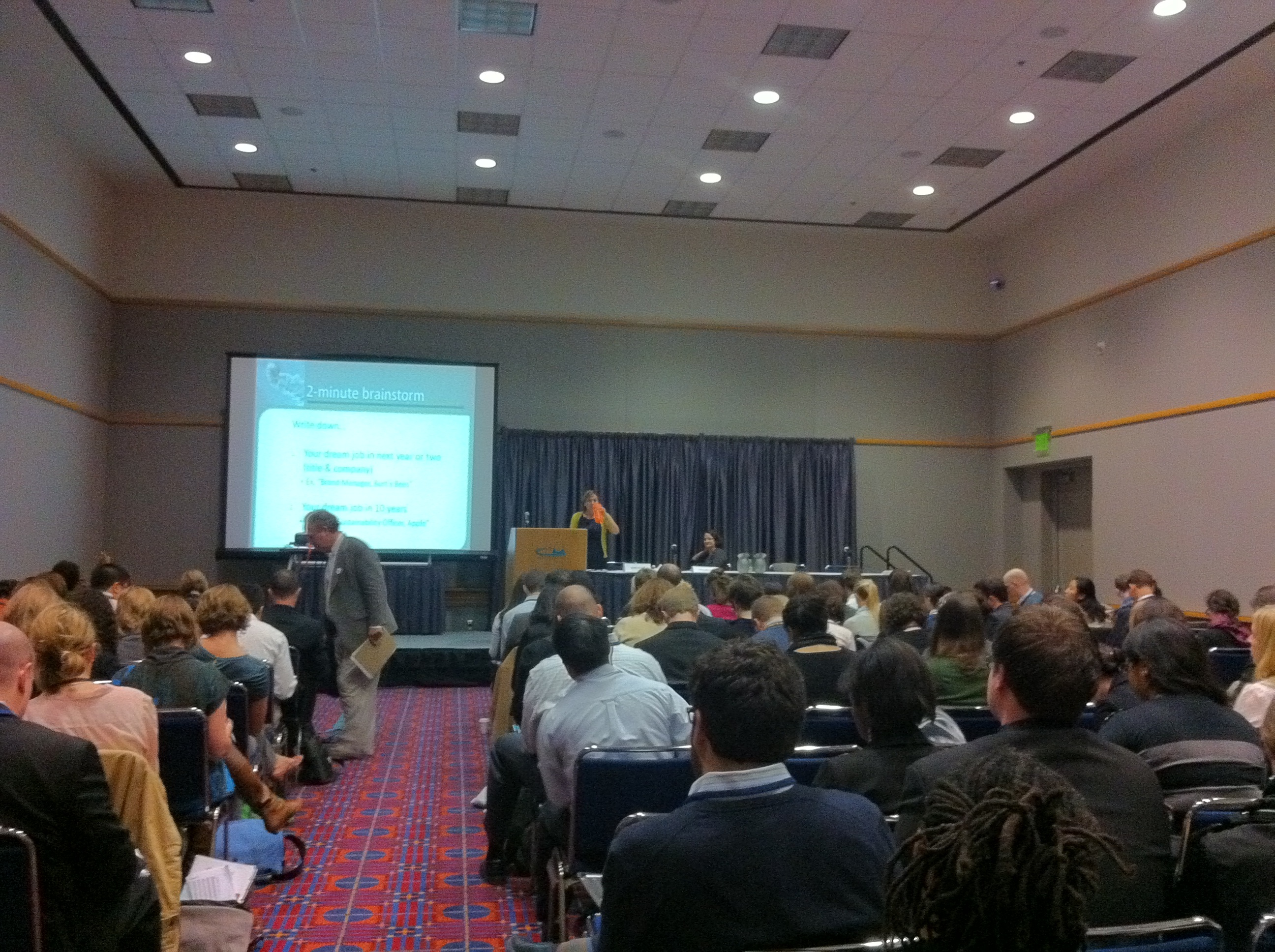
Everywhere, really, is the only correct answer, irrespective of where the chief sustainability officer sits. This, finally is getting addressed by what I consider a crucial component at any company: The HR and recruitment teams. In collaboration with IE Business School, I moderated seminars with recruiters, HR directors and organization design consultants on the value of CSR in candidate recruitment and retention.

We discussed the relationship between productivity, values, respect and growth. We heard from students who want to work for socially responsible companies and executives who are redirecting their organizations to instill a culture of ethics, responsibility, accountability and pride.

Mea culpa, most of them said. That’s a start.

Originally written for and published on CSRwire’s Commentary section Talkback on December 30, 2011.

Share this:

  • Tweet
  • Email a link to a friend (Opens in new window) Email
  • Share on Reddit (Opens in new window) Reddit
  • Print (Opens in new window) Print
Like Loading...

Link

2011: The Year Business Learned to Say Mea Culpa

30 Friday Dec 2011

Posted by Aman Singh in Uncategorized

≈ Leave a comment

Tags

corporate governance, corporate social responsibility, CSR, management, sustainability, transparency, Uncategorized


2011: The Year Business Learned to Say Mea Culpa

Share this:

  • Tweet
  • Email a link to a friend (Opens in new window) Email
  • Share on Reddit (Opens in new window) Reddit
  • Print (Opens in new window) Print
Like Loading...

Social Media Tactics: McDonald’s Hosts Twitter Chat. And Issues a Policy.

09 Friday Dec 2011

Posted by Aman Singh in CSR

≈ Leave a comment

Tags

aman singh, aman singh das, Bob Langert, Brand Management, consumer education, corporate social responsibility, CSR, CSR communications, CSR report, Management, McDonald's, McDonald's CSR report, PR, risk management, social media, Stakeholder Engagement, stakeholder engagement, Sustainability, sustainability, transparency, Twitter, Twitter chat


Certainly not the blog post I planned on writing after spending two weeks in New Delhi, India but I am compelled.

Today, McDonald’s hosted a Twitter chat with VP of CSR Bob Langert. The motivations are many for a company that is besieged for its product line and constantly under fire.

In fact, last year at a diversity benchmarking event at Hamburger University, I had the opportunity to hear the McDonald’s executive team discuss a whole host of business practices and strategies, including diversity (led by Global Chief Diversity Officer Pat Harris), employee learning and corporate social responsibility (CSR).

Here’s a snapshot of what I wrote then:

There is an argument that some companies–such as those that deal in weapons and tobacco–just can’t do corporate responsibility in a meaningful way. As a result, they are often excluded from CSR rankings and benchmarking exercises.

But what about a company like McDonald’s constantly under fire for its products? How does the world’s largest fast-food chain practice corporate social responsibility that is both contextual and real?

Led by Senior Manager for Corporate Social Responsibility Kathleen Bannan, who began her presentation by saying “CSR is everybody’s business,” the day-long event proved both thought-provoking (how does a company who doesn’t enjoy corporate America’s most favorable retention rates or the public’s uniform love tackle responsibility and that ever-amorphous doing the right thing?) and insightful (McDonald’s is among very few companies to institute an employee resource group for its white male workforce).

What happened today, however, was an effort at cautious transparency and an attempt at crowd sourcing corporate social responsibility.

The questions were introspective:

And the answers, alternatively useful, creative and critical.

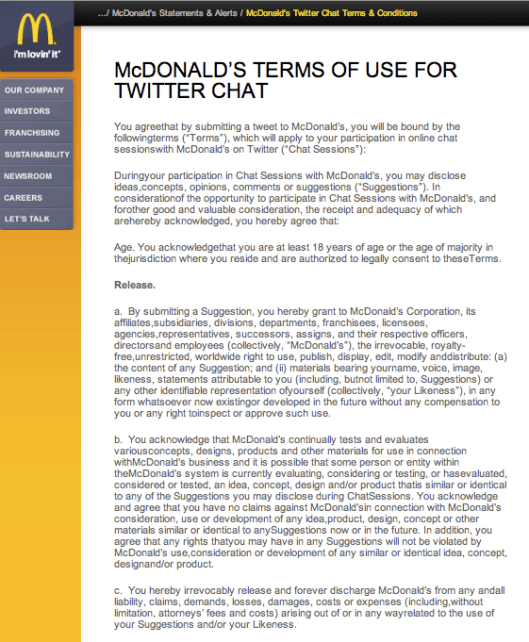
But then I saw this:

Now McDonald’s is not the first company to host a Twitter chat by any means. I have personally attended several as well as hosted a few — including one coming up next week with UPS’ Chief Sustainability Officer Scott Wicker — with varying levels of participation from a usually diverse set of activists, journalists, executives and consumers.

Never before, however, have I been handed a “Twitter Chat Policy.”

An indication of things to come or…?

Continue reading →

Share this:

  • Tweet
  • Email a link to a friend (Opens in new window) Email
  • Share on Reddit (Opens in new window) Reddit
  • Print (Opens in new window) Print
Like Loading...

Net Impact and BSR 2011: 7 Days, 2 Conferences, 5 Trends in CSR & Sustainability

07 Monday Nov 2011

Posted by Aman Singh in CSR

≈ 7 Comments

Tags

Al Gore, aman singh, aman singh das, Anheuser Busch, Bea Perez, brand management, Brand Management, Brian Dunn, BSR 2011, Business, Carlos Brito, cause marketing, Coca Cola, corporate citizenship, corporate social responsibility, CSR, CSR communications, CSR reporting, CSR strategy, ethical leadership, Events, Hanna Jones, hyper transparency, Liz Maw, Management, net impact 2011, Nike, Occupy Wall Street, Ofra Strauss, PR, radical transparency, risk management, Scott Wicker, shared value, Social Enterprise, Social Responsibility, Sustainability, sustainability, sustainable business practices, transparency, UPS, Vail Horton


There couldn’t have been a better way to end 2011 than the ambitious and cheerful Net Impact conference followed by Business for Social Responsibility‘s (BSR) annual conference.

Last year marked the inaugural year for my participation in both conferences. I came back encouraged, informed and enthused about the work ahead of us. [See: Can MBA Students be Taught Humility? and The Sustainability Jobs Debate] This year – perhaps because I have been deeply immersed in the CSR space – I feel a bit bereft, despite invigorating conversations and inspiring keynotes.

Don’t get me wrong.

While the Net Impact panels once again illustrated an incredibly knowledgeable student body set to graduate in coming years, BSR attendees and speakers showcased high aspirations and a deep understanding of the complexity of issues that face us today.

Throughout the seven days, I was continually questioned: Did you learn something new? What trends have you identified from all that you have heard? And each time I thought, what’s missing? Why am I not coming up with any articulate answers? Is my brain fried or is it something else?

On Friday, finally, sitting through a six-hour flight back to the east coast, it hit me. The CSR sector had grown up.

As a receiver of information, I was among familiarity, maturity. While last year the conferences motivated and inspired, this year the conversations focused on strategies, case studies, examples, successes and failures.

As Dave Stangis, VP of CSR for Campbell Soup articulated at a panel on Blue Sky Thinking during NI11, “CSR is no longer about identifying the business case. Today, we have evolved from questioning why to answering how.”

The Net Impact panels focused on nuts and bolts, dos and don’ts, a far cry from years past. The BSR roundtables featured honest evaluations, admittance of failure, collaborative statements of success and practical tips for newcomers.

Here then, are the top five trends I observed at two of the year’s most well-attended conferences on corporate social responsibility, innovation and sustainability:

1. We LOVE Shared Value:

Michael Porter’s “creating shared value” has appealed to the corporate sector like no other concept in recent years. Not corporate social responsibility or corporate sustainability, citizenship or conscious capitalism. There seems something so potent about shared value that CSR and sustainability executives cannot stop talking about it! A year ago, they would tell me “CSR is embedded in our DNA.” Now that statement has evolved to “Our culture has always been about creating shared value.”

Point is, CSV offers us nothing more radically new than the concept of CSR. It dictates the same concept of stakeholder engagement, mutual benefits, holistic bottom lines. But it has resonated by removing the morality that responsibility instantly dictates. For CSR and sustainability executives who have to make the business case to their C-suite, creating shared value provides them with their business case.

2. Familiarity breeds contempt

I found several attendees tell me how repetitive some of the sessions were, that they didn’t learn too much that was new or revolutionary. Perhaps it was because the same folks were attending the conferences every year? Earlier this year I wrote on Forbes’ CSR blog that instead of attending the conferences every year, we should send a colleague the following year so that we can actually widen the net of information and inspiration.

This continues to hold true: Chances are, every year there will be some common denominator at these conferences. With issues like energy conservation, water scarcity, poverty, community relations and employee engagement remaining the overarching topics, why not let one of the non-converted/uneducated learn next year?

Lesser chance of you suffering from conference fatigue.

3. Where are the CSOs?

In September, Ellen Weinreb, a prominent CSR and sustainability recruiter, released a report titled CSO Back Story*. Essentially, the report tracks every executive with the title of chief sustainability officer among the U.S.’s publicly traded companies. Her research points to 29 such individuals. While it omits the many hundreds of officers holding a wide breadth of titles ranging from CSR director to VP for sustainability and social responsibility, the report pinpointed several best practices and the continuing lack of standardization on how companies define, prioritize and implement corporate responsibility.

But I digress. [See what Corporate Secretary had to say about the report or download the complete report here.]*

Point is: Only two of the 29 CSOs Weinreb identified were in attendance at BSR: Coca-Cola’s Beatrice Perez and UPS’ Scott Wicker. Both were named CSO sometime this year. Where were the others? Wasn’t the conference meant for CSR and sustainability executives to come together for three days of knowledge sharing and benchmarking? What happened this year?

4. The Emotional Quotient

Both conferences featured wonderfully articulate keynote speakers, including KaBoom’s Darryl Hammond, Keen Mobility’ Vail Horton, Nike’s Hannah Jones, Al Gore, Strauss Group’s Ofra Strauss, Anheuser Busch’ Carlos Brito and Best Buy’s Brian Dunn.

While they discussed CSR and sustainability from their unique pedestal, the common denominator was the emotional connection they demonstrated with their cause, their brand, and their philosophy.

Hammond discussed how his childhood taught him the importance of play in a kid’s life. Strauss emphasized how her consumers and conflict-ridden Israel continues to teach her the right way of conducting business, of stakeholder engagement, of business being the real power in solving social problems.

Dunn on the other hand, focused on humility, responsible leadership and the importance of connecting with employees and consumers.

While last year’s speakers evinced more pragmatism, a businessman’s stoicism, this year the air held tension, an unspoken worry that things were going wrong too quickly, that we all needed to wake up. Quickly. The speakers were talking of soft – un-businesslike some would say – attributes: Social responsibility, connecting, respect, and the human condition, even destitution.

What had happened?

Let’s see: A recession that instead of leveling off, seems to be spreading across generations and countries for starters; a growing understanding that each of our actions – and inactions – impact many others in the world; a disastrous lack of trust for business; and a generational divide that seems to be holding the current decision makers accountable for their decades of excess.

Is business leadership finally waking up to their societal stakeholders?

5. Occupy Wall Street: Ignore or Engage?

Almost every keynote brought up this mass of undefined protestors that have continued to expand beyond American borders. Net Impact’s Executive Director Liz Maw opened the 2011 conference by asking attendees to “Occupy Wall Street but from within.”

Al Gore said, “Business must respond,” and that “it wasn’t a question any more.”

Ofra Strauss showed a three-minute video of the protestors equating them to civil unrest and a grassroots movement of discontent that business has to recognize and address.

At my BSR panel on hyper-transparency I brought up this commonality in one of my responses and posed a question for the audience: Will business ever think of these protestors as stakeholders? To my surprise, Jeff Mendelsohn from New Leaf Paper said that he and fellow attendees had, in fact, invited the Occupiers during a recent conference and that “The dialogue proved very productive for business and the protestors.”

Will anyone else follow?

*Full disclaimer: I worked with Weinreb on the report.

Share this:

  • Tweet
  • Email a link to a friend (Opens in new window) Email
  • Share on Reddit (Opens in new window) Reddit
  • Print (Opens in new window) Print
Like Loading...

KPMG’s Citizenship Director: Occupy Wall Street Protests Must Drive [Business] Transformation

31 Monday Oct 2011

Posted by Aman Singh in CSR

≈ 2 Comments

Tags

Accountability, aman singh, aman singh das, BBC, brand management, Brand Management, Business, Business Ethics, business strategy, corporate citizenship, corporate social responsibility, CSR, Director of Citizenship, diversity, diversity and inclusion, Ethics, Events, inclusion, KPMG, Leadership, Lord Michael Hastings, Management, Net Impact, Occupy Wall Street, Social Impact, social responsibility, Social Responsibility, transparency, war on terror, Work culture


“The greatest way to change the world is _________.”

That’s how KPMG’s Director of Citizenship and Diversity Lord Michael Hastings started the opening keynote at this year’s Net Impact Conference in Portland, Oregon.

In the next half an hour that followed, the former — and the first ever — CSR director of BBC offered observations that felt alternatively poignant, realistic and perhaps unattainable.

On America’s prison system:

We must recognize that social dysfunction is a critical part of our reality and is perilously expensive.

On 9/11:

I say this with the utmost respect in my heart for the victims of 9/11: It has cost us one trillion dollars and over 6,700 deaths to avenge one event. Within hours, what was supposed to be the war on illiteracy – remember the picture from that day of President Bush reading to a classroom of kids? – became the war on terror.

Today, we are facing the repercussions of that decision. Now, we must switch on our acutest sense: Our intuition and listening power.

On Occupy Wall Street:

[We have to figure out] how do we respond? Because we have to. These protests must drive transformation, which can only come through sacrifice, only by accepting responsibility.

On the answer to changing corporate culture and mindsets:

The answer is cynicism. This is an understanding that I am responsible for the conflicts around me, that I absorb the duty, steel my back and face society to do the unexpected.

On reputation:

We cannot build a reputation on what we are ‘going to do.’ Our moral fiber, clarity of values, past record and leadership contribute to our ultimate reputation.

On the role of people in business growth:

A change in reporting is occurring that will correctly calculate the real assets of a business. Integrated reporting offers this framework for the future. We’re in a time when the idea of responsible capitalism is becoming a part of business strategy. We must continue with it.

And his answer to the earlier question?

“Overcoming cynicism”

Share this:

  • Tweet
  • Email a link to a friend (Opens in new window) Email
  • Share on Reddit (Opens in new window) Reddit
  • Print (Opens in new window) Print
Like Loading...

Occupy Wall Street & Corporate America According to Michael Moore

25 Tuesday Oct 2011

Posted by Aman Singh in Uncategorized

≈ Leave a comment

Tags

Accountability, aman singh, aman singh das, Apple, Business, capitalism, careers, consumer education, corporate citizenship, corporate social responsibility, CSR, jobs, Leadership, michael moore, Occupy Wall Street, occupywallstreet, OWS, responsible capitalism, shared value, social responsibility, Social Responsibility, transparency


Interesting segment of Piers Morgan Tonight on CNN with Michael Moore in the hot seat and a live town hall to discuss Occupy Wall Street. Some of the highlights that made me think:

Who is to blame for today’s mess?

MM: One hundred percent corporate America. I don’t blame the government because corporate America funds and rules the government. The politicians act as their funders ask them to so blaming D.C. isn’t going to help anyone. The root cause is corporate America.

Are the “Occupiers” against capitalism or capitalist greed?

MM: Depends on who you ask. For students, this is about the debt they have when they graduate. For the parents, it’s the mortgage they owe on a house that is worth less than half of what they owe in debt. For many others, it is unemployment, lack of affordable health care, the manipulative bank industry and so much more.

Apple has more employees in China today than domestically and in many ways the company has become emblematic with capitalism. Isn’t China at least part of the problem?

MM: Part of the problem yes but do you know how much debt a student has when he/she graduates from Peking University? Zero dollars. American students? An average of $35,000.

It all started when General Motors decided that making $4 billion in profits wasn’t enough. That they had to stretch it to $5 billion and to do so, they would have to migrate tens of thousands of jobs to China.

And guess what, if Steve Jobs and Steve Wozniak were two entrepreneurs trying to start Apple today, they would have received no help from their local or national banks. That’s the America we are living in today.

——————

Also on my radar, the excellent coverage on CSRwire’s Talkback lately re: Occupy Wall Street:

Occupy Wall Street Considers A New Economy
Is the Occupy Movement a Call for Sustainability?
For Responsibility, Occupy Government as well as Wall Street

Share this:

  • Tweet
  • Email a link to a friend (Opens in new window) Email
  • Share on Reddit (Opens in new window) Reddit
  • Print (Opens in new window) Print
Like Loading...

Occupy Wall Street: The Average Joe Interprets Corporate Social Responsibility

19 Wednesday Oct 2011

Posted by Aman Singh in CSR

≈ 17 Comments

Tags

Accountability, aman singh, aman singh das, Aneel Karnani, Brand Management, Business, Career advice, corporate citizenship, corporate social responsibility, creating shared value, CSR, CSRwire, diversity, ethical markets, Ethics, Events, fair compensation, human rights, Job search, Jobs in CSR, jobs in CSR, joe sibilia, leadership, Management, Occupy Wall Street, OWS, rosalinda sanquiche, shared value, Social Enterprise, Social Impact, social justice, social responsibility, Social Responsibility, Stakeholder Engagement, supply chain, Sustainability, sustainable business practices, transparency, Wall Street, what is CSR?, Work culture


Earlier this week I was at the annual PRSA conference in humid and beautiful Orlando, Florida. Before you think that I have switched tracks from journalism to PR, stop right there! I was on site to speak on an interestingly personal topic: Sustainability: Walking the Walk.

Sustainability: Walking the Walk with CSRWire & Ethical Markets

Joining me on the panel were CEO of CSRwire Joe Sibilia and Executive Director of Ethical Markets Rosalinda Sanquiche. Sibilia started off the panel by talking about Occupy Wall Street. Not because he wanted a room full of dissent but because for Sibilia, as he emphasized on a recent Fox Business show, OWS goes to the heart of corporate social responsibility: A responsible capitalist system that takes into account a business’ social, economic and environmental stakeholders.

From a room of roughly 45 attendees, almost everyone raised their hands. However, when he followed up by asking how many understood what the protestors are demanding, the hands fell to a single digits. So, before I go any further, here’s a two-part question for you:

And:

Here’s the thing: Because so many continued to disagree with the holier-than-thou voice of CSR, claiming it is another cost business doesn’t need, a burden, not a business priority, so on and so forth, Michael Porter gave us an easier concept to embrace: Creating Shared Value.

You Don’t Get CSR? How About “Shared Value”?

Many more understood the economical efficacy offered by shared value than the tardy, accusatory and undefined acronym of CSR. But CSR as well as creating shared value are concepts spearheaded by economists, business leaders, researchers and activists.

Now we are all being forced to recognize and acknowledge a movement created by the average Joe (no pun intended!) demanding business to be more responsible, equal and just.

They want to be able to work, to have a home, a family. They want the right to live comfortably.

In other words, corporate social responsibility.

Yes, it’s one and the same thing, except now it’s not the activists or the bloggers taking up the case but an undefined mass of people who come from different backgrounds, experiences and age but are commonly united on one front: Fairness.

Regardless of whether you physically join the Occupy Wall Street protestors, it is far more important that you understand their message and recognize that this is your one chance to make things right.

Yes, You the Average Employee Can Make a Difference

So, go ahead: Nudge your boss to offer job sharing opportunities to candidates.

As a job candidate, question the recruiter on the company’s mission, values, priorities. As a student, ask your faculty to discuss business cases in context of economic recessions, environmental degradation and social upheaval.

Ask the tough questions, the right questions. As Michigan’s Ross School of Business Professor Aneel Karnani recently said, “You get the kind of government you vote for.” We as professionals and students get the kind of corporation we choose to work for.

This is your chance to influence business as an employee, a manager, and as a prospective candidate. For the longest time we have been told to vote with our dollars. Now it is time to vote with our expertise and professional skills.

Question is, are you up for it?

Share this:

  • Tweet
  • Email a link to a friend (Opens in new window) Email
  • Share on Reddit (Opens in new window) Reddit
  • Print (Opens in new window) Print
Like Loading...
← Older posts
Newer posts →

Let's Talk!

Virtual
732-322-7797
amansinghdas@gmail.com

Blogs I Follow

  • Nonprofit Chronicles
  • Learned On by Andrea Learned
  • Angry African on the Loose™
  • csr-reporting
  • The CSR Blog
  • In Good Company: Singh on CSR

My Cloud

Capitalism 2.0 CSR CSR reporting CSRwire ESG Guest Author HR Stakeholder Engagement Sustainability Uncategorized

Recently written…

  • Rationality is Ruining Us: Mayors, presidents and governors join major businesses in charting way forward on climate change
  • 2015: the year businesses recognize that climate change is real – and 4 other themes
  • Hardcore lessons of sustainability – ’10 Words or Less’
  • Brewing a Better Future [#BaBF] with Heineken: Examining the Many Flavors of Local Sourcing
  • From Conflict to Collaboration: Kimberly-Clark and Greenpeace Participate in LIVE Twitter Chat

What others are reading

aman singh aman singh das Brand Management Business corporate social responsibility CSR CSR reporting CSRwire ESG Leadership Stakeholder Engagement supply chain Sustainability sustainability Work culture

Categories

Most Read

  • None

Create a free website or blog at WordPress.com.

Nonprofit Chronicles

Journalism about foundations, nonprofits and their impact

Learned On by Andrea Learned

Angry African on the Loose™

I have opinions. I am from Africa. I live here now. I blog.

csr-reporting

Connecting the dots between Business, Society & the Environment

The CSR Blog

Connecting the dots between Business, Society & the Environment

In Good Company: Singh on CSR

Connecting the dots between Business, Society & the Environment

Privacy & Cookies: This site uses cookies. By continuing to use this website, you agree to their use.
To find out more, including how to control cookies, see here: Cookie Policy
  • Subscribe Subscribed
    • In Good Company: Singh on CSR
    • Join 119 other subscribers
    • Already have a WordPress.com account? Log in now.
    • In Good Company: Singh on CSR
    • Subscribe Subscribed
    • Sign up
    • Log in
    • Report this content
    • View site in Reader
    • Manage subscriptions
    • Collapse this bar
 

Loading Comments...
 

    %d