• ABOUT THE AUTHOR
  • Sustainability
  • CSR
  • CSR reporting

In Good Company: Singh on CSR

~ Connecting the dots between Business, Society & the Environment

Tag Archives: Sustainability

Marsh & McLennan’s 2010 CSR Report: Holistic, Aspirational, But Lean on Data

07 Wednesday Sep 2011

Posted by Aman Singh in CSR, CSR reporting, HR

≈ 2 Comments

Tags

Accountability, aman singh, aman singh das, brand management, Brand Management, Business, Business Ethics, Chief Diversity Officer, Chief sustainability officer, Christine Salerno, corporate citizenship, corporate social responsibility, CSR, CSR communications, CSR reporting, CSR strategy, Elizabeth Barry, guy carpenter, HR, Kathryn Komsa, Leadership, management, Management, marsh, mercer consulting, Michael Connor, oliver wyman, shared value, Silvia Davi, social responsibility, Social Responsibility, Stakeholder Engagement, supply chain, Sustainability, sustainability, Work culture


“Our corporate social responsibility is our best kept secret.”

What compels a company with 52,000 employees and with over 140 years of systems in place to publish a CSR report?
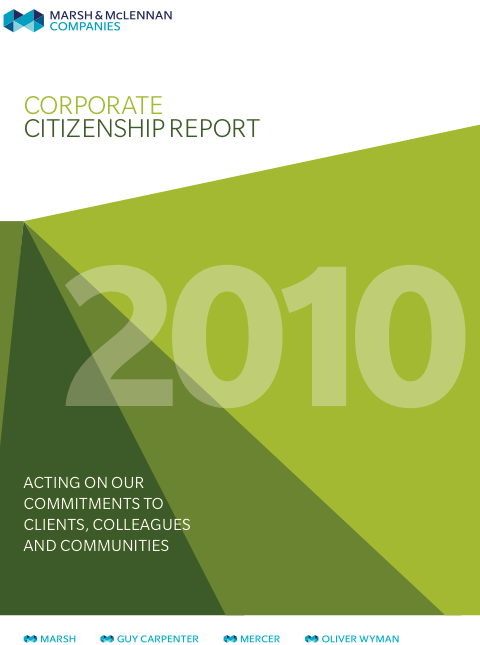
For professional services giant Marsh & McLennan, as CSR Director Christine Salerno put it, there was an urgency “to put a stake in the ground.” The company, following shortly on the footsteps of a rebranding initiative [from Marsh to Marsh & McLennan], released its first CSR report, complete with a press briefing at its New York headquarters, late last month.

At first — and second — glance, the Marsh CSR report is 21 pages of text and very little data. What the executives present at the briefing, however, had to say, was far more enlightening and worth noting.

After Silvia Davi, head of corporate communications and brand introduced the panel — an all-women team of Chief Sustainability Officer Elizabeth Barry, Chief Diversity Officer Kathryn Komsa and Salerno — Barry started off with some forward-looking statements.

1. Sustainability

“We were doing a lot [in sustainability] but we needed structure. Now we can gain much more from the same efforts by implementing them as part of a long term strategy,” she said, adding that, “This is not about today, this is about tomorrow.”

Our work in CSR is our best kept secret. Now we have decided to collaborate and communicate our successes and challenges because colleague education and engagement are key to the success of our sustainability strategy.

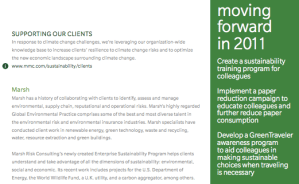
Pointing to a slide that charted key accomplishments since 2010, Barry noted that a majority of the data points were yet to occur. For example, the company is set to launch an internal “Green Traveler” program aimed at helping employees’ cut down their carbon footprint by educating them on telecommunication alternatives, etc. Also to follow later in the year: A “Paper Reduction Campaign” as well as a “Sustainability 101 Training Program.”

“I want everyone in the company to know that they are committing to a longterm strategy,” she emphasized. “Sustainability starts with people and our behavior and if every colleague made one tiny change, the impact collectively can be huge. It’s not a quick process but it is truly more sustainable.”

2. Diversity & Inclusion

The mission for CDO Komsa, who started in her current role in 2009, was “to create an enterprise-wide diversity and inclusion strategy.” “Our challenges are finding the right talent, resources, and the right market share in a multicultural world,” she said, adding a common refrain among the B2B sector, “Our raw material is our people and a diversity platform becomes a great way of creating shared value.”

Komsa also touched on an issue that has had insurance companies scratching their heads in recent years: How do you make a career in insurance sexy and attractive?

Noting that this is a big challenge and opportunity for Marsh, Komsa emphasized that her, “Team’s leading initiatives in coming months will be to tie in the four companies [Oliver Wyman, Marsh, Guy Carpenter and Mercer] and rebrand the insurance industry by emphasizing how we source our talent.”

3. Community Relations, Volunteerism, Philanthropy

Marsh and McLennan's 2010 CSR ReportSalerno who is an ex-investment banker chose to begin with a review of past challenges: “This is something that has always been done. What has been missing is the communications piece. There has been no cross collaboration internally within the units.”

“Our business case is to make sure that our CSR activities are creating impact in the communities we operate in and for our employees,” she added, noting that, “An engaged employee wants to stay. We want to make sure we are attracting the right people.”

The connection between CSR and recruitment is an increasingly acute problem for recruiters, especially in the B2B sector, where the commodity for sale isn’t so much a physical unit but organizational culture, intellectual growth and innovation. How do you leverage CSR as a recruitment strategy? [Join me at one of eight breakfast sessions on analyzing this very question starting next month.]

“Students coming out of college want to work for companies that are doing the right thing. Our strength is our people. So how do we use our biggest assets to create maximum impact?” Salerno responded.

4: Climate Change
In response to Business Ethics Publisher and veteran journalist Michael Connor’s question about setting goals on climate change, Barry pointed to the unique challenges of operating in cities like New York, where most companies don’t own their real estate. “Goals are hard for a professional services company. And when you add a lease to the equation, it becomes even harder. In most cases, we are in the middle of 10-year leases so in the interim, we are finding other ways to set goals, like how to reduce our real estate portfolio altogether.”

5: What Does Successful CSR Look Like for a Fortune 250 Company?

Employee engagement has always been a huge component of my blogs in the past because I truly believe that getting your employees on your side is half the battle for most companies struggling with reputation issues. They can be your best brand ambassadors and I asked the Marsh team what success looked like for all their CSR and sustainability efforts: A significant decrease in air travel, a certain number of LEED certifications, an internally set women and minority retention rate, or something else?

Repeating that they launched the CSR report as a way of putting a stake in the ground, Salerno emphasized that, “Employee engagement is a crucial piece and trying to quantify our efforts and rolling out a system to measure our activities has them talking.”

“We’re getting the information out there and they are discussing it,” she said, to which Komsa added that, “piles of resumes have been pouring in because the work we do aligns with someone’s values. That means our employees are talking, which is a huge win for us.”

Barry, however, might have put it best:

“This report doesn’t have as many foundations but it is an important story to tell. We don’t have all the answers but we do want to get started on finding them.”

At the end of the day, Marsh isn’t looking to solve the water crisis or achieve a zero carbon footprint. Their goals are moderate and their CSR report reflects a forward-looking attitude that is encouraging.

That they have a team in place approaching CSR strategically — and a lot more holistically than many other companies — is the right start.

Share this:

  • Tweet
  • Email a link to a friend (Opens in new window) Email
  • Share on Reddit (Opens in new window) Reddit
  • Print (Opens in new window) Print
Like Loading...

As Steve Jobs Departs, A Review of Our Love-Hate Relationship With Apple…and Sustainability

24 Wednesday Aug 2011

Posted by Aman Singh in CSR

≈ 1 Comment

Tags

aman singh, aman singh das, Apple, brand management, brands with purpose, BSR Conference, Business, Carol Cone, cause marketing, CEO Network, consumer education, consumerism, corporate social responsibility, CSR, Edelman, Good Purpose Study, Green, In Good Company, Leadership, Management, Matthew Bishop, Performance with Purpose, Steve Jobs, Sustainability, sustainability, sustainable business, sustainable technology, technology, Work culture


As we slowly recover from the stupor of the not completely unexpected news that Steve Jobs has stepped down as Apple’s CEO, here’s a post from recent months that’s worth a retake.

Context: At Business for Social Responsibility’s (BSR) annual conference last year, Edelman’s Managing Director for Corporate Citizenship Carol Cone released the 2010 Good Purpose Study with a dramatic declaration: “Cause marketing is dead.”

The main overarching finding of the study, as regular readers will recall, was this:

87 percent of consumers worldwide believe that business needs to equate at least equal weight on society’s interests as on business interests.

Accompanying Cone at the release were panelists from Levi Strauss, PepsiCo and a personal favorite: The Economist‘s Matthew Bishop, who amid the hype and hoopla of the report, quietly asked: “Are we really going to stop buying Apple because of its crappy environmental policies?”

An excerpt, originally published on Vault’s CSR blog: In Good Company:

The GoodPurpose study by Edelman

“Cause marketing is dead”

That controversial statement is how Cone opened the panel, adding, “That [cause marketing] world is way over. Purpose has replaced cause marketing and branding.” Companies aren’t building marketing plans around a cause anymore, she argued. Rather, “they are infusing their very strategy and business model with purposeful corporate citizenship.”

Defining real purpose

Picking up where Cone left off, the always-entertaining Matthew Bishop began with a prediction: “If we continue the current road toward demanding transparency and corporate social responsibility, within the next five to 10 years, we will begin to see corporate board meetings being live streamed to select people.”

Chuckling about the ambitiousness of his own statement, he went on to note, “Likewise, the real question is how much of this data [in the Good Purpose study] is picking up on aspirations rather than real choices [of consumers].”

PepsiCo: Performance with Purpose

Alleging that PepsiCo’s latest mantra of “Performance with Purpose” was indeed a verification of this shift from cause marketing to purposeful corporate citizenship at companies, Communications Director for PepsiCo Americas Beverages Melisa Tezanos gave high points to CEO Indra Nooyi for pushing for a company-wide cultural change that today drives all their business functions.

[READ: Pepsi Takes Performance with Purpose to Heart: An Interview with Chief Personnel Officer Cynthia Trudell]

“However, Nooyi is completely unapologetic about giving ‘performance’ as much importance as the ‘purpose’ part and she makes no bones about it,” said Tezanos, adding that this helps everyone across the company stay committed to a culture of profitability with purpose. Explaining the drivers behind PepsiCo’s highly successful Refresh project, she further stated, “For millennials, social responsibility is huge. We’ve seen through research again and again that their purchase intent goes up significantly when the brand is associated with a good cause.”

And finally, referring to the findings of the Edelman study—and Cone’s earlier comment, she said, “Marketing used to be blamed for being short-termism. Today, marketers are the biggest defenders of long-termism.”

But would you give up Cola…or Apple?

Bringing the conversation back to a level plain field, Bishop concluded with a sobering thought, “But what is real and what is fake with purpose? Will Pepsi ever move beyond the heart of its products, i.e., increasing obesity? Are we really going to stop buying Apple [products] because they have crappy environmental policies?”

———————————–

Just some food for thought as we go on a whirlwind ride with the media in coming days on the history, the present, and the future of America’s favorite company, Apple. Don’t forget to add your perspective by leaving a comment or connecting with me @AmanSinghCSR.

And if you haven’t already, share your opinion on whether social media engagement make better brands or more effective leaders by taking this new BRANDfog survey on social media and leadership.

More on Edelman’s Good Purpose study: Encompassing 7,259 respondents in 13 countries, the study was conducted by consulting firm StrategyOne with the objective of analyzing whether—and how much—purpose plays into purchase decisions worldwide, and further, how these transform into consumer activism via social media.

Share this:

  • Tweet
  • Email a link to a friend (Opens in new window) Email
  • Share on Reddit (Opens in new window) Reddit
  • Print (Opens in new window) Print
Like Loading...

CSR and Sustainability in Mainstream Media: Citizen Journalism Or Simply Shared Value?

18 Thursday Aug 2011

Posted by Aman Singh in CSR

≈ 16 Comments

Tags

alberto andreu, aman singh, aman singh das, Business, Career advice, cause marketing, corporate governance, corporate social responsibility, creating shared value, CSR, CSR communications, CSR reporting, examples of CSR, henk campher, jobs in CSR, journalism best practices, Leadership, philanthropy, reporting standards, risk management, shared value, Social Media, social media, social responsibility, Stakeholder Engagement, Sustainability, sustainability, sustainability jobs, sustainable business, Work culture


One of my most common complaints, after “Why Don’t Executives ‘GET’ CSR?” is why mainstream media hasn’t been giving due diligence to sustainability, corporate governance, employee engagement, social responsibility, the confluence of business, society and the environment, and everything else that connotes CSR.

2010: Professor Aneel Karnani’s Case Against CSR and Michael Porter’s Creating Shared Value

In 2010, there were a few noteworthy attempts. Aneel Karnani’s editorial in The Wall Street Journal on The Case Against Corporate Social Responsibility, which evoked numerous blogs, response pieces, live panels and tremendous conversations.

[READ: Why There Is a Case for Corporate Social Responsibility, Despite WSJ’s Obituary]

Then came Michael Porter’s piece on Creating Shared Value in Harvard Business Review. Not only did Porter start a flurry of debates, white papers and panels, the report even introduced new hashtags for Twitter users: #CSV and #sharedvalue; and a new hangtag for consultants.

Everyone understood shared value, they could contextualize the term, even measure it, and therefore, make a better case for business and social responsibility.

Debating Semantics: CSR vs. Sustainability

At Vault and more recently at Forbes, my effort has always been to highlight issues that needed addressing, questioning, cajoling, and analyzing. Soon after Porter’s piece, I asked two experts in the field to take on the debate, which often gets lost as semantics: Henk Campher, SVP for CSR and Sustainability with Edelman, and Alberto Andreu, Chief Reputation and Sustainability Officer with Telefonica accepted the challenge.

Campher took us through the evolution of the term “CSR,” concluding that corporate social responsibility, does indeed, fit best.

Here’s an excerpt:

We should look at the description of CSR itself. Why do we use these very specific three words to describe what we do? I would argue that the concept is actually a very good description of what we do today. Here’s why:

Corporate implies that this is about business.

  • It not only describes that we are busy with a discipline involving business but goes deeper.
  • It is about profits – how we make them and how we can make more of them today and tomorrow.
  • It is not about charity.
  • It is about building a sustainable business model that will continue to deliver business results for stakeholders – especially shareholders.

Social tells us this is about society.

  • It is about the impact business has on society and how we can manage this impact to ensure both business and societal benefit.
  • Even the environmental part of CSR is about society – how we can minimize environmental impact to benefit society in the end of the day.
  • The new developments in CSR – sustainability – further continue to prove that CSR is about a mutually beneficial relationship between product and service development, and societal value chains.

Responsibility reveals that business does carry a responsibility in this world–to do business in a way that benefits both business and society. Further, this responsibility gives business the opportunity to create new solutions to the needs of society. I would even argue that it is their responsibility to develop these new solutions and benefit by capturing new avenues of sustainable profit.

All three concepts—Corporate, Social and Responsibility—tell us exactly what we do today. CSR is also the perfect reminder of the relationship between business and society, and the responsibility they have towards each other. None of the other concepts proposed today actually tell us what we are doing and what we should be doing.

Andreu on the other hand, prefers sustainability over CSR. His key points:

Using CSR as an expression is not an academic problem but one that has very tangible consequences for companies.

Organizational: The classic case of the left hand not knowing what the right is doing. Most of the time, the rest of the company doesn’t know what the CSR team/executives do.

Defined functional areas don’t suffer from the same vagueness. HR is dedicated to people, the finance team crunches numbers, the operations team is in charge of systems and back up, etc. But how do you identify the team dedicated to such a vast array of duties, i.e., diversity and inclusion, environmental management, climate change, ethics, corporate volunteer management, social sponsorships, entrepreneurship, multistakeholder engagement, transparency, SRI, reputation, and human rights?

What we get instead is a big mess.

Structural: If CSR is about philanthropy, management will accordingly participate in sponsorship, PR and communications exercises because their objective is maximizing the return of investment in reputation building, not responsible and ethical business. For most companies, in fact, it is common practice for the CSR manager not be associated with evaluating social and environmental risk.

Budgetary: Let’s be honest. We all know that it is much easier to ask for a budget to implement philanthropic programs than for mapping out a business’ core environmental risks, or implementing an ethics code, or auditing the supply chain. Even in the best case scenarios, other areas of an organization will manage these issues as part of their day-to-day work but the reality is that when something is difficult to communicate, resource allocation becomes a much harder task.

Management: It’s easy to measure the impact your donations are having by stringing out the appropriate key performance indicators (KPI) for any given year. But what KPI efficiently summarizes responsible behavior? The resulting scorecard is usually so large and convoluted that even the most dedicated executives give it up because of its sheer confusion and lack of focus.

His conclusion:

The concept of CSR has been exhausted, we have to expand it for effective impact, and for that, we have to adopt sustainability. And that’s why I say, “It’s sustainability, stupid!”

The reason these debates work is because they compel people to chime in, share from their own experiences and research, and crowd-source solutions that everyone can agree on. While the debate elicited several comments on Vault, the tweets, comments, advice and feedback continued to pour in for weeks after publication.

Citizen Journalism Or Simply Responsible?

At the end of the day, media — and journalists — have a responsibility to business, to society, and to a global audience as well. Back in India when I was making the leap from kindergarten to first grade, it was The Times of India and other newspapers that became my primary sources of reading, grammar, comprehension and GK (a common monicker for ‘general knowledge’ used by school kids, at least in those days!).

Today, journalists are expected to inform and engage a vocal audience of readers. Bring in social media tools and you have a vocal and ready consumer base willing and confident to discuss, debate and make choices in real time with you. And this is where the CSR debate with Campher and Andreu did well.

For me, as a journalist and a resolute CSR practitioner, it is indeed heartening to see that those small, infrequent attempts are now becoming frequent analogies and commentaries within the circles of mainstream media.

In fact, here are three reports in recent weeks that came to my attention:

  • Sustainability Jobs Get Green Light At Large Firms: by WSJ’s Careers Reporter Joe Light
  • Doing Good to do Bad? by WSJ‘s Justin Lahart
  • ‘Shared Value’ Gains in Corporate Responsibility Efforts: by NY Times‘ Steve Lohr

While I give kudos to Light, Lahart and Lohr for highlighting these, we — the journalistic community — must evolve to a state of journalism where good and bad business practices and sustainability are part of everyday reporting and dialogue.

The incredible work of Alice Korngold and Ann Charles on Fast Company, my fabulous co-contributors on Forbes’ CSR blog, and Marc Gunther at Fortune must become more commonplace, much more grassroots, more mainstream.

Some call it citizen journalism. For me, it’s just plain professional responsibility. We owe it to our organizations, the economy, future generations, our planet, and at the end of the day, to ourselves.

More:

The 2011 CSR Debate: CSR is an Evolution, Not a Revolution
The 2011 CSR Debate: “It’s Sustainability, Stupid!”

Share this:

  • Tweet
  • Email a link to a friend (Opens in new window) Email
  • Share on Reddit (Opens in new window) Reddit
  • Print (Opens in new window) Print
Like Loading...

Social Media and Leadership: Are Twitter and Facebook 21st Century Necessities?

12 Friday Aug 2011

Posted by Aman Singh in CSR

≈ Leave a comment

Tags

Accountability, aman singh, aman singh das, brand loyalty, brand management, Business, corporate citizenship, corporate governance, corporate social responsibility, CSR, CSR communications, CSR strategy, employee engagement, Facebook, Google+, human resources, innovation, job hunting on social media, Job search, Leadership, leadership, management, Management, marketing, PR, Quora, Recruitment, recruitment, reddit, Social Media, social media, Stakeholder Engagement, stumbleupon, Sustainability, sustainability, transparency, Twitter, Work culture


There is a lot of love for social media among many in the corporate social responsibility (CSR) and sustainability community. [Take this short survey and have your say: Useful, necessary engagement tool or hate it and a complete hassle?]

Lucy Marcus, founder of Marcus Venture Consulting, for example, posted a blog today on Harvard Business Review, that talks about a particular Groupon deal that annoyed her enough to tweet about it and how that rose several eyebrows and an eventual resolution.

David Connor recently wrote about his love for Twitter, calling it a fascination and being constantly impressed by the simplicity of engagement and the tangible sense of community the platform provides. In his post, he alluded to a recent confession of mine, simply titled: In Defense of Twitter: 5 Reasons Why I am a Mad Tweeter, which was a response to an alternatively headlined Wall Street Journal article.

_________________________________

For those interested, here is a recount of my top five:

1) Community: Twitter has provided me with a very diverse community of individuals who are eager to engage, argue and collaborate.

2) Soundboard: Without the 20 odd tweets I send out every day, I wouldn’t get any work done. Sounds counter-intuitive, I know—but it’s true. You’ve got to go where your audience is. They have a voice and they like to use it—and as a blogger, hearing what’s working and what’s not is inarguably essential.

3) Collaborations: And of course, without Twitter, I wouldn’t have made HR Examiner‘s Top 25 HR Digital Influencers for 2011 or named among the Top 100 Thought Leaders by Trust Across America. Nor would I have been able to successfully put together the recent panel on responsible business with Carol Sanford, Jeffrey Hollender, Sarah Murray and Bank of America, or been able to interview thought leaders like Campbell Soup’s Dave Stangis, PwC’s Shannon Schuyler, EMC’s Kathrin Winkler and many others while at Vault—and collaborated with enterprising students like Ashley Jablow, Catherine Chong, entrepreneurs like Myles Lutheran and the EDF Climate Corp fellows, or published the much-referred to series on job hunting in CSR.

4) News: Believe it or not, Twitter has become a significant source of my daily news. With the help of coordinated lists, I can scan the morning news in one stream all at one source.

5) Innovation: How many times have you read an 800-word article in one the mainstream newspapers and thought “Wow, that’s interesting, I wonder how I could learn more” or “I’d love to get involved” but haven’t known what to do next? Well, because it’s so easy to connect with others on Twitter without having to jot down strenuous emails or phone calls, now you can!

_________________________________

But Connor also brought up transparency and corporate accountability.

And here is where most companies struggle with the plethora of choices available today under the domain of social media: Facebook, Twitter, LinkedIn, Quora, Digg, StumbleUpon, Reddit, and the new kids on the block BranchOut and Google+, to name just a few.

So, how helpful are these channels? BRANDfog, a social media and CSR consulting firm launched a survey last week that begins to dig deeper into some of these questions.

Social Media and Leadership:

Should CEOs be engaging on Twitter for example? Does that help gain trust with customers, loyalty with employees, or raise the bar on transparency?

Recruitment Decisions:

Has social media become a benchmarking tool for prospective candidates in their recruitment decisions?

CSR and Sustainability:

And does a presence on social media help companies illustrate their brand values, mission and corporate citizenship?

What do you think? Take this short survey and have your say. Is social media emerging as the differentiator in today’s crowded market of jobs, business, and consumer loyalty?

Share this:

  • Tweet
  • Email a link to a friend (Opens in new window) Email
  • Share on Reddit (Opens in new window) Reddit
  • Print (Opens in new window) Print
Like Loading...

The Convergence Economy: A New Reality For Business (Sustainability) and Nonprofits

10 Wednesday Aug 2011

Posted by Aman Singh in CSR, Guest Author

≈ 2 Comments

Tags

Accenture, business, CEO Network, consulting, convergence economy, corporate accountability, corporate social entrepreneurship, corporate social responsibility, crisis management, CSR, CSR strategy, ethics and compliance, future of nonprofits, Gib Bulloch, Green, leadership, management, Nonprofits, risk management, social enterprise, social entrepreneurship, Stakeholder Engagement, supply chain, Sustainability, sustainability, sustainable business, UN Millenium Development goals, water, Work culture


If ever we needed proof that conventional development approaches are failing to address poverty, disease and malnutrition, the 10 year checkpoint for the UN’s Millennium Development Goals provided it.

The shortfalls in achievement in parts of Africa and South Asia cruelly expose the limits of our current efforts. Debate has recently turned to how business, governments and NGOs can work together in ways that align commercial self-interest with societal value. But the emergence of a ‘convergence economy‘ will disrupt incumbent development providers and ask many questions of businesses.

The Good News… and The Bad News

The good news is that the struggle against seemingly intractable problems such as malaria, drought and extreme poverty coincides with a time when global companies are looking for new markets. It’s no surprise, therefore, that NGOs and the private sector are increasingly working together. But all too often this collaboration is for one-off projects and conducted at arm’s length.

Business provides funds and NGOs deliver solutions. This may give business a license to operate in new territories, but it misses a large opportunity to transform communities for the long-term.

What is the Convergence Economy?

It is based on a merging of issues: Water, sanitation, education and disease, for instance, can only be addressed effectively together. It recognizes that the interests of NGOS do not run counter to those of business. And this results in a convergence of solutions, where it no longer matters whose logo is on the product or service that is improving the welfare of communities. 

We are all aware of how leading brands are supporting local communities and farmers, but beyond ethical supply chains and community based business practices, some businesses will have to consider more radical transformations of their operations.

Accenture's New Era of Sustainability 2010 Report

We can expect to see hybrid organizations that genuinely bring together NGOs and businesses in newly formed entities that have joint and flexible value chains at their heart. Danone’s collaboration with Grameen in Bangladesh illustrates this and has resulted in entirely new products to combat infant malnutrition. In some cases, we can expect the private sector to receive grants rather than NGOs.

The ‘convergence economy’ therefore requires businesses to create new business and operating models in local markets and to identify where they may have the best capabilities to ‘touch’ local communities in place of or in partnership with traditional aid providers. These new businesses or subsidiaries may be in joint partnerships with NGOs and other players.

For solutions to be sustainable, they will need to feed back local innovations into the broader business to maximize commercial benefit. To maintain their commitment, they will have to persuade shareholders that these commitments with longer term pay back periods are essential for future growth.

What does the convergence economy mean for NGOs?

According to our survey with the United Nations Global Compact of 766 CEOs, 27 percent of CEOs saw NGOs as key stakeholders in areas of sustainability in 2007. That figure fell to just 15% in 2010.

NGOs will still occupy a vital position in development—indeed they must, as they possess the local knowledge and knowhow, but they will see their role changing.

NGOs will act as coordinators, not just providers.

They will attract investment finance as well as seeking grants. They will support free markets as a tool for development. This means adopting new capabilities and, to some extent, a new cultural outlook. In the same way private sector companies are used to disaggregating their businesses and outsourcing non-core operations, NGOs will have to redesign their structure and purpose.

They will need a venture capital mentality to create conditions for investment.

The convergence of development and commercial enterprise is not therefore merely about ethical supply chains or profit seekers embracing a broader definition of value.  It is about a far deeper and more fluid operational collaboration across sectors. As multinationals enter new markets, they will have to redesign their models and assist NGOS to do the same.

Then, what could be seen as a marriage of convenience today can become a more committed and productive long-term relationship in the future.

–By Gib Bulloch, Executive Director, Accenture Development Partnerships

Gib is the Founder and Executive Director of Accenture Development Partnerships (ADP), a ring-fenced not-for-profit consulting group within Accenture, whose clients include many of the major international NGOs and development agencies. ADP’s main focus is bringing affordable business and technology expertise to the international development sector and promoting private sector engagement in sustainable development. In 2007, ADP was awarded the Management Consulting Association (MCA)’s CSR Award and in 2008, Gib was named as the Sunday Times sponsored Management Consultant of the Year in the Best Partner/Director category.

Gib has lived and worked extensively in developing countries and is a regular speaker on the role of business in development, corporate social entrepreneurship and cross-sectoral partnerships.

Share this:

  • Tweet
  • Email a link to a friend (Opens in new window) Email
  • Share on Reddit (Opens in new window) Reddit
  • Print (Opens in new window) Print
Like Loading...

The American Credit Downgrade and Accenture’s Sector by Sector Report on Sustainability

06 Saturday Aug 2011

Posted by Aman Singh in CSR

≈ 2 Comments

Tags

Accenture, aman singh, aman singh das, corporate social responsibility, Credit Downgrade, CSR, CSR blogger, CSR communications, CSR strategy, Ethics, ethics and compliance, Leadership, leadership, management, New Era of Sustainability, shared value, social responsibility, Sustainability, sustainability, sustainability benchmarks, sustainable business, sustainable business practices, UNGC


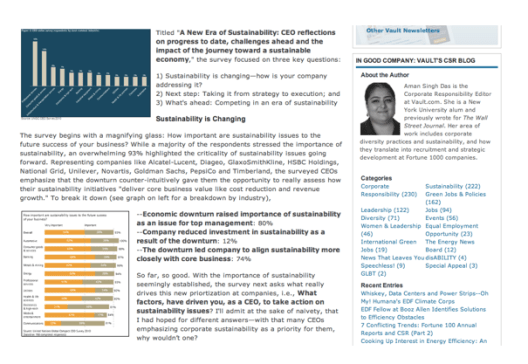
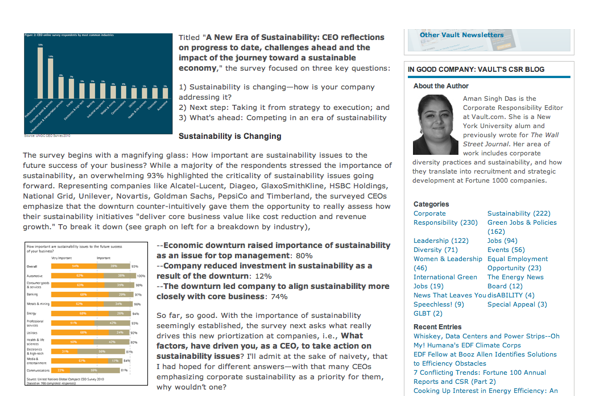
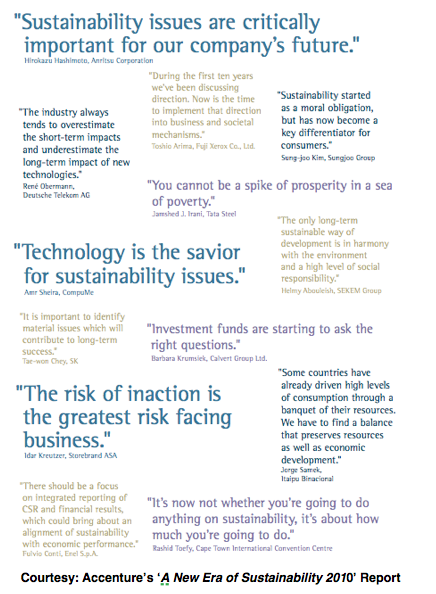
Last year, Accenture co-produced a report with the United Nations Global Compact titled A New Era of Sustainability: CEO reflections on progress to date, challenges ahead and the impact of the journey toward a sustainable economy. The report focused on examining three main questions with 766 CEOs serving as respondents: 1) Sustainability is changing—how is your company addressing it?; 2) Next step: Taking it from strategy to execution; and 3) What’s ahead: Competing in an era of sustainability.

The BIG finding from the report: 93 percent of 766 CEOs surveyed believe that sustainability will be “important” or “very important” to the future success of their company.

CSR Journalist Aman Singh reports on Accenture's New Era of Sustainability Report

Now, Accenture has produced a followup sector by sector report that offers more clarity — and a wide disparity in this percentage — to the overarching aggregated data by doing a deeper dive by industry.

For example, 100 percent of executives in the automotive and consumer products industries see sustainability as critical to their success but only 68 percent of banking executives see sustainability as “very important” to their future success, and 63 percent reporting that “their company is integrating sustainability ‘much more’ than five years ago.”

As for the communications sector, the percentage of executives seeing sustainability as “very important” to future growth drops to a mere 22 percent.

From Sustainability Strategy to Sustainable Business Practices

As the above-mentioned three questions indicate, however, the 2010 report attempted to be forward-looking in its data. Indicating a wide disconnect between the perceived importance of environmental, social and corporate governance for companies, and how these play in business strategy, the report pointed out that “while the belief in the strategic importance of sustainability issues is widespread among CEOs, executives continue to struggle to approach them as part and parcel of core business strategy.”

The new, follow-up report, adds teeth to this initial observation by showing a disparate practice of sustainable business practices across industries.

While 80 percent of utility industries report embedding sustainability metrics to track performance, 83 percent of CEOs in energy and 81 percent in infrastructure say their “company measures both positive and negative impacts of their activities on sustainability outcomes.”

Is sustainability measurement finally becoming accepted standard practice?

While this aggregated data might indicate so, the reality, according to Accenture’s Managing Director for Sustainability Services for Europe, Middle East, Africa and Latin America Peter Lacy, is that there remain “major gaps remain between CEO ambition and execution.” As evidence, the report offers the automotive industry as an example:

“Ninety-five percent of automotive executives believe that companies should invest in enhanced training of managers to integrate sustainability into strategy and operations, but just 52 percent report that their company already does so.”

Analyzing Sustainability Enthusiasm In a Recession

When Accenture’s New Era of Sustainability report
came out in June last year, I chose to go with a positive headline. I titled my detailed analysis as “Sustainability Moves from Discretionary Choice to Corporate Priority.”

Today, as we deal with a downgraded credit rating for the country of everyone’s dreams, a recession that might never have ended, and businesses once again returning to cautious growth, that optimism is hard to replicate. Troubled by debate after debate (subjects varied from accountability to Wal-mart, upstream recycling to upcycling, compensation limits, and much more) during the recent Sustainable Business Practices workshop held at the University of Vermont, several of the students jested that “Sustainability, after all, is a journey.”

I would add that it is also a mindset: A mindset that understands that business goals (profits, profits, profits) cannot be reached without taking into account the society and the environment you operate in and the human capital that helps you succeed. Will the rest of the sectors detailed in Accenture’s report follow through on their CEOs’ ambitions?

In coming months — and years — with America’s long-term sustainability as an economic power in question, all eyes will be on whether American businesses can pull up their socks and return their operating base to trustworthy status by using sustainability as a guiding principle. Where government fails, business steps in, right fellow #csrchat attendees?

Thoughts? Don’t forget to leave a comment or connect with me @AmanSinghCSR.

Next: Gib Bulloch, Executive Director of Accenture Development Partnerships discusses the report in Capabilities for the Convergence Economy.


Share this:

  • Tweet
  • Email a link to a friend (Opens in new window) Email
  • Share on Reddit (Opens in new window) Reddit
  • Print (Opens in new window) Print
Like Loading...

Sustaining Timberland: An Interview with VP of CSR Mark Newton

02 Tuesday Aug 2011

Posted by Aman Singh in CSR, CSR reporting

≈ 7 Comments

Tags

Accountability, aman singh, aman singh das, Apple, consumer education, Consumerism, consumerism, corporate social responsibility, cradle to cradle, CSR, CSR communications, CSR reporting, Dell, Ethics, ethics and compliance, Green, human rights, Jeff Swartz, Leadership, management, Mark Newton, marketing, Motorola, product lifecycle, Social Impact, Social Media, social media, supply chain, Sustainability, sustainability, Timberland CSR communications portal, Timberland VF merger, transparency, VF, Work culture


When one of the country’s few purpose-based and values-driven company announces new sustainability goals, chances are you won’t be as excited as you would be if it was BP, for instance.

Because we expect ambitious and aggressive goals from leaders, and at Timberland, this expectation is part of everyone’s job.

Before the boot maker announced its new set of revised sustainability goals earlier this week, I caught up with Timberland’s new Vice President for CSR Mark Newton on his new role, the goals, as well as their latest efforts at stakeholder engagement: Timberland’s new Communications Portal.

Sustainability: From Apple and Dell to Timberland

Newton, who has spent his entire career working on sustainability at electronics giants like Motorola, Apple, and most recently Dell, understands that the road ahead will be rocky as Timberland completes its merger with VF. VF owns several outdoor brands like The NorthFace, Wrangler, Jansport and Nautica.

We started with the new 2015 goals. What’s new about them?

“Focus,” said Newton. “Moving forward it is very important that we create focus for our companies, including a commitment to innovate from cradle to cradle.”

Timberland’s 2015 Sustainability Goals

Set in four broad categories of Climate, Product, Factories and Service; the goals are ambitious and aggressive, if not new or radically life-changing. I asked Newton the purpose of each category.

Climate: “This is a topical focus for us if not so much a functional one. But we’re not saying we’re going to be singularly focused on climate change but that this affects our customers and decisions and therefore, we must equip them with decisions and the right products.”

Product: “At some point we all want to start creating innovations that have a zero footprint. The idea is to move toward a vision of a closed loop product lifecycle. You can see where we are and where we want to go. It is directionally correct.”

Factories: “We have an obligation that is not just transactional to our suppliers, employees and other stakeholders. The whole idea of sustainability is to stay in business. In perpetuity, we cannot do that without treating our employees well and scaling our business properly.”

Service: “Timberland was founded on the idea of commerce and justice, of giving back and creating value. We offer our employees 40 hours to volunteer every year. Today we are asking what the impact of that workforce is. Where are we going with this, how do we prioritize our efforts and do it well?”

What underlines all of these goals and their success, however, is engaging and changing consumer behavior.

Changing Consumer Behavior: Timberland-style or VF-style?

Earlier this year, at the Annual GreenBiz conference, Timberland CEO Jeff Swartz said that sometimes companies have to lead consumers by taking a stand on what is right. “You cannot always wait for consumer demand to dictate your decisions,” he said.

Now with Timberland becoming a part of the VF family, are dynamics shifting? Will the merger bring a renewed and united effort in the apparel industry to shift consumer behavior or lead to inertia and inaction?

I put the question to Newton, who while new in his role, is a veteran in the consumer products industry. “We are having several conversations around this. We are Timberland and we will always be that. This is the reason people are interested in EarthKeepers and we will continue to move the needle,” he said.

What about Swartz’s inspiring declaration? Newton offered Timberland’s EarthKeepers product line as an example:

“The ultimate goal of every company that is working on sustainability is to be able to drive top line growth because of its sustainability efforts. It’s very rare to see top line growth associated with these things, many companies are running leaner and end up staying within compliance. At Timberland, our EarthKeepers product line is actually doing that with double-digit growth in the first quarter.”

Authentic Communications: Engage the Consumer, not Just Inform

With skepticism already high in the market, there is a fine line between selling more units and ensuring responsible consumerism. EarthKeepers seems to be clearly bucking the trend and providing a new, profitable way of doing business sustainably.

Was this growth the result of consumer education, eco labels, or increased communication?

“Authenticity. We’re finding success because it is authentic. We are intentionally focused on products that are environmentally friendly and socially conscious. And we are committed to continually communicating that. We’re not waiting for everything to become perfect, we’re putting it out there and calibrating it as it evolves,” he said.

Examples? Newton offered the eco-index, which Timberland was instrumental in creating and pushing out. “We are promoting the index so we can create real change and movement. That’s exciting and offers us a chance to drive real, calculable change,” he added.

What VF brings to the table then is scale. “VF has been a partner for years on making the process much more efficient. Now the merger will allow us to collectively drive things that Timberland alone simply cannot do. This bigger opportunity is huge for us,” he emphasized, adding, “It’s also not just forward-looking things and what we can do upstream. VF has a very efficient process in place because of their brands. We have had limited impact there but now we can have much more.”

Timberland’s New Communications Portal: CSR in Real Time

With Timberland already being aggressively visible and vocal in the consumer marketplace, why did Newton and team feel the need to launch a new CSR communications portal?

“We’re segmenting the conversations on our website around products and around topics so everyone has a better sense of clarity. Even though our authenticity ensures that sustainability conversations become natural in all parts of our business and you don’t have to go to the CSR portal to have a CSR conversation, we felt that different stakeholders have different perspectives. You can still go to the products portal and have the same conversation as you would on the CSR portal, because the intentional design, how we conduct business with suppliers and community issues are woven into the product and the product description.”

Why then is the new portal necessary if sustainability is so intricately embedded into the work culture at Timberland?

“We are having conversations with a very vast and diverse spectrum of people, from wholesalers and retailers to direct consumers. They all come with very different demands and perspectives and we want to offer them the opportunity to engage in the language they understand best,” he explained.

Fully integrated with social media tools, the portal is designed for consumers looking for details on green products, interesting stories and much more. Not only can you go to the redesigned portal and discuss Timberland products, you can also discuss the team’s CSR efforts, join ongoing conversations through their Bootmakers blog, and chime in on more topical discussions around the Green index and climate change.

Admittedly, many companies continue to struggle with this balance between preserving the granular stuff and promoting more general conversations around products.

For Timberland, the answer was to lead in both.

“People can go granular as they want or stay as generalist as they’d like. What’s different about the portal is that we are not starting conversations by discussing one of our pillars or metrics but focusing on stories that matter and then getting to the things that are underneath those stories; this marks a fundamental shift for our website,” Newton added.

Being a communications geek, I can definitely attest to Newton’s excitement about this new portal. The ability to throw open your business practices and product lifecycle to your stakeholders takes gumption and a resolute belief in transparency.

The Timberland team knows that this throws the door open to endless questions and scrutiny but Swart’z recruits are used to that and know that open engagement is the only way to maintain authenticity and empower their stakeholders toward sustainability and a zero impact footprint.

This is mission critical for Timberland.

As Newton put it, “Regardless of what happens post-merger, we are all in this together. Our values are integrated into all of us and everyone who works here. Jeff Swartz might be the leader but you can expect to hear the same things from all of us.”

This is Timberland’s — and VF’s — opportunity to drive the apparel industry toward a more sustainable future. The 2015 goals are the means to an end, a future that VF and Timberland can now together impact much more powerfully.

Comments? Leave a comment, email me or connect @AmanSinghCSR.

Share this:

  • Tweet
  • Email a link to a friend (Opens in new window) Email
  • Share on Reddit (Opens in new window) Reddit
  • Print (Opens in new window) Print
Like Loading...

How to Pursue a Career in CSR

01 Monday Aug 2011

Posted by Aman Singh in CSR

≈ Leave a comment

Tags

aman singh, aman singh das, Career advice, career advice, careers in CSR, careers in sustainability, corporate social responsibility, CSR, CSR communications, CSR jobs, finding jobs on social media, Job search, Jobs in CSR, jobs in CSR, jobs in sustainability, management, marketing, marketing jobs, PR jobs, Recruitment, Social Media, social media, social media strategy, Sustainability, sustainability, sustainability jobs


At a recent workshop on how to pursue a career in CSR, I asked students at the University of Minnesota how they define CSR. Some of their answers:

“Weaving sustainability, community responsibility, and diversity in any business role.”

“Considering all stakeholders (customer, employees, community) when making a business decision.”

“I define [it] as how the company does college student become a CSR practitioner?

While the essential job search in itself is undoubtedly important, identifying how you define CSR is more important for two reasons: 1) CSR jobs — or jobs with the specific title of CSR/sustainability — are scarce; and 2) The continuing lack of standardized scope and skills attributed with these jobs doesn’t make for a very structured job search.

This dual combination then makes it even more crucial that you understand which thread of CSR really interests you, because there are several.

Nancy Lublin from doSomething.org made an obtuse reference to this at the recent UN Social Innovation Summit, noting that most of the panelists with her were founders of something. “Everyone cannot be a founder,” she said. “It’s okay to join stuff.”

While Lublin was referring to social innovation, her comment applies to all of us: We don’t need to reinvent the wheel on responsible and ethical behavior—you just need to have a clear idea of where you stand on it, and how you can apply that to your job search.

Seriously.

So, how does a college student become a CSR practitioner? Here’s my two cents:

1. Define CSR: What does that mean to you — and your career?

If you are a great communicator and enjoy writing, then marketing would be a good fit. But if research, analysis and data are your passions, then working on CSR reporting would be a better fit.

And if working with people or organizing things is your deal, then HR or even community relations could prove to be better fits.

You get the idea.

2. Identify required skills

Now that you know what you would enjoy doing, evaluate your bucket of skills. Continuing with one of the examples above, if data gathering and analysis is your forte, here’s a few things that should be on your Skills Checklist:

  • • Understanding of what kind of data is used by companies in CSR reporting
  • • How this data is collected
  • • Industry standards
  • • Thorough knowledge of the structure and organization of CSR reports
  • • Certifications: One that instantly comes to mind is the Global Reporting Initiative (GRI) standards, which many more companies — and universities — are starting to adopt.

3. It’s time to think: Brand Awareness

Start building your personal brand. Blog: write about your passion, why you want to work in the field, your motivations, etc. (It might be for free but you’ll get a better-than-decent ROI if you’re seen by the right people.) Write for publications and websites, both mainstream and niche. Meet with like-minded students who are pursuing similar interests. Join your local Net Impact chapter. Arrange informational interviews with the faculty.

These conversations will go a long way towards helping you decide whether to pursue what you are passionate or change course: Either way, a huge benefit.

4. Get practical experience

Internships: Incredibly important. Pursue as many as possible in your four years at college because that’s the time when you have the least to lose.

Internships will give you the hands-on experience that no number of years spent in college can provide. But use these opportunities responsibly because there aren’t many out there. Network, approach each day as a new lap you need to complete, seek out projects, volunteer, focus on demonstrating your skills, and share your opinion.

And learn to fail.

When you do (not if), pick up the pieces and continue on, or start over—both are perfectly okay. Failures later in life will sting a lot more, so fail early and learn well.

5. Social Media: Learn to be a bystander and listen

Another skill that I just cannot overstate the importance of. While you build your personal brand–whether through blogging, research papers, tweeting, commentary on Facebook or the college newspaper—be sure to share it with others. And demand feedback: the good and the bad.

Listen to what is being written about the subject, who the prominent speakers are, the movers, the exemplified, the ridiculed (you’ll learn from both, trust me), the practitioners.

In the end, use your skills to guide your job search. Once at a company, let your passion guide you in creating the change you want to see happen. We can no longer afford to stand outside and point fingers.

Share this:

  • Tweet
  • Email a link to a friend (Opens in new window) Email
  • Share on Reddit (Opens in new window) Reddit
  • Print (Opens in new window) Print
Like Loading...

VIDEO: A Test in Corporate Transparency: Winning One for the Blue Shirts

29 Friday Jul 2011

Posted by Aman Singh in CSR reporting, HR

≈ 11 Comments

Tags

Accountability, aman singh das, Best Buy, conflict minerals, consumer education, Consumerism, corporate accountability, corporate social responsibility, CSR, CSR reporting, CSR strategy, diversity, diversity and inclusion, employee engagement, ESG, ethics and compliance, Events, fair trade, Green, GRI, HR, human resources, human rights, inclusion, Leadership, leadership, management, marketing, PR, risk management, shared value, Social Media, social media, supply chain, Sustainability, sustainability, Sustainability Report, technology, transparency, VIDEO


Last week I was at Best Buy headquarters in Minneapolis to moderate a live webinar with its CSR and sustainability executives. Joining me: Mary Capozzi, senior director of CSR, Leo Raudys, senior director of environmental sustainability and services compliance, and Hamlin Metzger, senior manager of corporate responsibility.

The agenda: To discuss Best Buy’s annual Sustainability Report and offer a live audience on Livestream and Twitter the opportunity to ask questions in real-time.

My job: To question, dig and examine, while moderating questions between the panel and the audience. About 20 minutes into the webinar, which is archived below — well worth a listen whether you are a sustainability nut, a tree hugger, a nonprofit exec, a job seeker or simply an electronics user — questions started streaming in.

From conflict minerals to employee education, every question was fair game.  While @Gchesman asked whether being a well-known company affects the level and degree of time and money spent on CSR and sustainability, @Davidcoethica wanted to know how Best Buy can better balance its role as a promoter of consumption of products against a sustainability ethos, and Robin Cangie wondered how Best Buy can help us all become more responsible consumers?

The conversation, thanks in part to an active and engaged audience, and wonderfully diverse questions, was invigorating, informative and challenging.

Barring the repeated mentions of their recycling efforts — sorry Leo, its a pet peeve — which to be fair is a huge and important undertaking for the global electronics retailer, the panelists were clear, comprehensive in their responses and unapologetically honest about their challenges: That there is a ton of work ahead and that they hadn’t figured it all out yet.

But as David Connor wrote earlier this week, when you’re a global player like Best Buy, expectations are higher as well. Did Best Buy live up to the expectations of CSR activists? Perhaps not.

Flip the coin though for a second.

Did they go on the defensive when I asked them why their retention rates were remarkable (74%) but the diversity of their recruits (12% African-American, 14% Hispanic; 180,000 employees) was quite underwhelming? No.

Did they dodge repeated questions about educating their supply chain, influencing consumer decisions, or the recently drafted UN Guiding Principals on Human Rights? No.

Bottom-line: Capozzi and team did not have all the answers but they didn’t pretend to either.

And that’s where, as an independent journalist, they get points from me for an attempt, however small, at open transparency, willingness to be accountable, and daring to do something new.

Remember the 11 Challenges for Corporate Sustainability? Well, a significant number of those relate to fear. For the Best Buy team, this webinar was a successful exercise in effectively addressing their own fears.

And that is where they just won one for their team of blue shirts.

Share this:

  • Tweet
  • Email a link to a friend (Opens in new window) Email
  • Share on Reddit (Opens in new window) Reddit
  • Print (Opens in new window) Print
Like Loading...

Constructive Consumerism: Why Buying Less Won’t Eradicate Poverty

28 Thursday Jul 2011

Posted by Aman Singh in Uncategorized

≈ Leave a comment

Tags

aman singh, aman singh das, Consumerism, consumerism, corporate social responsibility, CSR, fair trade, saleem ali, Social Impact, supply chain, Sustainability, sustainability


“What do people mean when they say ‘Think globally, act locally’? It’s utter nonsense. They create nothing but confusion in the public’s mind,” said University of Vermont Professor Saleem Ali at a recent workshop on campus.

Also the author of recently released Treasures of the Earth: Need, Greed and a Sustainable Future, Ali comes across as definitely informed, deeply academic, a bit eccentric, and somewhat at odds with the developed world. His advice: “Life is complicated, the world is complicated, get used to multi-tasking.

Desires vs. Needs

Surprisingly, I found myself nodding my head in agreement as he discussed the premise of his book and why he wrote it. “Linear narratives have destroyed us. It’s not about choice or constraint. The dialogue is about infinite desires as well as needs. Glossing over either is wrong,” he said.

Citing Gandhi who said, “The Earth provides enough to satisfy every man’s need, but not every man’s greed,” Ali, a Pakistan-born, American-educated scholar, asked the room full of students, professionals and faculty to free their minds and connect need with greed. “At one level I agree [with Gandhi]. If you have infinite desires, you won’t have sustainability. But the fact that there is a connection between need and greed is glossed over in this argument.”

How are the two connected? “Because geology hasn’t given us all a fair share of resources.” And so the premise of his book: Would the world be a better place if we curbed our desires for material goods?

The answer, at least for Ali: No.

How Do You Consume Less When You’re Already Surviving on the Bare Minimum?

His analogy: What social workers, have for decades, advised the developing world: Consume less to be more sustainable.

For decades, nonprofits have visited the rural areas of India, for example, and offered this apparently simple piece of advice to millions who continue to live below the poverty line and remain bereft of the simplest technological gadgets. According to Ali, this approach doesn’t work because “you cannot simplify the desire to want more.”

In a community where bare necessities are a struggle, continued Ali, consuming less doesn’t stick, let alone make sense. “People want to innovate so that they can have more, not so that they can reduce their consumption,” he said.

“We need more pluralism to come out with a sub-optimal solution. Take a look at what happened at the U.S. economy for example. In 1790, 90 percent of the U.S. economy was farming and extractive in nature. Today, our largest industries are technology and information enterprises.”

“We have more teachers, more bloggers, more artists today because its easier! Because we don’t need as many farmers and producers,” he continued.

His mantra: We have to look at livelihoods more holistically. We have to think of resources in a cyclical way.

Creating Shared Value: Constructive Consumerism

Before you leap to conclusions about Ali’s sermon, understanding his entire argument on what he calls “constructive consumerism” is important.

For the everyday consumer, who has more choices today than ever before, not to mention picking between green, organic, fair trade, socially responsible, etc., Ali’s dictum is clear — and mind numbingly simple.

“Think about what you buy. Don’t buy less. Boycotting luxury goods isn’t necessarily helping the problem,” he explained. For example,he continued, “ Botswana’s economy is primarily dependent on one single product: Diamonds.” It is because of this one export that everyone in Botswana can enjoy health care and free education till the PhD level, he said. Of course, how this is implemented on the ground in a traditionally male-dominated society is a question many continue to struggle with.

“The same thing with roses. I find people being all self-congratulatory by deciding not to buy roses. Save it, because you are being myopic,” he commented. Kenya’s primary export is roses.

So, what is the academician’s advice?

  • Don’t think local is necessarily better;
  • Don’t carbonize everything;
  • Resurrect ecological efficiency;
  • Choose responsible consumption over unfettered consumerism; and
  • Don’t do away with foreign aid; insist on fair and targeted trade.

Ali ended with one final thought on the role of culture in our lives and decisions.

Responding to a question from the audience on what he thought about the erosion of culture in the Amazon and other places in favor of modernization, he said, “Culture isn’t always a good thing. It has given us female infanticide and child abuse. Culture is not by nature a positive. Destroying culture then isn’t always a bad thing.”

Comments? Thoughts? Perspective? Leave a comment, email me or connect with me @AmanSinghCSR.

*Originally published on Forbes CSR blog.

Share this:

  • Tweet
  • Email a link to a friend (Opens in new window) Email
  • Share on Reddit (Opens in new window) Reddit
  • Print (Opens in new window) Print
Like Loading...
← Older posts
Newer posts →

Let's Talk!

Virtual
732-322-7797
amansinghdas@gmail.com

Blogs I Follow

  • Nonprofit Chronicles
  • Learned On by Andrea Learned
  • Angry African on the Loose™
  • csr-reporting
  • The CSR Blog
  • In Good Company: Singh on CSR

My Cloud

Capitalism 2.0 CSR CSR reporting CSRwire ESG Guest Author HR Stakeholder Engagement Sustainability Uncategorized

Recently written…

  • Rationality is Ruining Us: Mayors, presidents and governors join major businesses in charting way forward on climate change
  • 2015: the year businesses recognize that climate change is real – and 4 other themes
  • Hardcore lessons of sustainability – ’10 Words or Less’
  • Brewing a Better Future [#BaBF] with Heineken: Examining the Many Flavors of Local Sourcing
  • From Conflict to Collaboration: Kimberly-Clark and Greenpeace Participate in LIVE Twitter Chat

What others are reading

aman singh aman singh das Brand Management Business corporate social responsibility CSR CSR reporting CSRwire ESG Leadership Stakeholder Engagement supply chain Sustainability sustainability Work culture

Categories

Most Read

  • None

Create a free website or blog at WordPress.com.

Nonprofit Chronicles

Journalism about foundations, nonprofits and their impact

Learned On by Andrea Learned

Angry African on the Loose™

I have opinions. I am from Africa. I live here now. I blog.

csr-reporting

Connecting the dots between Business, Society & the Environment

The CSR Blog

Connecting the dots between Business, Society & the Environment

In Good Company: Singh on CSR

Connecting the dots between Business, Society & the Environment

Privacy & Cookies: This site uses cookies. By continuing to use this website, you agree to their use.
To find out more, including how to control cookies, see here: Cookie Policy
  • Subscribe Subscribed
    • In Good Company: Singh on CSR
    • Join 119 other subscribers
    • Already have a WordPress.com account? Log in now.
    • In Good Company: Singh on CSR
    • Subscribe Subscribed
    • Sign up
    • Log in
    • Report this content
    • View site in Reader
    • Manage subscriptions
    • Collapse this bar
 

Loading Comments...
 

    %d