• ABOUT THE AUTHOR
  • Sustainability
  • CSR
  • CSR reporting

In Good Company: Singh on CSR

~ Connecting the dots between Business, Society & the Environment

Tag Archives: ESG

Decoding Nestlé Waters North America’s Sustainability Journey: Environmental Villain or Facts vs. Emotions?

09 Wednesday Jul 2014

Posted by Aman Singh in CSR, CSR reporting, CSRwire, ESG

≈ Leave a comment

Tags

aman singh, Brand Management, Business, corporate social responsibility, CSR, CSR reporting, CSRwire, Disclosure & Transparency, environment, Environment, ESG, extended producer responsibility, heidi paul, kim jeffery, nestle waters, nestle waters north america, Net Impact, packaging, Philanthropy, recycling, shared value, Stakeholder Engagement, Supply chain management, Sustainability, sustainability, transparency, water conservation, watershed management


When a company labels its Annual CSR Report as Creating Shared Value, you have to stop and wonder if they’re responding to the latest buzzword in the market or leveraging its potential by truly embedding it into their reporting and cultural framework.

In its third cycle, Nestlé Waters North America’s [NWNA] latest Creating Shared Value Report attempts to accomplish the latter. Among its headlines:

  • What the company is doing to advance recycling in the U.S.
  • The company’s path to achieving a zero-waste future
  • Its continued efforts to be the most efficient user of water within the beverage industry

To gain some firsthand perspective and background on these goals and the accompanying challenges for North America’s largest seller of bottled water, I reached out to EVP for Corporate Affairs Heidi Paul [Join us for a Twitter Chat today, June 18th, at 1:00pm ET to connect with Paul directly at #SharedValue!].

NWNA_2012_CSR_Report_coverAmong my questions: how does the company balance criticism for selling bottled water while promoting healthy choices, what it is doing to shift its supply chain and use of plastic, its  well-acknowledged work in the area of Extended Producer Responsibility, and how her team plans on including consumers in its drive for sustainability.

Defining “Shared Value”

Paul started the conversation by setting the record straight on the company’s definition of what’s quickly gained momentum as a replacement for CSR: Creating Shared Value.

“We define CSV as a strategic way to achieve triple bottom line sustainability. In other words, be financially, environmentally and socially sustainable.  At the end of the day, Nestlé seeks to create shared value in those areas where we can make the most impact and that are material to our business. Globally, that is in the areas of Nutrition, Water and Rural Development. For our bottled water business in North America, our focus is on healthy hydration, packaging responsibility and watershed management.”

Has the terminology helped NWNA’s citizenship team – 28 people strong across the company – integrate its sustainability goals more effectively within its business units?

“It has done wonders. When you’re looking at philanthropy unconnected to business, it is not really sustainable. CSV focuses our engagement on the three critical topics and asks the whole company to see what can be improved for society and ourselves. We get the benefit of input from our supply chain, employee groups, community partners, etc.,” she said.

Coding the Impact of Bottled Water

Let’s get to NWNA’s main product then: bottled water. Does it feel the twinge of irony every time that is said in the same sentence as “shared value”? Paul chose to answer that with some data:

“Seventy percent of what Americans drink – according to the Beverage Marketing Corporation – today comes from a package, not from a cup or the tap. In fact, our research indicates that if people don’t have access to bottled water, 63 percent say they will buy some other beverage from a package instead, often a sugared or caloric drink with a greater environmental impact.”

“We play a key role in increasing Americans’ consumption of water, which is the healthiest beverage choice. As the data indicates, there is a crucial role that bottled water plays in consumer choice. Everywhere there is a high-calorie sugary, packaged drink available; we want to make sure there is water as well,” she emphasized.

Does the company’s sales data support Paul’s emphasis? “The volume sales increase for 2012 for the bottled water industry was 6.2 percent. And per capita consumption reached nearly 31 gallons, up more than 5 percent from 2011. Further, 51 percent of people who stop drinking sugared soft drinks are switching to bottled water. In fact, bottled water is outselling sugared soft drinks in grocery stores in eight major markets across the country,” she supplied.

At the end of the day, Paul believes, the company’s job is to talk about why bottled water is a choice – nestle waters north america brandsan amply available one – and why it should be available anywhere packaged beverages are being sold.

Is Nestlé Waters North America’s Business Model Sustainable?

That brought us to the next obvious thread: the plastic being used to produce the bottles. Recalling a keynote given by former NWNA CEO Kim Jeffery at a Net Impact conference years ago, I asked Paul how the company handles its fiercest critics regarding its use of plastic.

In a jungle of facts, fiction and emotions around environmental issues, Jeffery confronted the audience back in 2009 with a firm and resolute stand: we sell bottled water and we are doing everything we can to make that process sustainable.

Where there was a finality of “take it or leave it” to Jeffery’s remarks four years ago, Paul took a more nuanced approach to respond.

“Limited resources need to be used again and again. We have taken the mantle of becoming part of that solution. The larger point is there are billions of servings of beverages being sold everyday in some sort of package. Some populations are getting most of their calories from bottled drinks. And every time they choose water over a different drink, they’re making a more healthy and environmentally friendly choice,” she said.

And is a goal of reaching 60 percent recycling ambitious enough considering the climate and environmental challenges we face?

“At the time we were setting the goals, the nation was at a 28 percent recycling rate for PET plastic and thought that a goal to double that rate was ambitious and would require big changes. We had a lot to learn. We began to study recycling programs and the patchwork of policies and systems that were in place but were not moving overall recycling rates very much. There are big opportunities for increasing recycling by improving collection in public places, business and industry and in urban residential buildings. Today, however, there is no money going to fund this expansion of infrastructure.”

“There is also the issue of competing systems. Bottle bills for example do raise the recycling rates for bottles and cans, but actually reduce the efficiency of curbside because it is taking the most valuable commodities, which reduce the revenue, potential from curbside. Our goal was to work with others and find the most efficient system with the highest impact,” she emphasized. “

Environmental Villain or a Case of Facts vs. Emotions?

Of course the plastic of the bottled water we consume is bad for the environment. But so is almost every other product and consumer packaging we use in our day-to-day lives as study after study has shown.

Turning the argument on its head though, would we be wasting as much or filling up landfills as quickly as we are if we didn’t have the choice of bottled water to begin with? Where does consumer choice end and producer responsibility kick in?

Identifying that as another area for impact, Paul picked up:

“If bottled water isn’t available, people routinely purchase another packaged drink, one with calories and with a heavier environmental footprint. The availability of bottled water in times of natural disasters, where often tap water can be compromised, also creates a role for bottled water that goes beyond most product categories. Bottled water provides a reliable second source of water in these situations – that’s something everyone in our company is proud of.”

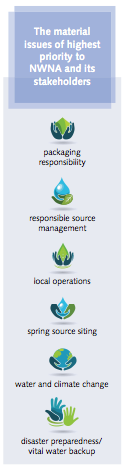
So when your business model is set around selling a product that is healthy and encourages nutrition while understanding and targeting its impacts through a well laid out sustainability strategy NWNA_priorities– as  Jeffery succinctly put it in his exit interview with Greenbiz Publisher Joel Makower earlier this year – is it fair to be labeled an environmental villain?
Perhaps, perhaps not.

The Challenges of Sustainability

As Paul reiterated, the journey of tackling facts vs. reality has been full of challenges and continues to be an uphill task. “Like anything else, our work in the area of recycling, water conservation and reducing our social and environmental footprint has been a constant education,” she said, citing the lack of modern and efficient recycling system as one of the company’s top challenges.

“Not too many people understand the current system in place. There are numerous questions like who is funding what, how does it work, who are the middle men, how do we get to the next stage, where can we build in efficiencies, etc. And if the goal is to accept our responsibility as a producer to recycle efficiently toward a goal of zero waste, then we need answers to these questions.”

“We’ve always said we’re open to options, and so far the option that we have seen with the highest potential to be low-cost and efficient is a well-constructed EPR system, run by industry. What makes this complicated is there are a dozen different ways EPR has been implemented globally. Many of those are not efficient. This uncertainty about the ability to do it “right” makes others in the dialogue want to take more of a “wait and see” approach. Even if you convince people who, done well, EPR in the form being proposed is the best solution, there are doubts about implementation across the board,” she said.

Other challenges?

Consumer vs. Producer Responsibility

Paul cited the potential of collaboration in building more sources for wind and solar energy, as well [“we’re not there yet but this is definitely on our radar”].

There is also a need for collaboration in the area of water stewardship. “Improving watersheds will require collaborations among the various stakeholders within a watershed, be that users, scientists, environmental groups or government. Nestlé Waters North America manages the watershed areas around the 40 springs we use that are overseen by our 10 Natural Resource Managers. We have also made a commitment to collaborate on two watershed projects per year,” Paul said.

And what about NWNA’s consumers? How does the company leverage its brand to shift consumer behavior?

“In the 1970s, recycling meant ‘putting it in the bin.’ Today, this is old news. What motivates people now is when they understand its benefits. If a consumer recycles a water bottle after use, the greenhouse gas impact of that bottle is estimated to be reduced by more than 15 percent.”

“Also, we need to close the loop on what happens to the bottles after they are recycled. They are not trash; they are a resource that can be used again and again. Right now our 50 percent r-pet bottles in our Arrowhead, Deer Park and Resource brands shows consumers what happens when they recycle. It becomes a new bottle. The visibility of this message on our bottles helps us tell the story that we need much better recycling to become a more sustainable world.”

The company’s top challenge moving forward?

“At the end of the day, you want zero impact, but is that possible? Our challenge is to keep finding those ways to improve when it feels like you’ve reduced the impact to the minimum,” she said, finishing with a flourish: “You need to find the next frontier every time – that’s the goal. And the challenge.”

Originally written for and published on CSRwire’s Commentary section Talkback on June 18, 2013.
Share this:

  • Tweet
  • Email a link to a friend (Opens in new window) Email
  • Share on Reddit (Opens in new window) Reddit
  • Print (Opens in new window) Print
Like Loading...

#SustLiving: In Conversation with Unilever’s Chief Sustainability Officer

09 Wednesday Jul 2014

Posted by Aman Singh in CSR reporting, CSRwire, ESG

≈ Leave a comment

Tags

#sustliving, aman singh, Brand Management, Chief sustainability officer, consumption, CSR reporting, CSRwire, Disclosure & Transparency, Environment, ESG, gail klintworth, Leadership, Stakeholder Engagement, stakeholder engagement, supply chain, Supply chain management, Sustainability, triplepundit, Twitter, unilever


A conversation with Unilever’s Chief Sustainability Officer Gail Klintworth on the Sustainable Living Plan’s progress, challenges, what’s necessary to shift global & local consumer mindsets and more: Moderated in partnership with Triple Pundit’s editorial duo Jennifer Boynton and Nick Aster.

[View the story “Unilever’s #SustLiving Trends Worldwide: Goals, Challenges & the Way Forward” on Storify]

Share this:

  • Tweet
  • Email a link to a friend (Opens in new window) Email
  • Share on Reddit (Opens in new window) Reddit
  • Print (Opens in new window) Print
Like Loading...

Examining The Sustainability of the Royal Bank of Scotland: Facing Your Demons

09 Wednesday Jul 2014

Posted by Aman Singh in CSR, CSR reporting, CSRwire

≈ 1 Comment

Tags

banking, corporate governance, CSR, CSR report, CSR reporting, CSRwire, Disclosure & Transparency, economy, employee retention, ESG, Ethics, finance, HR, Leadership, leadership, materiality, stakeholder engagement, Sustainability, sustainability, transparency, voluntary disclosure, Work culture


The finance sector continues to ride on the coattails of what started as a severe decline in trust, market performance and profits in 2008. And Royal Bank of Scotland [RBS] was no exception, facing its own share of customer distrust and instability as well as a government bailout.

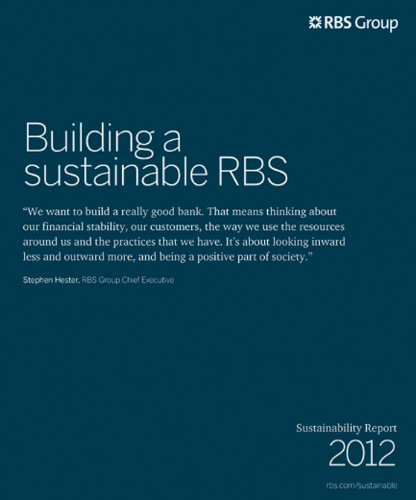
However, in its most recent CSR Report, the bank – as compared to its contemporaries – makes a marked effort to address these concerns and makes a public promise to examine its “financial stability, our customers, the way we use the resources around and the practices that we have.”

What really piqued my interest was the press release issued by the bank, which right from the headline – Royal Bank of Scotland Extends Meetings with Biggest Critics – told me change was afoot.

I caught up with Duncan Young, Deputy Head of Sustainability who is also in charge of producing the bank’s annual CSR Report. We began with an obvious question – I couldn’t hesitate – about a specific statement in CEO Stephen Hester’s quote that highlighted the Report’s very first page: What will it take to “build a really good bank”?

Aspirational Goals: “Building a Really Good Bank”

“There’s been debate about how aspirational that statement is…and a recognition that the sector has had a difficult time in recent years. We want to regain the trust of our customers and wider stakeholders – and we’re not going to become a really good bank till we do that,” he explained, adding: “We’ve spent the last few years working to make the bank secure and stable again. And made fairly significant progress. But as we go through the process of regaining trust with wider society, we think we need to deliver the kind of solutions that equate with us being a good bank.”

Fair enough. But what does an overarching statement of “becoming good” involve for an organization that serves a cross sector of business and consumer populations?

“We have significantly enhanced the remit of our Group Sustainability Committee this year. They will now cover wider reputational issues, impact on customers as well as U.K. industry practices, where too often, in the past customers were taken for granted. Today, we want to put customers at the heart of what we do to make sure we don’t make those mistakes again,” he said.

As for the committee’s expanded remit, “The committee will operate at the board level with full  RBS_Report_Cover_Alternativesupport from our leadership. Members will meet six times a year to review its larger mandate, which now includes conduct, culture and reputation, a very current issue for the industry.”

Underlining this is of course a sense of loss. As Young put it, “We are well aware that we have suffered heavily since the financial crisis and need to rethink how we work with our customers.”

“After the crisis, we were bailed out by the taxpayer. Our fundamental goal since has been to make the bank safe and secure. We’re getting there. Our loan to deposit ratio – traditionally held as a good measure of a bank – was at 140 percent at one point. Now we’re down to 100 percent, which is deemed to be a measurable sign of a stable bank,” he said.

“We’ve also repaid key aspects of government support. But it’s important that we focus on maintaining a culture now that ensures past mistakes do not recur. We have a much stronger focus on conduct risk and our engagement efforts are making sure the bank’s leadership are much better placed to pick up on issues of market behavior, reputation risk and have an understanding of what customers’ expectations are from us. That’s another reason why we have significantly increased our disclosures,” Young emphasized.

Transparent Leadership: Engaging With Critics

So how does the company plan to address and interact with its critics?

“We have had a program where the sustainability committee meets with our biggest external critics where they can make the case about their interests in how we operate directly to the executive team. Last year, we held three engagement sessions with 14-15 separate groups attending. This year, we transparency at RBSwill have six more. In fact, even as we talk, committee members are meeting with a few organizations to discuss cyber security and its impact on the bank and our customers,” offered Young.

The leverage and stature of the committee has proven an important approach in increasing the bank’s stakeholder engagement, according to Young, because of the members’ ability to represent critical points of view and risks directly to the leadership. “This ensures that our top leadership does not lose sight of our key stakeholders and the dialogue informs their decision-making and specific business-related outcomes,” he added.

The CEO Speaks

Another first for the bank: Publishing a Q&A with its CEO that makes a mighty honest effort at addressing issues like trust, stability, its lending practices as well as the 2012 LIBOR rate-fixing scandal. Highlights:

On sustainability:

“Our long-term success will be determined by how well we understand our customers and communities, and how well we can service their needs in a responsible way. 2012 was a very challenging year for the sector, but it certainly served to underline that point.”

Lending to small businesses:

“It’s a difficult environment at the moment. Ongoing economic uncertainty has unsurprisingly driven down demand from businesses. SME loan applications were down 19% from 2011. Nonetheless, we continue to provide significant support to customers. RBS advanced more than £74 billion to UK businesses and homeowners in 2012. We’re approving a higher proportion of loan applications than ever – 93% in the last quarter of 2012.”

Royal Bank of Scotland CSR Report

The impact of the LIBOR rate-fixing scandal:

“There is no place at RBS for such behavior. That’s why we’re determined to correct the control and risk management failures that originated in RBS during the financial boom years, of which attempted LIBOR manipulation is an example. This is a painstaking task, that’s been undertaken over several years and we can’t detect and solve every problem as fast as we would like. The aim is to create a safe and secure RBS that serves customers well and that, in the right way, creates value for those who rely on us.”

On customer trust:

“Staff don’t set out to serve customers poorly, but banks too often had other priorities before the crisis. They saw customers as a means of making money.”

On executive pay:

“The investment banking bonus pool has gone down by 20% on last year, despite operating profits in the markets division being up by nearly 70%. In fact, since 2009 our investment banking bonus pool has shrunk by more than 70%. We’ve also increased transparency around pay. But there’s a balance – we need high quality people if we are to achieve the goals we set out in 2008. So we must deliver reform, while not making the business unmanageable.”

Regaining Trust with External Stakeholders…

The report’s materiality map, worth a look by anyone interested in disclosure and how it can increase shareholder value and business performance, shows customer trust as the bank’s number one material risk. I asked Young how his team was planning to address this:

“Stakeholder engagement is one piece. We make our senior leaders available to the media, release quarterly disclosure and take advantage of public forums to explain where we’re taking the company, how we’re working on renewing customer trust and engaging with enterprise,” he said.

Other efforts include programs like “Working with You” where relationship managers spend a minimum of two days a year working with their clients to get a real understanding of those businesses, an accreditation scheme to ensure our bankers are suitably skilled and qualified, and simplifying our product range to make life easier for our High Street customers.

“It’s not just about the products but also how we offer them. We have to acknowledge that we’re operating against the backdrop of a tough regulatory landscape and immense pressure. The repercussions of offering the wrong products in the past continue to be felt across the organization and we have to get this right,” he added.

…And Employees

What about the bank’s internal culture? With massive layoffs having made headlines not too long ago, Employee retention at RBSwhat is Young’s team doing to retain and attract top talent? “Despite all the changes and the restructuring, our employee engagement measurements stack up very well. We’re quite pleased, for example, with our ongoing commitment to demo gender diversity at the executive level. We’re not at the optimum point but we’re getting much better at employing more women,” said Young.
Take a look at the report and you see Young’s sentiments reflected right from Page 1. It is commendable that the bank, despite its difficult regulatory environment and consumer marketplace, is facing up to its critics, shifting its cultural rotunda and putting programs in place that can ensure 2008 does not repeat itself. As Young put it, the report manages to “strike a realistic tone and successfully acknowledges that we did have a difficult year.”

After all, we’ve gone hoarse advocating to reporters that they mustn’t view CSR/sustainability Reports as yet another marketing document but as a piece of disclosure that is tied to materiality, engagement and business performance.

Final words? “If people read nothing more than the first 15 pages, they would get a good oversight of our challenges and how we’re responding. That’s mission accomplished for us,” offered Young.

Originally written for and published on CSRwire’s Commentary section Talkback on May 15, 2013.

Share this:

  • Tweet
  • Email a link to a friend (Opens in new window) Email
  • Share on Reddit (Opens in new window) Reddit
  • Print (Opens in new window) Print
Like Loading...

Connecting the Dots Between Consumers, Consumption & Sustainability: The External Face of Unilever’s Sustainable Living Plan

09 Wednesday Jul 2014

Posted by Aman Singh in CSRwire, ESG

≈ Leave a comment

Tags

Brand Management, Business, cause markeing, cause marketing, CSRwire, employee engagement, Environment, ESG, marketing, packaging, palm oil, PepsiCo, roundtable on sustainable palm oil, sanitation, Stakeholder Engagement, supply chain, Supply chain management, Sustainability, sustainability, unilever, unilever sustainable living plan, waste, water


What role does a consumer-facing sustainability strategy play in an ambitious plan like the Unilever Sustainable Living Plan? That’s where I left off in my interview with Marketing Chief Keith Weed last week in our review of the ambitious Plan two years since launch.

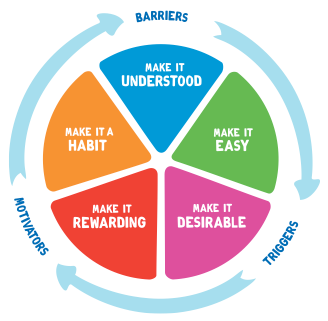
From Desire to Habit: Unilever’s Five Levers for Change

He chose to respond by explaining a framework called the “Five Levers for Change” that his team developed to solve exactly this dilemma. An excerpt:

  1. Make it understood. Sometimes people don’t know about a behavior and why they should do it. This Lever raises awareness and encourages acceptance.
  2. Make it easy. People are likely to take action if it’s easy, but not if it requires extra effort.  This Lever establishes convenience and confidence.
  3. Make it desirable. The new behavior needs to fit with how people like to think of themselves, and how they like others to think of them.  This Lever is about self and society.
  4. Make it rewarding. New behaviors need to articulate the tangible benefits that people care about.  This Lever demonstrates the proof and payoff.
  5. Make it a habit.  Once consumers have changed, it is important to create a strategy to help hold the behavior in place over time. This Lever is about reinforcing and reminding.

“We need to continue to work with others to drive this change. If we achieve the Sustainable Living  Five_Levers_of_Change_unileverPlan, and it doesn’t change business at scale, ultimately that’s a fail. Unilever’s impact is huge but we’re still a drop in the ocean. We need a movement going for businesses to help address this,” he explained.

“We are already working with organizations like the World Toilet Organization, UNICEF and others on sanitation, for example, which is a very important issue for us. Two million children die every year from pneumonia or diarrhoea. In a world where there are more mobile phones than toilets or toothbrushes, our work ahead is sure cut out for us,” he added.

The fact is Unilever cannot do it alone. None of it.

And Weed and team have understood that since launching the Unilever Sustainable Living Plan. While scale is a huge factor, organizations require individual and mass power to change consumer behavior and habits. And that is where the Five Levers for Change along with creative partnerships like the kind Weed referred to can help.

Making Sustainability Personal…

“I was in Brazil recently speaking to a lady in Sao Paulo about the environment and the city’s pollution. For her this meant dust from the nearby construction and the tainted flavor of her water supply. These were her immediate challenges – not deforestation or climate change. People view the world through the prism of my world – family, friends, and community. Our world is a step bigger: the city you live in, the supermarket, the local dump, etc. And the final level, ‘the world’ is the rainforest, the ice melting in the Arctic,” Weed continued.

His point: We need to connect “my world” with “the world” for consumers. “Right now we’re at level one. When I asked the lady what she thought would solve the issues, she suggested stopping the
littering because it would stop the drains from getting clogged and therefore avoid local floods. Level One,” he said.

What companies need to do is create a movement and work with people to drive change. A natural question then: Is Unilever working with other companies on its initiatives or primarily with nonprofits?

… and a Business Driver

One example Weed offered was palm oil.

“We purchase a lot of palm oil but it still makes only for three percent of the world’s palm oil. We started our journey by promising to source 100 percent of our palm oil sustainably by 2020. It’s a clear signal to the entire palm oil supply chain that that is the future we are working toward.”

“But this goal would be impossible to reach across the value chain without working with other purchasers of palm oil. So we work with other businesses and NGOs on the Roundtable on Sustainable Palm Oil to do this collectively.”

In fact, Weed says Unilever managed to reach the 100 percent goal last year because of this collective effort. The next step: To make the supply chain of sustainable palm oil easier and connected by 2020. “Right now procuring sustainable palm oil means weaving through a very complex supply chain,” he added.

Another example: the work of the Consumer Goods Forum, which includes 650 members including manufacturers, competitors, retailers and NGOs, responsible for over $2.5 trillion in sales. And Weed is pretty positive about the goals and work of the Forum: “There are a lot of companies getting behind the need to address the negative impacts of deforestation, and momentum is starting to build,” he said.

While momentum is starting to build – with several companies announcing new initiatives and collaborations – the issue did bring us back full circle to where we started: how do we connect these overarching partnerships with the average consumer?

Subtle Messaging & Cause Marketing

And what role does cause marketing play in Unilever’s 2020 plan? Should we expect more nuanced advertising on the lines of the Dove campaign, for example? Or go full throttle like Patagonia’s Sourcing_unilever“Don’t  Buy This Jacket” campaign?

It’s going to be subtler, says Weed. “For example, for our Tomato soup in Germany or our Ketchup in India, we talk about sourcing tomatoes sustainably. With our Lipton tea, we talk about sourcing all our tea and tea bags sustainably by 2020,” Weed explained.

“Consumers comprehend these messages differently though. When we talk about sourcing our tea sustainably, customers see the Rainforest Alliance logo as a sign of better quality and taste, not necessarily sustainability. With our Hellman’s mayonnaise we discuss cage-free eggs. Consumers perceive that as an indication of better food: animals are better looked after therefore they’re getting better food. However, it’s still early days,” he added.

Work Culture: Participating in Change

Early days also for Unilever’s employees, who are witnessing – and participating – in a significant shift culturally at a company that has left behind decades of “doing things one way” to a more complex ideology. How has the company’s culture evolved since 2010?

According to Weed, the greater purpose espoused by the Sustainable Living Plan has been significant for employees – kind of like Performance with Purpose over at competitor PepsiCo. “The notion that you can work for a business to earn money, build a career and also do it in a better way is significant. We need new ways of doing business in the future – our generation has stolen from our children’s
generation financially and environmentally – so we ‘re going out and saying we want our employees to innovate and encourage new ways of doing business,” Weed said.

In fact, the marketing chief, who also leads internal and external communications for Unilever, says despite the many crises facing our world today engagement levels among employees have gone up consistently every year.

A sentiment that resonated in an email I received this week from Kam Erik Fierstine, a project delivery manager in Unilever Engineering Services at the company’s Henderson, Nev.-based ice cream plant. Here’s what he wrote when I asked him about the culture at his company:

“The Sustainable Living Plan is something that is quite apparent to those of us that live in a desert-like area where we are very conscious of water usage. It has shown our employees that Unilever has the same values that we were raised with. Our employees would not put up with a leaky faucet at home, and now they have the backing of management to proactively fix these simple issues at work.”

“We all agree that we want to leave a healthy planet for future generations and we can help do that by conserving our resources. Our employees see the management team walking the talk and that empowers them to escalate issues and voice new ideas. They will now do small things to make a larger impact like pick up things from the floor or switch off conveyors or equipment when not in use.”

The Henderson, Nev.-based ice cream plant was recently honored by the Innovation Center for U.S. Dairy for its sustainability practices.

“They see us taking on challenges in a positive way and that’s inspiring,” Weed wraps up.

Originally written for and published on CSRwire’s Commentary section Talkback on May 1, 2013.

Share this:

  • Tweet
  • Email a link to a friend (Opens in new window) Email
  • Share on Reddit (Opens in new window) Reddit
  • Print (Opens in new window) Print
Like Loading...

Shared Success at Verizon: No Silver Bullet for Sustainability, Say CSR & Sustainability Chiefs

09 Wednesday Jul 2014

Posted by Aman Singh in CSR, CSR reporting, CSRwire, ESG

≈ Leave a comment

Tags

Business, carbon, community, Consumerism, CSR, CSR reporting, CSRwire, Disclosure & Transparency, energy, environment, Environment, ESG, ghg, iirc, integrated reporting, Philanthropy, recycling, shared value, supplier responsibility, supply chain, Sustainability, sustainability, technology, verizon


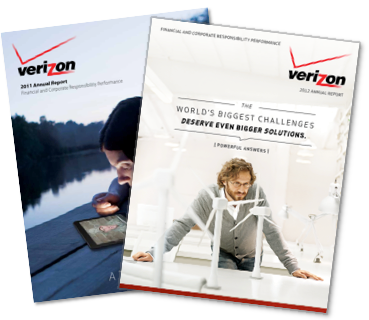
Verizon recently released its second Integrated Report, combining the company’s financial and non-financial data and metrics into one clean look at its overall performance.

While the technology giant has been publishing its environmental, social and governance results for almost a decade, integration with the firm’s financial performance is relatively new. And Verizon saw several significant changes in 2012 to its approach to sustainability and shared value – which Verizon calls “shared success” – including a reformat of its Foundation’s model.

In a recent webinar, I had the opportunity to discuss the report, Verizon’s goals, challenges and a whole host of issues with Verizon’s CSR and sustainability chiefs Kathy Brown and Jim Gowen, along with an engaged audience.

Here are excerpts – and a link to the webinar recording.

Whether you’re eager to learn more about Verizon’s approach to sustainability or what the future holds for integrated reporting and sustainability standards, the webinar will provide you with exemplary context, insights into one company’s efforts to reduce its impact, and how a multinational must pick a strategy that is holistic, focused and measurable.

Shared Success:

Kathy Brown: “When Lowell McAdam became our CEO a year and a half ago, he brought with him a set of principles by which he inspired us to live. It is a value-based approach to our work in the market. We deliver outstanding communication and technology for our communities and country. And we are to share our success with the community. While Michael Porter gets a deep bow for creating Shared Value, these pillars – solutions, service and sustainability – state our mission and our version of shared success.”

Verizon's Shared Success Innovation Process

“We want to achieve measurable social impact. We can do a number of things at one time because our technology is powerful enough for us to find a way to do well for our shareowners and stakeholders, communities and countries in tackling the world’s problems…Specifically, we are focusing on how technology can bring transformational change in education, healthcare and energy management. The platform is our fiber network [and] our wireless network. Through these [networks] we are able to reach millions of users and applications that can literally change the world.”

Setting Aggressive Targets:

Jim Gowen: “Our sustainability program includes aggressive targets, follow-up and our people [who] really do make the difference. In September 2009, when we created the Office of Sustainability, one of the challenges was how were we going to make an impact on a business that [in many areas] is growing exponentially. So we set the Carbon Intensity Metric as the way to grow most efficiently. We set an objective by 2020 to improve our carbon efficiency by 50 percent. Since 2009, we have driven our carbon efficiency 37 percent.”Verizon_networks

“But as I often tell my employees, that was the easy part. Now comes the tougher part. We’ve taken care of all the low hanging fruit. How do you keep that momentum going? For example, e-waste is one of our biggest impacts. We’ve set a goal of collecting more than 2 million pounds of e-waste by 2015. That’s no small feat.
We’re doing that internally as well as externally with our Recycling Rallies.In the last two years, we’ve held 36 of these [across the country]. That objective is very important to Verizon and our customers.”

Environmental Footprint: Setting the Stage

Jim: “Our environmental footprint is quite large. Supporting hundreds of millions of customers takes a lot of work. We operate 42,000 cell towers, 31,000 facilities globally, and [a] 38,000 private fleet of trucks and vans, etc. We had to concentrate on our own resources and see how to become sustainable.”

“We focus on four key areas: making our networks more efficient; expand[ing] our renewable sources of energy; run[ning] our fleets more efficiently; and reduc[ing] the lifecycle cost of ownership of how we operate.  From purchasing to logistics and sustainability – they all match up nicely.”

Highlights from 2012: From Packaging to the “Magic Bus”

Jim: “How do we make our packaging more environmentally-friendly? How do we handle the end of life for that? We asked our OEMs to make their equipment more energy efficient – 30 percent more than legacy equipment. Then we looked at our consumer stores: 131 stores have been LEED certified so far with the U.S. Green Building council, and a pilot is underway to increase that number across our markets.”

“We recently launched our Magic Bus program. The idea was generated by one of our line managers in New York who suggested that, instead of driving our own vans around very congested areas of New York, why couldn’t we drop off our employees with their equipment to provide service to our customers?”

“From that originated a three-month pilot where we used vans that could host eight to 10 technicians with their equipment and inventory on board, and we started driving them around areas of Manhattan. We would pick [up] and drop them [off] and provide service to them throughout the day when they needed it. The benefit was significant – for our customers and our employees. We’ve now started 25 of those Magic Buses in New York and removed 250 of our vans off the roads of New York City.”

No Silver Bullet for Sustainability

Jim: “There is no silver bullet and no magic button. It’s going to take a lot of trial and error and a lot of commitment. While we think and look at our lifecycle approach, we’re still in our immaturity stage,  and the Verizon_reportopportunities ahead of us are so powerful that we can have a significant impact”

From Sustainability to Integrated:

Kathy: “Our Shared Success Council is made up of senior executives across the company – including marketing officers, product managers, general counsel, etc. – who are clearing the strategy for growth and in the process, sharing the idea of Shared Success. The report recognizes these efforts.”

“The process involves a lot of collaboration between executives and the folks on the ground. We focus a lot on our data, and we don’t see this journey as involving any one data point. It’s a journey of doing business, and the report reflects that. We’ve shown enormous efforts and growth, and the information is easy to read and use for our stakeholders across the board.”

Jim: “The report also helps us tell our story concisely. Our customers are asking, as are our investors. They are asking how we’re measuring ourselves? What are our goals – people want to invest in sustainable companies – and how are we incrementally achieving those?”

Technology and Health Care: Powerful Answers

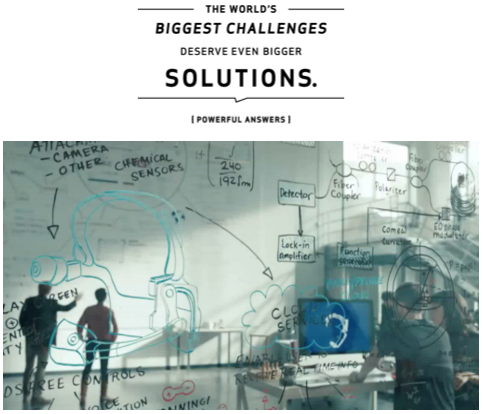
Kathy: “We need to work on reducing costs on factory delivery systems and improv[ing] patient outcomes. Think about what you have on your iPad or phone today. We believe we can, in a more systematic way, think of security and identity issues for patients, fast connections, and [the] ability for patients and doctors to talk to each other in a secure environment through our technology, etc. We call this Powerful Answers.”

Who’s Reading the Report?

Kathy: “Internally, the audience is our employees who can have sense of our values as a company. Externally, people want to do business with companies with a heart but also have the technology and wherewithal to solve their problems. Beyond individuals, this includes communities [and]  governments who take on big ideas about congestion, smarter cars, health care, etc. This report does a good job [of] painting the bigger picture for this audience.”Verizon_Powerful_Answers

Jim: “[The] hip market that will change the world [is] using our technology, and this report helps them see first-hand the choices they have. Sustainability at Verizon is driven by our employees and our communities, not just one executive.”

Supplier Responsibility:

Jim: “Over the last couple of years, we have queried our top 200 suppliers, which represent 80 percent of our total spend, to ask them how they manage their CO2 and greenhouse gas impact. What goes into the products they supply to Verizon? And we were very surprised at the answers we got back and tallied them up and graded them.”

“Whether they’re early adopters or much more mature with their sustainability strategies, we’ve set ourselves a 2015 goal: to operate with over 40 percent of our suppliers that have targets and greenhouse gas emission goals. That impact is significant, and we’ve already seen that through the innovation they’re bringing to us about how they can become more sustainable and continue working with us.”

Evaluating Success:

Kathy: “We get all sorts of consumer indicators of how we’re doing in our community. We know how they use our network, what they think of it, etc. Once we start asking consumers how we’re doing in terms of impact, the responses have been very good. But it has been a challenge to do that in a broad way across many segments.”

For more insights from Verizon, listen to the webcast.

Originally written for and published on CSRwire’s Commentary section Talkback on April 18, 2013.

Share this:

  • Tweet
  • Email a link to a friend (Opens in new window) Email
  • Share on Reddit (Opens in new window) Reddit
  • Print (Opens in new window) Print
Like Loading...

Access to Medicine, Transparency & Ethical Governance: GlaxoSmithKline’s 2012 CSR Report

09 Wednesday Jul 2014

Posted by Aman Singh in CSR, CSR reporting, CSRwire, ESG

≈ Leave a comment

Tags

avandia, carbon, clinical trials, community development, compliance, CSR, CSR report, CSR reporting, CSRwire, Disclosure & Transparency, Environment, ESG, Ethics, ethics, glaxosmithkline, governance, health care, paxil, Social Impact, Supply chain management, Sustainability, sustainability, Sustainability Report, transparency, vaccines, work culture


When a company is manufacturing critical need medicines and popular consumer products, how does it address increasing access to innovative products while managing its energy use?

On the launch of the GlaxoSmithKline’s 2012 Corporate Responsibility Report – a comprehensive read at 75 pages – I caught up with Director for Global Corporate Responsibility Clare Griffin for some updates.

Looking Ahead: GSK Switches Focus

For the first time the report, while focusing on the company’s 2012 performance, also includes a set of 23 forward-looking commitments across GSK’s business. The first thing that caught my eye in the report was the framework used to connect the firm’s vision with its business mission, assets, purpose and bottom line [see below]. How did the team use this chart to define CR’s focus at GSK?

“Lots of companies say they don’t have separate CR strategies; that they are completely embedded, etc. But how can you demonstrate that integration? This chart, for us, is a good way of explaining how CR is interwoven into our business. We have our business assets, our people, our priorities, our values, which leads us to create innovative products and drive access where people need it the most,” she explained.

“That’s the vision we want to create. We believe that if responsibility is absolutely integral to how we do business, we will deliver sustainable business growth for shareholders and benefits for our other stakeholders,” she added.

It’s all interrelated.

glaxosmithkline csr report

“For example, in the world’s poorest countries, our Developing Countries and Market Access (DCMA) operating unit has a clear objective to increase access to medicines and vaccines, while expanding our market presence and ensuring our business is sustainable for the long-term. This model is increasing our volume sales while increasing access to essential medicines and vaccines.”

Transparency, Pricing & Carbon: Challenges Ahead

“We will see through the implementation of our commitments on transparency of clinical trials data, continue with our commitments on pricing, and look to further harness manufacturing technologies to improve our carbon footprint,” writes GSK CEO Andrew Witty in the report.

Lots of promises in that one statement, I asked. How will these be implemented?

“We have a pretty diverse product line. Although pharmaceuticals are the majority, we also produce vaccines and consumer healthcare products. To improve our carbon emissions, we first invested in mapping our carbon footprint. For example, we found out that Amoxicillin, a very popular antibiotic, is Horlicksthe third-largest contributor to our carbon emissions due to the manufacturing process,” she said. “Our green chemistry team in Singapore has found a different way to produce Amoxicillin through using an enzyme instead which will cut carbon emissions from this process by 36,000 tonnes and reduce waste by 2,400 tonnes as well.”
Similarly with Horlicks, a popular malted milk drink: “We are working to further enhance an Indian government program aimed at modernizing milk production, and looking at introducing alternative energy generation, for example low-carbon biomass energy generation using waste wood to replace coal. Essentially, we are focusing on where we believe we can have the biggest impact,” she added.

Creating Access: Sharing Data From Clinical Trials

As for the transparency piece, while GSK has shared the summary results of all of its clinical trials – whether positive or negative – on a website accessible to all since 2004, the firm has committed to going further and now making anonymized patient-level data available to researchers.

“We’re setting up an independent panel which will review each request to make sure it is appropriate and will be using the data for valid scientific reasons. We also want the researchers to share their results back with the scientific community. We hope this initiative will be of value in developing and catalyzing a wider approach in the industry,” she explained.

Ethical Standards: Reinstating a Culture of Responsibility

Our discussion would not have been complete without taking into account, GSK’s rough tidings last year with the U.S. government. With the firm having to pay $3 billion to the U.S. government to settle allegations of unethical misconduct – failure to include information, etc. – in its sales and marketing practices around drugs Paxil and Avandia, several questions arose about the company’s corporate governance, accountability and sales practices – how do you move forward, I asked.

The company has taken significant steps to move beyond that, responded Griffin. “We have implemented a new incentive compensation system (Patient First) for our professional sales representatives who work directly with healthcare professionals in the U.S. The new system eliminates individual sales targets for these representatives as a basis for bonuses, and instead bases compensation primarily on sales competency, customer evaluations and the overall performance of their business unit,” she said.

glaxosmithkline csr report

The company has also brought together different Codes of Practices across regions and business units to create one Global Code and introduced standards that reinforce clear distinction between scientific dialogue and promotional activities. “These new standards govern the way we engage in scientific activities, such as advisory boards, publications, scientific congresses and medical education,” she said.

Other steps: A Corporate Ethics and Compliance Program for all employees, strengthened training programs, setting up an anti-bribery and corruption initiative and setting in motion disciplinary actions when needed.

“The 23 forward-looking commitments cut across the four areas of GSK’s responsibility: Health for all, Our behavior, Our People and Our Planet. It was important that we picked a time frame that is close enough that the current cadre of employees will be the people delivering the commitments while giving us enough time to create sustained change,” Griffin emphasized, alluding to the firm’s 2015 and 2020 goals.

Goals & Commitments: Highlights from 2012

So what were some of the year’s highlights for GSK?

  • The potential to bring around 15 new medicines and vaccines to patients over the next three years
  • 3.5 million pounds invested in R&D
  • 5 million pounds invested in the Tres Cantos Open Lab Foundation in Spain to fund research on solutions for diseases in the developed world
  • A concentrated focus on creating access, including monitoring the influential Access to Medicine Index, that measures what pharmaceuticals are doing to bring more medicines to more people [GSK won the top spot for the third time in 2012 although Griffin was quick to point out that “the index is a measure of what we’re doing, not the reason why we’re doing it.”]
  • A number of commitments around transparency established in 2012 including participating in the All-Trials Initiative, marking the next level of details on releasing results of GSK’s clinical trials.

What’s next?

“In 2013 we will continue to focus on innovation, access, and operating with transparency across the business. Specifically we will work to see through the implementation of our commitments on transparency of clinical trials data, continue with our commitments on pricing, and look to further harness manufacturing technologies to improve our carbon footprint,” finished Griffin.

Originally written for and published on CSRwire’s Commentary section Talkback onApril 16, 2013.

Share this:

  • Tweet
  • Email a link to a friend (Opens in new window) Email
  • Share on Reddit (Opens in new window) Reddit
  • Print (Opens in new window) Print
Like Loading...

SAP’s 1st Integrated Report: From Sustainability to Integrated Thinking

09 Wednesday Jul 2014

Posted by Aman Singh in CSR, CSR reporting, CSRwire

≈ Leave a comment

Tags

CSR, CSR report, CSR reporting, CSRwire, culture, Disclosure & Transparency, employee engagement, energy, ESG, ghg, governance, health, iirc, integrated reporting, leadership, paul druckman, retention, sap, Stakeholder Engagement, Supply chain management, Sustainability, Sustainability Report, transparency, voluntary disclosure


Using Integrated Reporting as a catalyst for integrated thinking.

That’s how Peter Graf, SAP’s Chief Sustainability Officer expressed the firm’s decision to replace two reports – the annual report mandated by the law and submitted to the SEC indicating the company’s financial performance and the sustainability report , voluntary in nature and showing its non-financial performance– by one Integrated Report for 2012.

While Integrated Reporting is a fairly new trend – The International Integrated Reporting Committee [IIRC] website hosts a total of 41 Integrated Reports since 2011 – it’s not surprising.

As the trend of CSR and sustainability reporting grows – due to multiple factors including a recessionary economy, dwindling resources, emerging conflicts in supply chains and a better connected world – logically, Integrated Reporting is the next step for any organization truly attempting to be as transparent as possible about its financial and non-financial challenges and performance.

Shift in Engagement: From Sustainability to Integrated

At SAP, the impetus for the shift was the realization that “we needed to engage within our organization on a different level” according to Graf. “We have been reporting on our sustainability performance since 2008. The report has grown in sophistication over the years and we even won several awards in the last two years for our report’s interactive nature, etc. So technically, we could have continued on that road,” he added.

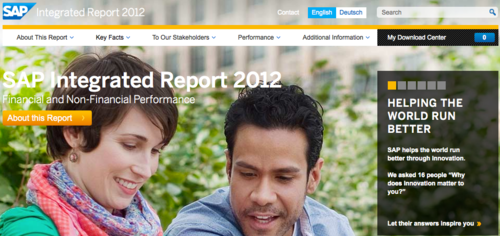
Last year, CSRwire collaborated with Graf and his team on a webinar to launch SAP’s new interactive report. Complete with social media buttons, comment sections and multimedia options, the report could be customized and perused in multiple ways depending on your agenda. The report was well received – and in a span of an hour SAP_Integrated_Reportwe received over 30 questions from a very engaged audience.  [Join us for a webinar with Peter Graf, IIRC CEO Paul Druckman and others today at 11am ET]

SAP set a trend last year, so why the shift again?


Connecting the Dots: The Bigger Picture

“We have been measuring key performance indicators [KPI] on the financial and non-financial side for quite a while. But one day, we started to put them all on a white board trying to draw connection lines between them. Before we knew it, the chart was pretty full. We started to do research both internally and externally , to better understand and compute those relationships. Suddenly it became clear, just how interconnected non-financial and financial performance indicators really are,” he explained.

“When I heard about Integrated Reporting for the first time, I got excited. But then I thought: It’s going to be a very long process to achieve the integrated thinking that must be portrayed in the report. I viewed the Integrated Report as an outcome. However, over time our team reached the conclusion that instead of waiting for the right engagement at SAP to happen, we should use the process of producing an integrated report as the forcing function to drive the necessary engagement,” Graf added.

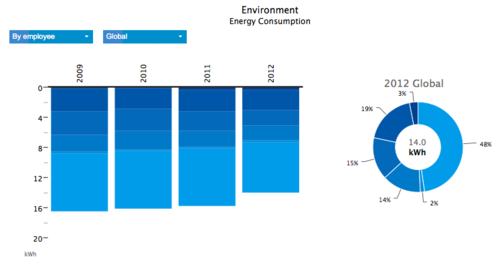
“In its integrated report, SAP lays out the interdependencies between financial and non-financial indicators,” said Graf. Proof points like: an increase or decrease of one percentage of SAP’s retention employee retention at SAPrate saves/costs the company 62 million euros. And since 2007, a peak year for energy consumption at the company, SAP has avoided 220 million euros ($285 million) through energy conservation efforts.
“When these kinds of relations appear between financial and non-financial indicators, they do more than make the business case for sustainability. They serve as the catalysts for an integrated corporate strategy.” said Graf.

While the entire report is available online, a parsed version – “we kept out customer stories but retained all other ESG data and metrics” – is submitted to the Securities & Exchange Commission.

SAP’s 2012 Performance: Key Highlights

So what will you find in the integrated Report this year?

For one, retention was up [94 percent in 2012] as was diversity, i.e., the number of women in management [an increase of one percent from 2011 to 19.4 percent].

The goal: to reach 25 percent by 2017.

Total energy consumed stayed stable at 2011 numbers while revenue increased by 17 percent and emissions per Euro in revenue and per employee were reduced for the sixth year in a row. Overall emissions were slightly reduced, in spite of the company  adding 9,000 new employees in 2012. Finally, the use of renewable energy increased from 47 percent in 2011 to 60 percent in 2012.

Also intriguing to me was a section, which detailed SAP’s People Strategy.

I asked Graf what the strategy involved – and how did they measure the outcomes besides retention and diversity?

“Having a sound strategy around people is essential in a company that solely relies on its employees to create value. Thus our ability to compete is highly dependent on our human resources and it’s impossible to separate that from our financial performance,” he said.

“First, we want to hire more diverse people. We believe more diverse groups innovate better. Second, we want to nurture our talent through clear development plans, challenging assignments, social media, e-learnings, etc. And finally, we want to leverage employee engagement as a decisive factor. So we measure retention and diversity but also engagement, which is a core and central KPI in driving our overall performance in the future,” Graf added.

Measuring Employee Engagement: Critical to Business Performance

So what contributed to a drop in employee engagement in 2006-2009?

“I believe there are various reasons that led to a decrease in engagement during that time. Most important, however, is how we made it back to the high engagement scores of today: When economic growth came back after the recession, the leadership of the company changed, a compelling innovation strategy for growth was established, the company was given the purpose of helping the  world run better to improve people’s lives and Energy_consumption_SAP_2012overall we enjoyed strong and continuous revenue growth as a result. So, a combination of issues got us into low engagement scores and a combination of things got us back on track.”

SAP also measures a Business Health Culture Index. Does that measure the company’s engagement quotient and connect it with business performance?

“We use this index to measure the health of our employees. There are four times as many stress-related illnesses in the intellectual property industry as compared to other industries. So we use data from eight questions [purpose, leadership, recognition, empowerment, rewards, stress levels, compared to people my age I feel more/less healthy] to understand where we stand and what we need to do to take care of our employees.”

In 2012, SAP’s Health Index stood at 66 percent, a one percent increase since 2011 and significant growth since 2008-2009.

Integrated Reporting: Check. What’s Next for SAP?

With all the data and metrics dancing around in my brain, the only question left to ask was, what’s next?

“On the one side, we recognize that integrated reporting is an early trend and that we certainly have to continue to improve and learn. On the other side, we have the ambition to lead, even if this means that we may make a mistake that followers might be able to avoid,” said Graf.

“The next steps clearly are to continue to move away from just having a sustainability strategy to making our corporate strategy more sustainable. This requires an engagement with leaders across SAP that we have not achieved before moving to integrated reporting,” he added.

His recommendations for companies who might be complacent with limited voluntary disclosure or perhaps hesitant to mix the voluntary with the mandatory?

“As soon as people recognize that  integrated reporting helps companies understand and grow the way how they create value at their core, , it will pick up. More and more people know this intuitively today but when someone connects all the financial and non-financial numbers with each other, then the big picture emerges,” he said.

SAP’s Integrated Report 2012 is available at www.SAPIntegratedReport.com.

Originally written for and published on CSRwire’s Commentary section Talkback on March 25, 2013.

Share this:

  • Tweet
  • Email a link to a friend (Opens in new window) Email
  • Share on Reddit (Opens in new window) Reddit
  • Print (Opens in new window) Print
Like Loading...

Earthwards 2.0: Johnson & Johnson Seeks to Evolve Sustainable Product Innovation

09 Wednesday Jul 2014

Posted by Aman Singh in CSRwire, ESG

≈ Leave a comment

Tags

andrew winston, Brand Management, CSR, CSRwire, earthwards, environment, Environment, ESG, health care, healthcare, hunter lovins, Innovation, lifecycle analysis, marks and spencer, Sustainability, sustainability, sustainability strategy, unilever, waste


In recent posts, I explored the genesis of Johnson & Johnson’s proprietary Earthwards® process and how it has been used to help develop greener products to meet customer needs. For Johnson & Johnson, the process of instilling a sustainability mindset began with introspection and questioning: How does an organization with multiple product lines and a global workforce develop and define greener products? And the process began with a tool called GAIA, or Global Aquatic Ingredient Assessment.

In the beginning, GAIA was operating almost exclusively with R&D because it was a science-based tool with specific emphasis on measuring downstream ecosystem impacts.  Implementation of the Earthwards process accelerated broader adoption and has helped spur greener product innovation based on lifecycle thinking that is, in part, quantified by tools like GAIA. But Earthwards, despite its rigor and initial success, is still in its infancy.

In 2012, Senior Director for Worldwide Environment Health and Safety Al Iannuzzi enlisted a team of experts that volunteered to examine the Earthwards process and recommend areas for improvement. What’s next? I explore the future of the program through the eyes of two well-respected sustainability experts who recently weighed in as part of that expert team: Andrew Winston and L. Hunter Lovins.

_____________________________

By now, you’ve probably caught a glimpse of that new inspiring Honda Civic 2013 commercial, framing innovation as believing that ‘things can always be better.’  For Winston, making things better begins by asking questions. “As we pursue sustainability in the future, asking the right questions will be as important as the answers we get,” he said.

For the people at Johnson & Johnson, the concept of continuous improvement is a driving force. So it makes sense that their efforts to evolve the current Earthwards methodology into a better process  began with some Earthwardshonest introspection and engagement with a few external experts, including Winston and Lovins.

In a recent phone call with Winston, I asked him his impressions of the Earthwards process.

He believes that the Earthwards process is a solid program with appropriate categories and logical steps that “empowers product developers with information and helps them understand the choices. It’s a well-designed system, but does have its pros and cons.”

I asked him to elaborate.

“They have the right categories, seven in all, but the concern is that a product could be improving in three distinct areas, but these may not be the most important areas to focus on in order to address the products’ greatest material impacts.  There’s a fine line between simplicity and enabling efficient assessments.”

Of course there are trade-offs. But the biggest challenge internally is giving employees the time and information they need to become comfortable with the Earthwards process and appreciate the impacts of improvements across the lifecycle.

“It is a fair point,” said Iannuzzi. “Our Review Board, including three external experts, also helps to keep the process objective, making sure that the brands focus their improvements on meaningful areas. To make this even more robust, we will require each application to address the lifecycle screen hot spot areas identified in step two of the Earthwards process, the lifecycle screen.”

Sufficiently Ambitious or Room for Improvement?

There is broad agreement among the experts that Johnson & Johnson has a long history of – and
interest in – environmental protection and sustainability. “The company has cared about its impact on the environment and on people, and taken a position of responsibility,” Lovins noted.

While both Lovins and Winston said that the Earthwards  process is one of the most comprehensive sustainable product tools in the industry, and in Lovins’ view, “a strong and rigorous process.” She also feels there is opportunity for the company to become even more aggressive in making this a companywide initiative.

“They need to examine the inadequacies of the Earthwards process, align it with tougher science-based goals and then make a commitment to hold every product to those goals.”

Winston had similar sentiments, specifically around the 10 percent benchmark Johnson & Johnson has set for improvements against Earthwards’ sustainability criteria. “The problem with a goal like 10 percent is that it’s kind of an internal-looking, corporate improvement. These goals at the product level need to be shooting for more dramatic increases.”

Some of J&J’s leading products are doing more than the required 10 percent anyway, so why stop there?

According to Iannuzzi, Johnson & Johnson sees the potential to raise the bar, perhaps substantially on some dimensions, but also recognizes the need to balance meaningful improvements within the original intent of Earthwards.

“J&J is always up for a challenge, but we want to make sure we don’t raise the bar so high that it becomes detrimental to Earthwards’ intended purpose of widespread adoption,” said Iannuzzi. “If we make the bar so high that almost no product can get there, no one would pursue it.”

 New Blueprint Needed?

According to a recent study commissioned by Johnson & Johnson titled The Growing Importance of Sustainable Products in the Global Health Care Industry, 54 percent of health care organizations globally say green attributes are very important in their purchasing decisions of health care products medical wasteand supplies. And this trend appears to be gaining traction, as 40 percent of global hospitals expect their future request for proposals to include sustainability criteria for the products they purchase. Among the greatest concerns hospitals share are the amount of energy they use and the volume of waste they generate.

With data like these indicating that the strongest push for sustainability is coming from within the healthcare sector, how will this influence the evolution of the Earthwards process?

To get at the heart of this question, Winston suggests that Johnson & Johnson ask itself whether doing better than 95 percent of its competitors is good enough.

In fact, Winston said Johnson & Johnson should go further than others and has challenged the company to raise the requirements for Earthwards recognition. For example, the baseline could be higher than the current 10 percent improvement needed to achieve recognition in the different categories, especially in the energy efficiency category, in light of the general scientific consensus that greenhouse gas emissions need to be reduced by 85 percent by 2050.

Iannuzzi responded: “We plan to better understand the greenhouse gas emissions impacts of the improvements we make this year with the Earthwards process and consider ways to further encourage them in our products.”

Lovins suggests the company be more transparent with customers about where it is in the process of sustainable product development and where it is going. Iannuzzi’s team is already responding by sharing more content on www.earthwards.com including more information about the 36 products that have received recognition so far and other external-facing efforts like a six-part series with CSRwire.

Internal Certification Process, Not a Sustainability Strategy

Coleman Bigelow, Johnson & Johnson Global Sustainability Marketing Director, sees the Earthwards program as an internal product stewardship and green marketing process rather than a long-term sustainability strategy like that of Marks & Spencer’s Plan A or Unilever’s Sustainable Living Plan.

The Earthwards process ensures “every product we produce has undergone a lifecycle screening and is as sustainable as possible. For the first time, we have a process that offers something to the developers, the R&D folks, as well as the marketers and sales associates,” Bigelow explained.

Iannuzzi, a Johnson & Johnson veteran of 28 years who has spearheaded the Earthwards program internally from the start and is a popular sustainability champion among the team, doesn’t foresee the company taking an approach akin to GE’s Ecomagination with a separate structure, either.

“Our philosophy is to embed sustainability into every product, not create something special or separate,” Iannuzzi explained. That said, the company does plan to track how much of its revenue stems from Earthwards recognized products. So while it is not its own revenue generating business unit, per se, it certainly could prove to save the company money over the long haul as well as drive innovation internally.

When I asked Iannuzzi about Earthwards’ ten-year plan, he reflected.

“Ideally, I envision it as a way of showing customers how we are coming up with more innovative products using sustainability as the driver. This means moving Earthwards process away from being an add-on and moving it toward full integration.  External communication will also be key.”

“But right now, it’s not as well integrated as we would like,” Iannuzzi admits.

Regardless, Winston seems convinced that Johnson & Johnson’s efforts have been both aggressive and innovative as a whole. The next tricky move for the company, say the experts, is to be mindful of how quickly the Earthwards program grows in scope without losing sight of the program’s quality.

As the team at Johnson & Johnson prepares for Earthwards round two, the experts’ advice should help the healthcare company scale its journey from green to greener without losing sight of the ultimate goal: A sustainable planet for future generations.

For now, it’s back to the white boards.

About Andrew Winston and L. Hunter Lovins

A globally recognized expert in green business strategies, Winston is the author of Green Recovery and co-author of Green to Gold, the international best-selling guide to what works – and what doesn’t – when companies go green. Winston is also founder of Winston Eco-Strategies, a sustainability consultancy dedicated to helping companies use environmental strategy to grow, create enduring value, and build stronger relationships with their stakeholders. He writes extensively on green business strategy, including a weekly column for Harvard Business Online and guest byline articles on Huffington Post.

Lovins is an award-winning sustainability consultant, featured speaker at conferences across the globe and author of Natural Capitalism: Creating the Next Industrial Revolution. Lovins is also president and founder of Natural Capitalism Solutions (NCS), which creates innovative, practical tools and strategies to enable companies, communities and countries to become more sustainable. Lovins is also a professor of sustainable business management at Bard College and Denver University, and consults for large and small companies, and governmental clients.

Originally written for and published on CSRwire’s Commentary section Talkback on March 13, 2013.

Share this:

  • Tweet
  • Email a link to a friend (Opens in new window) Email
  • Share on Reddit (Opens in new window) Reddit
  • Print (Opens in new window) Print
Like Loading...

Earthwards: A Front Row Seat to Sustainability in Action at Johnson & Johnson

09 Wednesday Jul 2014

Posted by Aman Singh in ESG

≈ Leave a comment

Tags

Bill McDonough, biomimicry, Brand Management, clean technology, coleman bigelow, consumer products, cradle to cradle, earthwards, environment, Environment, ESG, green, Innovation, johnson and johnson, keith sutter, organizational development, product design, Supply chain management, sustainability, Work culture, zero waste, zytiga


While hosting a panel last year on responsible business, a discussion ensued on the need for creating change and influencing millions to shift their habits. I was intrigued by a question from the audience:

“Would companies ever be receptive to the idea of ‘embedding journalists’ in their organizations to test the theory of transparency and therefore influence change?”

While many companies might bristle at this idea, it’s something I’ve thought about a lot. I wondered which company would be the first to invite a journalist inside for a closer look at how its commitment to responsible and sustainable business is put into practice. To my surprise, I didn’t have to wait too long before Johnson & Johnson reached out to me with an invitation. They wanted to discuss the possibility of going inside the organization to conduct an objective review of its sustainable product development process, aptly titled Earthwards®. As Keith Sutter, Senior Product Director of Sustainable Brand Marketing at Johnson & Johnson explained, the Earthwards process was developed as an internal tool in 2009 to assess the environmental impacts of various products and help drive improvements around specific sustainability criteria. The invitation meant I would get an unvarnished view inside a company that has traditionally shied away from the publicity spotlight. So I dived in.

Diving In: The Challenges of Meeting Sustainability Goals

My first exposure to the inner workings at Johnson & Johnson was a recent Earthwards quarterly board meeting. “Early on some of our external reviewers advised us to establish an Earthwards board of directors and appoint people from our legal, marketing and R&D groups, along with several subject matter  experts from the Earthwardsoutside,” explained Coleman Bigelow, a board member and Global Sustainability Marketing Director in the Consumer division at Johnson & Johnson. “Assembling a diverse group of stakeholders has been an important piece of the puzzle.” As the presentations started, I realized how challenging it could be to change the design, ingredients and packaging of existing products, built on years and years of research and testing. And for a healthcare company, its products must also meet the highest standards for consumer safety, patient usability and efficacy. So, layering on sustainability considerations to the product development process added even more complexity.

Diving Deeper: How High Should We Set the Bar?

One product reviewed by the board that day was Zytiga®, a drug made by Janssen (the pharmaceuticals group within Johnson & Johnson), used in the treatment of metastatic castration resistant prostate cancer. Through a recent acquisition, Janssen had received the rights to manufacture and distribute Zytiga and the team saw an opportunity to improve the way the active pharmaceutical ingredient (API) was produced to decrease its environmental impact and use the Earthwards process to guide the improvements. Zytiga After the chief scientist for Zytiga walked the group through a formal presentation, the questions began. Now picture a room full of people representing different disciplines across the company – from Product Development to Environment, Health and Safety – and several from outside. The range of questions was broad and impressive: Was the product in competition with another product? Why change the process that was previously used to make the API? Does the product have FDA approval yet? How does making the proposed changes to the design and production of the drug make it safer for the environment? What about the impact on plant workers? And does this change the packaging? More importantly, the group wanted to understand what innovations had led to the proposed changes for Zytiga, and whether these changes could be replicated for other products within the company’s portfolio. Following the Zytiga presentation and discussion, the board took up the next item on its agenda: Should the company move ahead with adding its internally developed Global Aquatic Ingredient Assessment [GAIA] to the Earthwards’ framework? This would allow products in the consumer sector – think Aveeno, for example – to receive one point for their improved GAIA score in the Materials  category of the Earthwards criteria. The company developed GAIA to evaluate the impact its product ingredients have on water, and determine if a potential for toxicity, persistence and bioaccumulation exists. Now the group questioned whether adding GAIA as an additional layer to the pre-qualifiers for Earthwards would raise the bar for other products competing forNatusan_shampoo the recognition. As with Zytiga, the questions were far-ranging and complex: Does GAIA only consider the environmental impact of product ingredients, or does the assessment also consider the impact of these ingredients on human health? How do we weigh the toxicity? How does the consumer sector look at human health? With suppliers changing, how do we streamline the process? Does this then become a “hazard assessment rather than a risk assessment?” One example the board used to flesh out the pros and cons of GAIA was Natusan shampoo, which recently earned Earthwards recognition after overcoming a significant hurdle: Scientists had to figure out how to reduce the number of ingredients from 13 to eight to be eligible for recognition. The team explained that while the 13 ingredients used in the initial product were thoroughly reviewed for toxicology to insure that the finished product was safe for human use, the GAIA tool focuses on reducing ecosystem impacts. The board questioned whether the bar set by GAIA would be too high for some products. “We’re pushing for continual improvement while watching for signs of backsliding, and so far 60 percent of our products have continued to make further improvements,” was one sentiment. Another was, “We need to set the bar high but not so high that it discourages product developers from going for it.” Another board member – this time an external reviewer – commented that the allowable limits of “red” ingredients (those that Johnson & Johnson tries to avoid, where possible, due to environmental impacts) seemed reasonable, but cautioned that it might not be reasonable to others.

Complexities Arise: Is Zero the Right Sustainability Target?

As the day wrapped up one thought stuck with me: how high should the bar be when it comes to meeting the sustainability criteria of the Earthwards process? Context is of course key in these discussions. For some products and their ingredients, it’s a fine line between raising the bar and raising it too high.  And since most of these products have been tested and retested for years for their impacts, toxicity and formulations, room for improvement is limited and, in some cases, tough to achieve. So how high should the bar be set? That’s the chicken or the egg question for companies today, isn’t it? While Bill McDonough, co-author of Cradle-to-Cradle and chief architect of this concept, promotes zero as the target – as in zero waste or zero negative impact – the reality is that everything we consume is made up of materials that we get from our environment, and therefore has an impact. The question is whether we can replenish the resources as quickly as we take them. And if not, how do we find alternatives? For believers of biomimicry, the answers may lie with nature. And how can a program like Earthwards, which the Johnson & Johnson team insists is not a certification or eco-label – indeed no product carries any indication of its Earthwards recognition on its label – help to push the bar consistently higher while acting as a purposeful motivator for the R&D team, the scientists, the product developers and the marketers, toward more sustainable products?

A Front Row Seat

For someone who doesn’t quite understand chemical equations and bioaccumulation, but does understand cancer, deforestation and the quest for sustainability, the board meeting was a revelation and a front row seat to an often-guarded corporate zone. For a company that earmarks a significant portion of its revenue to R&D, it is encouraging to see the commitment to sustainable product development in action. The board meeting ended on a high note. Zytiga was approved by the Earthwards board for recognition. There was excitement in the air and a belief that Earthwards is moving the company in the right direction. And the coffee pots were empty. All in a day’s work. Originally written for and published on CSRwire’s Commentary section Talkback on February 13, 2013 as part of a series about EARTHWARDS®, a Johnson & Johnson program designed to promote greener product development throughout the enterprise.

Share this:

  • Tweet
  • Email a link to a friend (Opens in new window) Email
  • Share on Reddit (Opens in new window) Reddit
  • Print (Opens in new window) Print
Like Loading...

IKEA’s Sustainability Strategy: Save the World, One Product At a Time

09 Wednesday Jul 2014

Posted by Aman Singh in CSR, CSRwire

≈ Leave a comment

Tags

CEO Network, Chief sustainability officer, CSR, CSR report, CSRwire, energy efficiency, environment, Environment, ESG, ikea, led, lifecycle, product development, steve howard, Supply chain management, Sustainability, sustainability, waste, wind farms


  • 154,000 workers.
  • 47 percent of all managers are women [compared to 17 percent of the American Fortune 500’s board seats or the female representation at the recently concluded World Economic Forum].
  • 338 stores worldwide.
  • 8 percent comparable store sales growth in FY2012.
  • A third of total energy consumption met through renewable energy.

Is IKEA‘s newly minted sustainability strategy working? Titled People & Planet Positive, the strategy was borne out of the retailer’s business mission: to create a better everyday life for the many people. The 2012 report marks the first update for the superstore whose goals start from the obvious – a fourfold increase in sales by 2020 – and go on to include the other two pillars of sustainability – engagement of customers, employees and suppliers, energy dependence, as well as community development.

In typical European fashion – understated with an emphasis on data – the release headline read: The IKEA Group is Growing and Financially Strong. Mind you, the release announces the retailer’s 2012 Sustainability report, not the latest quarterly report on financials. What better way to position sustainability?

I spoke to Chief Sustainability Officer Steve Howard briefly on the cusp of the report’s release. Excerpts:

Aman Singh: What are some of the key highlights of the 2012 Sustainability Report that you would want every CSRwire reader to know?

Steve Howard: We’ve divided the report into two parts. First is the forward-looking piece, which talks about our new sustainability strategy and lays out our 2020 goals. Implementing these goals has  meant a huge amount of work and unleashed an incredible amount of enthusiasm across the workforce. IKEA_2012_Sustainability_Report_Updates

The second piece deals with our impact. In terms of our operations, extending our work on energy has been significant. We completed installing 50,000 solar panels across our business locations by the end of FY 12. Last year, we committed to invest $2 billion in renewable energy by 2015. We’re already committed $500 million of that.

IKEA now owns wind farms in six countries. Thirty-four percent of our energy came from renewable sources last year. We’ve committed to reach 100 percent by 2020. Not bad for a furnishing company.

In our supply chain, we committed to reaching 100 percent compliance with our suppliers. We have 80 auditors working on this goal as well as independent team validating the work of our auditors. [Once we rolled this out] some suppliers agreed to collaborate while others decided not to. So we parted ways with as many as 60 suppliers. That has real business consequences – for us as well as the suppliers.

This goal has been a real test for us on how serious we are with our promises and commitments. Because our strategy is embedded and understood across divisions, our decision to part ways with 60 suppliers was not received with any criticism. We’ve also worked with our supply chain partners on funding projects and have reached more than 100,000 farmers on improving farm conditions, water conservation, etc.

Again, our goal is to reach every single one of our farmers by the end of 2015.

One of IKEA’s goals is to have at least 95 percent of coworkers, 95 percent of suppliers and 70 percent of consumers view IKEA as a company that takes social and environmental responsibility seriously. How’s that going?

Most of our suppliers, customers and coworkers are in the “I don’t know” category. They judge us and have opinions about IKEA but don’t know what we do on sustainability. What we also know is that people care. Once we communicate the urgency, they do care about things like climate change, the  future of their children, etc.

VIDJA_lamp_IKEAMoving forward, we will strengthen our customer communications. For example, last year we replaced the doors of one of our frame cupboards with honeycomb fiber, which is as strong as solid chipboard but uses 40 percent less material. Cupboards need strong doors, not heavy doors. And this reduces the cost to produce the cupboard, therefore, reducing the price for our customers, which makes it a better customer proposition.

Similarly, the VIDJA lamp was redesigned last year to take out unnecessary components [as many as 24 of the 33 original components were removed] and replaced with LED lights, resulting in half the weight and the same performance.  Additionally, we can now load 128 VIDJA lamps on a pallet vs. 80 previously, which means we can ship more at once, reducing our fuel usage and shipping costs.

Just like that, every IKEA product has a story. That’s the direction for our business. Soon everything will be traceable back to source but it’s a lot of hard work and we are starting to talk about these stories. But it will take us some time to get the communication across to our customers globally.

That’s emblematic of a true lifecycle approach. With thousands of products and a growing footprint internationally [IKEA is in China and will soon debut its first store in India] there must be some challenges in balancing sustainability goals and growing scale?

While having a mission and being a values-led business helps, it all comes down to a significant execution and implementation effort. Our people are motivated to lower prices and find sustainable solutions. I use three numbers to talk about sustainability within IKEA:

  • 1.5 planets: needed to provide resources for today’s population
  • 3 billion: extra consumers expected to overcome poverty across emerging markets by 2030
  • 6degrees centigrade warming: A catastrophe.

Integrating_sustainability_into_product_development_IKEAThese numbers are real. And hit hard. We’re over-consuming against the urgency of climate change.  This hits the heart of business: we are either sustainable or bust. We have to do whatever is needed. And we know that.

We can help our customers save energy by switching over to LED lights. We’re essentially banning non-LEDs by committing to sell and use only LED lights in our products. We can help people save water in a meaningful way by using energy-saving equipment. Simple things like LEDs, for example, can reduce our customers’ expenses by 30 percent. That’s equal to a 10 percent pay raise!

This is our opportunity…and it’s highly motivating.

How does reporting on these metrics help? Whose reading the report?

We just want to be transparent. We’re not expecting IKEA customers or coworkers to rush to read our sustainability report. It is meant for a specialist audience that believes in the phrase, you can only manage what you can measure.

Businesses – and management teams – like to have clear targets so that they can report against them [and benchmark, analyze and improve performance]. So why not use the same logic for sustainability?

Originally written for and published on CSRwire’s Commentary section Talkback on January  21, 2013.

Share this:

  • Tweet
  • Email a link to a friend (Opens in new window) Email
  • Share on Reddit (Opens in new window) Reddit
  • Print (Opens in new window) Print
Like Loading...
← Older posts
Newer posts →

Let's Talk!

Virtual
732-322-7797
amansinghdas@gmail.com

Blogs I Follow

  • Nonprofit Chronicles
  • Learned On by Andrea Learned
  • Angry African on the Loose™
  • csr-reporting
  • The CSR Blog
  • In Good Company: Singh on CSR

My Cloud

Capitalism 2.0 CSR CSR reporting CSRwire ESG Guest Author HR Stakeholder Engagement Sustainability Uncategorized

Recently written…

  • Rationality is Ruining Us: Mayors, presidents and governors join major businesses in charting way forward on climate change
  • 2015: the year businesses recognize that climate change is real – and 4 other themes
  • Hardcore lessons of sustainability – ’10 Words or Less’
  • Brewing a Better Future [#BaBF] with Heineken: Examining the Many Flavors of Local Sourcing
  • From Conflict to Collaboration: Kimberly-Clark and Greenpeace Participate in LIVE Twitter Chat

What others are reading

aman singh aman singh das Brand Management Business corporate social responsibility CSR CSR reporting CSRwire ESG Leadership Stakeholder Engagement supply chain Sustainability sustainability Work culture

Categories

Most Read

  • None

Create a free website or blog at WordPress.com.

Nonprofit Chronicles

Journalism about foundations, nonprofits and their impact

Learned On by Andrea Learned

Angry African on the Loose™

I have opinions. I am from Africa. I live here now. I blog.

csr-reporting

Connecting the dots between Business, Society & the Environment

The CSR Blog

Connecting the dots between Business, Society & the Environment

In Good Company: Singh on CSR

Connecting the dots between Business, Society & the Environment

Privacy & Cookies: This site uses cookies. By continuing to use this website, you agree to their use.
To find out more, including how to control cookies, see here: Cookie Policy
  • Subscribe Subscribed
    • In Good Company: Singh on CSR
    • Join 119 other subscribers
    • Already have a WordPress.com account? Log in now.
    • In Good Company: Singh on CSR
    • Subscribe Subscribed
    • Sign up
    • Log in
    • Report this content
    • View site in Reader
    • Manage subscriptions
    • Collapse this bar
 

Loading Comments...
 

    %d