• ABOUT THE AUTHOR
  • Sustainability
  • CSR
  • CSR reporting

In Good Company: Singh on CSR

~ Connecting the dots between Business, Society & the Environment

Tag Archives: CSR

Social Responsibility, Beer & Aliens: Journey to Becoming the Best Beer Company in a Better World

07 Monday Jul 2014

Posted by Aman Singh in CSR, CSRwire

≈ 1 Comment

Tags

ab inbev, Anheuser Busch, Brand Management, Business, carlos brio, carol clark, community, community development, CSR, CSR report, CSRwire, environment, ESG, executive compensation, Social Impact, Social Responsibility, Stakeholder Engagement, supply chain, Sustainability, sustainability, water conservation


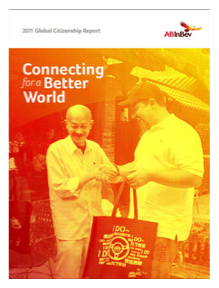
I caught up with Carol Clark, Global VP for Beer and Better World, to drill deeper into Anheuser-Busch InBev’s latest CSR report. Key highlights:

The report is titled Connecting for a Better World. AB InBev makes beer. What’s the connection?

At AB InBev, our dream is to be the Best Beer Company in a Better World. We believe that taking consistent, active measures in our core areas of social responsibility means constantly connecting our business with our stakeholders, especially in the communities where we live and work.

It takes a team effort to address these issues. Through our work to promote responsible drinking, reduce our impact on the environment and support our communities, we work with others who share our collective goal of making a difference.

There’s a quote in the report from Carlos Brito saying “We’re not aliens.” Can you offer some context?

Carol_Clark_AB_InBevWhen Carlos Brito said, “We are not aliens …” he was responding to a question at the Business for Social Responsibility Conference last fall about why AB InBev actively promotes responsible drinking.

AB InBev today has over 116,000 employees operating globally. We live on this planet and share the same concerns as our friends and neighbors. Many of us are parents and understand how important it is to talk with our children to help prevent underage drinking.

Similarly, we don’t want to be on the road with drunk drivers, and we’re committed to supporting prevention efforts such as encouraging the use of designated drivers. We’re committed to addressing these issues not only from a business perspective, but also from a personal perspective.

What is the ROI in producing a comprehensive CSR report such as this one? Media mentions? Retention? Rankings? Anheuser-Busch_CSR_Report
Publishing our CSR report keeps us focused and accountable to our stakeholders and ourselves. The scrutiny that this annual process brings gives us an updated perspective to help us further drive our performance, engage our employees and very importantly, thank them for their great work over the past year.

From an external perspective, we’re satisfying the requests from varied stakeholders for transparency on our social responsibility efforts.

The report is over 80 pages. Who is your primary target audience? And, who would you want to target?

We have a lot of good things to talk about! We use the report to share our progress with diverse audiences – from community stakeholders to investors, to media, to government officials – around the world.

Alex Prud’homme author of The Ripple Effect recently said that “Water is the headlining story of our century.” Are you focusing on sustaining your business by reducing water use, R&D on water replenishment or identifying alternative products altogether?

Water is our primary environmental focus and we aim to reach a water usage rate of 3.5 hectoliters of water for each hectoliter of production by the end of 2012.

We tackle the issue of responsible water use by doing more to conserve both in our operations and in the communities where our breweries are located. Progress requires operational changes and continually applying the most updated technical innovations. It means going further with supply chain and community partners to help conserve water outside our walls. But it also requires reinforcing a mindset that doesn’t take water for granted.

[Anheuser-Busch InBev’s 2011 Global Citizenship Report]

It can be argued that 8.2% reduction in water usage since 2010 is not a lot. Primary challenges in reaching double-digit reduction?

Actually, if you look at the beverage industry, this is a significant achievement. And it’s important to keep in mind that we’ve focused on water and energy efficiency for some time now, so there is very strong year-on-year progress. And we’re also making these reductions while continuing to grow our business. That means that each year, our brewing operations teams find innovative ways to do more with less when it comes to water.

To date, we’ve achieved an average water use of 3.71 hectoliters per hectoliter of production across our global business, which represents a 13.7% reduction against our 2009 baseline.

Our target, which we’ve stated publicly, is to reach 3.5 hectoliters of water per hectoliter of production by end-2012, which will put us on the leading edge of water usage for the brewing industry.

Your report mentions the billions paid in wages and income taxes. Not a lot of reports make these metrics a part of their community development results. Why the emphasis on wages? 

As the leading global brewer, we have operations in 23 countries. We have a significant economic impact on the local communities where we do business through the jobs we create, the wages we pay and the taxes we pay governments at all levels. We feel that it’s important to report on and recognize the value and impact we are bringing to communities where we live and work.

Can you talk to the “ownership culture” of the company?

One of our 10 AB InBev Principles is about ownership: “We are a company of owners. Owners take results personally.”

[Sustainable Beer: Anheuser-Busch InBev’s 2012 Environmental Goals]

We strive to create a culture that encourages responsibility and accountability, and that applies to our work on social responsibility as well. Creating this culture of ownership helps us build those connections and team approach, both internally and externally, to helping make a difference in our communities as we strive to be the Best Beer Company in a Better World.

Originally written for and published on CSRwire’s Commentary sectionTalkback on April 26, 2012.
Share this:

  • Tweet
  • Email a link to a friend (Opens in new window) Email
  • Share on Reddit (Opens in new window) Reddit
  • Print (Opens in new window) Print
Like Loading...

Weaving Ethics & Accountability into Free Enterprise: Leadership in Crisis

03 Thursday Jul 2014

Posted by Aman Singh in Capitalism 2.0, CSRwire

≈ Leave a comment

Tags

b lab, bcccc, Brand Management, Business Ethics, Capitalism 2.0, caux roundtable, common cause, corporate governance, Corporate Governance, CSR, CSRwire, Events, fiduciary responsibility, georgetown university, hershey, james nevels, Leadership, leadership, lucy marcus, Management, Sustainability, sustainability


“An entrepreneur is the engine of change. The dilemma: The glue that connects entrepreneurs, capital and the legal system.”

The real problem with companies today?

“A lack of purpose, intent and transparency.”

That’s how Erik Trojian, director of policy for nonprofit B Lab, opened his presentation at the recent seminar held jointly by Georgetown University, the Caux Round Table and the Sustainable Business Network of Washington (SBNOW).

The theme of the two-day seminar was weighty: Ethics, Leadership and Sustainability – to explore how the capitalist spirit of free enterprise and social entrepreneurship can help transform economic systems and promote social justice, basic rights, and human freedom around the world.

Common among the presentations of the day was a repeated emphasis on corporate governance, beginning with Trojian.

Modern Capitalism & Benefit Corporations

Trojian and his team are on a mission: To get all 50 states of the United States of America to sign the benefit corporation legislation into law. So far, they have succeeded in seven states.

He explained their goal:

“Modern capitalism began at a particular point of time in a certain type of culture. Somewhere in the 1960s, values began to shift and outcomes began to change. We want corporations to have an alternative form of operation that predicates protecting a business’ social and environmental communities.”

After a powerful presentation on the what, how and why(s) of the benefit corporation – a subject that has been covered quite comprehensively by CSRwire in recent weeks – Roderick M. Hills, Sr., former chair of the SEC and cofounder and chair of the Hills Program on Governance at the Center for Strategic and International Studies took the podium.

“Fixing” Bad Corporate Governance

“The Securities Exchange Commission [SEC] was set up to have more finite control of corporations’ governance. Auditors were expected to act on all suspicions. We convinced the New York Stock Exchange to address disclosure and transparency,” he started.

The next antidote according to Hill: The Foreign Corrupt Practices Act.

“The Act’s real problem was its uncertainty. They don’t want to deal with figuring out what is a crime and what isn’t resulting in people doing whatever they want to do. Plus the Act was not valid outside the geographic boundaries of the U.S. The rest of the world has no incentive to use this,” he said.

Aligning Board Service with Governance: A Conversation with Lucy Marcus

What’s really wrong with most corporation’ boards set up and governance standards according to him? His concerns were multifold so I turned to Lucy Marcus, renowned corporate governance expert, CEO of Marcus Consulting Ventures and Reuters columnist for some answers:

1. Too Much Agreement in the Boardroom

“There are too many directors today who would rather quit than disagree.”

Lucy: Asking the hard questions in the board room is essential, and also being willing to be persistent in the pursuit of the best outcome for the company and stakeholders is essential. Those are the kind of independent directors we want in the boardroom.

Anyone who is not willing to operate in this new reality doesn’t belong in the boardroom, and as we develop & educate new directors they need to know that this is what shall be expected of them.

2. The Fiduciary Responsibility of Directors

“There is a paradox in the country. Independent director doesn’t equal independence today. Every director has a preset job description regardless of who he represents/brings to the board.”

As directors it is vital that we understand going into the post what our job is inside and outside of the boardroom, what skills and knowledge we bring to the table, and also that we also operate beyond those strict skills we bring to also be able to synthesize data quickly and to make decisions in a well-informed and responsible manner.

3. Mandatory Retirement

“The mandatory rotational retirement is a terrible idea. There is no auditory protocol built-in and it gives directors too short a time to compel change, set standards, make a difference.”

I believe strongly in term limits. Best practice, as set out in the U.K., is several terms that add up to 9 years, and I think this is correct.

There is no way that someone can maintain their independence for much longer than that, and if the board room is to remain a place for dynamic discussion, it is incumbent upon boards to continually refresh themselves so that the people around the table bring a balance of continuity and change and the company is able to keep its finger on the pulse of changing agenda items, be it corporate social responsibility, technology, or anything else that is relevant to continued strength, growth and wellbeing of the organization.

If Capitalism Isn’t Bad, Are Capitalists?

Despite the somber notes, Bob Edgar, president and CEO of Common Cause, perhaps encapsulated the day – and our present crises – most succinctly with one question:

“Is it appropriate for [a form of] capitalism to exist that leads to unemployment, slavery and excess profits above all else?”

Readers: It’s your turn to participate in this dialogue and become the change makers you seek from our leaders. How are you solving ethical dilemmas between personal values and professional responsibilities?

As Chairman of the Hershey Company James Nevels put it recently at the BCCCC conference, “CSR above all begins and ends with personal responsibility.”

How do you define personal responsibility – and extend that to corporate responsibility?

Originally written for and published on CSRwire’s Commentary sectionTalkback on April 4, 2012.

Share this:

  • Tweet
  • Email a link to a friend (Opens in new window) Email
  • Share on Reddit (Opens in new window) Reddit
  • Print (Opens in new window) Print
Like Loading...

Conflict Minerals & Supply Chain Responsibility: Spotlight on the EICC

03 Thursday Jul 2014

Posted by Aman Singh in CSRwire

≈ Leave a comment

Tags

aman singh, conflict minerals, corporate social responsibility, CSR, CSRwire, dodd frank, eicc, Environment, Events, Global e-Sustainability Initiative, ibm, supply chain audit, supply chain management, Supply chain management, Sustainability, sustainability


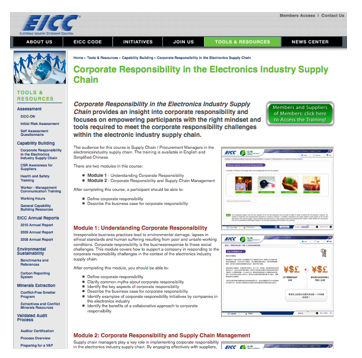
The Electronics Industry Citizenship Coalition (EICC) was formed in 2004 and incorporated in 2007 as a nonprofit industry trade group focused on the electronics sector. The aim: To help drive the industry collaboratively toward higher levels of socially responsible business practices.

It does so with a code of conduct and intensive means for implementation of the Code.  With over 65 members, the Coalition’s mission is simply stated: to “improve efficiency and social, ethical, and environmental responsibility in the global supply chain.”

Conflict Minerals & Supply Chain Responsibility

Recent U.S. laws and continued pressure from activists has pushed companies to focus on not only how they source their materials but also what they are doing to educate, empower and sustain their suppliers. For the electronics industry, this has become a major piece of work with conflict minerals and extractives playing a significant role.

In a webinar I conducted with Best Buy last year on the release of their latest sustainability report, for example, several questions from the live audience targeted the electronics retailers’ complex supply chain. With ethics dilemmas aplenty and multifold regulations across regions, how is the industry coping with the pressure to improve its sourcing practices while continually pushing themselves to do better?

John Gabriel, chairman of the EICC’s board of directors, will be joining Metalor Technologies, Research In Motion, Responsible Jewelry Association, the International Trade Centre, Chrysler and the CSR Group, in a workshop on Collaboration as an approach to Supply Chain Responsibility at the upcoming Ethical Sourcing Forum in New York City. We sat down for a chat.

Supply Chain Complexities: Compliance vs. Collaboration

As corporate manager of IBM‘s supply chain social responsibility program – a position he has held since 2004 – Gabriel is no stranger to the complexities of auditing, discipline, sustainability and compliance.

“The approach we have taken as an industry group [at the EICC] is to tackle this very challenging topic by engaging with a broad spectrum of our stakeholders directly,” he said.

“Work began a number of years ago with the Global e-Sustainability Initiative (GeSI). We also engaged leading NGOs and researchers on the topic in order to begin the task of developing solutions to this very complex challenge,” he added.

“We have developed a number of tools to help the process along including a smelter certification scheme and a due diligence survey application that enables companies to survey their suppliers for materiality knowledge” he continued.

EICCJointly developed by the EICC and GeSI members and other industry participants, the survey allows for industry-wide aggregation of responses in order to highlight upstream smelters being used and ultimately country of origin for the minerals in question.”

It’s, of course, easy to over simplify the complications – and the kind of progress needed across sectors – Gabriel is referring to.

In fact, verification of entire supply chains to ensure they are completely free of conflict minerals will require not only exemplary leadership among the industry but, according to Gabriel, a significant amount of out of the box thinking.

“For companies to be able to deploy this is a huge task. We are talking about years’ worth of work before all levels of the supply chain are vetted,” he emphasized, adding, “The infrastructure we are developing will enable this work, but it requires an even larger group of end users to adopt and deploy in order to drive the effort.”

Regulatory Pressure: Rising to the Challenge

With the Dodd-Frank bill ensuring that supply chain reporting on Conflict Minerals becomes mandatory for companies required to file SEC disclosures, Gabriel believes coordination and collaboration is the best way forward on the path to demonstrate regulatory compliance.

And this is what he hopes attendees at the upcoming Ethical Sourcing Forum can take back to their organizations.

Originally written for and published on CSRwire’s Commentary sectionTalkback on March 28, 2012.

Share this:

  • Tweet
  • Email a link to a friend (Opens in new window) Email
  • Share on Reddit (Opens in new window) Reddit
  • Print (Opens in new window) Print
Like Loading...

Bob Willard’s Business Case for Sustainability: A Better Way to Make a Bigger Profit

03 Thursday Jul 2014

Posted by Aman Singh in CSR, CSRwire, ESG

≈ Leave a comment

Tags

amazon defense coalition, apple's factory standards, bob willard, Brand Management, Business, Business Ethics, cecp, CEO Network, chevron in ecuador, corporate governance, CSR, CSRwire, Environment, ESG, Events, interface, ray anderson, supply chain, Supply chain management, Sustainability, sustainability, toronto sustainability speaker series


The constant struggle between business’ social and environmental responsibility and investor demands is already an old tale. “The field has stretched and magnified so quickly that even though I have only been doing this work for three years, it feels like 10,” confessed a fellow attendee at a recent conference.

It’s true. Increasingly, more of us – those of us who eat, drink, sleep and dream CSR and sustainability – succumb to the comfort of believing that the sector is steadily progressing toward safer, clearer, more transparent practices.

But are we?

With Wall Street continuing to demand quarterly results, stringent returns on investments and short payback periods, are we really supporting sustainability in its truest sense? The examples, after all, are endless: Apple’s factory standards, Goldman Sachs’ unethical business practices, Chevron’s continued governance malpractices as reported by the Amazon Defense Coalition, and a new report that calls Wal-Mart’s sustainability championship as mere greenwashing.

As the CECP’s Margaret Coady remarked recently on CSRwire Talkback, how can sustainability executives tie consumer expectations and investor pressure into cohesive strings of action? Are the two sides completely incompatible?

Bob_Willard_The_Sustainability_AdvantageBob Willard, author of The Sustainability Advantage – and the updated The New Sustainability Advantage – recently held a well-attended webinar organized by the Toronto Speaker Sustainability Series [TSSS] on objections handling for sustainability executives. Some of his lessons – which you will soon be able to download as a useful reference guide, courtesy TSSS – focus on identifying mind shifts, behavioral change, graciousness and emphasizing education.

Now, Willard is traveling to New York to present at the Ethical Sourcing Forum on March 29 – 30, 2012 on connecting these lamentations with the business case for sustainability. A former IBMer, Willard’s work is renowned for its articulate arguments and concrete examples. His book is a firestorm of information and data. Here’s what the founder of Interface, the late Ray Anderson, said:

Bob Willard has performed a service of inestimable value: quantifying the business case for sustainability. By focusing at the level of the firm, Willard has bypassed the overriding but somewhat esoteric question, “How long can the rape of Earth by the modern industrial system go on before ecological collapse?”

The answer to this big question lies in the cumulative effect of millions of firms, large and small, waking up to the untapped profit potential that’s all around them. Bob Willard has shown how to capture that potential in real profits. Consequently, the answer to the big question is: Let the rape stop now; there’s a better way to make a bigger profit. Read this book to learn how.

Willard believes that until recently, there has been little evidence expressed in business language to show executives actual benefits from sustainability strategies. But that sustainability strategies can drive new bottom-line opportunities, avoid impending risks, and be a catalyst for business innovation, even in an economic recession.

While there are speakers aplenty who can talk about sustainability today in logically constructed sentences, there are few who have decades of experience to back up their arguments and can not only envision sustainable capitalism but show us how to get there. Willard falls in the latter category. So, if you are in the New York City area, join the CSRwire team at the Ethical Sourcing Forum to learn and engage with the leader himself.

Originally written for and published on CSRwire’s Commentary sectionTalkback on March 16, 2012.

Share this:

  • Tweet
  • Email a link to a friend (Opens in new window) Email
  • Share on Reddit (Opens in new window) Reddit
  • Print (Opens in new window) Print
Like Loading...

Empowering Women Through Education: Talbots and BSR’s HERproject

03 Thursday Jul 2014

Posted by Aman Singh in CSR, CSRwire, ESG

≈ Leave a comment

Tags

BSR, CSR, CSRwire, ESG, Ethics, Events, health and wellness, herproject, marcus chung, Social Responsibility, supply chain, Supply chain management, talbots, women, women in the workplace, Work culture


It is often said that an empowered woman can lead to happy families, successful team projects, and a flourishing economy.

BSR_HERproject_1With women increasingly accounting for a higher proportion of our workforce — and supply chain — empowering them with healthy alternatives, training and access to medical information is critical. BSR’s HERproject has a similar objective in mind. The project, built around private-public partnerships, believes that businesses that invest in educating and empowering women in the workplace enjoy higher efficiencies, lower absenteeism and turnover rates, and higher return on investments.

In fact, “BSR’s HERproject has demonstrated the power of providing women’s reproductive health education in the workplace to transform individual lives, workplaces, and communities,” says Marcus Chung, Director of Corporate Responsibility at Talbots, a women’s apparel, shoes and accessories retailer.

Chung, in partnership with BSR’s Racheal Yeager, will lead a session at the upcoming Ethical Sourcing Forum in New York on some of the results, challenges and lessons learned from collaborating closely on implementing HERproject in Talbots’ contract factories.

Public-Private Partnerships to Drive Women Empowerment

Talbots has partnered with BSR since 2010 on creating, investing in and implementing curriculum to educate female garment workers around the world. What makes partnerships like these tougher to implement – but much more critical to push for – is that these workers are not Talbots employees – and the factories are not owned by Talbots either.

Return on Investment: BSR's HERproject“HERproject emphasizes partnering with local NGOs to deliver training to high potential workers, who in turn become internal trainers. We focus on health and nutrition issues which ultimately lead to increased confidence and competency among the workforce,” he says.

Chung admitted that besides higher rates of productivity, participation and loyalty, these exercises also help discern high potential candidates for leadership opportunities.

So far Talbots has launched the project in its factories in China, Bangladesh, India, Indonesia and Vietnam.

An Educated & Healthy Employee

There are some side benefits too, he agrees. “At one factory in Vietnam, management told me that other factories’ workers were approaching them to ask how they could join the factory to take advantage of the educational and training opportunities,” he says.

They have since seen higher rates of applications pour in.

For Talbots – a women-centric brand – this initiative has been crucial in driving social impact and demonstrating worker responsibility. But, according to Chung, it is much more than that. “HERproject also made it very easy for us to scale and take our philanthropic platform across our factories in a very real way,” he says.

“Of course it also helps with vendor dialogues: Our conversations with our suppliers and vendors used to be restricted to garment costing and quality. Now we have much more dynamic conversations.”

For retailers and manufacturers, HERproject, he says, offers a practical way of working with nonprofit partners and internal champions to bridge the complex cultural and economic divides that surround a global company’s supply chain.

Statistics have shown that a woman shunned is a dangerous woman. While an educated and empowered woman invests in the future and drives change for her family, herself, and her employer. Who wouldn’t want such a powerful employee on your side?

Originally written for and published on CSRwire’s Commentary sectionTalkback on March 1, 2011.

Share this:

  • Tweet
  • Email a link to a friend (Opens in new window) Email
  • Share on Reddit (Opens in new window) Reddit
  • Print (Opens in new window) Print
Like Loading...

Crowdfunding for Capital Creation: Fad or Business Opportunity?

03 Thursday Jul 2014

Posted by Aman Singh in CSR, CSRwire, Guest Author

≈ Leave a comment

Tags

capitalism, cityville, clay christensen, crowdfunding, CSR, CSRwire, donorschoose, Facebook, kickstarter, klout, LinkedIn, pinterest, small business, social enterprise, Social Media, social media, soho loft events, Stakeholder Engagement, tumblr, Twitter, youtube


Co-written with Patricia Smith

“You can’t evolve into being a social media company. You have to be born social,” began Lou Kerner, veteran internet analyst and former managing director of the Private Shares Group at LiquidNet, an institutional equities marketplace. {Kerner departed LiquidNet within three months of taking the job citing differences in views with upper management.]SoHo_Loft_Capital_Creation

The event: The SoHo Loft conference on capital creation and crowdfunding at law firm Reed Smith’s palatial New York City office.

The topic: Crowdfunding and social media, i.e., how investors, analysts and executives can now use the power of social crowds to raise capital.

Crowdfunding isn’t just the newest — and hippest — way of raising capital for entrepreneurs today. It is also a wide open opportunity for investors, analysts and activists to build new enterprise and address the change they continue to seek from traditional business. Crowdfunding, essentially, builds on our hunger for social connections to raise awareness, pique interest and channel that into opening access to capital for worthy projects.

Case in point: Kickstarter, RocketHub, Seedmatch, etc. Some would even put DonorsChoose in the same category.

Congressman Patrick McHenry, R-NC, who opened the conference, alluded to President Obama’s recent appeal to pass the crowdfunding legislation, titled The Entrepreneurs’ Access to Capital Act, to free up capital for entrepreneurs. A firm and emphatic supporter of the bill, he added:

“The marketplace desires this. Why else would so many people come here on such a gloomy day if you didn’t want this? Capital must flow where it is best used. This is what is at the heart of capital formation. Get to the point where the American dream was to grow a business and eventually access our public markets.”

Choosing to use Innovator Dilemma author Clay Christensen’s theory of disruptive innovation, Kerten exemplified Wal-Mart and Amazon not dominating the fast-growing social media space today despite their size and history because “you have to be born social to be social.”

Web 2.0: Banking on Social

KickstarterPrimarily “Second Internet” or Web 2.0 companies are all about facilitating sharing, he emphasized. Facebook is the dominant platform for these activities, he continued, adding that Twitter, Tumblr, LinkedIn, Pinterest and YouTube represent formidable platforms in their own user following and growth.

In this landscape, brands can no longer buy audiences. “They have to earn them because users choose what messages they’ll share with their social network,” he argued. Example: Gaming company Zynga’s ability to drive Cityville to 100 million users in just seven weeks by leveraging Facebook users’ willingness to share their passion.

Smart brands understand people with high social media influence can do a lot to help or hurt their brand with a simple tweet or Facebook post. Klout is the perfect example of this growing niche of influencers. In its short existence, Klout has rated over 100 million individuals’ influence on social media and devised a score that Kerner termed as the equivalent of a FICO score for the Internet.

The Palms Hotel in California, in fact, is using these scores to decide who gets an upgrade. Some airlines are using it to decide who gets bumped from a flight, he added.

Social Media: Fad or Opportunity?

Offering up a recent study of Facebook usage, Kerner noted that 16 percent of Facebook users’ time spent online was on Facebook. Further, that time spent online was up 40 percent from the year before. Compare this, he said to Facebook’s latest product, Frictionless Sharing, which allows you to share content with your Facebook network without actually being on the Facebook platform. The opportunities? Endless.Zynga_s_Cityville

Twitter’s uniqueness, on the other hand, is in the immediacy it offers users. This, according to Kerner, is only going to grow. Pointing out that news organizations were one of the weaker members when it comes to using social media, he added: “Of the top news organizations, 93 percent have Twitter links going back to their own content and only 2 percent have links that send them someplace else.” For Kerner, this emphasis on pushing out content and resulting failure in engaging their audience in real dialogue translates as lost revenue.

We’re already using social media to channel our passions, thoughts and build deeper relationships. So, why not also to fund projects and new ideas?

What do you think? Could crowdfunding be the way forward for budding entrepreneurs tired of working in a closed-door market?

Originally written for and published on CSRwire’s Commentary sectionTalkback on February 28, 2012.

Share this:

  • Tweet
  • Email a link to a friend (Opens in new window) Email
  • Share on Reddit (Opens in new window) Reddit
  • Print (Opens in new window) Print
Like Loading...

PwC Canada Releases 3rd Annual CSR Report: Staying the Course

03 Thursday Jul 2014

Posted by Aman Singh in CSR, CSR reporting, CSRwire, ESG

≈ Leave a comment

Tags

CSR, CSR report, CSR reporting, CSRwire, ESG, GRI, james temple, non-financial reporting, philanthropy, Philanthropy, pwc, Social Impact, Stakeholder Engagement, Sustainability, volunteerism, Work culture


PricewaterhouseCoopers (PwC) Canada released their third annual corporate responsibility report today. It’s nothing groundbreaking. But nor is it pages and pages of images and quotes from top leadership interspersed with hard-to-evaluate statistics.PwC_CR_Report_2011

In true PwC fashion, the report details commitments and achievements in 2011 only to quickly move on to highlighting challenges and the firm’s key plans for 2012 followed by an affirmation of the firm’s social and environmental strategy.

The pressure on firms big and small to report on their non-financial activities is significant. With the Global Reporting Initiative (GRI) officially launching in North America last year, CSR and sustainability reports are set to multiply in coming years. What always challenges me are the motivations behind the reporting: Is it simply peer pressure or do firms learn something from the process? Moreover, is the act of reporting an exercise in external communication or more of an introspective activity to improve processes and strategies?

I caught up with James Temple, PwC Canada’s Director of Corporate Responsibility for some insights:

What was the most important lesson learned from the often stressful exercise of putting this report together?

Every time we work on our Corporate Responsibility Report, we’re reminded that this is an evolving journey and one that requires us to be open to adapting to changing ideas, personalities and approaches to developing the most transparent narrative possible.

When you involve such a large number of stakeholders in such a rigorous process, all of whom are passionate about their work and the cause, it can prove to be a balancing act that requires a balance of leadership, managing expectations, and the ability to communicate with empathy and effectiveness.

Most importantly, the process has helped us finesse a blended approach that respects standard reporting frameworks and our unique firm culture and structure to develop a narrative that is representative of the success (and the challenges) we face along the way.”

The report mentions plans for a new three-year strategic plan to guide the next phase of PwC Canada’s CSR program. Any insights you can provide into that?

Over the next few months, we will be completing our environmental scan and a strengths, weaknesses, opportunities and threats (SWOT) analysis to ensure that we are being thoughtful about our dynamic marketplace conditions along with gaining valuable input from our Global Network of Firms.

Philanthropy plays a crucial role in targeting social and environmental challenges through nonprofit partnerships but it’s often the strategy behind these donations that helps make them effective. Any insights on what works well for PwC’s B2B industry?

From the 2011 CR Report: “In 2011, PwC contributed a total of $2,533,000 in charitable donations and sponsorships to community organizations across Canada.”

At PwC Canada, we have adopted a strategy that focuses on educating employees and other stakeholders about the most effective ways to give back to their communities.

We encourage people to utilize our PwC Canada Volunteer Continuum that spells out how a person or organization can deepen their engagement with the charitable sector while developing their skills and experiences.

This could include the ways people use their skills to volunteer, how they look at sharing their community experiences, calling on their business networks for support, or how to allocate their personal or organizational resources in the most effective way possible.  Our approach is rooted in the regular feedback we receive from the not-for-profit sector and considers impact (not just dollars and cents).

What are some points of achievements from the report that you feel especially proud of?

In the fall of 2010, PwC hosted a series of roundtable discussions with representatives from the not-for-profit sector, public and private foundations and major corporations called the Capacity Building Roundtable Project.

The purpose of the project was to raise awareness about how corporate funders could better allocate their resources to help the not-for-profit sector become more sustainable and deliver lasting results within their communities.

The report concluded with a step-by-step process that addressed critical needs identified by the community that could have the most immediate and scalable impacts.

One of the critical findings was the need to encourage other corporations to provide not-for-profits support for core operational expenditures, and ensure they build time for grant recipients to reflect, take risks and test new innovations into grant proposals.

How do you define success in CSR reporting? Metrics? Media mentions? Or a set of internal goals?

We encourage our employees and other stakeholders to integrate a CR mind-set into their day-to-day business operations.  We want to inspire and empower people to look for ways to embed good CR practices into their decision-making frameworks.

A great example of how we’ve engaged our stakeholders in a CR dialogue was through the Citizen’s Reference Panel. PwC Canada brought together people from across Ontario to discuss their views on how to build a more sustainable and cost-effective healthcare system across the province.   We published a piece of thought leadership outlining the results, and it’s something that will help our business, the public and governments have better insights into the development of new healthcare strategies.

Our firm can play in helping to shape the debate on sustainability issues impacting businesses today.

Success means knowing you’ve done everything you can to help develop the CR conversation.

Originally written for and published on CSRwire’s Commentary sectionTalkback on February 27, 2012..

Share this:

  • Tweet
  • Email a link to a friend (Opens in new window) Email
  • Share on Reddit (Opens in new window) Reddit
  • Print (Opens in new window) Print
Like Loading...

Pathway to Financial Success: Discover Activates Parents

03 Thursday Jul 2014

Posted by Aman Singh in CSRwire

≈ Leave a comment

Tags

activism, brand, Brand Management, children, CSR, CSRwire, discover, financial education, financial literacy, philanthropy, Philanthropy


Corporate social responsibility has many shapes and forms today. Some organizations continue to use philanthropy as the crutch while others are adopting more expansive and strategic measures to improve their relationship with society and the environment.

For Discover, a financial institution with a history of catering to an elite consumer group with high credit scores and deep pockets, the business model is simple: Provide credit to low-risk consumers while ensuring quality customer service.

However, social responsibility for a financial services provider is a complex debate. I’m a big proponent of context and financial literacy falls perfectly in line with Discover’s core audience and social footprint. But should Discover be educating all consumers on the viability and risks of financial products or simply restrict its outreach to its customer base? Considering that a wide swath of their consumer base is educated and high potential, where should Discover focus its consumer engagement efforts?

A couple of weeks ago, Discover announced a new five-year $10 million program designed to help get financial education into the classroom. Their target: high school students. But this latest initiative, called Pathway to Financial Success, isn’t going to be just about conversations in the classroom.

Financial_LiteracyLeslie Sutton, director of external affairs and head of CSR for Discover, spoke to CSRwire about the initiative. “Not only will the initiative provide grants to public high schools to cover the costs of implementing a course on personal finance and give them access to a standards-based curriculum, it will also emphasize teacher training,” she said.

Further, “through a public service announcement [called Awkward Conversations] and a website, we want to raise awareness of the need for financial education and to encourage parents to talk to schools about incorporating it into the school curriculum.”

Discover wants to activate parents this time in a meaningful way. And in true Discover fashion, they’re doing this in a funny and intuitively intelligent manner.

I caught up with Sutton for more insights:

Why the emphasis on financial education at such an early stage [high school] when most Discover’s customers are elite professionals?

This is one of the ways we give back to customers and our community.

Discover has been involved in financial education for over 15 years. Helping people achieve brighter financial futures is our company’s mission. And getting financial education into classrooms is one of the ways we can help achieve that. It’s critical that kids develop the skills they need to manage their finances to make informed decisions.

Discover sees a clear need for financial education in schools. Statistics show that a majority of Americans lack the knowledge to make good financial decisions. A Sallie Mae study showed that 84 percent of students said they needed more education on financial management topics, yet only 12 states require a personal finance course before graduation, according to the Survey of the States by The Council for Economic Education. That’s opportunity for us to use our resources and platform to compel change.

With an economy built on consumer demand and credit availability, only 12 states?

The problem is multifold. First, many states are not requiring students to learn about money basics at school. And many schools lack the resources to add curriculum. Both teachers and parents say they are uncomfortable talking to kids about money.

We know that we need to get financial education into the school curriculum. It is the only way to get them thinking early. That’s why Discover is awarding grants to public high schools to cover related costs and give them access to a standards-based curriculum with one of the requirements being that the school measure curriculum results, so that we can ensure this information is being retained – not just provided.

How do you plan on engaging parents considering some of them might not be Discover customers – and might not have the tools to activate their school districts?

Talking to kids about money can be awkward and we want parents to know that Pathway to Financial Success can help by providing the tools and resources to begin the conversation at home and in schools. We created a public service announcement to get parents’ attention on this issue. It directs parents to Pathway to Financial Success, where they can find financial education resources developed by independent organizations.

Discover: Pathway to Financial Success

It also contains information to help them become more comfortable talking about finances. And if they want to join us in addressing the inclusion of financial education in schools, the website also provides parents with the tools needed to address that with local school administrators.

How does Pathway to Financial Success align with Discover’s business model?

We have always believed in providing our customers with the tools and resources they need to make informed decisions about money. Through Pathway to Financial Success, we’re helping to ensure that the next generation develops the skills they need before they make decisions that will affect their futures. That’s in everyone’s interest, not just our customer base.

By working with parents and schools to get financial education incorporated into the school curriculum, we want to reach thousands of classrooms and over a half-million students with the hope that by raising awareness of the need for financial education, more parents, schools and corporations will get involved in the effort.

That is in everyone’s interest as well. Financial education and independence is a critical tool in our personal and professional happiness. At Discover, this is much more than consumer education. It is about long-term financial empowerment.

Originally written for and published on CSRwire’s Commentary sectionTalkback on February 23, 2012.

Share this:

  • Tweet
  • Email a link to a friend (Opens in new window) Email
  • Share on Reddit (Opens in new window) Reddit
  • Print (Opens in new window) Print
Like Loading...

The Justice League’s Latest Mission: Famine & Hunger in Africa

03 Thursday Jul 2014

Posted by Aman Singh in CSR, CSRwire

≈ Leave a comment

Tags

Brand Management, cause marketing, CSR, CSRwire, humanitarian crisis, Justice League, nonprofit, Occupy Wall Street, philanthropy, Stakeholder Engagement, time warner, unemployment, warner brothers


When the Justice League comes together to fight evil, evil stands little chance.

In a world of economic uncertainty and social unrest, superheroes provide children with mentors, entrepreneurs with lessons in responsibility, and the rest of us with inspiration.

Now, DC Entertainment, the creators of renowned characters like Batman, Superman and Wonder Woman, has joined hands with Time Warner and Warner Brothers to leverage the collective power of these superheroes to tackle the troubles of the real world.

Their target: The hunger crisis in the Horn of Africa, an epidemic that has reached frightening proportions while being sparsely reported by the media.

We Can Be Heroes comes with immense leverage [thousands of employees, millions of canvases and platforms, a global fan base] and aspirational goals. In collaboration with three global nonprofits – Save the Children, Mercy Corps and International Rescue Committee – the conglomerates will match dollar for dollar up to a million dollars.

Their two-year goal: $2 million spread evenly among the three NGOs.

“13 million people go hungry in Africa. That is unimaginable. How are we letting this happen?” asked Cokie Roberts, prominent NPR journalist, author and board trustee for international nonprofit Save the Children, at a press junket Monday morning in New York City.

We_Can_Be_HeroesIntegrated Corporate Social Responsibility

Jeff Bewkes, CEO of Time Warner, who opened the event iterated that this cause marketing campaign is much more than straight up philanthropy for the company. “This is our corporate responsibility,” he said, adding, “We Can Be Heroes will capitalize on 90 years of storytelling to a global audience. We can help create far reaching awareness on a famine that can be fixed.”

Alluding to a consumer base already saturated with information, diffused by competitive branding exercises and weakening attention spans, Bewkes said, “Today consumer engagement is more important than ever before. Hunger isn’t geographically bound and our humanitarian care shouldn’t be either. Like the Justice League, together we can be heroes.”

everaging The Power of Herosim — and Interactive Media

This well thought out campaign – there is a merchandising component, a well-designed website and plans to integrate the message on all possible Warner and DC platforms globally – will capitalize on two leverage points: 1) The potent power of our collective strength in making a difference, and 2) The effectiveness of rich storytelling through a vast platform of interactive media.

I often say that half the battle of doing the right thing is telling your story effectively. In today’s connected world, stories matter. And this is where “having the opportunity to do something bigger than ourselves” can prove inspirational and monumental.

Diane Nelson, President of DC Entertainment, put it well: “This [campaign] is about awareness and using the intellectual property our companies own to make consumers aware of the crisis.” Nelson was picking up on something Roberts alluded to in our earlier conversation:

“Americans just need to know about this. We are a wonderful people and once we know that people are in dire need, we respond. Getting that information out there will really save millions of lives.”

There is no arguing that the need for help is indeed great.

As Barry Meyer, Chairman and CEO of Warner Bros., who sat down with CSRwire exclusively for an interview said, it is a perfect fit for the entertainment conglomerates.

“We thought it was a very good fit: Both the messaging and the corporate commitment. We are a big company and we have a lot of ways to communicate with people…to get the message out on what’s going on in Africa. I certainly know many people who are anxious to find ways and mechanisms to help with problems like this including many of our employees outside the United States, who are more aware of the hunger crisis in Africa than frankly, our US employees are.”

With domestic unemployment stoically high, the stock market continuing to rollercoaster and a distracting election year in the U.S., attracting domestic consumers to engage, learn and perhaps most importantly, donate, will not be easy. “That’s where collaborating with three international Justice_LeagueNGOs with feet on the ground is crucial. We expect them to keep us on track, tell us what is working and what isn’t,” said Jeff Robinov, President of Warner Bros. Pictures Group.

For Robinov and team, this campaign falls fair and square within their corporate social responsibility strategy by fluidly integrating philanthropy, engagement, business units with their core competencies – story telling – to drive results for a humanitarian crisis.

I asked Meyer what his hopes are with activating the company’s internal audience:

“We have a significant employee population outside the U.S. We want them to know that we are behind these issues and working on them. As for the employees inside the US, where awareness is low, the aim is to raise that awareness. Make them aware of a huge humanitarian crisis that’s happening halfway around the world.”

With consumer confidence and employee morale low in recent years, it is no surprise that companies are looking for innovative ways to keep their employees motivated and loyal. Referring to the recent Occupy Wall Street protests, Robinov told me:

“See what’s going on with the protests across the country, a lot of that for me personally is related to a lack of human faces for corporations today. We need to be respectful of our bottom-line and our reputation but we are really moved and we really want to help these people. As a company, Time Warner has always reached out to people in times of need. We have a moral obligation to do this.”

CSR: Deploying Core Competencies To Target a Social Issue

At the end of the day, for the companies — and their nonprofit partners — involved, We Can Be Heroes is emblematic of what integrated CSR can look like: Knowing your strengths as a business entity and leveraging them and your stakeholders to target a social issue.

As Meyer told me, “Social responsibility in a certain way speaks for itself. The word responsibility implies an obligation. Big companies have an obligation to society. They make a lot of money and have an obligation to deal with issues that are important to their employee bases…and we feel the obligation very, very deeply.”

He also emphasized that this marks the first time the global brands have come together to target an issue that is long standing and will therefore require long term commitment and out of the box thinking that goes beyond one stop solutions.

The success of WeCanBeHeroes.org will ultimately rely on a global consumer awakening and the belief that together we can all be heroes. Who doesn’t believe in the power of that?

Originally written for and published on CSRwire’s Commentary section Talkback on January 24, 2012.

Share this:

  • Tweet
  • Email a link to a friend (Opens in new window) Email
  • Share on Reddit (Opens in new window) Reddit
  • Print (Opens in new window) Print
Like Loading...

The Power of Hiring Right: A Value Proposition that Most Recruiters Continue to Ignore

03 Thursday Jul 2014

Posted by Aman Singh in CSR, HR

≈ Leave a comment

Tags

corporate social responsibility, CSR, HR, Job search, jobs, Jobs in CSR, leadership, recruitment, sustainability


Sustainability isn’t the most favorable of topics with recruiters. But ask them about the sustainability of their hires and you’ll instantly hear a litany of complaints and frustrations.

Yesterday, Vault kicked off a series of seminars on this very important, if not the most popular, topic for the recruitment sector: The increasing role of CSR and sustainability in recruitment.

Sponsored by Madrid’s IE Business School, these seminars have been planned exclusively for recruiters and HR managers and align well with the School’s overarching commitment to sustainability (they have a master’s program dedicated to environmental change), social entrepreneurship, and CSR.

But what makes sense on college campuses doesn’t necessarily align with recruiters whose objective is much more linear: To hire the best talent based on a specific list of behavioral and technical skills, with the hope that they will stick around for at least a few years.

Retention? That’s an HR function.

This disconnect became the focus of my planning when I was approached by Vault to design the seminars. I came up with three distinct objectives:

  • Demonstrate how a growing consciousness about corporate social responsibility is changing expectations among prospective job candidates and employees;
  • Question whether recruitment teams are responding to this change in CSR awareness by modifying their outreach and strategy; and
  • Offer examples – and best practices – of how recruiters can best illustrate their company’s corporate citizenship before the candidate comes aboard.

In all my years at Vault (I left in July to start Singh Solutions, a research and advisory firm offering CSR communications and social media strategy services – and continue to write for CSRwire and Forbes), I have always put a premium on the efficacy of a responsible and innovative culture in attracting candidates. But when you bring in terms like CSR, sustainability, inclusion, things begin to get murky.

While no one can argue that a business’ corporate and social behavior is a POWERFUL tool in attracting talent, especially in the current recession, how do you convey as much in a job interview?

This is where the real disconnect then emerges, indicated amply by a series of interviews I conducted last year with four MBA candidates committed to pursuing work that aligned with their sense of corporate social responsibility: Boston University MBA Candidate Ashley Jablow, Geet Singh, Whit Tice and Larry Furman.

Jablow told me then:

“I have chosen to go to business school so that I can create change and be an ethical and responsible contributor to business.”

But who’s responding? Not a lot of companies, I found. As Tice put it:

“Without awareness, there is no sense of urgency.”

This lack of urgency became the underlying theme of session number one on Tuesday. Joined by PwC’s HR and Administrative Leader for Florida Kimberly Jones and Guillermo Montes, Managing Director for South US, Puerto Rico and the Caribbean region for IE Business School, I offered the audience an alternative view: A reality where recruiters are not only responsible for hiring the most skilled talent but also the best fit based on their values.

“Retention after all is half the battle. Getting the candidate in is hard but retention becomes equally challenging if we don’t invest in aligning the candidate’s personality to the company’s core values,” said Jones. For PwC, this has meant organizing initiatives like Project Belize and Project New Orleans, where summer interns get to participate in community building exercises, and the team hopes, get a real close look at the firm’s culture.

“The average age of a PwC employee is 26 years old. So demands and expectations are quite different from older generations,” she emphasized, adding that a brand that not only commits to CSR but also makes it a priority becomes an increasingly valuable ally in attracting candidates.

In a globalized economy where work can be outsourced at a click of a button and entrepreneurship is emerging as a serious alternative for many graduates, organizations have it tough, even if they don’t recognize it just yet. While recruiters might erroneously believe that the market is to their advantage, the fight for top talent remains fierce. This is where your organization’s culture, values, and social and environmental commitments can emerge as key differentiators for a generation that is demanding fairness, ethical behavior and responsibility from business.

While the debate was spirited and the conversation heated at times, it was clear that the panel had been well received. We ran over time with questions pouring in. Examples include the impact of globalization on recruitment, how companies are dealing with an increasingly age diverse candidate pool, and whether we should expect reformulation of job profiles and descriptions in coming years.

Suffice it to say, we together – the panel and the audience – shared something powerful this Tuesday: We experienced a crowd-sourced change in mentality. We made a commitment. Together. To bring back some of the equilibrium lost in recent years between business, society and the environment by focusing on a company’s most powerful assets: It’s human resources.

Are you ready to have a real conversation?

Originally written for and published on CSRwire’s Commentary section Talkback on September 29, 2011.

Share this:

  • Tweet
  • Email a link to a friend (Opens in new window) Email
  • Share on Reddit (Opens in new window) Reddit
  • Print (Opens in new window) Print
Like Loading...
← Older posts
Newer posts →

Let's Talk!

Virtual
732-322-7797
amansinghdas@gmail.com

Blogs I Follow

  • Nonprofit Chronicles
  • Learned On by Andrea Learned
  • Angry African on the Loose™
  • csr-reporting
  • The CSR Blog
  • In Good Company: Singh on CSR

My Cloud

Capitalism 2.0 CSR CSR reporting CSRwire ESG Guest Author HR Stakeholder Engagement Sustainability Uncategorized

Recently written…

  • Rationality is Ruining Us: Mayors, presidents and governors join major businesses in charting way forward on climate change
  • 2015: the year businesses recognize that climate change is real – and 4 other themes
  • Hardcore lessons of sustainability – ’10 Words or Less’
  • Brewing a Better Future [#BaBF] with Heineken: Examining the Many Flavors of Local Sourcing
  • From Conflict to Collaboration: Kimberly-Clark and Greenpeace Participate in LIVE Twitter Chat

What others are reading

aman singh aman singh das Brand Management Business corporate social responsibility CSR CSR reporting CSRwire ESG Leadership Stakeholder Engagement supply chain Sustainability sustainability Work culture

Categories

Most Read

  • amansinghd…

Blog at WordPress.com.

Nonprofit Chronicles

Journalism about foundations, nonprofits and their impact

Learned On by Andrea Learned

Angry African on the Loose™

I have opinions. I am from Africa. I live here now. I blog.

csr-reporting

Connecting the dots between Business, Society & the Environment

The CSR Blog

Connecting the dots between Business, Society & the Environment

In Good Company: Singh on CSR

Connecting the dots between Business, Society & the Environment

Privacy & Cookies: This site uses cookies. By continuing to use this website, you agree to their use.
To find out more, including how to control cookies, see here: Cookie Policy
  • Subscribe Subscribed
    • In Good Company: Singh on CSR
    • Join 119 other subscribers
    • Already have a WordPress.com account? Log in now.
    • In Good Company: Singh on CSR
    • Subscribe Subscribed
    • Sign up
    • Log in
    • Report this content
    • View site in Reader
    • Manage subscriptions
    • Collapse this bar
 

Loading Comments...
 

    %d