• ABOUT THE AUTHOR
  • Sustainability
  • CSR
  • CSR reporting

In Good Company: Singh on CSR

~ Connecting the dots between Business, Society & the Environment

Tag Archives: CSR

Life Technologies: When the Search for Sustainability Becomes a Radical Overhaul

09 Wednesday Jul 2014

Posted by Aman Singh in CSR, CSR reporting, CSRwire, ESG

≈ Leave a comment

Tags

agriculture, Brand Management, climate change, cristina amorim, cso, CSR, CSR reporting, CSRwire, Disclosure & Transparency, energy, environment, Environment, ESG, genetic sequencing, ghg, kimberly-clark, life technologies, lifecycle analysis, oil, packaging, recycling, supply chain, Supply chain management, Sustainability, sustainability, terracycle, thermo fisher scientific, zero waste


For Cristina Amorim, sustainability has been an evolutionary journey.

Having spent almost a decade with Life Technologies – a life sciences company that produces a wide range of medical and research science products – which quadrupled in size through a series of mergers and acquisitions in that time, the company’s chief sustainability officer has seen multiple renditions of sustainability evolving to the next level.

“I’ve spent a decade looking at opportunities and getting sustainability initiatives off the ground that engage every employee, from the copy room to the board room,” she says. On the heels of the announcement that Thermo Fisher Scientific, a giant in life sciences research, is acquiring Life Technologies, I caught up with Amorim on what the past decade has taught her – and her employer – about setting a sustainability strategy that is evolutionary—moving from being good to being smart business.

Evaluating Sustainability: Asking the Right Question

From 2008 to 2012, the company cut energy use by 22 percent, water use by 52 percent, hazardous waste by 13 percent and CO2 emissions by 21 percent, according to its latest sustainability report. With greater growth on the horizon, can Life Technologies continue its sustainability march?

According to Amorim, that’s the wrong question.

“We’re well positioned to harvest the smart business prophecies of sustainability. There is a lot to do to reach a closed loop system and position ourselves in the circular economy. The question is: when do you know you’ve gotten there?”

“I think this is a continuous spiral with no particular end point, but constantly looking for the new frontier that the sustainability lens brings. This is not about creeping incrementalism; it’s about radical change. It’s about turning a moment into a movement, and fostering multiple movements to effect real change”

“Five years ago, no one was talking about zero waste. The economy has changed, allowing zero waste to be a financially viable undertaking. We now have five certified zero waste sites, and the movement goes on. And what would come next?” she continued. “After zero waste, we would envision a zero emissions site—one that has no emissions to air, water, or landfill.”

Now in her fifth year of sustainability reporting, Amorim has spent the better part of the last decade in an environment, health and safety role and understands the complex dynamics of Life Technologies’ Cristina Amorimmainstream products. Acknowledging that her journey has been more about challenging the status quo, she explains:

“We constantly ask questions to challenge what we have been doing. For example, can we source raw materials that are less toxic? That would create a less permitted and safer operational environment with less waste to dispose of. This in turn leads to products that are simpler and cheaper to ship, as they require less packaging, less regulated storage and fewer transportation fees. As a result, our customers will have less packaging and hazardous waste to deal with, reducing their total cost of ownership.”

When Complex Challenges of the 21st Century Meet Genetic Sequencing

So how did Amorim, who was recognized by Ethical Corporation in 2012 as Sustainability Executive of the Year and is Life Technologies’ first CSO, initiate a sustainability strategy that leverages the company’s technology in the markets it serves?

“As I see it, the entire company is the epitome of sustainability. Our genetic sequencing technology has the potential to address some of the world’s most pressing challenges. Just like in the 20th century, computing science turned a mainframe computer into an iPhone, in this century, life sciences is increasingly putting more DNA sequencing power into smaller devices at a lower cost – making it accessible to every scientist in the world. As sequencing is becoming democratized, scientists increasingly have the tools to transform life as we know it.”

In a world where 70 percent of available freshwater is used for agricultural irrigation, Life Technologies products have the potential to transform food economics. By re-engineering seeds, scientists can create higher-yield and drought-resistant crops.

Amorim continues, “As scientists leverage DNA sequencing technology to harvest oil from algae, biofuels will free us from extracting petroleum from the earth and tackle climate change
simultaneously. The significantly decreasing cost of sequencing the genome hastens theLifeTech_2012 development of more effective medicines, vaccines and clinical solutions that alleviate the health and economic burdens on society.”
Embedding a Cultural Shift: A Decade in the Making

As a biotechnology company, Life Technologies manufactures temperature-sensitive products requiring storage and shipment conditions ranging from -80° Celsius to ambient. Cold shipping requires expanded polystyrene (EPS) coolers and refrigerants like dry ice and gel packs, to maintain specific conditions during transport.

As the U.S.’ largest shipper of dry ice with FedEx, each year we ship 800,000 EPS coolers (equivalent to 105 truckloads) and consume 4500 metric tons of dry ice, costing $15 million in packing, refrigerant and freight. Given the poor recyclability of EPS, energy intensity of refrigerants and package weight, this represents our largest environmental impact and opportunity.

How is Life Technologies turning this challenge into an opportunity? Amorim explains, “Our strategy includes eliminating the need for coolers by converting products from cold to ambient shipping, piloting cooler reuse options, and investigating alternative materials to expanded polystyrene.”

Through a robust stability testing program, we have proven that some of our products can safely withstand ambient transport conditions. Just like transporting ice cream from the supermarket to your home freezer– we don’t carry a cooler or dry ice in our trunk.

“So far we’ve converted genetic analysis, sequencing, cell culture and molecular biology reagents, top-selling capillary electrophoresis and transfection reagents. The impact has been significant—each year, we now ship 250,000 fewer EPS coolers (33 fewer truckloads), use 2400 fewer metric tons of refrigerant, and save $4 million in operational costs globally. Most importantly, we know our packaging becomes our customers’ waste. These product conversions help us leave less branded garbage in their hallways.

Of course, the effort requires engagement across multiple functions. “From R&D to distribution and sales & marketing, everyone has a part to play. We tapped into natural leaders across these functions to become ambassadors for these initiatives. It provided them with visibility and career growth opportunities. They are delivering cost savings, protecting the environment and feeling good about it,” she added.

The Externalities: Collaborating with Suppliers

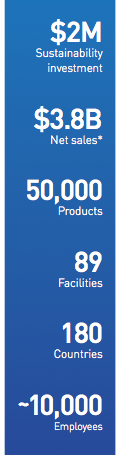
While these examples prove a significant point about how sustainability thinking can shift mindsets on profit, purpose and business value across organizations, what about Life Technologies’ external supply chain? With over 50,000 products and complex transportation cycles, how is the company addressing sustainability in its supply chain?

“I have a hard time understanding the traditional concept of ‘greening the supply chain.’ Asking hundreds of suppliers to fill out forms and check boxes provides no tangible value. We could never understand how to take action on that supplier data,” Amorim explained. “Instead, we find more value in partnering with key suppliers.”

One example is Kimberly-Clark. On the path to zero waste, Amorim and her team went dumpster diving one morning to understand their waste streams. What they found was a sea of blue and
purple  latex gloves.

We approached the glove supplier, Kimberly-Clark, who partnered with us to implement a glove take-back program. It started in one location and has today expanded to five. We segregate the gloves at the point of use and Kimberly-Clark sends them to TerraCycle, who turn them into purple park benches. This partnership provides true value—glove take-back helped us achieve our zero waste goal and helped Kimberly-Clark increase their revenue by becoming our sole glove supplier globally.

Take Back: Turning Obligation into Opportunity

The circular economy has arrived. That is what excites Amorim, one of very few female CSOs in the private sector. “The regulatory environment is also helping us close the loop. The WEEE [Waste Electric Electronic Equipment] legislation in Europe is one example,” says Amorim.

WEEE institutionalizes the cradle-to-cradle concept as a means of keeping electronic equipment containing heavy metals out of landfills. “Wouldn’t you like it if Maytag removed your dishwasher at the end of its life? I can’t move it and it doesn’t fit in my trashcan. In Europe, we now have to set up a take-back scheme for all of our instruments. How can this be done profitably?”

“We realized that by taking instruments back only to recycle the parts was a cost burden. Instead we bring them back to refurbish certain product lines for resale, harvest high-value parts to be used on service calls, and responsibly recycle what’s left.”

For Life Technologies and other companies, refurbished instruments open up an entire new market. At a lower price point, instruments such as DNA sequencers are more accessible to more scientists. And with increased revenue, the WEEE obligation becomes an opportunity.

While issues like cold chain shipment, waste, and regulatory compliance present thorns on the way to the gilded goal of a closed-loop model for Life Technologies, triangular connections in its supply chain and their appetite for cutting-edge innovation leads one to believe the opportunities are endless for Amorim and her team.

As the exuberant sustainability chief concludes, “We’re aiming for radical.”

Originally written for and published on CSRwire’s Commentary section Talkback on July 22, 2013.

Share this:

  • Tweet
  • Email a link to a friend (Opens in new window) Email
  • Share on Reddit (Opens in new window) Reddit
  • Print (Opens in new window) Print
Like Loading...

Stakeholder vs. Shareholder Value: Connecting the Sustainability Dots With Philips, Drexel University & Profits4Purpose

09 Wednesday Jul 2014

Posted by Aman Singh in CSR, CSRwire

≈ Leave a comment

Tags

aman singh, cause marketing, corporate citizenship, corporate social responsibility, CSR, CSR communications, CSRwire, employee engagement, ESG, HR, Leadership, philanthropy, phillips, profits4purpose, shareholder value, social media, Stakeholder Engagement, Sustainability, sustainability, transparency, Work culture, workplace giving


Is there a connection between employee engagement and shareholder value?

Several similar questions came up in a recent webinar I facilitated, held in partnership with Profits 4 Purpose with guests Philips and Drexel University. While the question doesn’t have a linear answer – as is often the case with sustainability – it did take us through quite a conversation on connecting engagement with value, how CSR strategies affect business performance, the whole conundrum of measurement as well as what the latest research suggests.

Daniel Korschun, Assistant Professor and Fellow at the Center for Corporate Reputation Management at Drexel University, led the conversation by sharing some of his research with our audience.

“We’re moving into a new phase …since the 1950s we have had a debate about whether more CSR is better than less. While I don’t think this debate has been completely settled, there is general agreement among most practitioners that the core issue today is how we do it, not the quantity. That means we need to concentrate on effectiveness, which is where I have focused my research,” he started.

Employee Engagement: All About Signals

Employees are paying attention to CSR, he said.

And they notice when managers or customers support the company’s CSR initiatives.  When they notice this support, they are more likely to develop CSR and business performance“feelings of membership with a company.” In its most powerful form, we may begin to hear things like “I am an IBMer or a UPSer.” This feeling of membership then translates into a whole host of measurable outcomes like job performance, intent to stay in the job, or intent to volunteer.

For example, Korschun said he finds that people who feel this sense of membership are 87 percent more likely than others to be among the top performers of their company. And these effects hold even after controlling for pay satisfaction, personality traits, tenure, and work experience. The big lesson then?

  • Make CSR an open secret! “The more people who are discussing your behavior, the better.”
  • Have upper management act as champions: “If people don’t feel that management is aligned with your CSR strategy, impact will be muted. Executives don’t need to dictate CSR from the ivory tower but employees must know definitively that their leaders are on the same page, and are committed to social responsibility.”
  • Encourage contagion across stakeholders: “Engage customers in the same CSR programs as employees? Programs that get customers and employees to join forces (especially on volunteering sites) can create a bond…and that sort of contagion can lead to both happy employees and happy customers.”

Philip Cares: Formalizing Responsibility

Melanie Michaud, Senior Manager for Internal Communications with Philips North America took the baton from Daniel to evidence his data and research with how the practice and implementation of employee engagement maps out across a corporation. Emphasizing that Philips USA did not have a process in place till 2010 to vet requests and manage engagement across the company. “It was sporadic and led by employees who cared about various causes,” she said.

After several acquisitions, the company realized they needed a more formal process to align all its community development work with its business and employee base. That led to Philips Cares, through which, the company focuses on environment, education and health.

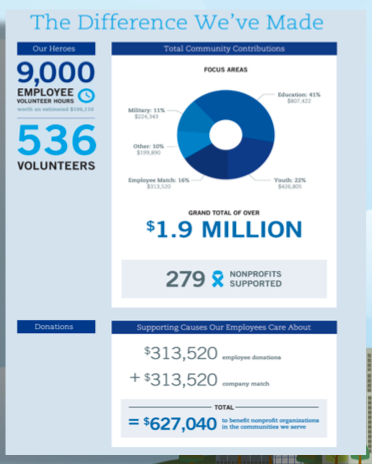
With tremendous uptick in the number of volunteers [over 8,000 volunteers] and donations in the 15 months since the program launched, Michaud highlighted the following keys to the success of Philips Philips caresCares – crucial for those managing relatively new programs or on the verge of launching one:
  • Do your research
  • Have a clear vision
  • Engage leadership
  • Have a volunteer tracking mechanism
  • Align with nonprofit partners
  • Emphasize local champions
  • Have consistent program branding
  • Engage in storytelling
  • Give employees a voice
  • Walk the talk

Setting a Global Strategy With Local Impact

So how does Philips ensure its CSR strategy is global in scope while local enough to support its communities?

That’s something we’re continually challenged with. We’re always tying everything back to our vision and mission of improving lives through innovation. We’re also doing some research now about rolling out a program like Philip Cares globally. In some areas there is greater interest than others and we’re currently working out how that will all work out,” Michaud responded.

One of the questions that came up during the webinar was around the survey Philips uses to seek feedback and make changes to its program. Emphasizing that the survey was a work in progress, Michaud said questions revolved around identifying causes, target audiences, types of volunteering activities as well as a bunch of open-ended questions for more elaborate feedback.

Practice vs. Software: Connecting Volunteerism With Impact

For Jason Burns, CEO of Profits 4 Purpose, the task was to connect Korschun’s research and Michaud’s practical perspective to how companies can best measure and track CSR and employee engagement activities. “We’re focused on helping companies make employee engagement simple, innovative and relational,” he started.

What are the key components to capture their attention? Burns summarized his comments in three neat categories:

  • Inspiring vision with easy execution: “We see a lot of companies starting with the end goal in mind, asking employees to focus on tracking…that’s less than inspiring. As human beings, we desire to be part of something bigger than ourselves so its important we start with a vision.”
  • Measuring impact: “Excel kills impact…how can we launch a strategy and review it for impact in real time and in alignment with employee engagement, mission and partners? Can we solve a specific problem that fits within the mission of a business? Can we cast a ‘what if’ scenario for employees to be motivated, to make a difference and get involved in a real easy and seamless way?”
  • Sharing a compelling story: “You’ve executed the strategy, and achieved great impact but why is it important? The most powerful piece for an employee when they volunteer is being part of that impact firsthand. The next powerful piece for those who might not be on the ground is communication, the story. It goes beyond the numbers.”

While the P4P platform helps companies do all of the above in one centralized place, what stood out was the fact that it also leverages the data into meaningful stories, disclosure commitments and  p4p_webinar_5filings. As Burns explained, “We saw companies that had the vision but were having difficulty making the management seamless with vendors, contractors and excel sheets. Things were duct taped and often a nightmare and we wanted to open that up to make the process productive and inspiring for all involved.”

Connecting The Dots Between Engagement & Shareholder Value…

But Jason’s iteration of execution versus measurement and reporting brought us back to a core question we began the panel with: how are companies like Phillips connecting the dots between volunteerism, engagement, retention and business growth?

“In terms of definitive links all the way to shareholder value, we have research connecting the steps of a CSR program all the way through. There is, however, no one study out there that links the end point with any one of the steps along the way. My research connects job performance with CSR and others have linked that to shareholder value. So while the connections are there, there is no one study that we can point to,” offered Korschun.

For Philips, it’s still to be determined, said Michaud.

“It is still a bit fragmented but we have moved from a theory to a practical emphasis on measurement and tracking. And the research being conducted is definitely encouraging, albeit complex,” added Burns, highlighting a trend we’ve been seeing on CSRwire as well where researchers are now, finally, being able to grab data on voluntary disclosures and link the connections between measurement, the various threads of sustainability and the question of value.

…Regardless of the Economic Climate…

What does the research then say about the impact of CSR programs on shareholder perspective and behavior irrespective of the economic climate? [Audience question]

While Korschun said he wasn’t aware of any studies that have looked at the influence of economic climate on how CSR drives value, “we generally find that for customers, the effects are clearest when CSR and employee engagementmost other product features are at parity. This suggests that CSR might become a little less important for consumers during a recession, when price becomes more critical.”
He added: “However, for employees, the company is a big part of their identity. So as long as a person feels fairly secure in their job, CSR should still have a similar effect. Putting this together, I would conjecture that ROI might drop a bit overall during a recession, but the drop would be uneven across stakeholders.”

…And Company Performance

“The weight of the evidence in academic studies suggests that there is a small positive effect of overall CSR on overall company performance. In my view, each company will have programs that are more and less effective. Since employees can express their commitment to the company in many ways, it is very difficult to put an ROI figure on any single program. The best way to measure it is usually to choose a couple of outcomes that are critical to shareholder value and then examine the link between CSR program(s) and these outcomes,” Korschun offered.

Final word on the erstwhile ROI of social contributions and impact?

For Michaud, this is a toss-up.

“We have some of the basics in place about measurement but I think qualitative measures are as significant. They’re really the next level of ROI. Of course, media stories help as well but we’re this is a discussion that is really ongoing for us.”

“A lot of companies are surveying employees and getting positive results. Now we need to work on finding the stories of impact,” added Burns while Korschun recommended systemic thinking:

I ‘d like to recommend [to companies] that they start with the goals. If one of your business challenges is employee retention, start with that and work backwards. Ask yourselves what is the right program that can have social/environmental impact and create business value at the same time?

Download the slides.

Originally written for and published on CSRwire’s Commentary sectionTalkback on June 25, 2013.

Share this:

  • Tweet
  • Email a link to a friend (Opens in new window) Email
  • Share on Reddit (Opens in new window) Reddit
  • Print (Opens in new window) Print
Like Loading...

#SharedValue & Sustainability: In Conversation with Nestlé Waters North America

09 Wednesday Jul 2014

Posted by Aman Singh in CSR, CSR reporting

≈ Leave a comment

Tags

Brand Management, consumer behavior, CSR, CSR reporting, Disclosure & Transparency, Environment, ethics, Leadership, nestle waters, packaging, recycling, shared value, social media, Stakeholder Engagement, stakeholder engagement, supply chain, Sustainability, sustainability, Twitter, water


A conversation with North America's largest seller of bottled water on how they define Shared Value, their take on what's often critiqued as an "unsustainable business model," their drive for modernizing recycling infrastructure and much more more!

[View the story “#SharedValue: A Chat with Nestle Waters North America” on Storify]

Share this:

  • Tweet
  • Email a link to a friend (Opens in new window) Email
  • Share on Reddit (Opens in new window) Reddit
  • Print (Opens in new window) Print
Like Loading...

Decoding Nestlé Waters North America’s Sustainability Journey: Environmental Villain or Facts vs. Emotions?

09 Wednesday Jul 2014

Posted by Aman Singh in CSR, CSR reporting, CSRwire, ESG

≈ Leave a comment

Tags

aman singh, Brand Management, Business, corporate social responsibility, CSR, CSR reporting, CSRwire, Disclosure & Transparency, environment, Environment, ESG, extended producer responsibility, heidi paul, kim jeffery, nestle waters, nestle waters north america, Net Impact, packaging, Philanthropy, recycling, shared value, Stakeholder Engagement, Supply chain management, Sustainability, sustainability, transparency, water conservation, watershed management


When a company labels its Annual CSR Report as Creating Shared Value, you have to stop and wonder if they’re responding to the latest buzzword in the market or leveraging its potential by truly embedding it into their reporting and cultural framework.

In its third cycle, Nestlé Waters North America’s [NWNA] latest Creating Shared Value Report attempts to accomplish the latter. Among its headlines:

  • What the company is doing to advance recycling in the U.S.
  • The company’s path to achieving a zero-waste future
  • Its continued efforts to be the most efficient user of water within the beverage industry

To gain some firsthand perspective and background on these goals and the accompanying challenges for North America’s largest seller of bottled water, I reached out to EVP for Corporate Affairs Heidi Paul [Join us for a Twitter Chat today, June 18th, at 1:00pm ET to connect with Paul directly at #SharedValue!].

NWNA_2012_CSR_Report_coverAmong my questions: how does the company balance criticism for selling bottled water while promoting healthy choices, what it is doing to shift its supply chain and use of plastic, its  well-acknowledged work in the area of Extended Producer Responsibility, and how her team plans on including consumers in its drive for sustainability.

Defining “Shared Value”

Paul started the conversation by setting the record straight on the company’s definition of what’s quickly gained momentum as a replacement for CSR: Creating Shared Value.

“We define CSV as a strategic way to achieve triple bottom line sustainability. In other words, be financially, environmentally and socially sustainable.  At the end of the day, Nestlé seeks to create shared value in those areas where we can make the most impact and that are material to our business. Globally, that is in the areas of Nutrition, Water and Rural Development. For our bottled water business in North America, our focus is on healthy hydration, packaging responsibility and watershed management.”

Has the terminology helped NWNA’s citizenship team – 28 people strong across the company – integrate its sustainability goals more effectively within its business units?

“It has done wonders. When you’re looking at philanthropy unconnected to business, it is not really sustainable. CSV focuses our engagement on the three critical topics and asks the whole company to see what can be improved for society and ourselves. We get the benefit of input from our supply chain, employee groups, community partners, etc.,” she said.

Coding the Impact of Bottled Water

Let’s get to NWNA’s main product then: bottled water. Does it feel the twinge of irony every time that is said in the same sentence as “shared value”? Paul chose to answer that with some data:

“Seventy percent of what Americans drink – according to the Beverage Marketing Corporation – today comes from a package, not from a cup or the tap. In fact, our research indicates that if people don’t have access to bottled water, 63 percent say they will buy some other beverage from a package instead, often a sugared or caloric drink with a greater environmental impact.”

“We play a key role in increasing Americans’ consumption of water, which is the healthiest beverage choice. As the data indicates, there is a crucial role that bottled water plays in consumer choice. Everywhere there is a high-calorie sugary, packaged drink available; we want to make sure there is water as well,” she emphasized.

Does the company’s sales data support Paul’s emphasis? “The volume sales increase for 2012 for the bottled water industry was 6.2 percent. And per capita consumption reached nearly 31 gallons, up more than 5 percent from 2011. Further, 51 percent of people who stop drinking sugared soft drinks are switching to bottled water. In fact, bottled water is outselling sugared soft drinks in grocery stores in eight major markets across the country,” she supplied.

At the end of the day, Paul believes, the company’s job is to talk about why bottled water is a choice – nestle waters north america brandsan amply available one – and why it should be available anywhere packaged beverages are being sold.
Is Nestlé Waters North America’s Business Model Sustainable?

That brought us to the next obvious thread: the plastic being used to produce the bottles. Recalling a keynote given by former NWNA CEO Kim Jeffery at a Net Impact conference years ago, I asked Paul how the company handles its fiercest critics regarding its use of plastic.

In a jungle of facts, fiction and emotions around environmental issues, Jeffery confronted the audience back in 2009 with a firm and resolute stand: we sell bottled water and we are doing everything we can to make that process sustainable.

Where there was a finality of “take it or leave it” to Jeffery’s remarks four years ago, Paul took a more nuanced approach to respond.

“Limited resources need to be used again and again. We have taken the mantle of becoming part of that solution. The larger point is there are billions of servings of beverages being sold everyday in some sort of package. Some populations are getting most of their calories from bottled drinks. And every time they choose water over a different drink, they’re making a more healthy and environmentally friendly choice,” she said.

And is a goal of reaching 60 percent recycling ambitious enough considering the climate and environmental challenges we face?

“At the time we were setting the goals, the nation was at a 28 percent recycling rate for PET plastic and thought that a goal to double that rate was ambitious and would require big changes. We had a lot to learn. We began to study recycling programs and the patchwork of policies and systems that were in place but were not moving overall recycling rates very much. There are big opportunities for increasing recycling by improving collection in public places, business and industry and in urban residential buildings. Today, however, there is no money going to fund this expansion of infrastructure.”

“There is also the issue of competing systems. Bottle bills for example do raise the recycling rates for bottles and cans, but actually reduce the efficiency of curbside because it is taking the most valuable commodities, which reduce the revenue, potential from curbside. Our goal was to work with others and find the most efficient system with the highest impact,” she emphasized. “

Environmental Villain or a Case of Facts vs. Emotions?

Of course the plastic of the bottled water we consume is bad for the environment. But so is almost every other product and consumer packaging we use in our day-to-day lives as study after study has shown.

Turning the argument on its head though, would we be wasting as much or filling up landfills as quickly as we are if we didn’t have the choice of bottled water to begin with? Where does consumer choice end and producer responsibility kick in?

Identifying that as another area for impact, Paul picked up:

“If bottled water isn’t available, people routinely purchase another packaged drink, one with calories and with a heavier environmental footprint. The availability of bottled water in times of natural disasters, where often tap water can be compromised, also creates a role for bottled water that goes beyond most product categories. Bottled water provides a reliable second source of water in these situations – that’s something everyone in our company is proud of.”

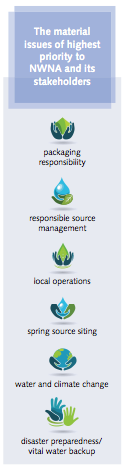
So when your business model is set around selling a product that is healthy and encourages nutrition while understanding and targeting its impacts through a well laid out sustainability strategy NWNA_priorities– as  Jeffery succinctly put it in his exit interview with Greenbiz Publisher Joel Makower earlier this year – is it fair to be labeled an environmental villain?

Perhaps, perhaps not.

The Challenges of Sustainability

As Paul reiterated, the journey of tackling facts vs. reality has been full of challenges and continues to be an uphill task. “Like anything else, our work in the area of recycling, water conservation and reducing our social and environmental footprint has been a constant education,” she said, citing the lack of modern and efficient recycling system as one of the company’s top challenges.

“Not too many people understand the current system in place. There are numerous questions like who is funding what, how does it work, who are the middle men, how do we get to the next stage, where can we build in efficiencies, etc. And if the goal is to accept our responsibility as a producer to recycle efficiently toward a goal of zero waste, then we need answers to these questions.”

“We’ve always said we’re open to options, and so far the option that we have seen with the highest potential to be low-cost and efficient is a well-constructed EPR system, run by industry. What makes this complicated is there are a dozen different ways EPR has been implemented globally. Many of those are not efficient. This uncertainty about the ability to do it “right” makes others in the dialogue want to take more of a “wait and see” approach. Even if you convince people who, done well, EPR in the form being proposed is the best solution, there are doubts about implementation across the board,” she said.

Other challenges?

Consumer vs. Producer Responsibility

Paul cited the potential of collaboration in building more sources for wind and solar energy, as well [“we’re not there yet but this is definitely on our radar”].

There is also a need for collaboration in the area of water stewardship. “Improving watersheds will require collaborations among the various stakeholders within a watershed, be that users, scientists, environmental groups or government. Nestlé Waters North America manages the watershed areas around the 40 springs we use that are overseen by our 10 Natural Resource Managers. We have also made a commitment to collaborate on two watershed projects per year,” Paul said.

And what about NWNA’s consumers? How does the company leverage its brand to shift consumer behavior?

“In the 1970s, recycling meant ‘putting it in the bin.’ Today, this is old news. What motivates people now is when they understand its benefits. If a consumer recycles a water bottle after use, the greenhouse gas impact of that bottle is estimated to be reduced by more than 15 percent.”

“Also, we need to close the loop on what happens to the bottles after they are recycled. They are not trash; they are a resource that can be used again and again. Right now our 50 percent r-pet bottles in our Arrowhead, Deer Park and Resource brands shows consumers what happens when they recycle. It becomes a new bottle. The visibility of this message on our bottles helps us tell the story that we need much better recycling to become a more sustainable world.”

The company’s top challenge moving forward?

“At the end of the day, you want zero impact, but is that possible? Our challenge is to keep finding those ways to improve when it feels like you’ve reduced the impact to the minimum,” she said, finishing with a flourish: “You need to find the next frontier every time – that’s the goal. And the challenge.”

Originally written for and published on CSRwire’s Commentary section Talkback on June 18, 2013.

Share this:

  • Tweet
  • Email a link to a friend (Opens in new window) Email
  • Share on Reddit (Opens in new window) Reddit
  • Print (Opens in new window) Print
Like Loading...

Examining The Sustainability of the Royal Bank of Scotland: Facing Your Demons

09 Wednesday Jul 2014

Posted by Aman Singh in CSR, CSR reporting, CSRwire

≈ 1 Comment

Tags

banking, corporate governance, CSR, CSR report, CSR reporting, CSRwire, Disclosure & Transparency, economy, employee retention, ESG, Ethics, finance, HR, Leadership, leadership, materiality, stakeholder engagement, Sustainability, sustainability, transparency, voluntary disclosure, Work culture


The finance sector continues to ride on the coattails of what started as a severe decline in trust, market performance and profits in 2008. And Royal Bank of Scotland [RBS] was no exception, facing its own share of customer distrust and instability as well as a government bailout.

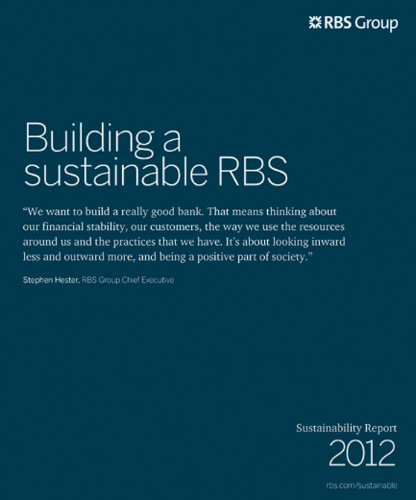
However, in its most recent CSR Report, the bank – as compared to its contemporaries – makes a marked effort to address these concerns and makes a public promise to examine its “financial stability, our customers, the way we use the resources around and the practices that we have.”

What really piqued my interest was the press release issued by the bank, which right from the headline – Royal Bank of Scotland Extends Meetings with Biggest Critics – told me change was afoot.

I caught up with Duncan Young, Deputy Head of Sustainability who is also in charge of producing the bank’s annual CSR Report. We began with an obvious question – I couldn’t hesitate – about a specific statement in CEO Stephen Hester’s quote that highlighted the Report’s very first page: What will it take to “build a really good bank”?

Aspirational Goals: “Building a Really Good Bank”

“There’s been debate about how aspirational that statement is…and a recognition that the sector has had a difficult time in recent years. We want to regain the trust of our customers and wider stakeholders – and we’re not going to become a really good bank till we do that,” he explained, adding: “We’ve spent the last few years working to make the bank secure and stable again. And made fairly significant progress. But as we go through the process of regaining trust with wider society, we think we need to deliver the kind of solutions that equate with us being a good bank.”

Fair enough. But what does an overarching statement of “becoming good” involve for an organization that serves a cross sector of business and consumer populations?

“We have significantly enhanced the remit of our Group Sustainability Committee this year. They will now cover wider reputational issues, impact on customers as well as U.K. industry practices, where too often, in the past customers were taken for granted. Today, we want to put customers at the heart of what we do to make sure we don’t make those mistakes again,” he said.

As for the committee’s expanded remit, “The committee will operate at the board level with full  RBS_Report_Cover_Alternativesupport from our leadership. Members will meet six times a year to review its larger mandate, which now includes conduct, culture and reputation, a very current issue for the industry.”

Underlining this is of course a sense of loss. As Young put it, “We are well aware that we have suffered heavily since the financial crisis and need to rethink how we work with our customers.”

“After the crisis, we were bailed out by the taxpayer. Our fundamental goal since has been to make the bank safe and secure. We’re getting there. Our loan to deposit ratio – traditionally held as a good measure of a bank – was at 140 percent at one point. Now we’re down to 100 percent, which is deemed to be a measurable sign of a stable bank,” he said.

“We’ve also repaid key aspects of government support. But it’s important that we focus on maintaining a culture now that ensures past mistakes do not recur. We have a much stronger focus on conduct risk and our engagement efforts are making sure the bank’s leadership are much better placed to pick up on issues of market behavior, reputation risk and have an understanding of what customers’ expectations are from us. That’s another reason why we have significantly increased our disclosures,” Young emphasized.

Transparent Leadership: Engaging With Critics

So how does the company plan to address and interact with its critics?

“We have had a program where the sustainability committee meets with our biggest external critics where they can make the case about their interests in how we operate directly to the executive team. Last year, we held three engagement sessions with 14-15 separate groups attending. This year, we transparency at RBSwill have six more. In fact, even as we talk, committee members are meeting with a few organizations to discuss cyber security and its impact on the bank and our customers,” offered Young.

The leverage and stature of the committee has proven an important approach in increasing the bank’s stakeholder engagement, according to Young, because of the members’ ability to represent critical points of view and risks directly to the leadership. “This ensures that our top leadership does not lose sight of our key stakeholders and the dialogue informs their decision-making and specific business-related outcomes,” he added.

The CEO Speaks

Another first for the bank: Publishing a Q&A with its CEO that makes a mighty honest effort at addressing issues like trust, stability, its lending practices as well as the 2012 LIBOR rate-fixing scandal. Highlights:

On sustainability:

“Our long-term success will be determined by how well we understand our customers and communities, and how well we can service their needs in a responsible way. 2012 was a very challenging year for the sector, but it certainly served to underline that point.”

Lending to small businesses:

“It’s a difficult environment at the moment. Ongoing economic uncertainty has unsurprisingly driven down demand from businesses. SME loan applications were down 19% from 2011. Nonetheless, we continue to provide significant support to customers. RBS advanced more than £74 billion to UK businesses and homeowners in 2012. We’re approving a higher proportion of loan applications than ever – 93% in the last quarter of 2012.”

Royal Bank of Scotland CSR Report

The impact of the LIBOR rate-fixing scandal:

“There is no place at RBS for such behavior. That’s why we’re determined to correct the control and risk management failures that originated in RBS during the financial boom years, of which attempted LIBOR manipulation is an example. This is a painstaking task, that’s been undertaken over several years and we can’t detect and solve every problem as fast as we would like. The aim is to create a safe and secure RBS that serves customers well and that, in the right way, creates value for those who rely on us.”

On customer trust:

“Staff don’t set out to serve customers poorly, but banks too often had other priorities before the crisis. They saw customers as a means of making money.”

On executive pay:

“The investment banking bonus pool has gone down by 20% on last year, despite operating profits in the markets division being up by nearly 70%. In fact, since 2009 our investment banking bonus pool has shrunk by more than 70%. We’ve also increased transparency around pay. But there’s a balance – we need high quality people if we are to achieve the goals we set out in 2008. So we must deliver reform, while not making the business unmanageable.”

Regaining Trust with External Stakeholders…

The report’s materiality map, worth a look by anyone interested in disclosure and how it can increase shareholder value and business performance, shows customer trust as the bank’s number one material risk. I asked Young how his team was planning to address this:

“Stakeholder engagement is one piece. We make our senior leaders available to the media, release quarterly disclosure and take advantage of public forums to explain where we’re taking the company, how we’re working on renewing customer trust and engaging with enterprise,” he said.

Other efforts include programs like “Working with You” where relationship managers spend a minimum of two days a year working with their clients to get a real understanding of those businesses, an accreditation scheme to ensure our bankers are suitably skilled and qualified, and simplifying our product range to make life easier for our High Street customers.

“It’s not just about the products but also how we offer them. We have to acknowledge that we’re operating against the backdrop of a tough regulatory landscape and immense pressure. The repercussions of offering the wrong products in the past continue to be felt across the organization and we have to get this right,” he added.

…And Employees

What about the bank’s internal culture? With massive layoffs having made headlines not too long ago, Employee retention at RBSwhat is Young’s team doing to retain and attract top talent? “Despite all the changes and the restructuring, our employee engagement measurements stack up very well. We’re quite pleased, for example, with our ongoing commitment to demo gender diversity at the executive level. We’re not at the optimum point but we’re getting much better at employing more women,” said Young.

Take a look at the report and you see Young’s sentiments reflected right from Page 1. It is commendable that the bank, despite its difficult regulatory environment and consumer marketplace, is facing up to its critics, shifting its cultural rotunda and putting programs in place that can ensure 2008 does not repeat itself. As Young put it, the report manages to “strike a realistic tone and successfully acknowledges that we did have a difficult year.”

After all, we’ve gone hoarse advocating to reporters that they mustn’t view CSR/sustainability Reports as yet another marketing document but as a piece of disclosure that is tied to materiality, engagement and business performance.

Final words? “If people read nothing more than the first 15 pages, they would get a good oversight of our challenges and how we’re responding. That’s mission accomplished for us,” offered Young.

Originally written for and published on CSRwire’s Commentary section Talkback on May 15, 2013.

Share this:

  • Tweet
  • Email a link to a friend (Opens in new window) Email
  • Share on Reddit (Opens in new window) Reddit
  • Print (Opens in new window) Print
Like Loading...

Unilever’s Sustainable Living Plan: The Challenges of Being Too Ambitious

09 Wednesday Jul 2014

Posted by Aman Singh in CSR, CSR reporting, CSRwire

≈ 1 Comment

Tags

agriculture, Brand Management, Business, cause marketing, climate change, Consumerism, Corporate Governance, CSR, CSR reporting, CSRwire, disclosure, Disclosure & Transparency, dove, energy, environment, Environment, food, hygiene, Leadership, lifebouy, marketing, nutrition, paul polman, Social Enterprise, supply chain, Supply chain management, Sustainability, sustainability, Sustainability Report, unilever, unilever sustainable living plan, water


Unilever’s Sustainable Living Plan was created and launched amid much fanfare in 2010. It was lauded for its ambitious goals, an exhaustive list of metrics and for its commitment to put sustainable and equitable growth at the heart of its business model.

This week, the consumer products company released its second progress report and it began with a stark statement from CEO Paul Polman:

The world continues to face big challenges. The lack of access of many to food, nutrition, basic hygiene and sanitation, clean drinking water or a decent job should be a concern to all of us. We firmly believe business has a big role to play in striving for more equitable and sustainable growth, but large-scale change will only come about if there is real collaboration between companies, governments and NGOs across all these areas.

Now, the report is impressive, exhaustive and filled with data. So to get beyond the flash, the  avalanche of Keith_Weed_Unilevernumbers and statistics, I reached out to Keith Weed, Chief Marketing & Communications Officer also responsible for the Sustainable Living Plan, to discuss not only the challenges of reaching some of the goals Unilever is striving for by 2020 but also the successes, the unforeseen road bumps and the transformation the company is undergoing culturally because of the Plan.

To get started, here are the three overarching goals Unilever began its Plan with:

  1. Help more than a billion people take action to improve their health and well-being;
  2. Source 100 percent of agricultural raw materials sustainably;
  3. Halve the environmental footprint of its products across the value chain.

Ambition: Sustainability in Perspective

“The report is indicative of what we’re trying to do. We’re trying to do things at scale. This is not a [standalone] CSR project in Africa but something that touches every single element across our value chain,” he began.

It takes a mindset shift to put Unilever’s plan in perspective. As Weed explained, “The idea that it isn’t just about the footprint of your facilities…we have to think all the way through the lifecycle of a  product from consumer to facilities to sourcing to the impact of key productions. The Unilever Sustainable Living Plan guides our direction.”Unilever__Sustainable_Living_Plan

Did his team realize the magnanimity of the goals they were setting? “We knew that we couldn’t achieve all of them but that if we set them like this, we would find solutions along the way by working with others,” he said, adding, “When you get interconnected, solutions and opportunities open up. That was the spirit we started with.”

And the results encapsulated on Unilever’s website and a 53-page PDF download, are in keeping with that spirit. “It’s not about mechanically ticking off the targets and goals. Our Sustainable Living Plan is a movement to get business to move toward socially and environmentally sustainable future,” he clarified.

The Unilever Sustainable Living Plan: Highlights

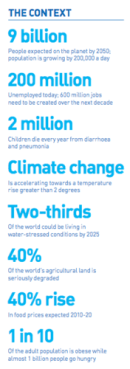
First of, he reminds me that from the outset, the Plan set out the sustainability goals to be achieved alongside the mission set out in 2009 to double the business. “We serve two billion people a day and another 2.5 billion are expected to be added to the world’s population by 2050. So our goal is to reduce our environmental footprint and increase our social impact while doubling our business.”

The good news: “We have started to drive sustainability into the core of our business and today, our sustainability efforts are helping to drive business growth.” One example is Unilever’s popular Lifebouy  soap, which was rebranded in 2010 with a social purpose alongside:

[We went] from selling soap to encouraging people to wash their hands – and wash them correctly. And our efforts have resulted in double-digit growth over the last three years – and reaching millions with our Handwashing campaign. It’s proving the coherence of our strategy of combining social impact with business growth instead of just a sales goal,” Weed explained.

USLP_ContextOther examples:

  • Laundry cleaner: Unilever increased its market share by 10 percentage points since 2010 to over 25 percent, with its concentrated liquids, which according to Weed carry a much lower carbon footprint in production and use.
  • Dry shampoos: A huge opportunity for the company, right now dry shampoos are mostly sold in the U.S. – where Unilever occupies a 75 percent market share. But as the company enters into more water-restricted countries, Weed predicted an accompanying increase in sales.  The environmental benefit? Compared to heated water, dry shampoo reduces CO2 by 90 percent through lower water usage and less heating of water for the shower. An added benefit for developing countries: water conservation.
  • Dove: The Self Esteem campaign continued to gain momentum with 62 percent of women who know of the campaign now recommending Dove to others. “The campaign started with the idea that we should think differently about how we portray beauty,” said Weed, “Today, it’s a global movement.”
  • Oral hygiene: Unilever’s oral hygiene campaign helped its Signal brand grow by 22 percent in 2012. “People brush their teeth in the morning and evening, which requires more toothpaste, ergo a virtuous circle,” contextualized Weed.

A Twist on Purposeful Cause Marketing?

So cause marketing spelt and implemented differently. By attaching value and impact with its core products, Unilever is addressing a question all consumer products companies continue to struggle with: how do you change consumer behavior to scale a company’s sustainability efforts?

For Unilever, this has meant active pairing of product and messaging with a focus on impact and growth, yet ultimate success is far away.

As Weed explained:

This is a coherent strategy that works – we’re increasing our social impact while growing our business. However, while we’re making good progress, we’re still facing challenges across the value chain, whether it’s with sourcing, food production or disposal.

And each carries with it a nuanced set of challenges, a complex set of solutions and invariably a cobweb of marketing, brand positioning and partnerships.

We have reduced our CO2 emissions, non-hazardous waste to landfill has been reduced in 50 percent of our factory sites, we’re sourcing over a third of our agricultural raw material from sustainable sources, up from 14 percent when we started in 2010…yet we’re miles away from our 2020 target of 100 percent,” he offered.

Scaling Behavior: Easier Ideated than Done

Of course, a key ingredient in Unilever’s Plan is the ability to scale. For the world’s largest tea consumer behaviorproducer, these achievements might mean small metrics today but when scaled are attribution to an entire value chain at work on technological improvements, environmental studies, and more. However, the opportunity is also a challenge:

“The sheer scale of our commitments is tremendous. For example, we want to be able to educate a billion people by 2020 on washing their hands correctly. That’s a lot of people – despite the progress we’ve already made since 2010 –119 million people reached since 2010, of whom 71 million were reached in 2012. Scale has been more challenging than we originally thought,” Weed explained.

Another challenge: encouraging people to adopt new behaviors.

Consumer Behavior: The Toughest Challenge Yet?

“When someone tells you something about hygiene, it’s easy to do it for a couple of days and then switch back to your old habits. Habits are hard to change and we’re seeing this come up in almost every initiative,” he said.

Using the example of laundry, he exemplified:

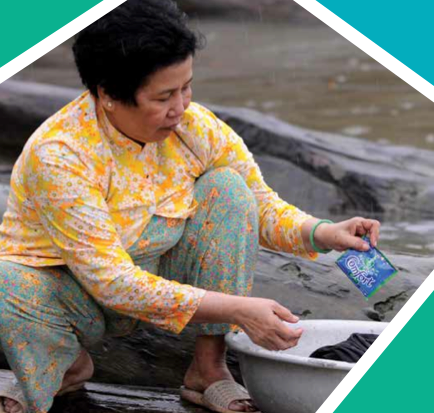
The biggest use of domestic water across households worldwide is for laundry.  Only a few hundred million in North America and Europe use machines. The other billions wash their clothes by hand and usually use four buckets of water to do so: wash in one, rinse in three. Our challenge is to reduce that rinsing from three buckets to one.  So we came up with a product that kills the foam – wash in one bucket and rinse in one bucket. Water used is instantly cut to half. And we expected the product to be a runaway success.

The team found that embedding that behavior change of using one bucket instead of three was  instrumentally Laundry_Unilevertough. Even in water scarce markets where people have to walk long distances for water. “Rinsing is hard work. I thought this would be a rapid victory but we found that it takes time to change habits and we ended up reaching only 29 million households, much lower than anticipated,” he recalled.

When your footprint encompasses billions of culturally diverse populations with very different social and environmental settings, scale becomes an ever-moving target.

Perhaps Weed puts it best again: “If you went to work in a Boeing 747, it wouldn’t make a difference to the planet. If half the planet started doing that, it would make a huge difference. The power of individuals is when you scale them together.”

Its hard work.

And Unilever’s 2012 Progress Report while celebrating the company’s achievements does not undercut the challenges ahead. “We’re breaking new ground every day. We’re showing results. But there are several pieces we are yet to crack,” said Weed.

Originally written for and published on CSRwire’s Commentary section Talkback on April 24, 2013.

Share this:

  • Tweet
  • Email a link to a friend (Opens in new window) Email
  • Share on Reddit (Opens in new window) Reddit
  • Print (Opens in new window) Print
Like Loading...

Shared Success at Verizon: No Silver Bullet for Sustainability, Say CSR & Sustainability Chiefs

09 Wednesday Jul 2014

Posted by Aman Singh in CSR, CSR reporting, CSRwire, ESG

≈ Leave a comment

Tags

Business, carbon, community, Consumerism, CSR, CSR reporting, CSRwire, Disclosure & Transparency, energy, environment, Environment, ESG, ghg, iirc, integrated reporting, Philanthropy, recycling, shared value, supplier responsibility, supply chain, Sustainability, sustainability, technology, verizon


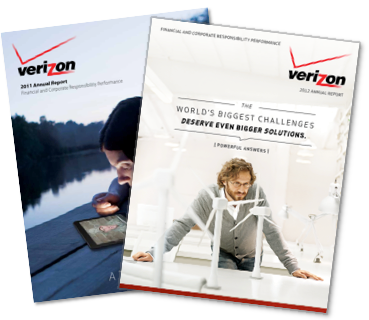
Verizon recently released its second Integrated Report, combining the company’s financial and non-financial data and metrics into one clean look at its overall performance.

While the technology giant has been publishing its environmental, social and governance results for almost a decade, integration with the firm’s financial performance is relatively new. And Verizon saw several significant changes in 2012 to its approach to sustainability and shared value – which Verizon calls “shared success” – including a reformat of its Foundation’s model.

In a recent webinar, I had the opportunity to discuss the report, Verizon’s goals, challenges and a whole host of issues with Verizon’s CSR and sustainability chiefs Kathy Brown and Jim Gowen, along with an engaged audience.

Here are excerpts – and a link to the webinar recording.

Whether you’re eager to learn more about Verizon’s approach to sustainability or what the future holds for integrated reporting and sustainability standards, the webinar will provide you with exemplary context, insights into one company’s efforts to reduce its impact, and how a multinational must pick a strategy that is holistic, focused and measurable.

Shared Success:

Kathy Brown: “When Lowell McAdam became our CEO a year and a half ago, he brought with him a set of principles by which he inspired us to live. It is a value-based approach to our work in the market. We deliver outstanding communication and technology for our communities and country. And we are to share our success with the community. While Michael Porter gets a deep bow for creating Shared Value, these pillars – solutions, service and sustainability – state our mission and our version of shared success.”

Verizon's Shared Success Innovation Process

“We want to achieve measurable social impact. We can do a number of things at one time because our technology is powerful enough for us to find a way to do well for our shareowners and stakeholders, communities and countries in tackling the world’s problems…Specifically, we are focusing on how technology can bring transformational change in education, healthcare and energy management. The platform is our fiber network [and] our wireless network. Through these [networks] we are able to reach millions of users and applications that can literally change the world.”

Setting Aggressive Targets:

Jim Gowen: “Our sustainability program includes aggressive targets, follow-up and our people [who] really do make the difference. In September 2009, when we created the Office of Sustainability, one of the challenges was how were we going to make an impact on a business that [in many areas] is growing exponentially. So we set the Carbon Intensity Metric as the way to grow most efficiently. We set an objective by 2020 to improve our carbon efficiency by 50 percent. Since 2009, we have driven our carbon efficiency 37 percent.”Verizon_networks

“But as I often tell my employees, that was the easy part. Now comes the tougher part. We’ve taken care of all the low hanging fruit. How do you keep that momentum going? For example, e-waste is one of our biggest impacts. We’ve set a goal of collecting more than 2 million pounds of e-waste by 2015. That’s no small feat.
We’re doing that internally as well as externally with our Recycling Rallies.In the last two years, we’ve held 36 of these [across the country]. That objective is very important to Verizon and our customers.”

Environmental Footprint: Setting the Stage

Jim: “Our environmental footprint is quite large. Supporting hundreds of millions of customers takes a lot of work. We operate 42,000 cell towers, 31,000 facilities globally, and [a] 38,000 private fleet of trucks and vans, etc. We had to concentrate on our own resources and see how to become sustainable.”

“We focus on four key areas: making our networks more efficient; expand[ing] our renewable sources of energy; run[ning] our fleets more efficiently; and reduc[ing] the lifecycle cost of ownership of how we operate.  From purchasing to logistics and sustainability – they all match up nicely.”

Highlights from 2012: From Packaging to the “Magic Bus”

Jim: “How do we make our packaging more environmentally-friendly? How do we handle the end of life for that? We asked our OEMs to make their equipment more energy efficient – 30 percent more than legacy equipment. Then we looked at our consumer stores: 131 stores have been LEED certified so far with the U.S. Green Building council, and a pilot is underway to increase that number across our markets.”

“We recently launched our Magic Bus program. The idea was generated by one of our line managers in New York who suggested that, instead of driving our own vans around very congested areas of New York, why couldn’t we drop off our employees with their equipment to provide service to our customers?”

“From that originated a three-month pilot where we used vans that could host eight to 10 technicians with their equipment and inventory on board, and we started driving them around areas of Manhattan. We would pick [up] and drop them [off] and provide service to them throughout the day when they needed it. The benefit was significant – for our customers and our employees. We’ve now started 25 of those Magic Buses in New York and removed 250 of our vans off the roads of New York City.”

No Silver Bullet for Sustainability

Jim: “There is no silver bullet and no magic button. It’s going to take a lot of trial and error and a lot of commitment. While we think and look at our lifecycle approach, we’re still in our immaturity stage,  and the Verizon_reportopportunities ahead of us are so powerful that we can have a significant impact”

From Sustainability to Integrated:

Kathy: “Our Shared Success Council is made up of senior executives across the company – including marketing officers, product managers, general counsel, etc. – who are clearing the strategy for growth and in the process, sharing the idea of Shared Success. The report recognizes these efforts.”

“The process involves a lot of collaboration between executives and the folks on the ground. We focus a lot on our data, and we don’t see this journey as involving any one data point. It’s a journey of doing business, and the report reflects that. We’ve shown enormous efforts and growth, and the information is easy to read and use for our stakeholders across the board.”

Jim: “The report also helps us tell our story concisely. Our customers are asking, as are our investors. They are asking how we’re measuring ourselves? What are our goals – people want to invest in sustainable companies – and how are we incrementally achieving those?”

Technology and Health Care: Powerful Answers

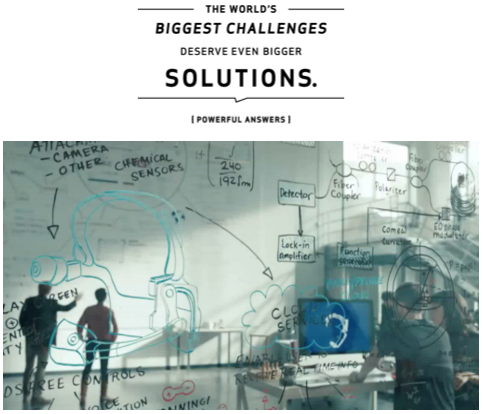
Kathy: “We need to work on reducing costs on factory delivery systems and improv[ing] patient outcomes. Think about what you have on your iPad or phone today. We believe we can, in a more systematic way, think of security and identity issues for patients, fast connections, and [the] ability for patients and doctors to talk to each other in a secure environment through our technology, etc. We call this Powerful Answers.”

Who’s Reading the Report?

Kathy: “Internally, the audience is our employees who can have sense of our values as a company. Externally, people want to do business with companies with a heart but also have the technology and wherewithal to solve their problems. Beyond individuals, this includes communities [and]  governments who take on big ideas about congestion, smarter cars, health care, etc. This report does a good job [of] painting the bigger picture for this audience.”Verizon_Powerful_Answers

Jim: “[The] hip market that will change the world [is] using our technology, and this report helps them see first-hand the choices they have. Sustainability at Verizon is driven by our employees and our communities, not just one executive.”

Supplier Responsibility:

Jim: “Over the last couple of years, we have queried our top 200 suppliers, which represent 80 percent of our total spend, to ask them how they manage their CO2 and greenhouse gas impact. What goes into the products they supply to Verizon? And we were very surprised at the answers we got back and tallied them up and graded them.”

“Whether they’re early adopters or much more mature with their sustainability strategies, we’ve set ourselves a 2015 goal: to operate with over 40 percent of our suppliers that have targets and greenhouse gas emission goals. That impact is significant, and we’ve already seen that through the innovation they’re bringing to us about how they can become more sustainable and continue working with us.”

Evaluating Success:

Kathy: “We get all sorts of consumer indicators of how we’re doing in our community. We know how they use our network, what they think of it, etc. Once we start asking consumers how we’re doing in terms of impact, the responses have been very good. But it has been a challenge to do that in a broad way across many segments.”

For more insights from Verizon, listen to the webcast.

Originally written for and published on CSRwire’s Commentary section Talkback on April 18, 2013.

Share this:

  • Tweet
  • Email a link to a friend (Opens in new window) Email
  • Share on Reddit (Opens in new window) Reddit
  • Print (Opens in new window) Print
Like Loading...

Access to Medicine, Transparency & Ethical Governance: GlaxoSmithKline’s 2012 CSR Report

09 Wednesday Jul 2014

Posted by Aman Singh in CSR, CSR reporting, CSRwire, ESG

≈ Leave a comment

Tags

avandia, carbon, clinical trials, community development, compliance, CSR, CSR report, CSR reporting, CSRwire, Disclosure & Transparency, Environment, ESG, Ethics, ethics, glaxosmithkline, governance, health care, paxil, Social Impact, Supply chain management, Sustainability, sustainability, Sustainability Report, transparency, vaccines, work culture


When a company is manufacturing critical need medicines and popular consumer products, how does it address increasing access to innovative products while managing its energy use?

On the launch of the GlaxoSmithKline’s 2012 Corporate Responsibility Report – a comprehensive read at 75 pages – I caught up with Director for Global Corporate Responsibility Clare Griffin for some updates.

Looking Ahead: GSK Switches Focus

For the first time the report, while focusing on the company’s 2012 performance, also includes a set of 23 forward-looking commitments across GSK’s business. The first thing that caught my eye in the report was the framework used to connect the firm’s vision with its business mission, assets, purpose and bottom line [see below]. How did the team use this chart to define CR’s focus at GSK?

“Lots of companies say they don’t have separate CR strategies; that they are completely embedded, etc. But how can you demonstrate that integration? This chart, for us, is a good way of explaining how CR is interwoven into our business. We have our business assets, our people, our priorities, our values, which leads us to create innovative products and drive access where people need it the most,” she explained.

“That’s the vision we want to create. We believe that if responsibility is absolutely integral to how we do business, we will deliver sustainable business growth for shareholders and benefits for our other stakeholders,” she added.

It’s all interrelated.

glaxosmithkline csr report

“For example, in the world’s poorest countries, our Developing Countries and Market Access (DCMA) operating unit has a clear objective to increase access to medicines and vaccines, while expanding our market presence and ensuring our business is sustainable for the long-term. This model is increasing our volume sales while increasing access to essential medicines and vaccines.”

Transparency, Pricing & Carbon: Challenges Ahead

“We will see through the implementation of our commitments on transparency of clinical trials data, continue with our commitments on pricing, and look to further harness manufacturing technologies to improve our carbon footprint,” writes GSK CEO Andrew Witty in the report.

Lots of promises in that one statement, I asked. How will these be implemented?

“We have a pretty diverse product line. Although pharmaceuticals are the majority, we also produce vaccines and consumer healthcare products. To improve our carbon emissions, we first invested in mapping our carbon footprint. For example, we found out that Amoxicillin, a very popular antibiotic, is Horlicksthe third-largest contributor to our carbon emissions due to the manufacturing process,” she said. “Our green chemistry team in Singapore has found a different way to produce Amoxicillin through using an enzyme instead which will cut carbon emissions from this process by 36,000 tonnes and reduce waste by 2,400 tonnes as well.”

Similarly with Horlicks, a popular malted milk drink: “We are working to further enhance an Indian government program aimed at modernizing milk production, and looking at introducing alternative energy generation, for example low-carbon biomass energy generation using waste wood to replace coal. Essentially, we are focusing on where we believe we can have the biggest impact,” she added.

Creating Access: Sharing Data From Clinical Trials

As for the transparency piece, while GSK has shared the summary results of all of its clinical trials – whether positive or negative – on a website accessible to all since 2004, the firm has committed to going further and now making anonymized patient-level data available to researchers.

“We’re setting up an independent panel which will review each request to make sure it is appropriate and will be using the data for valid scientific reasons. We also want the researchers to share their results back with the scientific community. We hope this initiative will be of value in developing and catalyzing a wider approach in the industry,” she explained.

Ethical Standards: Reinstating a Culture of Responsibility

Our discussion would not have been complete without taking into account, GSK’s rough tidings last year with the U.S. government. With the firm having to pay $3 billion to the U.S. government to settle allegations of unethical misconduct – failure to include information, etc. – in its sales and marketing practices around drugs Paxil and Avandia, several questions arose about the company’s corporate governance, accountability and sales practices – how do you move forward, I asked.

The company has taken significant steps to move beyond that, responded Griffin. “We have implemented a new incentive compensation system (Patient First) for our professional sales representatives who work directly with healthcare professionals in the U.S. The new system eliminates individual sales targets for these representatives as a basis for bonuses, and instead bases compensation primarily on sales competency, customer evaluations and the overall performance of their business unit,” she said.

glaxosmithkline csr report

The company has also brought together different Codes of Practices across regions and business units to create one Global Code and introduced standards that reinforce clear distinction between scientific dialogue and promotional activities. “These new standards govern the way we engage in scientific activities, such as advisory boards, publications, scientific congresses and medical education,” she said.

Other steps: A Corporate Ethics and Compliance Program for all employees, strengthened training programs, setting up an anti-bribery and corruption initiative and setting in motion disciplinary actions when needed.

“The 23 forward-looking commitments cut across the four areas of GSK’s responsibility: Health for all, Our behavior, Our People and Our Planet. It was important that we picked a time frame that is close enough that the current cadre of employees will be the people delivering the commitments while giving us enough time to create sustained change,” Griffin emphasized, alluding to the firm’s 2015 and 2020 goals.

Goals & Commitments: Highlights from 2012

So what were some of the year’s highlights for GSK?

  • The potential to bring around 15 new medicines and vaccines to patients over the next three years
  • 3.5 million pounds invested in R&D
  • 5 million pounds invested in the Tres Cantos Open Lab Foundation in Spain to fund research on solutions for diseases in the developed world
  • A concentrated focus on creating access, including monitoring the influential Access to Medicine Index, that measures what pharmaceuticals are doing to bring more medicines to more people [GSK won the top spot for the third time in 2012 although Griffin was quick to point out that “the index is a measure of what we’re doing, not the reason why we’re doing it.”]
  • A number of commitments around transparency established in 2012 including participating in the All-Trials Initiative, marking the next level of details on releasing results of GSK’s clinical trials.

What’s next?

“In 2013 we will continue to focus on innovation, access, and operating with transparency across the business. Specifically we will work to see through the implementation of our commitments on transparency of clinical trials data, continue with our commitments on pricing, and look to further harness manufacturing technologies to improve our carbon footprint,” finished Griffin.

Originally written for and published on CSRwire’s Commentary section Talkback onApril 16, 2013.

Share this:

  • Tweet
  • Email a link to a friend (Opens in new window) Email
  • Share on Reddit (Opens in new window) Reddit
  • Print (Opens in new window) Print
Like Loading...

Creating Access For All: CVS Caremark Sets Ambitious Goals

09 Wednesday Jul 2014

Posted by Aman Singh in CSR, CSRwire

≈ Leave a comment

Tags

cause marketing, charity, community development, CSR, CSRwire, cvs, eileen howard boone, employee engagement, grants, healthcare, inclusion, ngo, nonprofit, philanthropy, Philanthropy, volunteerism, Work culture


The neighborhood pharmacy. The alternative to supermarkets. Chances are there is a CVS/pharmacy store within walking distance of your house. Or at least one within a couple of miles.

There was for me. As a new citizen, a kind CVS manager gave me my first American job, taught me how to differentiate between a nickel and a quarter – and the basics of customer service in a country where consumers rule a market spoiled with choice.

So how does a brand with deep community roots across a nation and significant impact support its business mission while keeping its social and environmental missions aligned and relevant? And how do you measure success beyond revenue dollars and flu shots?

I recently checked in with Eileen Howard Boone, SVP of Corporate Communications and Community Relations for CVS Caremark and VP of its foundation, the CVS Caremark Charitable Trust, for some insights into the pharmacy healthcare company’s CSR strategy as well as their unique perspective on community development.

License to Drive Results

“We have a license to drive social impact in ways that are independent of what’s going on in our company,” she began, explaining that the Foundation is the philanthropic arm of the company and reports to a board of trustees, giving Boone and her team some latitude to define their own priorities.

Interestingly, Boone is head of CVS’ Foundation but also heads the company’s communication efforts, highlighting a close alignment between impact and engagement within the centralized organization. “I sit across the company and work with our senior leadership on where we are going and how our
giving strategy fits with our future plans. Embedding the Foundation’s work and mission into the corporate strategy is critical to stay true to our business and values,” she explained.

Of course, as with most foundations, CVS’ Charitable Trust focuses primarily on the annual grant cycle. “Starting in 2012, we decided to focus on four categories: access to healthcare, coordinated care, early intervention and inclusion – a theme we use as a base criteria for all the grants we make,” she said.

“The primary focus through these categories is to measure how we along with our partners are driving impact in our markets. Are our nonprofit partners moving missions? Nine years ago, when I joined CVS, we weren’t measuring the impact of everything we were doing in our communities. It was scattered and not strategic. So we stepped back and asked: how are we living, operating and working in our communities?”

Need for Focus, Strategy

The introspection brought some expected results, namely, the need for focus and more research-based decisions. Eighteen months of research followed – with customers, employees, nonprofits, experts in pediatrics, etc. – on how to tighten the Foundation’s focus while having the most impact. “The idea was to find an issue of opportunity within healthcare that we could support and significantly impact five different ways: awareness, funding, in kind products, volunteerism and strategic counsel,” Boone emphasized.

“We wanted to have the opportunity to engage our employees. They live in our communities – and we were not leveraging their potential as volunteers, activists, decision makers and advisers,” she added.

In 2012, CVS employees donated an equivalent of $1 million in volunteering hours. But with 7,400 CVS Caremark: All kids canstores across diverse communities, volunteering and giving campaigns are effective only when localized. “Our All Kids Can program creates equal opportunity for all kids regardless of disability or situation and as we roll that out across our stores, we find that our employees really like to define “all kids can” in their own way. In one town, for example, it meant supporting the Special Olympics, in others it meant building a new playground,” Boone replied.
And that’s okay.

Volunteerism vs. Grants: Measuring Effectiveness

It’s difficult to have a cookie-cutter approach across 7,400 stores when local impact is the main driver. As the “local pharmacy building healthier communities,” CVS’ mandate is national but hyper-local in intensity. Do grants work better on a local level or volunteerism? With causes aplenty and communities diverse, how does the retailer juggle impact with dollars and employee time?’

According to Boone, monetary grants are definitely the first point of entry.

In 2012 alone, grants made through the All Kids Can program touched the lives of more than 5.8 million children and families. Despite all the benefits espoused about pro bono and volunteerism, the essence and impact of grant making is not lost on Boone who has been working in this sector for more than 20 years, including leading the Office Depot Foundation for six years.

“When we think of our large national partners, we need to understand that once the initial grant is made, there are other opportunities for engagement that we must leverage to extend the impact of that grant. But that initial grant is critical to move the needle and scale programs,” she said, adding, “For example, in a New Bedford school, we sponsored an incoming fifth grade class to connect with
our pharmacists around careers in healthcare, hygiene, health issues etc. In Rhode Island, we supported a free clinic, a multilevel partnership that started with grants, but now sees pharmacists often volunteering to support the clinic,” she explained.

For NGOs, grants from companies like CVS are critical.

And Boone understands the importance of looking at impact through a multidimensional prism:

“Awareness is a big thing that we can bring along with our dollars and other assets for nonprofits. They become better at fundraising and implementing programs after they’ve done some due diligence,” she said. “It gives them confidence, competence and the much-needed publicity support, “she added.

Measuring Impact: Healthcare For All

As a mother of six, however, Boone does feel strongly about CVS’ primary impact area: healthcare for all. And that becomes a tough metric to measure when you take into account the company’s diverse communities’ needs.

“We have learned over the years that we need to be asking the right things. Last year, we announced a partnership with the National Association of Community Health Centers to distribute $3 million over three years, across their centers for chronic disease management programs – and plan to monitor results. Measurement will include everything from number of people served to patient health outcomes.”

“We strive to measure our impact in a variety of ways including quantitative results like the number of patients served or the number of additional days a clinic is open, qualitative measures program outcomes and employee participation. We also place a heavy focus on storytelling and gathering stories from our partners to bring to life the successes of a program.”

Yet, that’s measurement of specific programs.

What is the company’s impact on the sector it sits centrally within, i.e., access to all, quality of life, awareness, hygiene, etc.? How does CVS measure its success as a healthcare retailer? As a conscious business? As a neighborhood pharmacy? As a collaborator with pharmaceuticals?

In Boone’s mind, her footprint – and her employer’s – is pretty clear: “We feel we are successful if our nonprofits are successful,” she said.

It’s that simple.

Originally written for and published on CSRwire’s Commentary section Talkback on April 3, 2013.

Share this:

  • Tweet
  • Email a link to a friend (Opens in new window) Email
  • Share on Reddit (Opens in new window) Reddit
  • Print (Opens in new window) Print
Like Loading...

SAP’s 1st Integrated Report: From Sustainability to Integrated Thinking

09 Wednesday Jul 2014

Posted by Aman Singh in CSR, CSR reporting, CSRwire

≈ Leave a comment

Tags

CSR, CSR report, CSR reporting, CSRwire, culture, Disclosure & Transparency, employee engagement, energy, ESG, ghg, governance, health, iirc, integrated reporting, leadership, paul druckman, retention, sap, Stakeholder Engagement, Supply chain management, Sustainability, Sustainability Report, transparency, voluntary disclosure


Using Integrated Reporting as a catalyst for integrated thinking.

That’s how Peter Graf, SAP’s Chief Sustainability Officer expressed the firm’s decision to replace two reports – the annual report mandated by the law and submitted to the SEC indicating the company’s financial performance and the sustainability report , voluntary in nature and showing its non-financial performance– by one Integrated Report for 2012.

While Integrated Reporting is a fairly new trend – The International Integrated Reporting Committee [IIRC] website hosts a total of 41 Integrated Reports since 2011 – it’s not surprising.

As the trend of CSR and sustainability reporting grows – due to multiple factors including a recessionary economy, dwindling resources, emerging conflicts in supply chains and a better connected world – logically, Integrated Reporting is the next step for any organization truly attempting to be as transparent as possible about its financial and non-financial challenges and performance.

Shift in Engagement: From Sustainability to Integrated

At SAP, the impetus for the shift was the realization that “we needed to engage within our organization on a different level” according to Graf. “We have been reporting on our sustainability performance since 2008. The report has grown in sophistication over the years and we even won several awards in the last two years for our report’s interactive nature, etc. So technically, we could have continued on that road,” he added.

Last year, CSRwire collaborated with Graf and his team on a webinar to launch SAP’s new interactive report. Complete with social media buttons, comment sections and multimedia options, the report could be customized and perused in multiple ways depending on your agenda. The report was well received – and in a span of an hour SAP_Integrated_Reportwe received over 30 questions from a very engaged audience.  [Join us for a webinar with Peter Graf, IIRC CEO Paul Druckman and others today at 11am ET]

SAP set a trend last year, so why the shift again?


Connecting the Dots: The Bigger Picture

“We have been measuring key performance indicators [KPI] on the financial and non-financial side for quite a while. But one day, we started to put them all on a white board trying to draw connection lines between them. Before we knew it, the chart was pretty full. We started to do research both internally and externally , to better understand and compute those relationships. Suddenly it became clear, just how interconnected non-financial and financial performance indicators really are,” he explained.

“When I heard about Integrated Reporting for the first time, I got excited. But then I thought: It’s going to be a very long process to achieve the integrated thinking that must be portrayed in the report. I viewed the Integrated Report as an outcome. However, over time our team reached the conclusion that instead of waiting for the right engagement at SAP to happen, we should use the process of producing an integrated report as the forcing function to drive the necessary engagement,” Graf added.

“In its integrated report, SAP lays out the interdependencies between financial and non-financial indicators,” said Graf. Proof points like: an increase or decrease of one percentage of SAP’s retention employee retention at SAPrate saves/costs the company 62 million euros. And since 2007, a peak year for energy consumption at the company, SAP has avoided 220 million euros ($285 million) through energy conservation efforts.
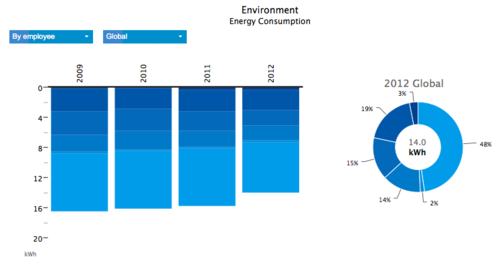
“When these kinds of relations appear between financial and non-financial indicators, they do more than make the business case for sustainability. They serve as the catalysts for an integrated corporate strategy.” said Graf.

While the entire report is available online, a parsed version – “we kept out customer stories but retained all other ESG data and metrics” – is submitted to the Securities & Exchange Commission.

SAP’s 2012 Performance: Key Highlights

So what will you find in the integrated Report this year?

For one, retention was up [94 percent in 2012] as was diversity, i.e., the number of women in management [an increase of one percent from 2011 to 19.4 percent].

The goal: to reach 25 percent by 2017.

Total energy consumed stayed stable at 2011 numbers while revenue increased by 17 percent and emissions per Euro in revenue and per employee were reduced for the sixth year in a row. Overall emissions were slightly reduced, in spite of the company  adding 9,000 new employees in 2012. Finally, the use of renewable energy increased from 47 percent in 2011 to 60 percent in 2012.

Also intriguing to me was a section, which detailed SAP’s People Strategy.

I asked Graf what the strategy involved – and how did they measure the outcomes besides retention and diversity?

“Having a sound strategy around people is essential in a company that solely relies on its employees to create value. Thus our ability to compete is highly dependent on our human resources and it’s impossible to separate that from our financial performance,” he said.

“First, we want to hire more diverse people. We believe more diverse groups innovate better. Second, we want to nurture our talent through clear development plans, challenging assignments, social media, e-learnings, etc. And finally, we want to leverage employee engagement as a decisive factor. So we measure retention and diversity but also engagement, which is a core and central KPI in driving our overall performance in the future,” Graf added.

Measuring Employee Engagement: Critical to Business Performance

So what contributed to a drop in employee engagement in 2006-2009?

“I believe there are various reasons that led to a decrease in engagement during that time. Most important, however, is how we made it back to the high engagement scores of today: When economic growth came back after the recession, the leadership of the company changed, a compelling innovation strategy for growth was established, the company was given the purpose of helping the  world run better to improve people’s lives and Energy_consumption_SAP_2012overall we enjoyed strong and continuous revenue growth as a result. So, a combination of issues got us into low engagement scores and a combination of things got us back on track.”

SAP also measures a Business Health Culture Index. Does that measure the company’s engagement quotient and connect it with business performance?

“We use this index to measure the health of our employees. There are four times as many stress-related illnesses in the intellectual property industry as compared to other industries. So we use data from eight questions [purpose, leadership, recognition, empowerment, rewards, stress levels, compared to people my age I feel more/less healthy] to understand where we stand and what we need to do to take care of our employees.”

In 2012, SAP’s Health Index stood at 66 percent, a one percent increase since 2011 and significant growth since 2008-2009.

Integrated Reporting: Check. What’s Next for SAP?

With all the data and metrics dancing around in my brain, the only question left to ask was, what’s next?

“On the one side, we recognize that integrated reporting is an early trend and that we certainly have to continue to improve and learn. On the other side, we have the ambition to lead, even if this means that we may make a mistake that followers might be able to avoid,” said Graf.

“The next steps clearly are to continue to move away from just having a sustainability strategy to making our corporate strategy more sustainable. This requires an engagement with leaders across SAP that we have not achieved before moving to integrated reporting,” he added.

His recommendations for companies who might be complacent with limited voluntary disclosure or perhaps hesitant to mix the voluntary with the mandatory?

“As soon as people recognize that  integrated reporting helps companies understand and grow the way how they create value at their core, , it will pick up. More and more people know this intuitively today but when someone connects all the financial and non-financial numbers with each other, then the big picture emerges,” he said.

SAP’s Integrated Report 2012 is available at www.SAPIntegratedReport.com.

Originally written for and published on CSRwire’s Commentary section Talkback on March 25, 2013.

Share this:

  • Tweet
  • Email a link to a friend (Opens in new window) Email
  • Share on Reddit (Opens in new window) Reddit
  • Print (Opens in new window) Print
Like Loading...
← Older posts
Newer posts →

Let's Talk!

Virtual
732-322-7797
amansinghdas@gmail.com

Blogs I Follow

  • Nonprofit Chronicles
  • Learned On by Andrea Learned
  • Angry African on the Loose™
  • csr-reporting
  • The CSR Blog
  • In Good Company: Singh on CSR

My Cloud

Capitalism 2.0 CSR CSR reporting CSRwire ESG Guest Author HR Stakeholder Engagement Sustainability Uncategorized

Recently written…

  • Rationality is Ruining Us: Mayors, presidents and governors join major businesses in charting way forward on climate change
  • 2015: the year businesses recognize that climate change is real – and 4 other themes
  • Hardcore lessons of sustainability – ’10 Words or Less’
  • Brewing a Better Future [#BaBF] with Heineken: Examining the Many Flavors of Local Sourcing
  • From Conflict to Collaboration: Kimberly-Clark and Greenpeace Participate in LIVE Twitter Chat

What others are reading

aman singh aman singh das Brand Management Business corporate social responsibility CSR CSR reporting CSRwire ESG Leadership Stakeholder Engagement supply chain Sustainability sustainability Work culture

Categories

Most Read

  • amansinghd…

Create a free website or blog at WordPress.com.

Nonprofit Chronicles

Journalism about foundations, nonprofits and their impact

Learned On by Andrea Learned

Angry African on the Loose™

I have opinions. I am from Africa. I live here now. I blog.

csr-reporting

Connecting the dots between Business, Society & the Environment

The CSR Blog

Connecting the dots between Business, Society & the Environment

In Good Company: Singh on CSR

Connecting the dots between Business, Society & the Environment

Privacy & Cookies: This site uses cookies. By continuing to use this website, you agree to their use.
To find out more, including how to control cookies, see here: Cookie Policy
  • Subscribe Subscribed
    • In Good Company: Singh on CSR
    • Join 119 other subscribers
    • Already have a WordPress.com account? Log in now.
    • In Good Company: Singh on CSR
    • Subscribe Subscribed
    • Sign up
    • Log in
    • Report this content
    • View site in Reader
    • Manage subscriptions
    • Collapse this bar
 

Loading Comments...
 

    %d