• ABOUT THE AUTHOR
  • Sustainability
  • CSR
  • CSR reporting

In Good Company: Singh on CSR

~ Connecting the dots between Business, Society & the Environment

Tag Archives: CSR strategy

Behind Every Responsible Company Is a PR Agency? A Closer Look @ Ruder Finn’s New CSR Practice

30 Tuesday Aug 2011

Posted by Aman Singh in CSR

≈ 10 Comments

Tags

aman singh, aman singh das, brand management, Brand Management, Business, Career advice, careers in CSR, cause marketing, Cone, corporate social responsibility, CRO Magazine, CSR, CSR communications, CSR marketing, CSR programs, CSR strategy, Edelman, employee engagement, Ethics, Golin Harris, Jobs in CSR, jobs in CSR, ketchum, marketing, marketing careers, PR, PR careers, public relations, risk management, Ruder Finn, Sarah Coles, shared value, social responsibility, Social Responsibility, strategic marketing


They say, behind every successful brand, is a PR agency.

How about: Behind every responsible brand, is a PR agency?

Now, what is the first thought that comes to your mind when you hear that a public relations agency has decided to roll its “CSR experience” into a new division offering clients the opportunity to use their PR capabilities and budget more responsibly, more strategically?

  1. You condemn them as a reactionary, out-to-make-money business;
  2. You think: CSR is not PR, how many times do we have to say it?
  3. Wonder how long this will last.
  4. That’s interesting. Yet another way we can help businesses create shared value

That last statement was the main driver behind Ruder Finn’s new CSR practice, which officially launched two months ago, according to Senior Vice President Sarah Coles. “We had already been doing CSR work with clients like Novartis and Gerber. It felt like a natural next step [for the firm],” she says.

The communications industry is abuzz with the notion of creating shared value and the professional services sector especially, is in the center of all the activity.

Of course, Ruder Finn is not the first PR company to offer CSR strategy and solutions. Edelman has a robust CSR and sustainability solutions practice, as do Burson-Marsteller, Ketchum, Golin Harris, Cone, and many others.
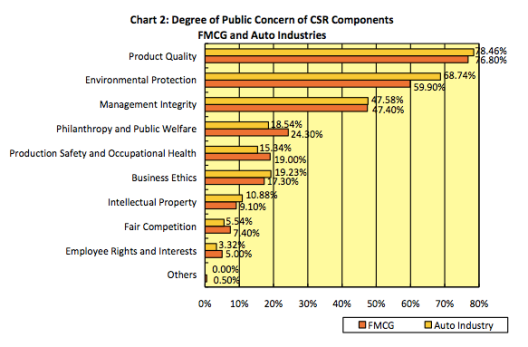
http://www.ruderfinnasia.com/files/csr-index-fmcg-and-auto-in-china-appendix.pdf

In fact, a quick search revealed that CRO Magazine even released a Top 10 list of “Corporate Responsibility PR firms” back in 2008, that placed Ruder Finn at No. 5. But how do you decipher such a ranking? If Ruder Finn was already being lauded for “CSR PR (?)” in 2008, what propelled them to create a new division now three years later?

And the big question: What is the differentiator in this burgeoning industry? 

I turned to Coles who will be leading the new practice and has spent 13 years in PR with the last seven at Ruder Finn, for some answers.

Sarah Coles, SVP, Ruder Finn

“When I started working with clients on CSR strategy, it wasn’t called CSR. Many were doing this without realizing it was called CSR. For example, at Novartis, we didn’t see our work in malaria treatment as CSR per se. It was part of their core mission, part of everyday business.”

“My first contact with CSR was when I started working with Gerber on childhood nutrition and later with Novartis. In the five years that followed, I got the chance to really see the effects of giving back to your community. I got to meet some of the patients and really saw firsthand the challenges that we in the western world would otherwise never understand. The whole experience really changed my impression of what needs to get done.”

The Case For CSR: What were the main motivations behind setting up a new practice focusing on CSR?

“There is a demand today to put together more strategic CSR programs; programs that are distinguished, unique to the company, and meaningful.”

“Consumers are pretty smart these days: They can see when something is reactionary and when it has been a longterm commitment. They trust brands that have longterm missions and whose programs are in sync with brand value.”

“A great example is the latest Tide for Hope campaign. It’s a perfect example of how core competencies can help provide value. This builds way more trust than something thrown together in a short-term cycle.”

“Ruder Finn also strongly believes that this is not only an opportunity to grow our practice but also to help define what the industry means by CSR and educate companies the issue to ensure that it continues to build as a best practice.”

The Nature of PR: Aren’t most programs reactionary in nature at first contact?

“It’s certainly a mix. Some companies who have been doing this for a long time are doing well and CSR contributes to that reputation. They build trust. Others are more reactionary but won’t be sustained or provide strategic value in the long run.”

“There is a real business case for CSR and companies are beginning to see that. Companies that have longterm Initiatives don’t have to resort to crisis management and there is value in that.”

Strategizing CSR: What then is the underlining ethos of the new practice?

“We learned a lot from working with PepsiCo on their Dream Machine recycling program. Today, we see a real opportunity in helping clients with cause marketing initiatives that reinforce their business practices and core competencies.”

“We counsel clients to do corporate social responsibility strategically. To build something that looks inside the company…dig around and see what they are already doing, what they stand for, what their core values are, and then create a campaign that captures all of that.”

Implementing CSR: How is implementing a CSR strategy going to differ from PR campaigns?

“We’re moving into pure strategy now. It’s not about short-term projects anymore. CSR is more about what makes sense for the business. How can I create something that my company stands for and does good for our community at the same time?”

“These programs go to the root of what CSR is all about: Good business sense that also provides value.”

Comments? Thoughts? Leave a comment or connect with me @AmanSinghCSR.
Share this:

  • Tweet
  • Email a link to a friend (Opens in new window) Email
  • Share on Reddit (Opens in new window) Reddit
  • Print (Opens in new window) Print
Like Loading...

Social Media and Leadership: Are Twitter and Facebook 21st Century Necessities?

12 Friday Aug 2011

Posted by Aman Singh in CSR

≈ Leave a comment

Tags

Accountability, aman singh, aman singh das, brand loyalty, brand management, Business, corporate citizenship, corporate governance, corporate social responsibility, CSR, CSR communications, CSR strategy, employee engagement, Facebook, Google+, human resources, innovation, job hunting on social media, Job search, Leadership, leadership, management, Management, marketing, PR, Quora, Recruitment, recruitment, reddit, Social Media, social media, Stakeholder Engagement, stumbleupon, Sustainability, sustainability, transparency, Twitter, Work culture


There is a lot of love for social media among many in the corporate social responsibility (CSR) and sustainability community. [Take this short survey and have your say: Useful, necessary engagement tool or hate it and a complete hassle?]

Lucy Marcus, founder of Marcus Venture Consulting, for example, posted a blog today on Harvard Business Review, that talks about a particular Groupon deal that annoyed her enough to tweet about it and how that rose several eyebrows and an eventual resolution.

David Connor recently wrote about his love for Twitter, calling it a fascination and being constantly impressed by the simplicity of engagement and the tangible sense of community the platform provides. In his post, he alluded to a recent confession of mine, simply titled: In Defense of Twitter: 5 Reasons Why I am a Mad Tweeter, which was a response to an alternatively headlined Wall Street Journal article.

_________________________________

For those interested, here is a recount of my top five:

1) Community: Twitter has provided me with a very diverse community of individuals who are eager to engage, argue and collaborate.

2) Soundboard: Without the 20 odd tweets I send out every day, I wouldn’t get any work done. Sounds counter-intuitive, I know—but it’s true. You’ve got to go where your audience is. They have a voice and they like to use it—and as a blogger, hearing what’s working and what’s not is inarguably essential.

3) Collaborations: And of course, without Twitter, I wouldn’t have made HR Examiner‘s Top 25 HR Digital Influencers for 2011 or named among the Top 100 Thought Leaders by Trust Across America. Nor would I have been able to successfully put together the recent panel on responsible business with Carol Sanford, Jeffrey Hollender, Sarah Murray and Bank of America, or been able to interview thought leaders like Campbell Soup’s Dave Stangis, PwC’s Shannon Schuyler, EMC’s Kathrin Winkler and many others while at Vault—and collaborated with enterprising students like Ashley Jablow, Catherine Chong, entrepreneurs like Myles Lutheran and the EDF Climate Corp fellows, or published the much-referred to series on job hunting in CSR.

4) News: Believe it or not, Twitter has become a significant source of my daily news. With the help of coordinated lists, I can scan the morning news in one stream all at one source.

5) Innovation: How many times have you read an 800-word article in one the mainstream newspapers and thought “Wow, that’s interesting, I wonder how I could learn more” or “I’d love to get involved” but haven’t known what to do next? Well, because it’s so easy to connect with others on Twitter without having to jot down strenuous emails or phone calls, now you can!

_________________________________

But Connor also brought up transparency and corporate accountability.

And here is where most companies struggle with the plethora of choices available today under the domain of social media: Facebook, Twitter, LinkedIn, Quora, Digg, StumbleUpon, Reddit, and the new kids on the block BranchOut and Google+, to name just a few.

So, how helpful are these channels? BRANDfog, a social media and CSR consulting firm launched a survey last week that begins to dig deeper into some of these questions.

Social Media and Leadership:

Should CEOs be engaging on Twitter for example? Does that help gain trust with customers, loyalty with employees, or raise the bar on transparency?

Recruitment Decisions:

Has social media become a benchmarking tool for prospective candidates in their recruitment decisions?

CSR and Sustainability:

And does a presence on social media help companies illustrate their brand values, mission and corporate citizenship?

What do you think? Take this short survey and have your say. Is social media emerging as the differentiator in today’s crowded market of jobs, business, and consumer loyalty?

Share this:

  • Tweet
  • Email a link to a friend (Opens in new window) Email
  • Share on Reddit (Opens in new window) Reddit
  • Print (Opens in new window) Print
Like Loading...

The Convergence Economy: A New Reality For Business (Sustainability) and Nonprofits

10 Wednesday Aug 2011

Posted by Aman Singh in CSR, Guest Author

≈ 2 Comments

Tags

Accenture, business, CEO Network, consulting, convergence economy, corporate accountability, corporate social entrepreneurship, corporate social responsibility, crisis management, CSR, CSR strategy, ethics and compliance, future of nonprofits, Gib Bulloch, Green, leadership, management, Nonprofits, risk management, social enterprise, social entrepreneurship, Stakeholder Engagement, supply chain, Sustainability, sustainability, sustainable business, UN Millenium Development goals, water, Work culture


If ever we needed proof that conventional development approaches are failing to address poverty, disease and malnutrition, the 10 year checkpoint for the UN’s Millennium Development Goals provided it.

The shortfalls in achievement in parts of Africa and South Asia cruelly expose the limits of our current efforts. Debate has recently turned to how business, governments and NGOs can work together in ways that align commercial self-interest with societal value. But the emergence of a ‘convergence economy‘ will disrupt incumbent development providers and ask many questions of businesses.

The Good News… and The Bad News

The good news is that the struggle against seemingly intractable problems such as malaria, drought and extreme poverty coincides with a time when global companies are looking for new markets. It’s no surprise, therefore, that NGOs and the private sector are increasingly working together. But all too often this collaboration is for one-off projects and conducted at arm’s length.

Business provides funds and NGOs deliver solutions. This may give business a license to operate in new territories, but it misses a large opportunity to transform communities for the long-term.

What is the Convergence Economy?

It is based on a merging of issues: Water, sanitation, education and disease, for instance, can only be addressed effectively together. It recognizes that the interests of NGOS do not run counter to those of business. And this results in a convergence of solutions, where it no longer matters whose logo is on the product or service that is improving the welfare of communities. 

We are all aware of how leading brands are supporting local communities and farmers, but beyond ethical supply chains and community based business practices, some businesses will have to consider more radical transformations of their operations.

Accenture's New Era of Sustainability 2010 Report

We can expect to see hybrid organizations that genuinely bring together NGOs and businesses in newly formed entities that have joint and flexible value chains at their heart. Danone’s collaboration with Grameen in Bangladesh illustrates this and has resulted in entirely new products to combat infant malnutrition. In some cases, we can expect the private sector to receive grants rather than NGOs.

The ‘convergence economy’ therefore requires businesses to create new business and operating models in local markets and to identify where they may have the best capabilities to ‘touch’ local communities in place of or in partnership with traditional aid providers. These new businesses or subsidiaries may be in joint partnerships with NGOs and other players.

For solutions to be sustainable, they will need to feed back local innovations into the broader business to maximize commercial benefit. To maintain their commitment, they will have to persuade shareholders that these commitments with longer term pay back periods are essential for future growth.

What does the convergence economy mean for NGOs?

According to our survey with the United Nations Global Compact of 766 CEOs, 27 percent of CEOs saw NGOs as key stakeholders in areas of sustainability in 2007. That figure fell to just 15% in 2010.

NGOs will still occupy a vital position in development—indeed they must, as they possess the local knowledge and knowhow, but they will see their role changing.

NGOs will act as coordinators, not just providers.

They will attract investment finance as well as seeking grants. They will support free markets as a tool for development. This means adopting new capabilities and, to some extent, a new cultural outlook. In the same way private sector companies are used to disaggregating their businesses and outsourcing non-core operations, NGOs will have to redesign their structure and purpose.

They will need a venture capital mentality to create conditions for investment.

The convergence of development and commercial enterprise is not therefore merely about ethical supply chains or profit seekers embracing a broader definition of value.  It is about a far deeper and more fluid operational collaboration across sectors. As multinationals enter new markets, they will have to redesign their models and assist NGOS to do the same.

Then, what could be seen as a marriage of convenience today can become a more committed and productive long-term relationship in the future.

–By Gib Bulloch, Executive Director, Accenture Development Partnerships

Gib is the Founder and Executive Director of Accenture Development Partnerships (ADP), a ring-fenced not-for-profit consulting group within Accenture, whose clients include many of the major international NGOs and development agencies. ADP’s main focus is bringing affordable business and technology expertise to the international development sector and promoting private sector engagement in sustainable development. In 2007, ADP was awarded the Management Consulting Association (MCA)’s CSR Award and in 2008, Gib was named as the Sunday Times sponsored Management Consultant of the Year in the Best Partner/Director category.

Gib has lived and worked extensively in developing countries and is a regular speaker on the role of business in development, corporate social entrepreneurship and cross-sectoral partnerships.

Share this:

  • Tweet
  • Email a link to a friend (Opens in new window) Email
  • Share on Reddit (Opens in new window) Reddit
  • Print (Opens in new window) Print
Like Loading...

The American Credit Downgrade and Accenture’s Sector by Sector Report on Sustainability

06 Saturday Aug 2011

Posted by Aman Singh in CSR

≈ 2 Comments

Tags

Accenture, aman singh, aman singh das, corporate social responsibility, Credit Downgrade, CSR, CSR blogger, CSR communications, CSR strategy, Ethics, ethics and compliance, Leadership, leadership, management, New Era of Sustainability, shared value, social responsibility, Sustainability, sustainability, sustainability benchmarks, sustainable business, sustainable business practices, UNGC


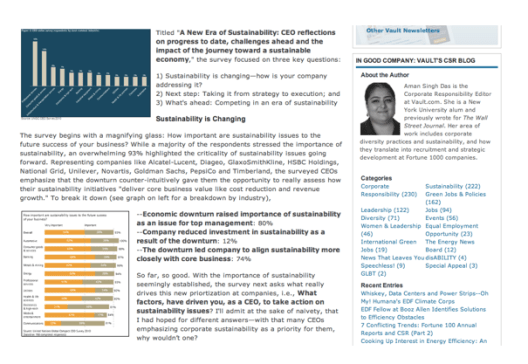
Last year, Accenture co-produced a report with the United Nations Global Compact titled A New Era of Sustainability: CEO reflections on progress to date, challenges ahead and the impact of the journey toward a sustainable economy. The report focused on examining three main questions with 766 CEOs serving as respondents: 1) Sustainability is changing—how is your company addressing it?; 2) Next step: Taking it from strategy to execution; and 3) What’s ahead: Competing in an era of sustainability.

The BIG finding from the report: 93 percent of 766 CEOs surveyed believe that sustainability will be “important” or “very important” to the future success of their company.

CSR Journalist Aman Singh reports on Accenture's New Era of Sustainability Report

Now, Accenture has produced a followup sector by sector report that offers more clarity — and a wide disparity in this percentage — to the overarching aggregated data by doing a deeper dive by industry.

For example, 100 percent of executives in the automotive and consumer products industries see sustainability as critical to their success but only 68 percent of banking executives see sustainability as “very important” to their future success, and 63 percent reporting that “their company is integrating sustainability ‘much more’ than five years ago.”

As for the communications sector, the percentage of executives seeing sustainability as “very important” to future growth drops to a mere 22 percent.

From Sustainability Strategy to Sustainable Business Practices

As the above-mentioned three questions indicate, however, the 2010 report attempted to be forward-looking in its data. Indicating a wide disconnect between the perceived importance of environmental, social and corporate governance for companies, and how these play in business strategy, the report pointed out that “while the belief in the strategic importance of sustainability issues is widespread among CEOs, executives continue to struggle to approach them as part and parcel of core business strategy.”

The new, follow-up report, adds teeth to this initial observation by showing a disparate practice of sustainable business practices across industries.

While 80 percent of utility industries report embedding sustainability metrics to track performance, 83 percent of CEOs in energy and 81 percent in infrastructure say their “company measures both positive and negative impacts of their activities on sustainability outcomes.”

Is sustainability measurement finally becoming accepted standard practice?

While this aggregated data might indicate so, the reality, according to Accenture’s Managing Director for Sustainability Services for Europe, Middle East, Africa and Latin America Peter Lacy, is that there remain “major gaps remain between CEO ambition and execution.” As evidence, the report offers the automotive industry as an example:

“Ninety-five percent of automotive executives believe that companies should invest in enhanced training of managers to integrate sustainability into strategy and operations, but just 52 percent report that their company already does so.”

Analyzing Sustainability Enthusiasm In a Recession

When Accenture’s New Era of Sustainability report
came out in June last year, I chose to go with a positive headline. I titled my detailed analysis as “Sustainability Moves from Discretionary Choice to Corporate Priority.”

Today, as we deal with a downgraded credit rating for the country of everyone’s dreams, a recession that might never have ended, and businesses once again returning to cautious growth, that optimism is hard to replicate. Troubled by debate after debate (subjects varied from accountability to Wal-mart, upstream recycling to upcycling, compensation limits, and much more) during the recent Sustainable Business Practices workshop held at the University of Vermont, several of the students jested that “Sustainability, after all, is a journey.”

I would add that it is also a mindset: A mindset that understands that business goals (profits, profits, profits) cannot be reached without taking into account the society and the environment you operate in and the human capital that helps you succeed. Will the rest of the sectors detailed in Accenture’s report follow through on their CEOs’ ambitions?

In coming months — and years — with America’s long-term sustainability as an economic power in question, all eyes will be on whether American businesses can pull up their socks and return their operating base to trustworthy status by using sustainability as a guiding principle. Where government fails, business steps in, right fellow #csrchat attendees?

Thoughts? Don’t forget to leave a comment or connect with me @AmanSinghCSR.
Next: Gib Bulloch, Executive Director of Accenture Development Partnerships discusses the report in Capabilities for the Convergence Economy.


Share this:

  • Tweet
  • Email a link to a friend (Opens in new window) Email
  • Share on Reddit (Opens in new window) Reddit
  • Print (Opens in new window) Print
Like Loading...

VIDEO: A Test in Corporate Transparency: Winning One for the Blue Shirts

29 Friday Jul 2011

Posted by Aman Singh in CSR reporting, HR

≈ 11 Comments

Tags

Accountability, aman singh das, Best Buy, conflict minerals, consumer education, Consumerism, corporate accountability, corporate social responsibility, CSR, CSR reporting, CSR strategy, diversity, diversity and inclusion, employee engagement, ESG, ethics and compliance, Events, fair trade, Green, GRI, HR, human resources, human rights, inclusion, Leadership, leadership, management, marketing, PR, risk management, shared value, Social Media, social media, supply chain, Sustainability, sustainability, Sustainability Report, technology, transparency, VIDEO


Last week I was at Best Buy headquarters in Minneapolis to moderate a live webinar with its CSR and sustainability executives. Joining me: Mary Capozzi, senior director of CSR, Leo Raudys, senior director of environmental sustainability and services compliance, and Hamlin Metzger, senior manager of corporate responsibility.

The agenda: To discuss Best Buy’s annual Sustainability Report and offer a live audience on Livestream and Twitter the opportunity to ask questions in real-time.

My job: To question, dig and examine, while moderating questions between the panel and the audience. About 20 minutes into the webinar, which is archived below — well worth a listen whether you are a sustainability nut, a tree hugger, a nonprofit exec, a job seeker or simply an electronics user — questions started streaming in.

From conflict minerals to employee education, every question was fair game.  While @Gchesman asked whether being a well-known company affects the level and degree of time and money spent on CSR and sustainability, @Davidcoethica wanted to know how Best Buy can better balance its role as a promoter of consumption of products against a sustainability ethos, and Robin Cangie wondered how Best Buy can help us all become more responsible consumers?

The conversation, thanks in part to an active and engaged audience, and wonderfully diverse questions, was invigorating, informative and challenging.

Barring the repeated mentions of their recycling efforts — sorry Leo, its a pet peeve — which to be fair is a huge and important undertaking for the global electronics retailer, the panelists were clear, comprehensive in their responses and unapologetically honest about their challenges: That there is a ton of work ahead and that they hadn’t figured it all out yet.

But as David Connor wrote earlier this week, when you’re a global player like Best Buy, expectations are higher as well. Did Best Buy live up to the expectations of CSR activists? Perhaps not.

Flip the coin though for a second.

Did they go on the defensive when I asked them why their retention rates were remarkable (74%) but the diversity of their recruits (12% African-American, 14% Hispanic; 180,000 employees) was quite underwhelming? No.

Did they dodge repeated questions about educating their supply chain, influencing consumer decisions, or the recently drafted UN Guiding Principals on Human Rights? No.

Bottom-line: Capozzi and team did not have all the answers but they didn’t pretend to either.

And that’s where, as an independent journalist, they get points from me for an attempt, however small, at open transparency, willingness to be accountable, and daring to do something new.

Remember the 11 Challenges for Corporate Sustainability? Well, a significant number of those relate to fear. For the Best Buy team, this webinar was a successful exercise in effectively addressing their own fears.

And that is where they just won one for their team of blue shirts.

Share this:

  • Tweet
  • Email a link to a friend (Opens in new window) Email
  • Share on Reddit (Opens in new window) Reddit
  • Print (Opens in new window) Print
Like Loading...
Newer posts →

Let's Talk!

Virtual
732-322-7797
amansinghdas@gmail.com

Blogs I Follow

  • Nonprofit Chronicles
  • Learned On by Andrea Learned
  • Angry African on the Loose™
  • csr-reporting
  • The CSR Blog
  • In Good Company: Singh on CSR

My Cloud

Capitalism 2.0 CSR CSR reporting CSRwire ESG Guest Author HR Stakeholder Engagement Sustainability Uncategorized

Recently written…

  • Rationality is Ruining Us: Mayors, presidents and governors join major businesses in charting way forward on climate change
  • 2015: the year businesses recognize that climate change is real – and 4 other themes
  • Hardcore lessons of sustainability – ’10 Words or Less’
  • Brewing a Better Future [#BaBF] with Heineken: Examining the Many Flavors of Local Sourcing
  • From Conflict to Collaboration: Kimberly-Clark and Greenpeace Participate in LIVE Twitter Chat

What others are reading

aman singh aman singh das Brand Management Business corporate social responsibility CSR CSR reporting CSRwire ESG Leadership Stakeholder Engagement supply chain Sustainability sustainability Work culture

Categories

Most Read

  • None

Blog at WordPress.com.

Nonprofit Chronicles

Journalism about foundations, nonprofits and their impact

Learned On by Andrea Learned

Angry African on the Loose™

I have opinions. I am from Africa. I live here now. I blog.

csr-reporting

Connecting the dots between Business, Society & the Environment

The CSR Blog

Connecting the dots between Business, Society & the Environment

In Good Company: Singh on CSR

Connecting the dots between Business, Society & the Environment

Privacy & Cookies: This site uses cookies. By continuing to use this website, you agree to their use.
To find out more, including how to control cookies, see here: Cookie Policy
  • Subscribe Subscribed
    • In Good Company: Singh on CSR
    • Join 119 other subscribers
    • Already have a WordPress.com account? Log in now.
    • In Good Company: Singh on CSR
    • Subscribe Subscribed
    • Sign up
    • Log in
    • Report this content
    • View site in Reader
    • Manage subscriptions
    • Collapse this bar
 

Loading Comments...
 

    %d