• ABOUT THE AUTHOR
  • Sustainability
  • CSR
  • CSR reporting

In Good Company: Singh on CSR

~ Connecting the dots between Business, Society & the Environment

Tag Archives: CSR reporting

PwC Canada Releases 3rd Annual CSR Report: Staying the Course

03 Thursday Jul 2014

Posted by Aman Singh in CSR, CSR reporting, CSRwire, ESG

≈ Leave a comment

Tags

CSR, CSR report, CSR reporting, CSRwire, ESG, GRI, james temple, non-financial reporting, philanthropy, Philanthropy, pwc, Social Impact, Stakeholder Engagement, Sustainability, volunteerism, Work culture


PricewaterhouseCoopers (PwC) Canada released their third annual corporate responsibility report today. It’s nothing groundbreaking. But nor is it pages and pages of images and quotes from top leadership interspersed with hard-to-evaluate statistics.PwC_CR_Report_2011

In true PwC fashion, the report details commitments and achievements in 2011 only to quickly move on to highlighting challenges and the firm’s key plans for 2012 followed by an affirmation of the firm’s social and environmental strategy.

The pressure on firms big and small to report on their non-financial activities is significant. With the Global Reporting Initiative (GRI) officially launching in North America last year, CSR and sustainability reports are set to multiply in coming years. What always challenges me are the motivations behind the reporting: Is it simply peer pressure or do firms learn something from the process? Moreover, is the act of reporting an exercise in external communication or more of an introspective activity to improve processes and strategies?

I caught up with James Temple, PwC Canada’s Director of Corporate Responsibility for some insights:

What was the most important lesson learned from the often stressful exercise of putting this report together?

Every time we work on our Corporate Responsibility Report, we’re reminded that this is an evolving journey and one that requires us to be open to adapting to changing ideas, personalities and approaches to developing the most transparent narrative possible.

When you involve such a large number of stakeholders in such a rigorous process, all of whom are passionate about their work and the cause, it can prove to be a balancing act that requires a balance of leadership, managing expectations, and the ability to communicate with empathy and effectiveness.

Most importantly, the process has helped us finesse a blended approach that respects standard reporting frameworks and our unique firm culture and structure to develop a narrative that is representative of the success (and the challenges) we face along the way.”

The report mentions plans for a new three-year strategic plan to guide the next phase of PwC Canada’s CSR program. Any insights you can provide into that?

Over the next few months, we will be completing our environmental scan and a strengths, weaknesses, opportunities and threats (SWOT) analysis to ensure that we are being thoughtful about our dynamic marketplace conditions along with gaining valuable input from our Global Network of Firms.

Philanthropy plays a crucial role in targeting social and environmental challenges through nonprofit partnerships but it’s often the strategy behind these donations that helps make them effective. Any insights on what works well for PwC’s B2B industry?

From the 2011 CR Report: “In 2011, PwC contributed a total of $2,533,000 in charitable donations and sponsorships to community organizations across Canada.”

At PwC Canada, we have adopted a strategy that focuses on educating employees and other stakeholders about the most effective ways to give back to their communities.

We encourage people to utilize our PwC Canada Volunteer Continuum that spells out how a person or organization can deepen their engagement with the charitable sector while developing their skills and experiences.

This could include the ways people use their skills to volunteer, how they look at sharing their community experiences, calling on their business networks for support, or how to allocate their personal or organizational resources in the most effective way possible.  Our approach is rooted in the regular feedback we receive from the not-for-profit sector and considers impact (not just dollars and cents).

What are some points of achievements from the report that you feel especially proud of?

In the fall of 2010, PwC hosted a series of roundtable discussions with representatives from the not-for-profit sector, public and private foundations and major corporations called the Capacity Building Roundtable Project.

The purpose of the project was to raise awareness about how corporate funders could better allocate their resources to help the not-for-profit sector become more sustainable and deliver lasting results within their communities.

The report concluded with a step-by-step process that addressed critical needs identified by the community that could have the most immediate and scalable impacts.

One of the critical findings was the need to encourage other corporations to provide not-for-profits support for core operational expenditures, and ensure they build time for grant recipients to reflect, take risks and test new innovations into grant proposals.

How do you define success in CSR reporting? Metrics? Media mentions? Or a set of internal goals?

We encourage our employees and other stakeholders to integrate a CR mind-set into their day-to-day business operations.  We want to inspire and empower people to look for ways to embed good CR practices into their decision-making frameworks.

A great example of how we’ve engaged our stakeholders in a CR dialogue was through the Citizen’s Reference Panel. PwC Canada brought together people from across Ontario to discuss their views on how to build a more sustainable and cost-effective healthcare system across the province.   We published a piece of thought leadership outlining the results, and it’s something that will help our business, the public and governments have better insights into the development of new healthcare strategies.

Our firm can play in helping to shape the debate on sustainability issues impacting businesses today.

Success means knowing you’ve done everything you can to help develop the CR conversation.

Originally written for and published on CSRwire’s Commentary sectionTalkback on February 27, 2012..

Share this:

  • Tweet
  • Email a link to a friend (Opens in new window) Email
  • Share on Reddit (Opens in new window) Reddit
  • Print (Opens in new window) Print
Like Loading...

Sustainability & Your Supply Chain: Risks, Metrics & Opportunities

03 Thursday Jul 2014

Posted by Aman Singh in CSR reporting, CSRwire, ESG

≈ Leave a comment

Tags

accountability, Coca Cola, CSR reporting, CSRwire, Environment, ESG, ethical sourcing forum, ethics, intel, supply chain, Supply chain management, Sustainability, sustainability, transparency


What combination of education, training and technical solutions does it take to compel change through your organization as well as your supply chain?

It is a question that continues to dog manufacturers and retailers big and small as supply chains grow complex and social and environmental challenges multiply. What role should companies play in educating – and engaging – their suppliers? What’s ethical? With Sustainability Reporting becoming a mark of competitive advantage, how can organizations best track their performance?

The upcoming Ethical Sourcing Forum will kickoff its two-day conference next month by putting Coca-Cola, Intel, Bic, the International Trade Centre (ITC) and Intertek on the hot seat to try to answer some of these complex questions.

Ethical_Sourcing_Forum

The panel, led by me, will not only offer best practices but also discuss specific tools that the companies have either developed or collaborated with their nonprofit partners on, to track and examine sustainability progress with their suppliers.

For a preview of what promises to be a compelling session of benchmarking and teasing apart a sensitive topic, I turned to Mathieu Lamolle, a market analyst with the ITC for some insights.

An Ethical Supply Chain

The ITC, a United Nations agency for trade related technical assistance, has one goal: To help businesses become more competitive in global markets, speeding economic development and contributing to sustainable development.

Part of this goal, Mathieu told me, is a “Standards Map web tool for organizations to analyze, map and compare themselves according to an array of 75+ sustainability standards in supply chains.”

“We also want to enable any organization that has its own code of conduct and assessment protocol to benchmark what they are doing against others. They can benchmark their own corporate practices and see how they measure up against other companies and sustainability standards.”

Ranging from small companies, traders and suppliers to retailers, importers and others, this new tool will encourage data sharing for the purpose of internal benchmarking with the ultimate goal being an ethical and efficient supply chain.

While it remains strictly a business-to-business tool for now, Mathieu emphasized that there are plans to eventually roll it out for general consumption and public benchmarking as well.

Benchmarking Sustainability Progress

StandardsWhat’s especially promising about ITC’s new tool is its abject emphasis on sharing for the purpose of benchmarking. The organization’s role as a UN neutral intermediary between public-private partnerships further helps break through the risk-averse behavior that often delays well-meaning initiatives within organizations.

Although, so far the tool has found resonance with participants for the primary purpose of internal tracking and public sharing of information on the Standards Map web tool, Mathieu admitted that the true value of the tool “is going to unfold when we can spread the news globally” and allow people to compare the true progress being made by participating organizations on educating and training their supply chains. “The more people use it the better it is,” he said.

The impact of such a global tool can prove to be significant in an industry that is evolving and constantly juggling multifold standards and regulations. Want to learn more about the Standards Map? Wondering how you can use the tool to track your organization’s sustainability progress?

Join us at the Ethical Sourcing Forum for a lively discussion that will focus not only on available tools, but also how to best manage metrics, challenges of a global supply chain and whether any of the present panelists’ tools can be customized to work in your industry.

Originally written for and published on CSRwire’s Commentary sectionTalkback on February 22, 2012.

Share this:

  • Tweet
  • Email a link to a friend (Opens in new window) Email
  • Share on Reddit (Opens in new window) Reddit
  • Print (Opens in new window) Print
Like Loading...

Marks & Spencer’s Plan A: Five Years Later

02 Wednesday Jul 2014

Posted by Aman Singh in CSR reporting

≈ Leave a comment

Tags

Brand Management, BSR, business, consumers, corporate responsibility, CSR, CSR reporting, greater good, marc gunther, marks and spencer, plan b, Sustainability, sustainability, sustainability strategy


“We launched Plan A because there is no Plan B,” started Richard Gillies, Marks & Spencer’s Director of Plan A, CSR Sustainable Business during a panel on how to nudge consumers to buy more sustainable products at the recently concluded BSR Conference.

Marks & Spencer’s sustainability strategy, more popularly called Plan A, has been the topic of several discussions and numerous awards since it was launched in 2007, mostly for its innovative and expansive approach (over 180 commitments) but also for its honest declaration of a business’ shortcomings.

And Gillies attested to that: “We made some very public and very defined goals back in 2007.” As the retailer approaches the five-year anniversary of Plan A, what are some of the results we can expect?

For starters, Gillies offered the following:

  • Carbon footprint reduction of 26 percent
  • Reduction in energy use by 25 percent
  • All packaging now sourced from sustainable sources
  • Waste to landfill cut from 80 percent to zero

Where does the consumer fall into place with these achievements – and the ultimate goal of a zero environmental footprint? And what will it take for consumers to make decisions based on sustainability performance – or as someone in the audience put it: “How do we make sustainability sexy?”

“Consumers are not prepared to pay more or compromise in the name of sustainability. We have to learn to market goods that work well and are sustainable, instead of naively believing that they will sell simply because they are sustainable,” Gillies emphasized. The market isn’t there yet, he indicated.

Gillies also admitted Marks & Spencer, the UK’s largest clothing retailer and a significant marketer of food in Europe, was “only just beginning on our sustainability journey.” “We are only now exploring our business in the mainstream. We’re trying to get our own house in order before venturing outside,” he said alluding to the initial intent of Plan A to set a sustainability strategy internally that would impact every single product line of the business.

The outspoken yet charming CSR director, who has been with the food and clothing retailer since 1984, did not mince words when moderator Virginia Terry from BSR asked him how M&S was approaching the huge task of consumer education.

Indicating that businesses must understand the potential for consumer education and their role in it, he said, “For us, consumers have to be educated behind the scenes by only being offered sustainable choices. If the array of choices on a supermarket’s shelves are all sustainable, then we don’t have an option any more.” It is because we are competing with varying levels of products – and brands – in the market that have historically put a premium price on sustainability, that consumers invariably pick the cheaper product, he added.

The next step for Marks & Spencer?

“Consumer engagement,” offered Gillies. “For example, we have been incentivizing customers to give back to Oxfam. Every time they donate used clothing, etc. to Oxfam, they receive a voucher to be used at our stores. In three years, we have helped Oxfam generate an additional $7 million in revenue because of this program.”

This, in turn, promotes customer loyalty and brings M&S’s recycling commitment to the forefront of consumer action.

As for employee participation in sustainability, there is no question in Gillies’ mind that for Plan A to be successfully integrated, a company’s internal audience must be deeply commitment and passionate about the work. “Plan A has taken a life of its own and employee engagement has been an integral aspect of this. Our employees see the benefit of what Plan A offers for themselves and their families’ lifestyles and sustenance,” he said.

Because employee participation has been incredibly high, sustainability at Marks & Spencer continues to be a journey with several discoveries along the way. For example, the carbon-free bra launched earlier this year or their re-spun coats. Gillies explained: “We take waste wool and re-spin it into coat fabric. Turns out, this can be produced in Europe for a lower cost and much lesser environmental footprint than in one of our factories in Asia.”

As for the bra, it was part of a well-strategized plan to showcase an energy-efficient factory in Sri Lanka, which is powered partially by solar and hydro energy, and one of the first sites to test its eco-factory concept. As Marc Gunther wrote earlier this year, “To offset the CO2 generated by the bra’s manufacturing and shipping, M&S is planting 6,000 trees in Sri Lanka, some of which are lime and mango trees intended to generate income for farmers.”

Gillies offered some context: “The workers in Sri Lanka weren’t doing a drive to benefit the company. They were doing it because they saw the benefits of the program for their community, their families.”

A well thought out sustainability strategy ensures the business is doing more good instead of less bad. For Gillies, this means “inspiring consumers to get to a new place without telling them that they have to sacrifice along the way.”

“Business has to reset the values of what is quality, premium and sustainable. We have to look at our products and systems and rethink how consumers evaluate value,” he added.

It’s a tough task and enough to keep the best of intentions under cover for fear of failure or the immensity of scale required. But even for those, Gillies had a word of advice: “Business cannot be paralyzed by the scale of what needs to be done. This is very much a journey. We just need to stay focused on the greater good for our planet.”

Originally written for and published on CSRwire’s Commentary section Talkback on November 8, 2011.

Share this:

  • Tweet
  • Email a link to a friend (Opens in new window) Email
  • Share on Reddit (Opens in new window) Reddit
  • Print (Opens in new window) Print
Like Loading...

The Makings of a CSR Program: In Conversation with Avon, LinkedIn & Jones Lang LaSalle

02 Wednesday Jul 2014

Posted by Aman Singh in CSR, CSR reporting

≈ Leave a comment

Tags

avon, business, career advice, careers, corporate responsibility, CSR, CSR reporting, employees, HR, Jobs in CSR, Jones Lang LaSalle, Leadership, LinkedIn, Management, Net Impact, social impact, Sustainability, sustainability, Work culture


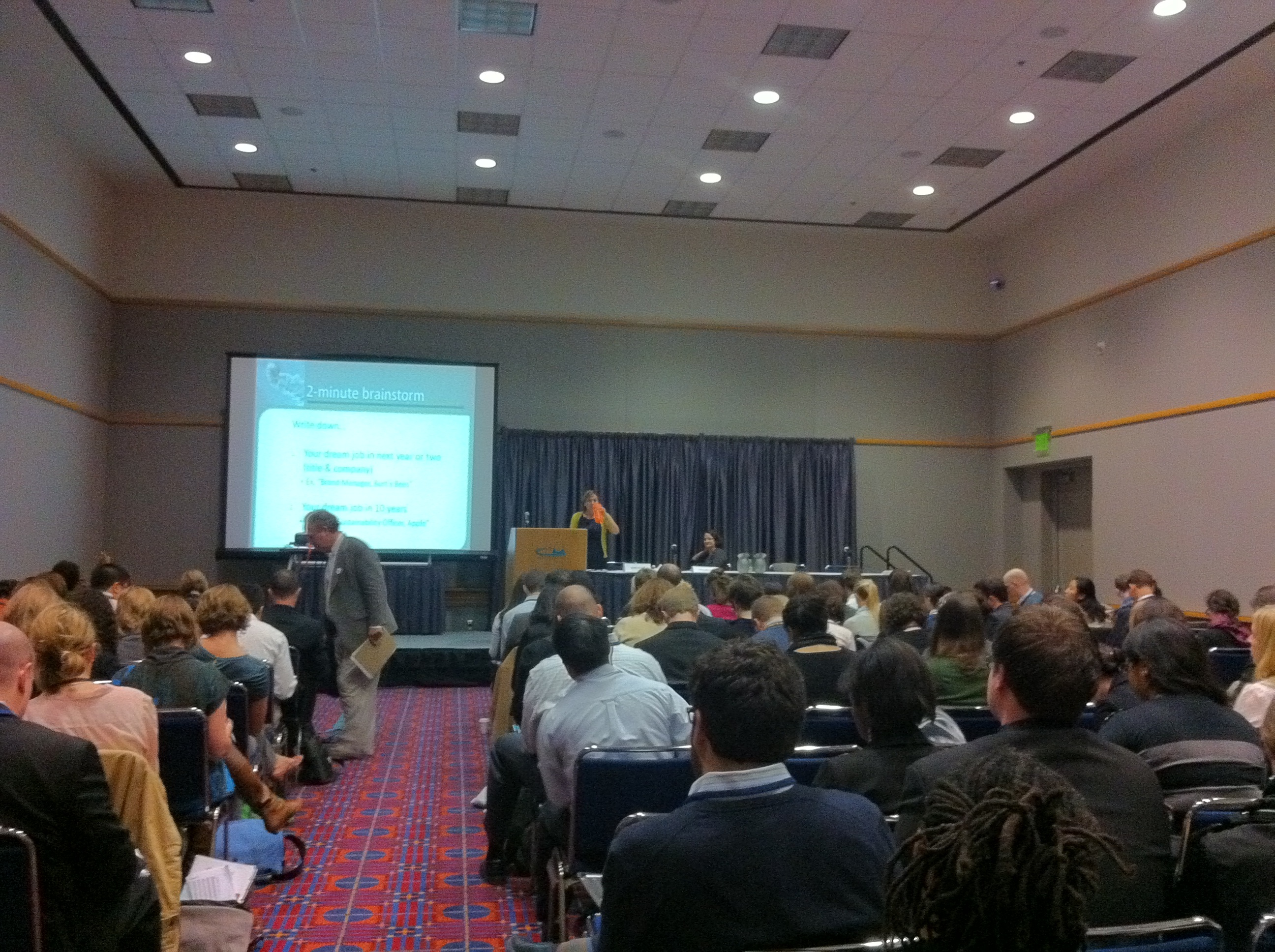
That was the focus of one of the panels at Net Impact 2011 featuring Avon’s VP of Sustainability and Corporate Responsibility, Tod Arbogast; LinkedIn’s Head of Employment, Branding and Community, Meg Garlinghouse; and Jones Lang LaSalle’s SVP of Sustainability Strategy, Michael Jordan.

Representing companies that are often called out for their out of the box thinking on social responsibility and sustainability, the speakers discussed a range of topics including the always debatable definition of corporate social responsiblity, measuring employee engagement as well as the skill sets that go into the makings of a CSR director.

Main highlights:

CSR: Burden or Boon?

“CSR should die as a term. CSR departments tend to take away from possible impact. Just like ‘global’ is part of everything we do at LinkedIn, so is CSR,” Garlinghouse emphasized, noting, “Employee engagement is key for CSR, not separate departments.”

Jordan picked up where Garlinghouse left off adding that businesses must leverage engaged employees and identify champions early on for successful CSR programs.

“CSR has a direct tie-in with our business. After you’ve built the business case and identified regional champions, work together on identifying and building in efficiencies,” he advised.

“Build friendships, be seen as pragmatic and capture early wins. Then leverage those to go further and faster,” Arbogast said.

Measuring Employee Engagement

But how do you measure the efficacy of employee engagement?

A survey I conducted a few months ago with Smartbrief on Sustainability asked whether companies were measuring employee engagement on CSR. With over 70 percent of respondents saying they did not measure employee engagement, how were these panelists identifying wins and scale?

Once again, there was a healthy difference of opinion across the panel. While Garlinghouse emphasized company mission, the other two focused on operational procedures and policies.

“We recruit on the notion of social impact. These conversations happen during the interview process,” Garlinghouse alluded, noting LinkedIn’s entire modus operandi is based on “creating economic opportunities.” LinkedIn also offers employees the opportunity to do whatever they feel passionate about one Friday a month. “They have to come to work but they can pursue whatever they are interested in,” she said.

“For us, measuring the progress of your platform from awareness to implementation to operational strategy has always been key,” added Jordan.

Defining CSR With Strong Stakeholders

Responding to an audience question about resourcing for CSR initiatives, Jordan emphasized that most of Jones Lang LaSalle’s sustainability activities have been client-driven. “There is a clear business case because our clients are demanding sustainability strategies,” he said.

For Garlinghouse, employees have been the most forthcoming about corporate social responsibility initiatives. “Our CEO is very involved. Also, our employees are really committed to our company mission,” she said.

Skill Sets for a CSR Officer

Arbogast, who joined Avon in late 2009 after successfully leading Dell’s Giving program for a number of years, is a well-sought after speaker at the Net Impact conference each year. This year too, he was asked what aspiring professionals could do to become effective CSR officers. He laid out three crucial skills sets:

  1. People’s Person: Know how to communicate with people from all kinds of backgrounds and perspectives.
  2. Conflict Resolution: You must be a skilled mediator. Know that business cases will vary from group to group and you must be willing and diplomatic enough to finesse the tension lines and bring about resolution.
  3. Business Pragmatism: You must be a realist and know the business inside out. For CSR and sustainability programs to be effective, you need to understand what drives decisions and action.

Originally written for and published on CSRwire’s Commentary section Talkback on November 9, 2011.

Share this:

  • Tweet
  • Email a link to a friend (Opens in new window) Email
  • Share on Reddit (Opens in new window) Reddit
  • Print (Opens in new window) Print
Like Loading...

2011 in review @ Singh on CSR: 5 Months, 31 Blog Posts, 9,500 Visits

08 Sunday Jan 2012

Posted by Aman Singh in CSR

≈ Leave a comment

Tags

aman singh, aman singh das, Brand Management, BSR 2011, citizen journalism, corporate citizenship, corporate social responsibility, CSR, CSR communication, CSR journalist, CSR reporting, CSR strategy, economic value, employee engagement, In Good Company, mainstream media, net impact 2011, Occupy Wall Street, shared value, social media, sustainability, sustainable business, sustainable business practices


The WordPress.com stats helper monkeys prepared a 2011 annual report for this blog.

Here’s an excerpt:

The concert hall at the Sydney Opera House holds 2,700 people. This blog was viewed about 9,500 times in 2011. If it were a concert at Sydney Opera House, it would take about 4 sold-out performances for that many people to see it.

While I won’t bore you with the stats, here are the top three winners of 2011:

  1. Net Impact and BSR 2011: 7 Days, 2 Conferences, 5 Trends in CSR & Sustainability
  2. Does Expending Resources on CSR and Sustainability Destroy Economic Value?
  3. CSR and Sustainability in Mainstream Media: Citizen Journalism Or Simply Shared Value?

Thank you to all of you for a tremendous year! I value your support, trust, readership, comments, courage and enthusiasm to say, do and compel others toward the right action.

Here’s to expanding our “small world” of CSR and sustainability slowly but surely, one person at a time in 2012!

– Aman

Share this:

  • Tweet
  • Email a link to a friend (Opens in new window) Email
  • Share on Reddit (Opens in new window) Reddit
  • Print (Opens in new window) Print
Like Loading...

The Unruliness of Corporate Responsibility & Hyper Transparency: Quotable Quotes from Net Impact & BSR 2011

09 Wednesday Nov 2011

Posted by Aman Singh in CSR, CSR reporting

≈ Leave a comment

Tags

aman singh, aman singh das, Autodesk, Bea Perez, brand management, Brian Dunn, BSR, BSR 2011, Business for Social Responsibility, Carol Cone, cause marketing, Chris Jochnick, corporate citizenship, corporate social responsibility, CSR, CSR reporting, Deloitte, Edelman, Events, Gregory Unruh, hyper trasnparency, integrated reporting, Jessica Fries, Kate Heiny, Leadership, LinkedIn, Lynelle Cameron, Management, Meg Garlinghouse, Net Impact, Occupy Wall Street, Ofra Strauss, Social Responsibility, Stakeholder Engagement, Sustainability, sustainability reporting


I spent the last two weeks attending and speaking at the Net Impact and BSR conferences. As is typical at both conferences there is always too much to choose from and a lot to absorb. Since I cannot offer you a summary of each and every panel I attended/spoke at, here are some of the top line quotes heard at the conferences:

CSR: Always a Difference in Opinions

“CSR used to be about doing the right thing. Now it’s all about how it makes business sense.” – Campbell Soup’s VP for CSR Dave Stangis

“I hate the term CSR. It has slowed the movement and in many ways ensured that it is not built into systems, accounting, etc. I prefer [the term] sustainability although that’s not a big favorite either.” – Lynelle Cameron, Director of Sustainability, Autodesk

“We think CSR is good business.” – Suzanne Keel-Eckmann, National Director for Corporate Responsibility and Sustainability, Deloitte

A bag of sweet potato fries at Burgerville in Portland, Oregon: Social messaging done right?

“CSR should be led by charity and employee engagement, not CSR departments.” – Meg Garlinghouse, Head of Employment Branding and Community, LinkedIn

“Our CEO still believes that he is the company’s chief sustainability officer. But he realized that we need to be more organized and structured in our efforts because there is a lot to be done.” – Bea Perez, Chief Sustainability Officer, Coca-Cola in response to Reverse Cause Marketing: Coca Cola’s Pursuits in the Middle East

The Role of Business in Social Enterprise

“We must see social problems as business opportunities.” – Carol Cone, EVP, Edelman

“I worked on Wall Street, driven by greed. Regardless of what anyone says, greed is not good. You get so immersed in the system you forget what all you can do with your life.” – Charles Kane, Former CEO and Board Member, One Laptop Per Child

“A lot of charities are beginning to worry that a lot of the problems they have been trying to solve are not going away. Business still tends to be more sustainable.” – Steve Andrews, CEO, SolarAid

“In the last few years, business has lost tremendous trust in the marketplace. That we are GOOD now rests on us.” – Ofra Strauss, Chairperson and former CEO, The Strauss Group 

Personal Responsibility

“When you know what you’re doing is helping thousands, the payback is so much more fulfilling than any number of stock options and bonuses.” – Charles Kane, Former CEO and Board Member, One Laptop Per Child

“We need to change without giving up who we are. There are no riots against business that are profitable. We need to talk with them, not talk to them.” – Ofra Strauss, Chairperson and former CEO, The Strauss Group

“The more you peel the onion, the more you realize there is to be done. You just need to be constantly excited about peeling the onion.” – Brian Dunn, CEO, Best Buy

The Role of an MBA

“No profession exists to make the practitioners rich. There is always a higher purpose.” – Gregory Unruh, Director, Lincoln Center for Ethics, Thunderbird School of Global Management

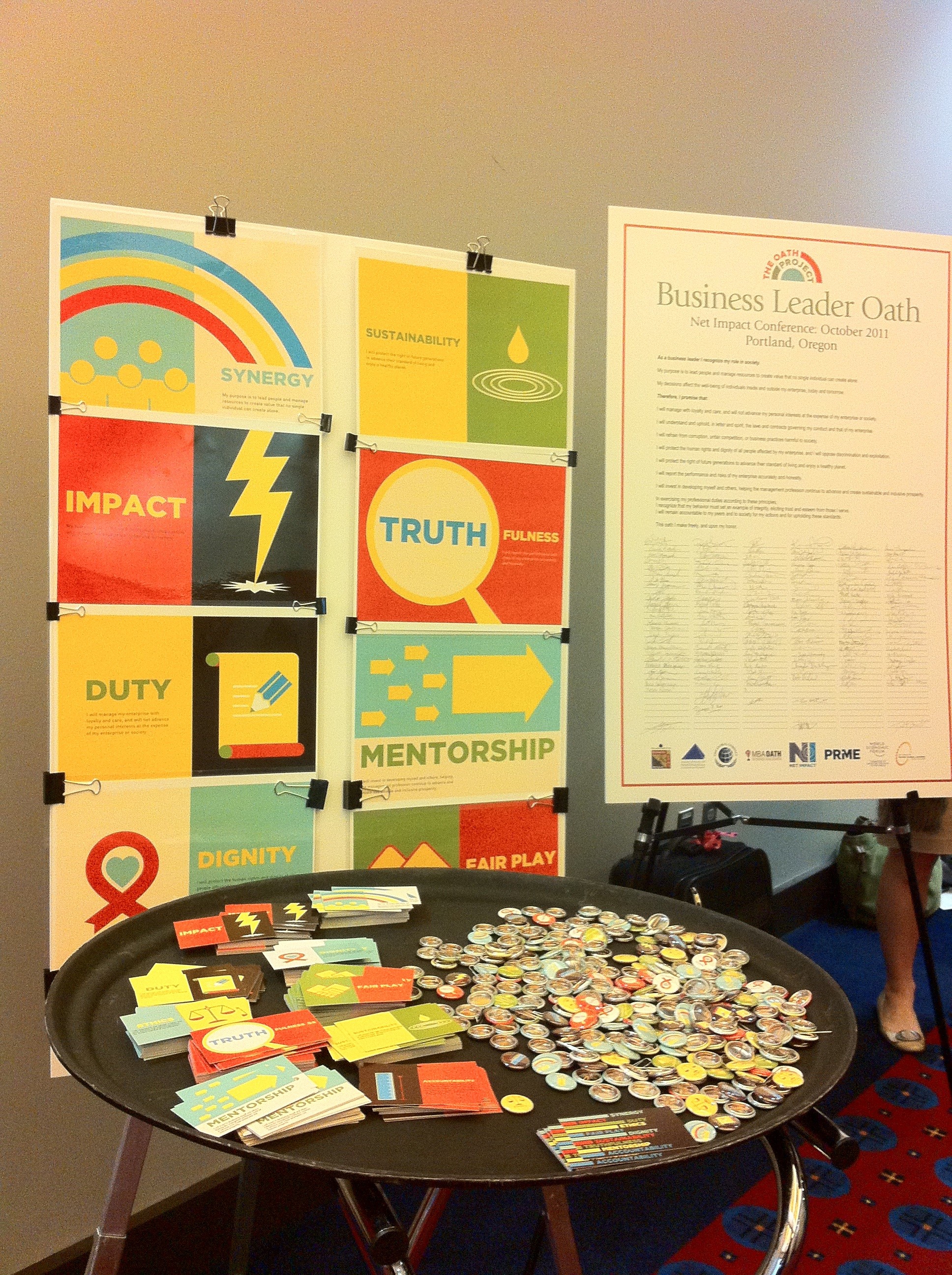
“I don’t know if its [The MBA Oath] is going to work. But it is in the right direction and symbolizes a complete shift in mentality.” – Max Anderson, President and Cofounder, The MBA Oath

“I’m waiting to see the day when a new employee tells me they attended a class in college called Change Agent 101.” – Anonymous 

Transparency

“We’re from the Midwest. We don’t advertise our initiatives. But lately there has been a shift in this thinking and our communication style. Transparency is a journey and we are in the early stages of that.” – Kate Heiny, Group Manager of Sustainability, Target

“The priority should always be why not disclose instead of why disclose.” – Chris Jochnick, Director, Oxfam America

“When you are increasingly naked, fitness is not optional.” – Quoted by yours truly during a BSR panel on hyper-transparency. Citation: Macrowikinomics

Integrated Reporting

“For us, integrated reporting starts with the thinking within the company on how they will sustain their value in the future. Integrated reporting starts with integrated thinking.” – Jessica Fries, Director, International Integrated Reporting Committee

Share this:

  • Tweet
  • Email a link to a friend (Opens in new window) Email
  • Share on Reddit (Opens in new window) Reddit
  • Print (Opens in new window) Print
Like Loading...

Net Impact and BSR 2011: 7 Days, 2 Conferences, 5 Trends in CSR & Sustainability

07 Monday Nov 2011

Posted by Aman Singh in CSR

≈ 7 Comments

Tags

Al Gore, aman singh, aman singh das, Anheuser Busch, Bea Perez, brand management, Brand Management, Brian Dunn, BSR 2011, Business, Carlos Brito, cause marketing, Coca Cola, corporate citizenship, corporate social responsibility, CSR, CSR communications, CSR reporting, CSR strategy, ethical leadership, Events, Hanna Jones, hyper transparency, Liz Maw, Management, net impact 2011, Nike, Occupy Wall Street, Ofra Strauss, PR, radical transparency, risk management, Scott Wicker, shared value, Social Enterprise, Social Responsibility, Sustainability, sustainability, sustainable business practices, transparency, UPS, Vail Horton


There couldn’t have been a better way to end 2011 than the ambitious and cheerful Net Impact conference followed by Business for Social Responsibility‘s (BSR) annual conference.

Last year marked the inaugural year for my participation in both conferences. I came back encouraged, informed and enthused about the work ahead of us. [See: Can MBA Students be Taught Humility? and The Sustainability Jobs Debate] This year – perhaps because I have been deeply immersed in the CSR space – I feel a bit bereft, despite invigorating conversations and inspiring keynotes.

Don’t get me wrong.

While the Net Impact panels once again illustrated an incredibly knowledgeable student body set to graduate in coming years, BSR attendees and speakers showcased high aspirations and a deep understanding of the complexity of issues that face us today.

Throughout the seven days, I was continually questioned: Did you learn something new? What trends have you identified from all that you have heard? And each time I thought, what’s missing? Why am I not coming up with any articulate answers? Is my brain fried or is it something else?

On Friday, finally, sitting through a six-hour flight back to the east coast, it hit me. The CSR sector had grown up.

As a receiver of information, I was among familiarity, maturity. While last year the conferences motivated and inspired, this year the conversations focused on strategies, case studies, examples, successes and failures.

As Dave Stangis, VP of CSR for Campbell Soup articulated at a panel on Blue Sky Thinking during NI11, “CSR is no longer about identifying the business case. Today, we have evolved from questioning why to answering how.”

The Net Impact panels focused on nuts and bolts, dos and don’ts, a far cry from years past. The BSR roundtables featured honest evaluations, admittance of failure, collaborative statements of success and practical tips for newcomers.

Here then, are the top five trends I observed at two of the year’s most well-attended conferences on corporate social responsibility, innovation and sustainability:

1. We LOVE Shared Value:

Michael Porter’s “creating shared value” has appealed to the corporate sector like no other concept in recent years. Not corporate social responsibility or corporate sustainability, citizenship or conscious capitalism. There seems something so potent about shared value that CSR and sustainability executives cannot stop talking about it! A year ago, they would tell me “CSR is embedded in our DNA.” Now that statement has evolved to “Our culture has always been about creating shared value.”

Point is, CSV offers us nothing more radically new than the concept of CSR. It dictates the same concept of stakeholder engagement, mutual benefits, holistic bottom lines. But it has resonated by removing the morality that responsibility instantly dictates. For CSR and sustainability executives who have to make the business case to their C-suite, creating shared value provides them with their business case.

2. Familiarity breeds contempt

I found several attendees tell me how repetitive some of the sessions were, that they didn’t learn too much that was new or revolutionary. Perhaps it was because the same folks were attending the conferences every year? Earlier this year I wrote on Forbes’ CSR blog that instead of attending the conferences every year, we should send a colleague the following year so that we can actually widen the net of information and inspiration.

This continues to hold true: Chances are, every year there will be some common denominator at these conferences. With issues like energy conservation, water scarcity, poverty, community relations and employee engagement remaining the overarching topics, why not let one of the non-converted/uneducated learn next year?

Lesser chance of you suffering from conference fatigue.

3. Where are the CSOs?

In September, Ellen Weinreb, a prominent CSR and sustainability recruiter, released a report titled CSO Back Story*. Essentially, the report tracks every executive with the title of chief sustainability officer among the U.S.’s publicly traded companies. Her research points to 29 such individuals. While it omits the many hundreds of officers holding a wide breadth of titles ranging from CSR director to VP for sustainability and social responsibility, the report pinpointed several best practices and the continuing lack of standardization on how companies define, prioritize and implement corporate responsibility.

But I digress. [See what Corporate Secretary had to say about the report or download the complete report here.]*

Point is: Only two of the 29 CSOs Weinreb identified were in attendance at BSR: Coca-Cola’s Beatrice Perez and UPS’ Scott Wicker. Both were named CSO sometime this year. Where were the others? Wasn’t the conference meant for CSR and sustainability executives to come together for three days of knowledge sharing and benchmarking? What happened this year?

4. The Emotional Quotient

Both conferences featured wonderfully articulate keynote speakers, including KaBoom’s Darryl Hammond, Keen Mobility’ Vail Horton, Nike’s Hannah Jones, Al Gore, Strauss Group’s Ofra Strauss, Anheuser Busch’ Carlos Brito and Best Buy’s Brian Dunn.

While they discussed CSR and sustainability from their unique pedestal, the common denominator was the emotional connection they demonstrated with their cause, their brand, and their philosophy.

Hammond discussed how his childhood taught him the importance of play in a kid’s life. Strauss emphasized how her consumers and conflict-ridden Israel continues to teach her the right way of conducting business, of stakeholder engagement, of business being the real power in solving social problems.

Dunn on the other hand, focused on humility, responsible leadership and the importance of connecting with employees and consumers.

While last year’s speakers evinced more pragmatism, a businessman’s stoicism, this year the air held tension, an unspoken worry that things were going wrong too quickly, that we all needed to wake up. Quickly. The speakers were talking of soft – un-businesslike some would say – attributes: Social responsibility, connecting, respect, and the human condition, even destitution.

What had happened?

Let’s see: A recession that instead of leveling off, seems to be spreading across generations and countries for starters; a growing understanding that each of our actions – and inactions – impact many others in the world; a disastrous lack of trust for business; and a generational divide that seems to be holding the current decision makers accountable for their decades of excess.

Is business leadership finally waking up to their societal stakeholders?

5. Occupy Wall Street: Ignore or Engage?

Almost every keynote brought up this mass of undefined protestors that have continued to expand beyond American borders. Net Impact’s Executive Director Liz Maw opened the 2011 conference by asking attendees to “Occupy Wall Street but from within.”

Al Gore said, “Business must respond,” and that “it wasn’t a question any more.”

Ofra Strauss showed a three-minute video of the protestors equating them to civil unrest and a grassroots movement of discontent that business has to recognize and address.

At my BSR panel on hyper-transparency I brought up this commonality in one of my responses and posed a question for the audience: Will business ever think of these protestors as stakeholders? To my surprise, Jeff Mendelsohn from New Leaf Paper said that he and fellow attendees had, in fact, invited the Occupiers during a recent conference and that “The dialogue proved very productive for business and the protestors.”

Will anyone else follow?

*Full disclaimer: I worked with Weinreb on the report.

Share this:

  • Tweet
  • Email a link to a friend (Opens in new window) Email
  • Share on Reddit (Opens in new window) Reddit
  • Print (Opens in new window) Print
Like Loading...

11 Challenges for Corporate Sustainability: A Review

24 Saturday Sep 2011

Posted by Aman Singh in CSR, CSR reporting

≈ 5 Comments

Tags

Accountability, aman singh, aman singh das, benchmarking sustainability, brand management, Brand Management, Business, conference board, corporate citizenship, corporate social responsibility, CSR, CSR events, CSR reporting, CSR strategy, ethics and compliance, Events, global reporting initiative, GRI, innovation, integrated reporting, Leadership, leadership, Management, risk management, social media, Social Responsibility, Stakeholder Engagement, supply chain, Sustainability, sustainability, sustainability reporting


Early this year, at the Global Reporting Initiative’s official launch in North America, Director of the Conference Board’s Center for Sustainability David Vidal asked a room full of senior CSR and sustainability executives:

What are the top three reasons for your company’s reluctance to embrace sustainability—and adopt sustainability reporting?

Now, as I prepare my keynote presentation for the Center’s annual summit next week on Innovation, Sustainability & Social Media, the answers to David’s question six months ago remind me of how quickly some businesses — and the sustainability space — are evolving.

Here’s what I wrote then on Vault’s CSR blog:

——————————–

The responses that came from an audience representing the glitterati of the corporate social responsibility world might surprise.

Keep in mind that a majority of them (I’m almost tempted to say all) don’t need another lecture on the business case for CSR or sustainability, are active advocates, and represent companies that–for a multitude of reasons–recognize the link to their bottom lines.

What these responses point to, however, is the continued sense of reluctance across senior leadership toward combining the social and environmental with corporate. The path to effective CSR isn’t a linear process by any means and these responses should help those who continue to struggle with mental and ideological barriers within their companies.

Because knowing the challenge is half the battle.

As you go through these, make an elementary checklist. Which of these sound familiar? How did you tackle them? Do any seem/remain insurmountable in the current corporate reality of thrift and inflexibility? Share your perspectives by leaving a comment or connecting with me @AmanSinghCSR.

And, without further ado, and in no particular order:

  1. Doubt
  2. Liabilities
  3. Denial
  4. Resources
  5. Causality
  6. Lack of Global Standards
  7. Benchmarking
  8. Lack of comparative credibility
  9. Uncertainty
  10. Fear of the unknown
  11. Fear of the known

——————————–

My estimation is that this list continues to evolve depending on the industry, the chief in charge, and even by which quarter we are in.

In coming days, I will review these challenges  — after hearing from some of business’ most eminent executives at the Annual Summit —  and hopefully shed some light on how some businesses’ have indeed managed to overcome them, and found advantage in doing so.

Stay tuned!

Share this:

  • Tweet
  • Email a link to a friend (Opens in new window) Email
  • Share on Reddit (Opens in new window) Reddit
  • Print (Opens in new window) Print
Like Loading...

Does Expending Resources on CSR and Sustainability Destroy Economic Value?

13 Tuesday Sep 2011

Posted by Aman Singh in CSR

≈ 11 Comments

Tags

aman singh, aman singh das, Aneel Karnani, BP, brand management, Brand Management, Business, business strategy, Campbell Soup, CEO Network, Commitforum, corporate citizenship, corporate social responsibility, CSR, CSR reporting, CSR strategy, Dave Stangis, Ethics, ethics and compliance, Events, Fenton, Gerry Sullivan, Green, green jobs, Leadership, Management, Paul Herman, risk management, shared value, social enterprise, Social Impact, social responsibility, Social Responsibility, Starbucks, Sustainability, sustainability, sustainable business


Corporate Social Responsibility isn’t about giving money away and adopting the latest cause of activists. CSR and sustainability are approaches to business operation and execution that build employee engagement, improve environmental performance, create positive social impact, enable operational efficiency, reduce cost, foster innovation, strengthen relationships with customers and consumers and ultimately…create business advantage.

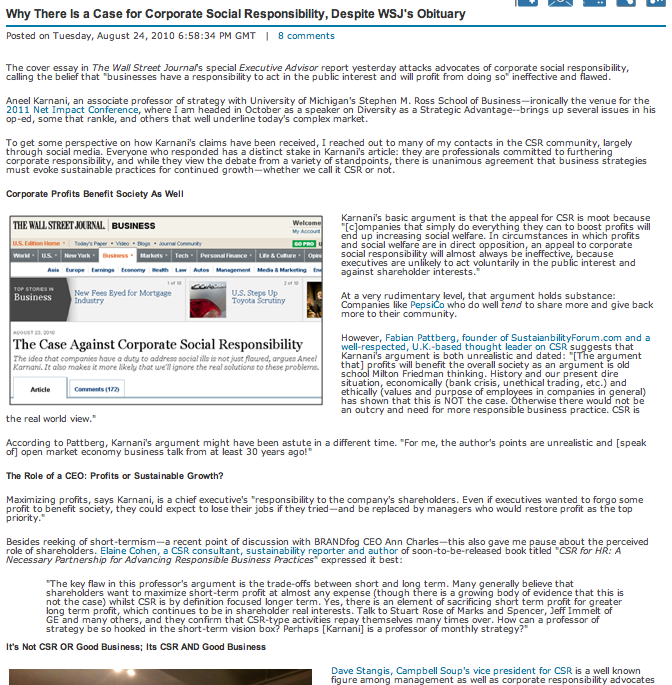
That was Dave Stangis, VP for Corporate Responsibility with Campbell Soup Company responding to University of Michigan Professor Aneel Karnani’s infamous editorial in The Wall Street Journal, “The Case Against Corporate Social Responsibility.”

Then, the argument was “capitalism versus corporate social responsibility, CSR versus profits, and where an idea like CSR fits into a business’ main objective, which is to make profits for its shareholders.”

Despite numerous debates [Fenton’s BIG CSR debate] and as many editorials and reports [Why There Is a Case for Corporate Social Responsibility], the inequity of the idea — or the perception that being responsible will cost a company money and therefore is an expense business doesn’t need — prevails.

But the actual essence of this debate no one can seem to pinpoint. Are we fighting over semantics or strategy?

Is it the misperception that CSR is a cost, a tagged on responsibility, and therefore, unnecessary for companies? Or that CSR is completely estranged from the notions of capitalism as Professor Karnani believes — and is, in fact, the wrong argument?

Since his controversial editorial, Karnani of course has continued to incite criticism for what many call an “extremely shortsighted and narrow view.”

Now, the associate professor of management and strategy for Michigan’s Ross School of Business is headed to New York City to debate his argument in real-time on the occasion of the CR COMMIT! Forum 2011, organized by Corporate Responsibility Magazine and NYSE Euronext [Details below].

Fashioned as an Oxford-style debate [DEBATE: RESOLVED that when companies expend resources on corporate responsibility and sustainability they destroy economic value], Karnani will be joined by Gerry Sullivan, president of the VICE fund, on the pro-markets side.

On the pro-sustainability side will be Paul Herman, CEO of HIP Investor and Dr. Vinay Nair, founding partner of Ada Investments and adjunct associate professor of finance and economics at Columbia Business School.

In a sneak peek, I talked to three of the debaters [Dr. Nair couldn’t make it] on the essence of their arguments as well as: How does each of them define CSR?

Take a read:

Thriving on the Value of Vice

Gerry Sullivan from VICE funds believes in the power of capitalism. His funds select well performing stocks of tobacco, alcohol, gaming and weapons companies because they believe that, “Vice industries tend to thrive regardless of the economy as a whole.” Anyone reminded of the root of the financial collapse?

“I believe in capitalism because it ensures that products and services coming out are tested on the profit mandate and ultimately are good processes because they come through the interaction and the ability to gain profit,” he said.

Fair enough. Historically, companies who do well tend to share more.

Making Too Much of CSR?

“My biggest fear of CSR is that people want to make more of it than it really is. A company’s ability to employ better people and deploy profits is the real goal. Everything else is settled by the market,” he continued.

But clearly there is a differentiator between companies that invest in their community and immediate environment over the long-term and those that focus on short-term yields?

Affirmative, says Paul Herman.

Citing the ever quotable example of BP, he said, “When you look at their track record, BP was not a good corporate citizen and lost 40% of shareholder value in just a few months post the oil spill. Companies are not prepared for the volatility of climate change and its effect on cash flows and natural resources.”

Further, “Research from Wharton School and other academics has shown measurably that companies that help solve social and environmental problems can enjoy a higher shareholder and portfolio value,” he said.

“This decreases risk for business and increases value,” he added.

CSR Cannot Dictate Social Enterprise, But Profits Can

Because it had begun to sound like a battle between two followers of capitalism with opposite operational ideologies, I asked Karnani to step in.

“Companies can maximize profits and social enterprise at the same time, which is why capitalism works well. This is where Paul makes a good argument. Of course companies should do all this,” he said.

“But we don’t need CSR to make this argument. It’s as simple as ‘make the money, help employees.’” he added.

Here is where the caveat comes in however, he said. “This isn’t always true. When markets fail, we cannot appeal to companies to sacrifice profits for CSR and it is naive of anyone to think that all the stakeholders are always aligned in their interests. If this were true, we wouldn’t need the study of economics,” he argued.

His solution? Going back to what he had argued in the WSJ editorial last year: Government regulation.

And this is where my problem with the debate starts: How can government regulate behavioral change, cultural perceptions, and a deteriorating environment? Or are we now talking of CSR as a program, an initiative, a fundraising for charity opportunity?

If so, was Karnani suggesting the route the Indian government took recently by “mandating 2.5% of net operating profits must be spent on CSR” by all publicly traded companies?

Perhaps, although we won’t know till the live debate at the COMMIT! Forum.

Back to Square One: What the heck is CSR?

Clearly, the next question: How are these men defining corporate social responsibility? Intentionally or not, I had hit the nail on its head.

VICE Funds: “CSR is Green, And It Isn’t Generating Green”

According to Sullivan, “CSR is embedded into green and green hasn’t generated green for most companies.” Also blaming the government for supporting “and pumping a ton of money into green jobs,” which many say has been a failed effort at reviving the economy, Sullivan continued:

The internet bubble taught us that having pool tables and kegs doesn’t make the companies money. If the jury is still out on whether good companies will do good things, I say they’re smart enough to treat their employees well. You don’t need CSR for that.”

“I would like the companies I invest in to not be socially responsible but responsible to their shareholders and producing products that the government can use to generate revenue. I certainly hope that these companies think highly of their employees but I’m less inclined to think that they would give up profits over socially responsible activities.

HIP Investor: “CSR is Generating Top Line Growth”

For Paul, the question isn’t about green or management. “You start by asking yourself what social or environmental problem you are solving. Companies who are doing well have a core mission of improving the world in some way and making money while doing so.”

Citing the example of banks, he explained, “Banks were started to help people grow their income and wealth and became more integrated in their communities.”

“Starbucks in the U.S. spends more on the health care of its employees than the coffee beans because they support a better quality of life for employees and a higher labor standard.”

The argument, at least for Herman, isn’t about the validity of CSR anymore. “It’s about generating top-line growth and bottom-line profits. That’s why employees and investor relations teams are key in solving this paradigm,” he concluded.

Karnani: “If CSR is Beyond Making Money, Then It’s Not Making Money”

“CSR is a very confused notion. If you just mean businesses doing good for society, then capitalism is actually good [for society]. If CSR goes beyond ‘making money,’ then it’s not about ‘making money.’ When a company does something socially useful and loses money over it, that’s CSR. And definitionally, CSR loses money,” he concluded.

Confused? Irate? Redeemed?

Want to attend the COMMIT!Forum? Register here or connect with me on Twitter @AmanSinghCSR for a special discount code. The Forum begins on September 26, 2011, at the Javits Center in New York City and offers a full two-day agenda complete with a CSR careers symposium, keynotes and workshops.

And if you cannot make it, stay tuned here for more coverage.

Share this:

  • Tweet
  • Email a link to a friend (Opens in new window) Email
  • Share on Reddit (Opens in new window) Reddit
  • Print (Opens in new window) Print
Like Loading...

Marsh & McLennan’s 2010 CSR Report: Holistic, Aspirational, But Lean on Data

07 Wednesday Sep 2011

Posted by Aman Singh in CSR, CSR reporting, HR

≈ 2 Comments

Tags

Accountability, aman singh, aman singh das, brand management, Brand Management, Business, Business Ethics, Chief Diversity Officer, Chief sustainability officer, Christine Salerno, corporate citizenship, corporate social responsibility, CSR, CSR communications, CSR reporting, CSR strategy, Elizabeth Barry, guy carpenter, HR, Kathryn Komsa, Leadership, management, Management, marsh, mercer consulting, Michael Connor, oliver wyman, shared value, Silvia Davi, social responsibility, Social Responsibility, Stakeholder Engagement, supply chain, Sustainability, sustainability, Work culture


“Our corporate social responsibility is our best kept secret.”

What compels a company with 52,000 employees and with over 140 years of systems in place to publish a CSR report?

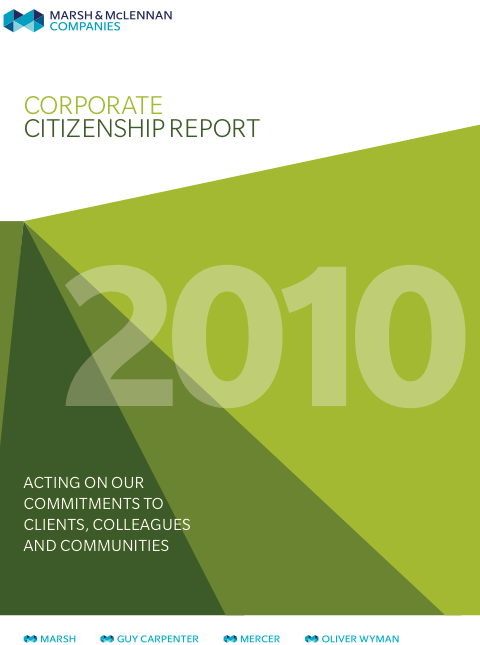
For professional services giant Marsh & McLennan, as CSR Director Christine Salerno put it, there was an urgency “to put a stake in the ground.” The company, following shortly on the footsteps of a rebranding initiative [from Marsh to Marsh & McLennan], released its first CSR report, complete with a press briefing at its New York headquarters, late last month.

At first — and second — glance, the Marsh CSR report is 21 pages of text and very little data. What the executives present at the briefing, however, had to say, was far more enlightening and worth noting.

After Silvia Davi, head of corporate communications and brand introduced the panel — an all-women team of Chief Sustainability Officer Elizabeth Barry, Chief Diversity Officer Kathryn Komsa and Salerno — Barry started off with some forward-looking statements.

1. Sustainability

“We were doing a lot [in sustainability] but we needed structure. Now we can gain much more from the same efforts by implementing them as part of a long term strategy,” she said, adding that, “This is not about today, this is about tomorrow.”

Our work in CSR is our best kept secret. Now we have decided to collaborate and communicate our successes and challenges because colleague education and engagement are key to the success of our sustainability strategy.

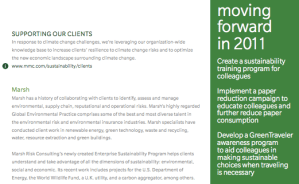
Pointing to a slide that charted key accomplishments since 2010, Barry noted that a majority of the data points were yet to occur. For example, the company is set to launch an internal “Green Traveler” program aimed at helping employees’ cut down their carbon footprint by educating them on telecommunication alternatives, etc. Also to follow later in the year: A “Paper Reduction Campaign” as well as a “Sustainability 101 Training Program.”

“I want everyone in the company to know that they are committing to a longterm strategy,” she emphasized. “Sustainability starts with people and our behavior and if every colleague made one tiny change, the impact collectively can be huge. It’s not a quick process but it is truly more sustainable.”

2. Diversity & Inclusion

The mission for CDO Komsa, who started in her current role in 2009, was “to create an enterprise-wide diversity and inclusion strategy.” “Our challenges are finding the right talent, resources, and the right market share in a multicultural world,” she said, adding a common refrain among the B2B sector, “Our raw material is our people and a diversity platform becomes a great way of creating shared value.”

Komsa also touched on an issue that has had insurance companies scratching their heads in recent years: How do you make a career in insurance sexy and attractive?

Noting that this is a big challenge and opportunity for Marsh, Komsa emphasized that her, “Team’s leading initiatives in coming months will be to tie in the four companies [Oliver Wyman, Marsh, Guy Carpenter and Mercer] and rebrand the insurance industry by emphasizing how we source our talent.”

3. Community Relations, Volunteerism, Philanthropy

Marsh and McLennan's 2010 CSR ReportSalerno who is an ex-investment banker chose to begin with a review of past challenges: “This is something that has always been done. What has been missing is the communications piece. There has been no cross collaboration internally within the units.”

“Our business case is to make sure that our CSR activities are creating impact in the communities we operate in and for our employees,” she added, noting that, “An engaged employee wants to stay. We want to make sure we are attracting the right people.”

The connection between CSR and recruitment is an increasingly acute problem for recruiters, especially in the B2B sector, where the commodity for sale isn’t so much a physical unit but organizational culture, intellectual growth and innovation. How do you leverage CSR as a recruitment strategy? [Join me at one of eight breakfast sessions on analyzing this very question starting next month.]

“Students coming out of college want to work for companies that are doing the right thing. Our strength is our people. So how do we use our biggest assets to create maximum impact?” Salerno responded.

4: Climate Change

In response to Business Ethics Publisher and veteran journalist Michael Connor’s question about setting goals on climate change, Barry pointed to the unique challenges of operating in cities like New York, where most companies don’t own their real estate. “Goals are hard for a professional services company. And when you add a lease to the equation, it becomes even harder. In most cases, we are in the middle of 10-year leases so in the interim, we are finding other ways to set goals, like how to reduce our real estate portfolio altogether.”

5: What Does Successful CSR Look Like for a Fortune 250 Company?

Employee engagement has always been a huge component of my blogs in the past because I truly believe that getting your employees on your side is half the battle for most companies struggling with reputation issues. They can be your best brand ambassadors and I asked the Marsh team what success looked like for all their CSR and sustainability efforts: A significant decrease in air travel, a certain number of LEED certifications, an internally set women and minority retention rate, or something else?

Repeating that they launched the CSR report as a way of putting a stake in the ground, Salerno emphasized that, “Employee engagement is a crucial piece and trying to quantify our efforts and rolling out a system to measure our activities has them talking.”

“We’re getting the information out there and they are discussing it,” she said, to which Komsa added that, “piles of resumes have been pouring in because the work we do aligns with someone’s values. That means our employees are talking, which is a huge win for us.”

Barry, however, might have put it best:

“This report doesn’t have as many foundations but it is an important story to tell. We don’t have all the answers but we do want to get started on finding them.”

At the end of the day, Marsh isn’t looking to solve the water crisis or achieve a zero carbon footprint. Their goals are moderate and their CSR report reflects a forward-looking attitude that is encouraging.

That they have a team in place approaching CSR strategically — and a lot more holistically than many other companies — is the right start.

Share this:

  • Tweet
  • Email a link to a friend (Opens in new window) Email
  • Share on Reddit (Opens in new window) Reddit
  • Print (Opens in new window) Print
Like Loading...
← Older posts
Newer posts →

Let's Talk!

Virtual
732-322-7797
amansinghdas@gmail.com

Blogs I Follow

  • Nonprofit Chronicles
  • Learned On by Andrea Learned
  • Angry African on the Loose™
  • csr-reporting
  • The CSR Blog
  • In Good Company: Singh on CSR

My Cloud

Capitalism 2.0 CSR CSR reporting CSRwire ESG Guest Author HR Stakeholder Engagement Sustainability Uncategorized

Recently written…

  • Rationality is Ruining Us: Mayors, presidents and governors join major businesses in charting way forward on climate change
  • 2015: the year businesses recognize that climate change is real – and 4 other themes
  • Hardcore lessons of sustainability – ’10 Words or Less’
  • Brewing a Better Future [#BaBF] with Heineken: Examining the Many Flavors of Local Sourcing
  • From Conflict to Collaboration: Kimberly-Clark and Greenpeace Participate in LIVE Twitter Chat

What others are reading

aman singh aman singh das Brand Management Business corporate social responsibility CSR CSR reporting CSRwire ESG Leadership Stakeholder Engagement supply chain Sustainability sustainability Work culture

Categories

Most Read

  • None

Create a free website or blog at WordPress.com.

Nonprofit Chronicles

Journalism about foundations, nonprofits and their impact

Learned On by Andrea Learned

Angry African on the Loose™

I have opinions. I am from Africa. I live here now. I blog.

csr-reporting

Connecting the dots between Business, Society & the Environment

The CSR Blog

Connecting the dots between Business, Society & the Environment

In Good Company: Singh on CSR

Connecting the dots between Business, Society & the Environment

Privacy & Cookies: This site uses cookies. By continuing to use this website, you agree to their use.
To find out more, including how to control cookies, see here: Cookie Policy
  • Subscribe Subscribed
    • In Good Company: Singh on CSR
    • Join 119 other subscribers
    • Already have a WordPress.com account? Log in now.
    • In Good Company: Singh on CSR
    • Subscribe Subscribed
    • Sign up
    • Log in
    • Report this content
    • View site in Reader
    • Manage subscriptions
    • Collapse this bar
 

Loading Comments...
 

    %d