• ABOUT THE AUTHOR
  • Sustainability
  • CSR
  • CSR reporting

In Good Company: Singh on CSR

~ Connecting the dots between Business, Society & the Environment

Tag Archives: CEO Network

Ceres Investor Summit 2012: 5 Trends Not to Bet Against

03 Thursday Jul 2014

Posted by Aman Singh in CSR, CSRwire

≈ Leave a comment

Tags

bank of america, bill gates, Brand Management, Business, carbon, carol sanford, CEO Network, ceres, chad holliday, climate change, CSR, CSRwire, dupont, energy, ESG, Events, investor relations, Leadership, Management, Social Responsibility, stem, Sustainability, sustainability


Last week, Ceres and the United Nations came together to host the 2012 Investor Summit on Climate Risk & Energy Solutions in New York City. With several announcements marking the day—a record $260 billion was invested in clean energy in 2011—it was Bank of America Chairman Chad Holliday’s pre-lunch presentation that stood out for its aspirational message.

I had the opportunity to host Holliday last year for a keynote on responsible business practices. The occasion: The release of Carol Sanford‘s book The Responsible Business, for which Holliday provided an articulate Foreword.

This time around too, Holliday chose to focus on lessons learned from his years leading DuPont, which saw record growth, transition from a chemical company to a science-based products company, as well as the country’s first chief sustainability officer appointment.

“As you listen, make sure you’re not inadvertently betting against something,” he cautioned adding, “Whether you want to own it or not is merely situational. But listen.”

Here then are Holliday’s five things to not bet against:

1. Don’t Bet Against Breakthroughs

“Don’t bet against a major breakthrough or a series of breakthroughs that create clean, cheap energy.” Holliday followed this warning by a reminder that “the price of natural gas in the Middle East” used to be our prime concern.

“No one was talking about shale energy, tidal [energy] 10 years ago. Somehow we missed that,” he added. Holliday also alluded to the American Energy Innovation Council he set up when at DuPont that counts Bill Gates, Xerox CEO Ursula Burns, GE’s Jeff Immelt and others as members: “We
really felt that such a breakthrough was probable so don’t discount the power of innovation.”

2. Don’t Bet Against America

“Particularly American engineers and research universities,” he continued. “Thirty five of the 50 top research institutions worldwide are located in the U.S. Seventeen of the top 20 are in the U.S.,” he said

Bank of America Chairman Chad Holliday Admission rates in Science, Technology, Engineering and Mathematics (STEM) have been declining for years in the U.S., and several sectors are ramping up their community development and research dollars to invest in STEM initiatives and academic institutions. While it is true that graduates from Asian countries have increasingly filled STEM jobs—and have an incredible presence in Silicon Valley—in recent years, Holliday was quite right to point out that “it will require other countries to grow awfully fast to catch up with us.”

“What we see in the press is that China is overtaking us in engineering. In fact, there is no question that China is indeed leading us in the number of graduating engineers. But when it comes to quality and diversity—biotechnology, nanotechnology, quality control, systems engineering—we are hands down champions,” Holliday said.

3. Don’t Bet Against Sustainable Energy For All

“One of the three commitments of the United Nations General Secretary was to provide electricity to the 1.3 billion people globally who still don’t have access to electricity,” said Holliday. “Now let’s discuss the 1.3 billion-strong population of China: How productive would they be without access to electricity?”

His message: That’s opportunity to deliver value for business, investors and entrepreneurs.

4. Don’t Bet Against Dramatic Events Driving Dramatic Government Action

“One nuclear fallout after the tsunami that struck Japan was enough to compel Germany to take the decision to go completely nuclear-free for their energy supply,” he said.

Emphasizing that one must increasingly view business and investment in the context of their social and environmental setting, Holliday offered a glimpse into his role on Shell’s CR committee: “I regularly meet with NGO groups and investors to understand what they are thinking. I then coordinate with Shell’s corporate responsibility committee to visit sites to really check and see if they are doing what they commit to. Then it makes a difference,” he said, adding, “We cannot measure growth and success from afar because that’s just PR.”

5. Don’t Bet Against People in This Room

Putting the onus on the over 500 investors in attendance, Holliday said: “You’re here today because you think private money can make a difference in this sector. You’ve made a good decision.”

Indicating to his recent appointment as Bank of America’s chairman, he continued:

“I joined Bank of America in the time of a recession. I didn’t have much time to do any due diligence so I decided to find out what they were doing on sustainability. And I’m proud to say that I was impressed. They have already made an 18 percent deduction in greenhouse gases (GHG), made a $20 million commitment to loans for sustainable projects and nurture a working culture that prioritizes sustainability.”

Many other firms in the room could probably tell similar stories, he added, warning: “But don’t bet against each other.”

Emphasizing the need for public private partnerships, he concluded: “Working with the public sector and other stakeholders is going to be key in our goal of sustainable energy for all.” There too, he had the same warning: “Don’t bet against each other.”

Originally written for and published on CSRwire’s Commentary section Talkback on January 18, 2012.
Share this:

  • Tweet
  • Email a link to a friend (Opens in new window) Email
  • Share on Reddit (Opens in new window) Reddit
  • Print (Opens in new window) Print
Like Loading...

Link

Translating Business Responsibility: An interview with Warner Bros. CEO & Chairman Barry Meyer: Now LIVE on CSRwire!

24 Tuesday Jan 2012

Posted by Aman Singh in CSR, Uncategorized

≈ Leave a comment

Tags

aman singh, Barry Meyer, Brand Management, Business, cause marketing, CEO Network, corporate social responsibility, CSR, CSRwire, Ethics, Events, Justice League, Leadership, Management, Nonprofits, Social Enterprise, Social Impact, Social Media, Social Responsibility, Uncategorized, We Can Be Heroes


Translating Business Responsibility: An interview with Warner Bros. CEO & Chairman Barry Meyer: Now LIVE on CSRwire!

When the Justice League comes together to fight evil, evil stands little chance. In a world of economic uncertainty and social unrest, superheroes provide children with mentors, entrepreneurs with lessons in responsibility, and the rest of us with inspiration. Now, DC Entertainment has joined hands with Time Warner and Warner Bros. to launch We Can Be Heroes.

Their target: The hunger crisis in the Horn of Africa.

Their spokescharacters: The Justice League

Share this:

  • Tweet
  • Email a link to a friend (Opens in new window) Email
  • Share on Reddit (Opens in new window) Reddit
  • Print (Opens in new window) Print
Like Loading...

REI CEO: Sustainability is a Team Sport…and a Business Enabler

02 Wednesday Nov 2011

Posted by Aman Singh in Uncategorized

≈ 1 Comment

Tags

aman singh, aman singh das, Brand Management, Business, business case for sustainability, CEO, CEO Network, cooperative, corporate social responsibility, CSR, Events, green, green products, Leadership, leadership, Management, Net Impact, net impact 2011, REI, Sally Jewell, shared value, social responsibility, supply chain, Sustainability, sustainability, sustainable business, sustainable business practices, women CEO


My latest post on CSRwire’s Talkback: Sustainability is a Team Sport.

Share this:

  • Tweet
  • Email a link to a friend (Opens in new window) Email
  • Share on Reddit (Opens in new window) Reddit
  • Print (Opens in new window) Print
Like Loading...

Does Expending Resources on CSR and Sustainability Destroy Economic Value?

13 Tuesday Sep 2011

Posted by Aman Singh in CSR

≈ 11 Comments

Tags

aman singh, aman singh das, Aneel Karnani, BP, brand management, Brand Management, Business, business strategy, Campbell Soup, CEO Network, Commitforum, corporate citizenship, corporate social responsibility, CSR, CSR reporting, CSR strategy, Dave Stangis, Ethics, ethics and compliance, Events, Fenton, Gerry Sullivan, Green, green jobs, Leadership, Management, Paul Herman, risk management, shared value, social enterprise, Social Impact, social responsibility, Social Responsibility, Starbucks, Sustainability, sustainability, sustainable business


Corporate Social Responsibility isn’t about giving money away and adopting the latest cause of activists. CSR and sustainability are approaches to business operation and execution that build employee engagement, improve environmental performance, create positive social impact, enable operational efficiency, reduce cost, foster innovation, strengthen relationships with customers and consumers and ultimately…create business advantage.

That was Dave Stangis, VP for Corporate Responsibility with Campbell Soup Company responding to University of Michigan Professor Aneel Karnani’s infamous editorial in The Wall Street Journal, “The Case Against Corporate Social Responsibility.”

Then, the argument was “capitalism versus corporate social responsibility, CSR versus profits, and where an idea like CSR fits into a business’ main objective, which is to make profits for its shareholders.”

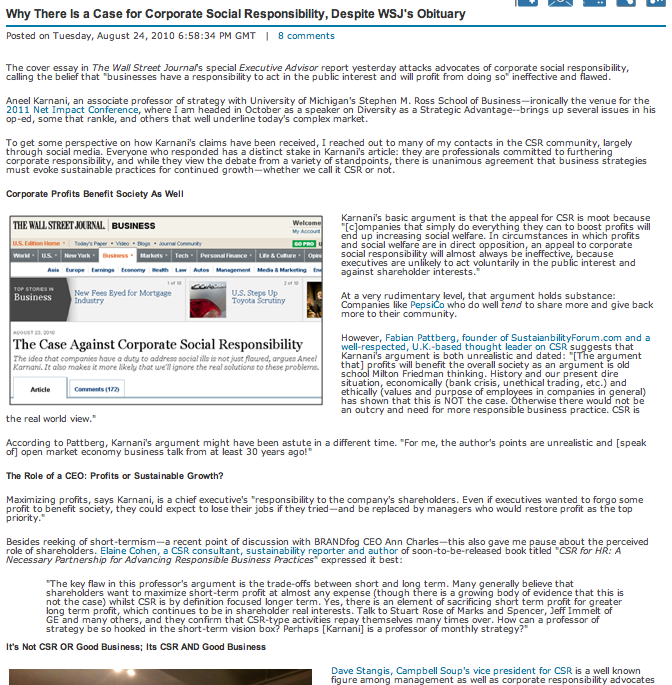
Despite numerous debates [Fenton’s BIG CSR debate] and as many editorials and reports [Why There Is a Case for Corporate Social Responsibility], the inequity of the idea — or the perception that being responsible will cost a company money and therefore is an expense business doesn’t need — prevails.

But the actual essence of this debate no one can seem to pinpoint. Are we fighting over semantics or strategy?

Is it the misperception that CSR is a cost, a tagged on responsibility, and therefore, unnecessary for companies? Or that CSR is completely estranged from the notions of capitalism as Professor Karnani believes — and is, in fact, the wrong argument?

Since his controversial editorial, Karnani of course has continued to incite criticism for what many call an “extremely shortsighted and narrow view.”

Now, the associate professor of management and strategy for Michigan’s Ross School of Business is headed to New York City to debate his argument in real-time on the occasion of the CR COMMIT! Forum 2011, organized by Corporate Responsibility Magazine and NYSE Euronext [Details below].

Fashioned as an Oxford-style debate [DEBATE: RESOLVED that when companies expend resources on corporate responsibility and sustainability they destroy economic value], Karnani will be joined by Gerry Sullivan, president of the VICE fund, on the pro-markets side.

On the pro-sustainability side will be Paul Herman, CEO of HIP Investor and Dr. Vinay Nair, founding partner of Ada Investments and adjunct associate professor of finance and economics at Columbia Business School.

In a sneak peek, I talked to three of the debaters [Dr. Nair couldn’t make it] on the essence of their arguments as well as: How does each of them define CSR?

Take a read:

Thriving on the Value of Vice

Gerry Sullivan from VICE funds believes in the power of capitalism. His funds select well performing stocks of tobacco, alcohol, gaming and weapons companies because they believe that, “Vice industries tend to thrive regardless of the economy as a whole.” Anyone reminded of the root of the financial collapse?

“I believe in capitalism because it ensures that products and services coming out are tested on the profit mandate and ultimately are good processes because they come through the interaction and the ability to gain profit,” he said.

Fair enough. Historically, companies who do well tend to share more.

Making Too Much of CSR?

“My biggest fear of CSR is that people want to make more of it than it really is. A company’s ability to employ better people and deploy profits is the real goal. Everything else is settled by the market,” he continued.

But clearly there is a differentiator between companies that invest in their community and immediate environment over the long-term and those that focus on short-term yields?

Affirmative, says Paul Herman.

Citing the ever quotable example of BP, he said, “When you look at their track record, BP was not a good corporate citizen and lost 40% of shareholder value in just a few months post the oil spill. Companies are not prepared for the volatility of climate change and its effect on cash flows and natural resources.”

Further, “Research from Wharton School and other academics has shown measurably that companies that help solve social and environmental problems can enjoy a higher shareholder and portfolio value,” he said.

“This decreases risk for business and increases value,” he added.

CSR Cannot Dictate Social Enterprise, But Profits Can

Because it had begun to sound like a battle between two followers of capitalism with opposite operational ideologies, I asked Karnani to step in.

“Companies can maximize profits and social enterprise at the same time, which is why capitalism works well. This is where Paul makes a good argument. Of course companies should do all this,” he said.

“But we don’t need CSR to make this argument. It’s as simple as ‘make the money, help employees.’” he added.

Here is where the caveat comes in however, he said. “This isn’t always true. When markets fail, we cannot appeal to companies to sacrifice profits for CSR and it is naive of anyone to think that all the stakeholders are always aligned in their interests. If this were true, we wouldn’t need the study of economics,” he argued.

His solution? Going back to what he had argued in the WSJ editorial last year: Government regulation.

And this is where my problem with the debate starts: How can government regulate behavioral change, cultural perceptions, and a deteriorating environment? Or are we now talking of CSR as a program, an initiative, a fundraising for charity opportunity?

If so, was Karnani suggesting the route the Indian government took recently by “mandating 2.5% of net operating profits must be spent on CSR” by all publicly traded companies?

Perhaps, although we won’t know till the live debate at the COMMIT! Forum.

Back to Square One: What the heck is CSR?

Clearly, the next question: How are these men defining corporate social responsibility? Intentionally or not, I had hit the nail on its head.

VICE Funds: “CSR is Green, And It Isn’t Generating Green”

According to Sullivan, “CSR is embedded into green and green hasn’t generated green for most companies.” Also blaming the government for supporting “and pumping a ton of money into green jobs,” which many say has been a failed effort at reviving the economy, Sullivan continued:

The internet bubble taught us that having pool tables and kegs doesn’t make the companies money. If the jury is still out on whether good companies will do good things, I say they’re smart enough to treat their employees well. You don’t need CSR for that.”

“I would like the companies I invest in to not be socially responsible but responsible to their shareholders and producing products that the government can use to generate revenue. I certainly hope that these companies think highly of their employees but I’m less inclined to think that they would give up profits over socially responsible activities.

HIP Investor: “CSR is Generating Top Line Growth”

For Paul, the question isn’t about green or management. “You start by asking yourself what social or environmental problem you are solving. Companies who are doing well have a core mission of improving the world in some way and making money while doing so.”

Citing the example of banks, he explained, “Banks were started to help people grow their income and wealth and became more integrated in their communities.”

“Starbucks in the U.S. spends more on the health care of its employees than the coffee beans because they support a better quality of life for employees and a higher labor standard.”

The argument, at least for Herman, isn’t about the validity of CSR anymore. “It’s about generating top-line growth and bottom-line profits. That’s why employees and investor relations teams are key in solving this paradigm,” he concluded.

Karnani: “If CSR is Beyond Making Money, Then It’s Not Making Money”

“CSR is a very confused notion. If you just mean businesses doing good for society, then capitalism is actually good [for society]. If CSR goes beyond ‘making money,’ then it’s not about ‘making money.’ When a company does something socially useful and loses money over it, that’s CSR. And definitionally, CSR loses money,” he concluded.

Confused? Irate? Redeemed?

Want to attend the COMMIT!Forum? Register here or connect with me on Twitter @AmanSinghCSR for a special discount code. The Forum begins on September 26, 2011, at the Javits Center in New York City and offers a full two-day agenda complete with a CSR careers symposium, keynotes and workshops.

And if you cannot make it, stay tuned here for more coverage.

Share this:

  • Tweet
  • Email a link to a friend (Opens in new window) Email
  • Share on Reddit (Opens in new window) Reddit
  • Print (Opens in new window) Print
Like Loading...

As Steve Jobs Departs, A Review of Our Love-Hate Relationship With Apple…and Sustainability

24 Wednesday Aug 2011

Posted by Aman Singh in CSR

≈ 1 Comment

Tags

aman singh, aman singh das, Apple, brand management, brands with purpose, BSR Conference, Business, Carol Cone, cause marketing, CEO Network, consumer education, consumerism, corporate social responsibility, CSR, Edelman, Good Purpose Study, Green, In Good Company, Leadership, Management, Matthew Bishop, Performance with Purpose, Steve Jobs, Sustainability, sustainability, sustainable business, sustainable technology, technology, Work culture


As we slowly recover from the stupor of the not completely unexpected news that Steve Jobs has stepped down as Apple’s CEO, here’s a post from recent months that’s worth a retake.

Context: At Business for Social Responsibility’s (BSR) annual conference last year, Edelman’s Managing Director for Corporate Citizenship Carol Cone released the 2010 Good Purpose Study with a dramatic declaration: “Cause marketing is dead.”

The main overarching finding of the study, as regular readers will recall, was this:

87 percent of consumers worldwide believe that business needs to equate at least equal weight on society’s interests as on business interests.

Accompanying Cone at the release were panelists from Levi Strauss, PepsiCo and a personal favorite: The Economist‘s Matthew Bishop, who amid the hype and hoopla of the report, quietly asked: “Are we really going to stop buying Apple because of its crappy environmental policies?”

An excerpt, originally published on Vault’s CSR blog: In Good Company:

The GoodPurpose study by Edelman

“Cause marketing is dead”

That controversial statement is how Cone opened the panel, adding, “That [cause marketing] world is way over. Purpose has replaced cause marketing and branding.” Companies aren’t building marketing plans around a cause anymore, she argued. Rather, “they are infusing their very strategy and business model with purposeful corporate citizenship.”

Defining real purpose

Picking up where Cone left off, the always-entertaining Matthew Bishop began with a prediction: “If we continue the current road toward demanding transparency and corporate social responsibility, within the next five to 10 years, we will begin to see corporate board meetings being live streamed to select people.”

Chuckling about the ambitiousness of his own statement, he went on to note, “Likewise, the real question is how much of this data [in the Good Purpose study] is picking up on aspirations rather than real choices [of consumers].”

PepsiCo: Performance with Purpose

Alleging that PepsiCo’s latest mantra of “Performance with Purpose” was indeed a verification of this shift from cause marketing to purposeful corporate citizenship at companies, Communications Director for PepsiCo Americas Beverages Melisa Tezanos gave high points to CEO Indra Nooyi for pushing for a company-wide cultural change that today drives all their business functions.

[READ: Pepsi Takes Performance with Purpose to Heart: An Interview with Chief Personnel Officer Cynthia Trudell]

“However, Nooyi is completely unapologetic about giving ‘performance’ as much importance as the ‘purpose’ part and she makes no bones about it,” said Tezanos, adding that this helps everyone across the company stay committed to a culture of profitability with purpose. Explaining the drivers behind PepsiCo’s highly successful Refresh project, she further stated, “For millennials, social responsibility is huge. We’ve seen through research again and again that their purchase intent goes up significantly when the brand is associated with a good cause.”

And finally, referring to the findings of the Edelman study—and Cone’s earlier comment, she said, “Marketing used to be blamed for being short-termism. Today, marketers are the biggest defenders of long-termism.”

But would you give up Cola…or Apple?

Bringing the conversation back to a level plain field, Bishop concluded with a sobering thought, “But what is real and what is fake with purpose? Will Pepsi ever move beyond the heart of its products, i.e., increasing obesity? Are we really going to stop buying Apple [products] because they have crappy environmental policies?”

———————————–

Just some food for thought as we go on a whirlwind ride with the media in coming days on the history, the present, and the future of America’s favorite company, Apple. Don’t forget to add your perspective by leaving a comment or connecting with me @AmanSinghCSR.

And if you haven’t already, share your opinion on whether social media engagement make better brands or more effective leaders by taking this new BRANDfog survey on social media and leadership.

More on Edelman’s Good Purpose study: Encompassing 7,259 respondents in 13 countries, the study was conducted by consulting firm StrategyOne with the objective of analyzing whether—and how much—purpose plays into purchase decisions worldwide, and further, how these transform into consumer activism via social media.

Share this:

  • Tweet
  • Email a link to a friend (Opens in new window) Email
  • Share on Reddit (Opens in new window) Reddit
  • Print (Opens in new window) Print
Like Loading...

The Convergence Economy: A New Reality For Business (Sustainability) and Nonprofits

10 Wednesday Aug 2011

Posted by Aman Singh in CSR, Guest Author

≈ 2 Comments

Tags

Accenture, business, CEO Network, consulting, convergence economy, corporate accountability, corporate social entrepreneurship, corporate social responsibility, crisis management, CSR, CSR strategy, ethics and compliance, future of nonprofits, Gib Bulloch, Green, leadership, management, Nonprofits, risk management, social enterprise, social entrepreneurship, Stakeholder Engagement, supply chain, Sustainability, sustainability, sustainable business, UN Millenium Development goals, water, Work culture


If ever we needed proof that conventional development approaches are failing to address poverty, disease and malnutrition, the 10 year checkpoint for the UN’s Millennium Development Goals provided it.

The shortfalls in achievement in parts of Africa and South Asia cruelly expose the limits of our current efforts. Debate has recently turned to how business, governments and NGOs can work together in ways that align commercial self-interest with societal value. But the emergence of a ‘convergence economy‘ will disrupt incumbent development providers and ask many questions of businesses.

The Good News… and The Bad News

The good news is that the struggle against seemingly intractable problems such as malaria, drought and extreme poverty coincides with a time when global companies are looking for new markets. It’s no surprise, therefore, that NGOs and the private sector are increasingly working together. But all too often this collaboration is for one-off projects and conducted at arm’s length.

Business provides funds and NGOs deliver solutions. This may give business a license to operate in new territories, but it misses a large opportunity to transform communities for the long-term.

What is the Convergence Economy?

It is based on a merging of issues: Water, sanitation, education and disease, for instance, can only be addressed effectively together. It recognizes that the interests of NGOS do not run counter to those of business. And this results in a convergence of solutions, where it no longer matters whose logo is on the product or service that is improving the welfare of communities. 

We are all aware of how leading brands are supporting local communities and farmers, but beyond ethical supply chains and community based business practices, some businesses will have to consider more radical transformations of their operations.

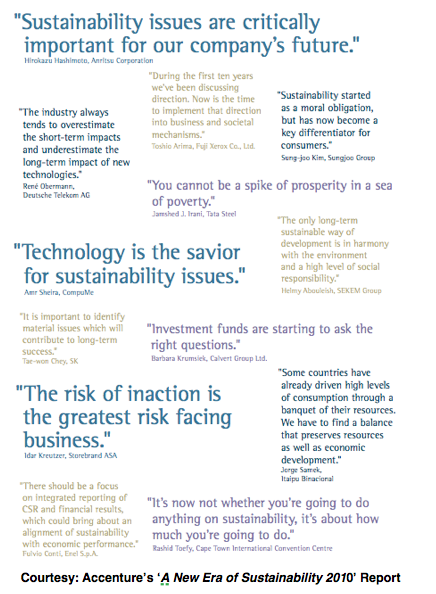
Accenture's New Era of Sustainability 2010 Report

We can expect to see hybrid organizations that genuinely bring together NGOs and businesses in newly formed entities that have joint and flexible value chains at their heart. Danone’s collaboration with Grameen in Bangladesh illustrates this and has resulted in entirely new products to combat infant malnutrition. In some cases, we can expect the private sector to receive grants rather than NGOs.

The ‘convergence economy’ therefore requires businesses to create new business and operating models in local markets and to identify where they may have the best capabilities to ‘touch’ local communities in place of or in partnership with traditional aid providers. These new businesses or subsidiaries may be in joint partnerships with NGOs and other players.

For solutions to be sustainable, they will need to feed back local innovations into the broader business to maximize commercial benefit. To maintain their commitment, they will have to persuade shareholders that these commitments with longer term pay back periods are essential for future growth.

What does the convergence economy mean for NGOs?

According to our survey with the United Nations Global Compact of 766 CEOs, 27 percent of CEOs saw NGOs as key stakeholders in areas of sustainability in 2007. That figure fell to just 15% in 2010.

NGOs will still occupy a vital position in development—indeed they must, as they possess the local knowledge and knowhow, but they will see their role changing.

NGOs will act as coordinators, not just providers.

They will attract investment finance as well as seeking grants. They will support free markets as a tool for development. This means adopting new capabilities and, to some extent, a new cultural outlook. In the same way private sector companies are used to disaggregating their businesses and outsourcing non-core operations, NGOs will have to redesign their structure and purpose.

They will need a venture capital mentality to create conditions for investment.

The convergence of development and commercial enterprise is not therefore merely about ethical supply chains or profit seekers embracing a broader definition of value.  It is about a far deeper and more fluid operational collaboration across sectors. As multinationals enter new markets, they will have to redesign their models and assist NGOS to do the same.

Then, what could be seen as a marriage of convenience today can become a more committed and productive long-term relationship in the future.

–By Gib Bulloch, Executive Director, Accenture Development Partnerships

Gib is the Founder and Executive Director of Accenture Development Partnerships (ADP), a ring-fenced not-for-profit consulting group within Accenture, whose clients include many of the major international NGOs and development agencies. ADP’s main focus is bringing affordable business and technology expertise to the international development sector and promoting private sector engagement in sustainable development. In 2007, ADP was awarded the Management Consulting Association (MCA)’s CSR Award and in 2008, Gib was named as the Sunday Times sponsored Management Consultant of the Year in the Best Partner/Director category.

Gib has lived and worked extensively in developing countries and is a regular speaker on the role of business in development, corporate social entrepreneurship and cross-sectoral partnerships.

Share this:

  • Tweet
  • Email a link to a friend (Opens in new window) Email
  • Share on Reddit (Opens in new window) Reddit
  • Print (Opens in new window) Print
Like Loading...
Newer posts →

Let's Talk!

Virtual
732-322-7797
amansinghdas@gmail.com

Blogs I Follow

  • Nonprofit Chronicles
  • Learned On by Andrea Learned
  • Angry African on the Loose™
  • csr-reporting
  • The CSR Blog
  • In Good Company: Singh on CSR

My Cloud

Capitalism 2.0 CSR CSR reporting CSRwire ESG Guest Author HR Stakeholder Engagement Sustainability Uncategorized

Recently written…

  • Rationality is Ruining Us: Mayors, presidents and governors join major businesses in charting way forward on climate change
  • 2015: the year businesses recognize that climate change is real – and 4 other themes
  • Hardcore lessons of sustainability – ’10 Words or Less’
  • Brewing a Better Future [#BaBF] with Heineken: Examining the Many Flavors of Local Sourcing
  • From Conflict to Collaboration: Kimberly-Clark and Greenpeace Participate in LIVE Twitter Chat

What others are reading

aman singh aman singh das Brand Management Business corporate social responsibility CSR CSR reporting CSRwire ESG Leadership Stakeholder Engagement supply chain Sustainability sustainability Work culture

Categories

Most Read

  • None

Blog at WordPress.com.

Nonprofit Chronicles

Journalism about foundations, nonprofits and their impact

Learned On by Andrea Learned

Angry African on the Loose™

I have opinions. I am from Africa. I live here now. I blog.

csr-reporting

Connecting the dots between Business, Society & the Environment

The CSR Blog

Connecting the dots between Business, Society & the Environment

In Good Company: Singh on CSR

Connecting the dots between Business, Society & the Environment

Privacy & Cookies: This site uses cookies. By continuing to use this website, you agree to their use.
To find out more, including how to control cookies, see here: Cookie Policy
  • Subscribe Subscribed
    • In Good Company: Singh on CSR
    • Join 119 other subscribers
    • Already have a WordPress.com account? Log in now.
    • In Good Company: Singh on CSR
    • Subscribe Subscribed
    • Sign up
    • Log in
    • Report this content
    • View site in Reader
    • Manage subscriptions
    • Collapse this bar
 

Loading Comments...
 

    %d