• ABOUT THE AUTHOR
  • Sustainability
  • CSR
  • CSR reporting

In Good Company: Singh on CSR

~ Connecting the dots between Business, Society & the Environment

Category Archives: CSR reporting

PwC Canada Releases 3rd Annual CSR Report: Staying the Course

03 Thursday Jul 2014

Posted by Aman Singh in CSR, CSR reporting, CSRwire, ESG

≈ Leave a comment

Tags

CSR, CSR report, CSR reporting, CSRwire, ESG, GRI, james temple, non-financial reporting, philanthropy, Philanthropy, pwc, Social Impact, Stakeholder Engagement, Sustainability, volunteerism, Work culture


PricewaterhouseCoopers (PwC) Canada released their third annual corporate responsibility report today. It’s nothing groundbreaking. But nor is it pages and pages of images and quotes from top leadership interspersed with hard-to-evaluate statistics.PwC_CR_Report_2011

In true PwC fashion, the report details commitments and achievements in 2011 only to quickly move on to highlighting challenges and the firm’s key plans for 2012 followed by an affirmation of the firm’s social and environmental strategy.

The pressure on firms big and small to report on their non-financial activities is significant. With the Global Reporting Initiative (GRI) officially launching in North America last year, CSR and sustainability reports are set to multiply in coming years. What always challenges me are the motivations behind the reporting: Is it simply peer pressure or do firms learn something from the process? Moreover, is the act of reporting an exercise in external communication or more of an introspective activity to improve processes and strategies?

I caught up with James Temple, PwC Canada’s Director of Corporate Responsibility for some insights:

What was the most important lesson learned from the often stressful exercise of putting this report together?

Every time we work on our Corporate Responsibility Report, we’re reminded that this is an evolving journey and one that requires us to be open to adapting to changing ideas, personalities and approaches to developing the most transparent narrative possible.

When you involve such a large number of stakeholders in such a rigorous process, all of whom are passionate about their work and the cause, it can prove to be a balancing act that requires a balance of leadership, managing expectations, and the ability to communicate with empathy and effectiveness.

Most importantly, the process has helped us finesse a blended approach that respects standard reporting frameworks and our unique firm culture and structure to develop a narrative that is representative of the success (and the challenges) we face along the way.”

The report mentions plans for a new three-year strategic plan to guide the next phase of PwC Canada’s CSR program. Any insights you can provide into that?

Over the next few months, we will be completing our environmental scan and a strengths, weaknesses, opportunities and threats (SWOT) analysis to ensure that we are being thoughtful about our dynamic marketplace conditions along with gaining valuable input from our Global Network of Firms.

Philanthropy plays a crucial role in targeting social and environmental challenges through nonprofit partnerships but it’s often the strategy behind these donations that helps make them effective. Any insights on what works well for PwC’s B2B industry?

From the 2011 CR Report: “In 2011, PwC contributed a total of $2,533,000 in charitable donations and sponsorships to community organizations across Canada.”

At PwC Canada, we have adopted a strategy that focuses on educating employees and other stakeholders about the most effective ways to give back to their communities.

We encourage people to utilize our PwC Canada Volunteer Continuum that spells out how a person or organization can deepen their engagement with the charitable sector while developing their skills and experiences.

This could include the ways people use their skills to volunteer, how they look at sharing their community experiences, calling on their business networks for support, or how to allocate their personal or organizational resources in the most effective way possible.  Our approach is rooted in the regular feedback we receive from the not-for-profit sector and considers impact (not just dollars and cents).

What are some points of achievements from the report that you feel especially proud of?

In the fall of 2010, PwC hosted a series of roundtable discussions with representatives from the not-for-profit sector, public and private foundations and major corporations called the Capacity Building Roundtable Project.

The purpose of the project was to raise awareness about how corporate funders could better allocate their resources to help the not-for-profit sector become more sustainable and deliver lasting results within their communities.

The report concluded with a step-by-step process that addressed critical needs identified by the community that could have the most immediate and scalable impacts.

One of the critical findings was the need to encourage other corporations to provide not-for-profits support for core operational expenditures, and ensure they build time for grant recipients to reflect, take risks and test new innovations into grant proposals.

How do you define success in CSR reporting? Metrics? Media mentions? Or a set of internal goals?

We encourage our employees and other stakeholders to integrate a CR mind-set into their day-to-day business operations.  We want to inspire and empower people to look for ways to embed good CR practices into their decision-making frameworks.

A great example of how we’ve engaged our stakeholders in a CR dialogue was through the Citizen’s Reference Panel. PwC Canada brought together people from across Ontario to discuss their views on how to build a more sustainable and cost-effective healthcare system across the province.   We published a piece of thought leadership outlining the results, and it’s something that will help our business, the public and governments have better insights into the development of new healthcare strategies.

Our firm can play in helping to shape the debate on sustainability issues impacting businesses today.

Success means knowing you’ve done everything you can to help develop the CR conversation.

Originally written for and published on CSRwire’s Commentary sectionTalkback on February 27, 2012..

Share this:

  • Tweet
  • Email a link to a friend (Opens in new window) Email
  • Share on Reddit (Opens in new window) Reddit
  • Print (Opens in new window) Print
Like Loading...

Sustainability & Your Supply Chain: Risks, Metrics & Opportunities

03 Thursday Jul 2014

Posted by Aman Singh in CSR reporting, CSRwire, ESG

≈ Leave a comment

Tags

accountability, Coca Cola, CSR reporting, CSRwire, Environment, ESG, ethical sourcing forum, ethics, intel, supply chain, Supply chain management, Sustainability, sustainability, transparency


What combination of education, training and technical solutions does it take to compel change through your organization as well as your supply chain?

It is a question that continues to dog manufacturers and retailers big and small as supply chains grow complex and social and environmental challenges multiply. What role should companies play in educating – and engaging – their suppliers? What’s ethical? With Sustainability Reporting becoming a mark of competitive advantage, how can organizations best track their performance?

The upcoming Ethical Sourcing Forum will kickoff its two-day conference next month by putting Coca-Cola, Intel, Bic, the International Trade Centre (ITC) and Intertek on the hot seat to try to answer some of these complex questions.

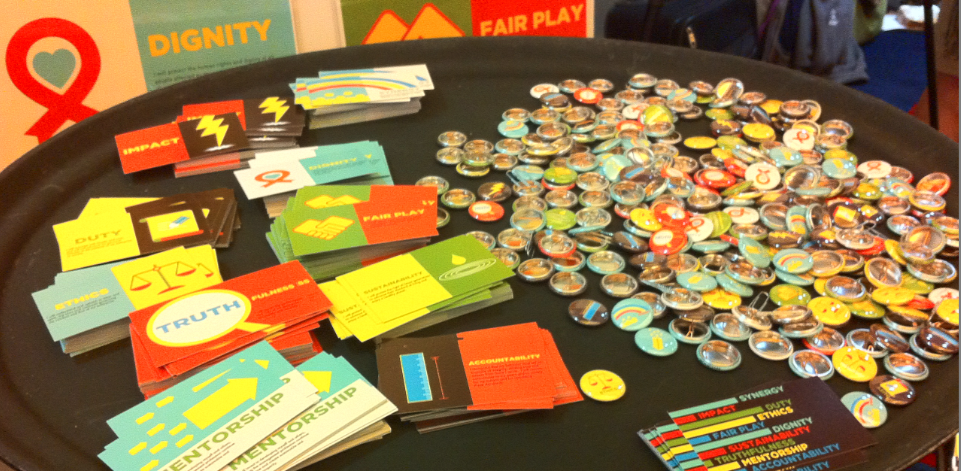
Ethical_Sourcing_Forum

The panel, led by me, will not only offer best practices but also discuss specific tools that the companies have either developed or collaborated with their nonprofit partners on, to track and examine sustainability progress with their suppliers.

For a preview of what promises to be a compelling session of benchmarking and teasing apart a sensitive topic, I turned to Mathieu Lamolle, a market analyst with the ITC for some insights.

An Ethical Supply Chain

The ITC, a United Nations agency for trade related technical assistance, has one goal: To help businesses become more competitive in global markets, speeding economic development and contributing to sustainable development.

Part of this goal, Mathieu told me, is a “Standards Map web tool for organizations to analyze, map and compare themselves according to an array of 75+ sustainability standards in supply chains.”

“We also want to enable any organization that has its own code of conduct and assessment protocol to benchmark what they are doing against others. They can benchmark their own corporate practices and see how they measure up against other companies and sustainability standards.”

Ranging from small companies, traders and suppliers to retailers, importers and others, this new tool will encourage data sharing for the purpose of internal benchmarking with the ultimate goal being an ethical and efficient supply chain.

While it remains strictly a business-to-business tool for now, Mathieu emphasized that there are plans to eventually roll it out for general consumption and public benchmarking as well.

Benchmarking Sustainability Progress

StandardsWhat’s especially promising about ITC’s new tool is its abject emphasis on sharing for the purpose of benchmarking. The organization’s role as a UN neutral intermediary between public-private partnerships further helps break through the risk-averse behavior that often delays well-meaning initiatives within organizations.

Although, so far the tool has found resonance with participants for the primary purpose of internal tracking and public sharing of information on the Standards Map web tool, Mathieu admitted that the true value of the tool “is going to unfold when we can spread the news globally” and allow people to compare the true progress being made by participating organizations on educating and training their supply chains. “The more people use it the better it is,” he said.

The impact of such a global tool can prove to be significant in an industry that is evolving and constantly juggling multifold standards and regulations. Want to learn more about the Standards Map? Wondering how you can use the tool to track your organization’s sustainability progress?

Join us at the Ethical Sourcing Forum for a lively discussion that will focus not only on available tools, but also how to best manage metrics, challenges of a global supply chain and whether any of the present panelists’ tools can be customized to work in your industry.

Originally written for and published on CSRwire’s Commentary sectionTalkback on February 22, 2012.

Share this:

  • Tweet
  • Email a link to a friend (Opens in new window) Email
  • Share on Reddit (Opens in new window) Reddit
  • Print (Opens in new window) Print
Like Loading...

Marks & Spencer’s Plan A: Five Years Later

02 Wednesday Jul 2014

Posted by Aman Singh in CSR reporting

≈ Leave a comment

Tags

Brand Management, BSR, business, consumers, corporate responsibility, CSR, CSR reporting, greater good, marc gunther, marks and spencer, plan b, Sustainability, sustainability, sustainability strategy


“We launched Plan A because there is no Plan B,” started Richard Gillies, Marks & Spencer’s Director of Plan A, CSR Sustainable Business during a panel on how to nudge consumers to buy more sustainable products at the recently concluded BSR Conference.

Marks & Spencer’s sustainability strategy, more popularly called Plan A, has been the topic of several discussions and numerous awards since it was launched in 2007, mostly for its innovative and expansive approach (over 180 commitments) but also for its honest declaration of a business’ shortcomings.

And Gillies attested to that: “We made some very public and very defined goals back in 2007.” As the retailer approaches the five-year anniversary of Plan A, what are some of the results we can expect?

For starters, Gillies offered the following:

  • Carbon footprint reduction of 26 percent
  • Reduction in energy use by 25 percent
  • All packaging now sourced from sustainable sources
  • Waste to landfill cut from 80 percent to zero

Where does the consumer fall into place with these achievements – and the ultimate goal of a zero environmental footprint? And what will it take for consumers to make decisions based on sustainability performance – or as someone in the audience put it: “How do we make sustainability sexy?”

“Consumers are not prepared to pay more or compromise in the name of sustainability. We have to learn to market goods that work well and are sustainable, instead of naively believing that they will sell simply because they are sustainable,” Gillies emphasized. The market isn’t there yet, he indicated.

Gillies also admitted Marks & Spencer, the UK’s largest clothing retailer and a significant marketer of food in Europe, was “only just beginning on our sustainability journey.” “We are only now exploring our business in the mainstream. We’re trying to get our own house in order before venturing outside,” he said alluding to the initial intent of Plan A to set a sustainability strategy internally that would impact every single product line of the business.

The outspoken yet charming CSR director, who has been with the food and clothing retailer since 1984, did not mince words when moderator Virginia Terry from BSR asked him how M&S was approaching the huge task of consumer education.

Indicating that businesses must understand the potential for consumer education and their role in it, he said, “For us, consumers have to be educated behind the scenes by only being offered sustainable choices. If the array of choices on a supermarket’s shelves are all sustainable, then we don’t have an option any more.” It is because we are competing with varying levels of products – and brands – in the market that have historically put a premium price on sustainability, that consumers invariably pick the cheaper product, he added.

The next step for Marks & Spencer?

“Consumer engagement,” offered Gillies. “For example, we have been incentivizing customers to give back to Oxfam. Every time they donate used clothing, etc. to Oxfam, they receive a voucher to be used at our stores. In three years, we have helped Oxfam generate an additional $7 million in revenue because of this program.”

This, in turn, promotes customer loyalty and brings M&S’s recycling commitment to the forefront of consumer action.

As for employee participation in sustainability, there is no question in Gillies’ mind that for Plan A to be successfully integrated, a company’s internal audience must be deeply commitment and passionate about the work. “Plan A has taken a life of its own and employee engagement has been an integral aspect of this. Our employees see the benefit of what Plan A offers for themselves and their families’ lifestyles and sustenance,” he said.

Because employee participation has been incredibly high, sustainability at Marks & Spencer continues to be a journey with several discoveries along the way. For example, the carbon-free bra launched earlier this year or their re-spun coats. Gillies explained: “We take waste wool and re-spin it into coat fabric. Turns out, this can be produced in Europe for a lower cost and much lesser environmental footprint than in one of our factories in Asia.”

As for the bra, it was part of a well-strategized plan to showcase an energy-efficient factory in Sri Lanka, which is powered partially by solar and hydro energy, and one of the first sites to test its eco-factory concept. As Marc Gunther wrote earlier this year, “To offset the CO2 generated by the bra’s manufacturing and shipping, M&S is planting 6,000 trees in Sri Lanka, some of which are lime and mango trees intended to generate income for farmers.”

Gillies offered some context: “The workers in Sri Lanka weren’t doing a drive to benefit the company. They were doing it because they saw the benefits of the program for their community, their families.”

A well thought out sustainability strategy ensures the business is doing more good instead of less bad. For Gillies, this means “inspiring consumers to get to a new place without telling them that they have to sacrifice along the way.”

“Business has to reset the values of what is quality, premium and sustainable. We have to look at our products and systems and rethink how consumers evaluate value,” he added.

It’s a tough task and enough to keep the best of intentions under cover for fear of failure or the immensity of scale required. But even for those, Gillies had a word of advice: “Business cannot be paralyzed by the scale of what needs to be done. This is very much a journey. We just need to stay focused on the greater good for our planet.”

Originally written for and published on CSRwire’s Commentary section Talkback on November 8, 2011.

Share this:

  • Tweet
  • Email a link to a friend (Opens in new window) Email
  • Share on Reddit (Opens in new window) Reddit
  • Print (Opens in new window) Print
Like Loading...

The Makings of a CSR Program: In Conversation with Avon, LinkedIn & Jones Lang LaSalle

02 Wednesday Jul 2014

Posted by Aman Singh in CSR, CSR reporting

≈ Leave a comment

Tags

avon, business, career advice, careers, corporate responsibility, CSR, CSR reporting, employees, HR, Jobs in CSR, Jones Lang LaSalle, Leadership, LinkedIn, Management, Net Impact, social impact, Sustainability, sustainability, Work culture


That was the focus of one of the panels at Net Impact 2011 featuring Avon’s VP of Sustainability and Corporate Responsibility, Tod Arbogast; LinkedIn’s Head of Employment, Branding and Community, Meg Garlinghouse; and Jones Lang LaSalle’s SVP of Sustainability Strategy, Michael Jordan.

Representing companies that are often called out for their out of the box thinking on social responsibility and sustainability, the speakers discussed a range of topics including the always debatable definition of corporate social responsiblity, measuring employee engagement as well as the skill sets that go into the makings of a CSR director.

Main highlights:

CSR: Burden or Boon?

“CSR should die as a term. CSR departments tend to take away from possible impact. Just like ‘global’ is part of everything we do at LinkedIn, so is CSR,” Garlinghouse emphasized, noting, “Employee engagement is key for CSR, not separate departments.”

Jordan picked up where Garlinghouse left off adding that businesses must leverage engaged employees and identify champions early on for successful CSR programs.

“CSR has a direct tie-in with our business. After you’ve built the business case and identified regional champions, work together on identifying and building in efficiencies,” he advised.

“Build friendships, be seen as pragmatic and capture early wins. Then leverage those to go further and faster,” Arbogast said.

Measuring Employee Engagement

But how do you measure the efficacy of employee engagement?

A survey I conducted a few months ago with Smartbrief on Sustainability asked whether companies were measuring employee engagement on CSR. With over 70 percent of respondents saying they did not measure employee engagement, how were these panelists identifying wins and scale?

Once again, there was a healthy difference of opinion across the panel. While Garlinghouse emphasized company mission, the other two focused on operational procedures and policies.

“We recruit on the notion of social impact. These conversations happen during the interview process,” Garlinghouse alluded, noting LinkedIn’s entire modus operandi is based on “creating economic opportunities.” LinkedIn also offers employees the opportunity to do whatever they feel passionate about one Friday a month. “They have to come to work but they can pursue whatever they are interested in,” she said.

“For us, measuring the progress of your platform from awareness to implementation to operational strategy has always been key,” added Jordan.

Defining CSR With Strong Stakeholders

Responding to an audience question about resourcing for CSR initiatives, Jordan emphasized that most of Jones Lang LaSalle’s sustainability activities have been client-driven. “There is a clear business case because our clients are demanding sustainability strategies,” he said.

For Garlinghouse, employees have been the most forthcoming about corporate social responsibility initiatives. “Our CEO is very involved. Also, our employees are really committed to our company mission,” she said.

Skill Sets for a CSR Officer

Arbogast, who joined Avon in late 2009 after successfully leading Dell’s Giving program for a number of years, is a well-sought after speaker at the Net Impact conference each year. This year too, he was asked what aspiring professionals could do to become effective CSR officers. He laid out three crucial skills sets:

  1. People’s Person: Know how to communicate with people from all kinds of backgrounds and perspectives.
  2. Conflict Resolution: You must be a skilled mediator. Know that business cases will vary from group to group and you must be willing and diplomatic enough to finesse the tension lines and bring about resolution.
  3. Business Pragmatism: You must be a realist and know the business inside out. For CSR and sustainability programs to be effective, you need to understand what drives decisions and action.

Originally written for and published on CSRwire’s Commentary section Talkback on November 9, 2011.

Share this:

  • Tweet
  • Email a link to a friend (Opens in new window) Email
  • Share on Reddit (Opens in new window) Reddit
  • Print (Opens in new window) Print
Like Loading...

The Unruliness of Corporate Responsibility & Hyper Transparency: Quotable Quotes from Net Impact & BSR 2011

09 Wednesday Nov 2011

Posted by Aman Singh in CSR, CSR reporting

≈ Leave a comment

Tags

aman singh, aman singh das, Autodesk, Bea Perez, brand management, Brian Dunn, BSR, BSR 2011, Business for Social Responsibility, Carol Cone, cause marketing, Chris Jochnick, corporate citizenship, corporate social responsibility, CSR, CSR reporting, Deloitte, Edelman, Events, Gregory Unruh, hyper trasnparency, integrated reporting, Jessica Fries, Kate Heiny, Leadership, LinkedIn, Lynelle Cameron, Management, Meg Garlinghouse, Net Impact, Occupy Wall Street, Ofra Strauss, Social Responsibility, Stakeholder Engagement, Sustainability, sustainability reporting


I spent the last two weeks attending and speaking at the Net Impact and BSR conferences. As is typical at both conferences there is always too much to choose from and a lot to absorb. Since I cannot offer you a summary of each and every panel I attended/spoke at, here are some of the top line quotes heard at the conferences:

CSR: Always a Difference in Opinions

“CSR used to be about doing the right thing. Now it’s all about how it makes business sense.” – Campbell Soup’s VP for CSR Dave Stangis

“I hate the term CSR. It has slowed the movement and in many ways ensured that it is not built into systems, accounting, etc. I prefer [the term] sustainability although that’s not a big favorite either.” – Lynelle Cameron, Director of Sustainability, Autodesk

“We think CSR is good business.” – Suzanne Keel-Eckmann, National Director for Corporate Responsibility and Sustainability, Deloitte

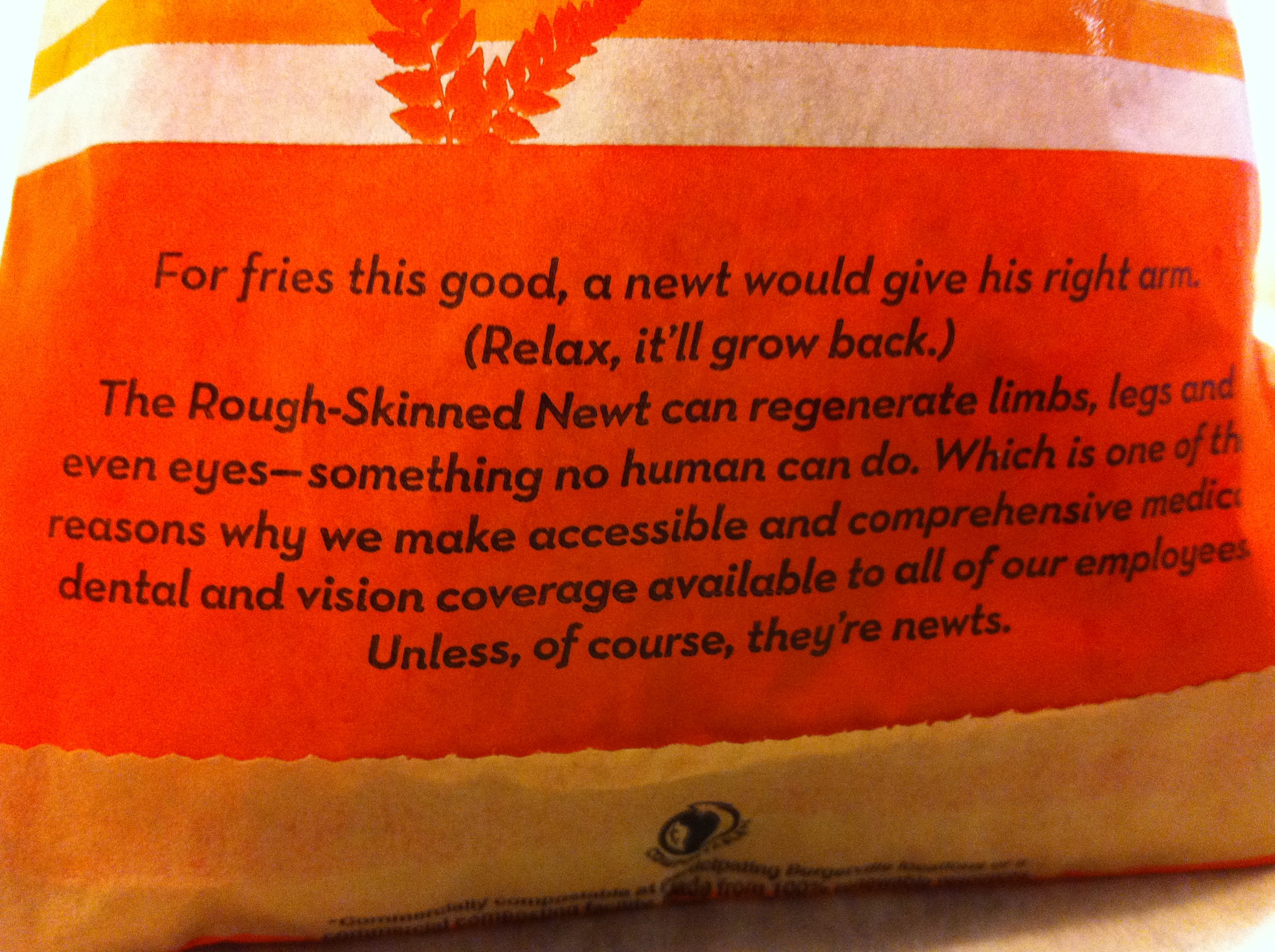
A bag of sweet potato fries at Burgerville in Portland, Oregon: Social messaging done right?

“CSR should be led by charity and employee engagement, not CSR departments.” – Meg Garlinghouse, Head of Employment Branding and Community, LinkedIn

“Our CEO still believes that he is the company’s chief sustainability officer. But he realized that we need to be more organized and structured in our efforts because there is a lot to be done.” – Bea Perez, Chief Sustainability Officer, Coca-Cola in response to Reverse Cause Marketing: Coca Cola’s Pursuits in the Middle East

The Role of Business in Social Enterprise

“We must see social problems as business opportunities.” – Carol Cone, EVP, Edelman

“I worked on Wall Street, driven by greed. Regardless of what anyone says, greed is not good. You get so immersed in the system you forget what all you can do with your life.” – Charles Kane, Former CEO and Board Member, One Laptop Per Child

“A lot of charities are beginning to worry that a lot of the problems they have been trying to solve are not going away. Business still tends to be more sustainable.” – Steve Andrews, CEO, SolarAid

“In the last few years, business has lost tremendous trust in the marketplace. That we are GOOD now rests on us.” – Ofra Strauss, Chairperson and former CEO, The Strauss Group 

Personal Responsibility

“When you know what you’re doing is helping thousands, the payback is so much more fulfilling than any number of stock options and bonuses.” – Charles Kane, Former CEO and Board Member, One Laptop Per Child

“We need to change without giving up who we are. There are no riots against business that are profitable. We need to talk with them, not talk to them.” – Ofra Strauss, Chairperson and former CEO, The Strauss Group

“The more you peel the onion, the more you realize there is to be done. You just need to be constantly excited about peeling the onion.” – Brian Dunn, CEO, Best Buy

The Role of an MBA

“No profession exists to make the practitioners rich. There is always a higher purpose.” – Gregory Unruh, Director, Lincoln Center for Ethics, Thunderbird School of Global Management

“I don’t know if its [The MBA Oath] is going to work. But it is in the right direction and symbolizes a complete shift in mentality.” – Max Anderson, President and Cofounder, The MBA Oath

“I’m waiting to see the day when a new employee tells me they attended a class in college called Change Agent 101.” – Anonymous 

Transparency

“We’re from the Midwest. We don’t advertise our initiatives. But lately there has been a shift in this thinking and our communication style. Transparency is a journey and we are in the early stages of that.” – Kate Heiny, Group Manager of Sustainability, Target

“The priority should always be why not disclose instead of why disclose.” – Chris Jochnick, Director, Oxfam America

“When you are increasingly naked, fitness is not optional.” – Quoted by yours truly during a BSR panel on hyper-transparency. Citation: Macrowikinomics

Integrated Reporting

“For us, integrated reporting starts with the thinking within the company on how they will sustain their value in the future. Integrated reporting starts with integrated thinking.” – Jessica Fries, Director, International Integrated Reporting Committee

Share this:

  • Tweet
  • Email a link to a friend (Opens in new window) Email
  • Share on Reddit (Opens in new window) Reddit
  • Print (Opens in new window) Print
Like Loading...

11 Challenges for Corporate Sustainability: A Review

24 Saturday Sep 2011

Posted by Aman Singh in CSR, CSR reporting

≈ 5 Comments

Tags

Accountability, aman singh, aman singh das, benchmarking sustainability, brand management, Brand Management, Business, conference board, corporate citizenship, corporate social responsibility, CSR, CSR events, CSR reporting, CSR strategy, ethics and compliance, Events, global reporting initiative, GRI, innovation, integrated reporting, Leadership, leadership, Management, risk management, social media, Social Responsibility, Stakeholder Engagement, supply chain, Sustainability, sustainability, sustainability reporting


Early this year, at the Global Reporting Initiative’s official launch in North America, Director of the Conference Board’s Center for Sustainability David Vidal asked a room full of senior CSR and sustainability executives:

What are the top three reasons for your company’s reluctance to embrace sustainability—and adopt sustainability reporting?

Now, as I prepare my keynote presentation for the Center’s annual summit next week on Innovation, Sustainability & Social Media, the answers to David’s question six months ago remind me of how quickly some businesses — and the sustainability space — are evolving.

Here’s what I wrote then on Vault’s CSR blog:

——————————–

The responses that came from an audience representing the glitterati of the corporate social responsibility world might surprise.

Keep in mind that a majority of them (I’m almost tempted to say all) don’t need another lecture on the business case for CSR or sustainability, are active advocates, and represent companies that–for a multitude of reasons–recognize the link to their bottom lines.

What these responses point to, however, is the continued sense of reluctance across senior leadership toward combining the social and environmental with corporate. The path to effective CSR isn’t a linear process by any means and these responses should help those who continue to struggle with mental and ideological barriers within their companies.

Because knowing the challenge is half the battle.

As you go through these, make an elementary checklist. Which of these sound familiar? How did you tackle them? Do any seem/remain insurmountable in the current corporate reality of thrift and inflexibility? Share your perspectives by leaving a comment or connecting with me @AmanSinghCSR.

And, without further ado, and in no particular order:

  1. Doubt
  2. Liabilities
  3. Denial
  4. Resources
  5. Causality
  6. Lack of Global Standards
  7. Benchmarking
  8. Lack of comparative credibility
  9. Uncertainty
  10. Fear of the unknown
  11. Fear of the known

——————————–

My estimation is that this list continues to evolve depending on the industry, the chief in charge, and even by which quarter we are in.

In coming days, I will review these challenges  — after hearing from some of business’ most eminent executives at the Annual Summit —  and hopefully shed some light on how some businesses’ have indeed managed to overcome them, and found advantage in doing so.

Stay tuned!

Share this:

  • Tweet
  • Email a link to a friend (Opens in new window) Email
  • Share on Reddit (Opens in new window) Reddit
  • Print (Opens in new window) Print
Like Loading...

Marsh & McLennan’s 2010 CSR Report: Holistic, Aspirational, But Lean on Data

07 Wednesday Sep 2011

Posted by Aman Singh in CSR, CSR reporting, HR

≈ 2 Comments

Tags

Accountability, aman singh, aman singh das, brand management, Brand Management, Business, Business Ethics, Chief Diversity Officer, Chief sustainability officer, Christine Salerno, corporate citizenship, corporate social responsibility, CSR, CSR communications, CSR reporting, CSR strategy, Elizabeth Barry, guy carpenter, HR, Kathryn Komsa, Leadership, management, Management, marsh, mercer consulting, Michael Connor, oliver wyman, shared value, Silvia Davi, social responsibility, Social Responsibility, Stakeholder Engagement, supply chain, Sustainability, sustainability, Work culture


“Our corporate social responsibility is our best kept secret.”

What compels a company with 52,000 employees and with over 140 years of systems in place to publish a CSR report?

For professional services giant Marsh & McLennan, as CSR Director Christine Salerno put it, there was an urgency “to put a stake in the ground.” The company, following shortly on the footsteps of a rebranding initiative [from Marsh to Marsh & McLennan], released its first CSR report, complete with a press briefing at its New York headquarters, late last month.

At first — and second — glance, the Marsh CSR report is 21 pages of text and very little data. What the executives present at the briefing, however, had to say, was far more enlightening and worth noting.

After Silvia Davi, head of corporate communications and brand introduced the panel — an all-women team of Chief Sustainability Officer Elizabeth Barry, Chief Diversity Officer Kathryn Komsa and Salerno — Barry started off with some forward-looking statements.

1. Sustainability

“We were doing a lot [in sustainability] but we needed structure. Now we can gain much more from the same efforts by implementing them as part of a long term strategy,” she said, adding that, “This is not about today, this is about tomorrow.”

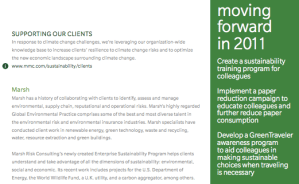
Our work in CSR is our best kept secret. Now we have decided to collaborate and communicate our successes and challenges because colleague education and engagement are key to the success of our sustainability strategy.

Pointing to a slide that charted key accomplishments since 2010, Barry noted that a majority of the data points were yet to occur. For example, the company is set to launch an internal “Green Traveler” program aimed at helping employees’ cut down their carbon footprint by educating them on telecommunication alternatives, etc. Also to follow later in the year: A “Paper Reduction Campaign” as well as a “Sustainability 101 Training Program.”

“I want everyone in the company to know that they are committing to a longterm strategy,” she emphasized. “Sustainability starts with people and our behavior and if every colleague made one tiny change, the impact collectively can be huge. It’s not a quick process but it is truly more sustainable.”

2. Diversity & Inclusion

The mission for CDO Komsa, who started in her current role in 2009, was “to create an enterprise-wide diversity and inclusion strategy.” “Our challenges are finding the right talent, resources, and the right market share in a multicultural world,” she said, adding a common refrain among the B2B sector, “Our raw material is our people and a diversity platform becomes a great way of creating shared value.”

Komsa also touched on an issue that has had insurance companies scratching their heads in recent years: How do you make a career in insurance sexy and attractive?

Noting that this is a big challenge and opportunity for Marsh, Komsa emphasized that her, “Team’s leading initiatives in coming months will be to tie in the four companies [Oliver Wyman, Marsh, Guy Carpenter and Mercer] and rebrand the insurance industry by emphasizing how we source our talent.”

3. Community Relations, Volunteerism, Philanthropy

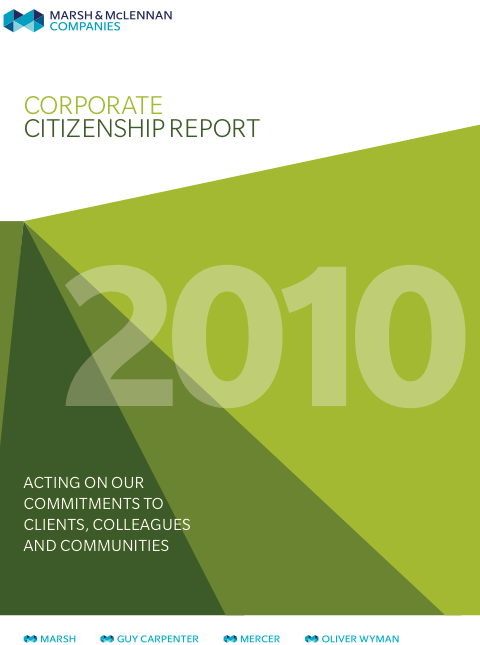
Marsh and McLennan's 2010 CSR ReportSalerno who is an ex-investment banker chose to begin with a review of past challenges: “This is something that has always been done. What has been missing is the communications piece. There has been no cross collaboration internally within the units.”

“Our business case is to make sure that our CSR activities are creating impact in the communities we operate in and for our employees,” she added, noting that, “An engaged employee wants to stay. We want to make sure we are attracting the right people.”

The connection between CSR and recruitment is an increasingly acute problem for recruiters, especially in the B2B sector, where the commodity for sale isn’t so much a physical unit but organizational culture, intellectual growth and innovation. How do you leverage CSR as a recruitment strategy? [Join me at one of eight breakfast sessions on analyzing this very question starting next month.]

“Students coming out of college want to work for companies that are doing the right thing. Our strength is our people. So how do we use our biggest assets to create maximum impact?” Salerno responded.

4: Climate Change

In response to Business Ethics Publisher and veteran journalist Michael Connor’s question about setting goals on climate change, Barry pointed to the unique challenges of operating in cities like New York, where most companies don’t own their real estate. “Goals are hard for a professional services company. And when you add a lease to the equation, it becomes even harder. In most cases, we are in the middle of 10-year leases so in the interim, we are finding other ways to set goals, like how to reduce our real estate portfolio altogether.”

5: What Does Successful CSR Look Like for a Fortune 250 Company?

Employee engagement has always been a huge component of my blogs in the past because I truly believe that getting your employees on your side is half the battle for most companies struggling with reputation issues. They can be your best brand ambassadors and I asked the Marsh team what success looked like for all their CSR and sustainability efforts: A significant decrease in air travel, a certain number of LEED certifications, an internally set women and minority retention rate, or something else?

Repeating that they launched the CSR report as a way of putting a stake in the ground, Salerno emphasized that, “Employee engagement is a crucial piece and trying to quantify our efforts and rolling out a system to measure our activities has them talking.”

“We’re getting the information out there and they are discussing it,” she said, to which Komsa added that, “piles of resumes have been pouring in because the work we do aligns with someone’s values. That means our employees are talking, which is a huge win for us.”

Barry, however, might have put it best:

“This report doesn’t have as many foundations but it is an important story to tell. We don’t have all the answers but we do want to get started on finding them.”

At the end of the day, Marsh isn’t looking to solve the water crisis or achieve a zero carbon footprint. Their goals are moderate and their CSR report reflects a forward-looking attitude that is encouraging.

That they have a team in place approaching CSR strategically — and a lot more holistically than many other companies — is the right start.

Share this:

  • Tweet
  • Email a link to a friend (Opens in new window) Email
  • Share on Reddit (Opens in new window) Reddit
  • Print (Opens in new window) Print
Like Loading...

Sustaining Timberland: An Interview with VP of CSR Mark Newton

02 Tuesday Aug 2011

Posted by Aman Singh in CSR, CSR reporting

≈ 7 Comments

Tags

Accountability, aman singh, aman singh das, Apple, consumer education, Consumerism, consumerism, corporate social responsibility, cradle to cradle, CSR, CSR communications, CSR reporting, Dell, Ethics, ethics and compliance, Green, human rights, Jeff Swartz, Leadership, management, Mark Newton, marketing, Motorola, product lifecycle, Social Impact, Social Media, social media, supply chain, Sustainability, sustainability, Timberland CSR communications portal, Timberland VF merger, transparency, VF, Work culture


When one of the country’s few purpose-based and values-driven company announces new sustainability goals, chances are you won’t be as excited as you would be if it was BP, for instance.

Because we expect ambitious and aggressive goals from leaders, and at Timberland, this expectation is part of everyone’s job.

Before the boot maker announced its new set of revised sustainability goals earlier this week, I caught up with Timberland’s new Vice President for CSR Mark Newton on his new role, the goals, as well as their latest efforts at stakeholder engagement: Timberland’s new Communications Portal.

Sustainability: From Apple and Dell to Timberland

Newton, who has spent his entire career working on sustainability at electronics giants like Motorola, Apple, and most recently Dell, understands that the road ahead will be rocky as Timberland completes its merger with VF. VF owns several outdoor brands like The NorthFace, Wrangler, Jansport and Nautica.

We started with the new 2015 goals. What’s new about them?

“Focus,” said Newton. “Moving forward it is very important that we create focus for our companies, including a commitment to innovate from cradle to cradle.”

Timberland’s 2015 Sustainability Goals

Set in four broad categories of Climate, Product, Factories and Service; the goals are ambitious and aggressive, if not new or radically life-changing. I asked Newton the purpose of each category.

Climate: “This is a topical focus for us if not so much a functional one. But we’re not saying we’re going to be singularly focused on climate change but that this affects our customers and decisions and therefore, we must equip them with decisions and the right products.”

Product: “At some point we all want to start creating innovations that have a zero footprint. The idea is to move toward a vision of a closed loop product lifecycle. You can see where we are and where we want to go. It is directionally correct.”

Factories: “We have an obligation that is not just transactional to our suppliers, employees and other stakeholders. The whole idea of sustainability is to stay in business. In perpetuity, we cannot do that without treating our employees well and scaling our business properly.”

Service: “Timberland was founded on the idea of commerce and justice, of giving back and creating value. We offer our employees 40 hours to volunteer every year. Today we are asking what the impact of that workforce is. Where are we going with this, how do we prioritize our efforts and do it well?”

What underlines all of these goals and their success, however, is engaging and changing consumer behavior.

Changing Consumer Behavior: Timberland-style or VF-style?

Earlier this year, at the Annual GreenBiz conference, Timberland CEO Jeff Swartz said that sometimes companies have to lead consumers by taking a stand on what is right. “You cannot always wait for consumer demand to dictate your decisions,” he said.

Now with Timberland becoming a part of the VF family, are dynamics shifting? Will the merger bring a renewed and united effort in the apparel industry to shift consumer behavior or lead to inertia and inaction?

I put the question to Newton, who while new in his role, is a veteran in the consumer products industry. “We are having several conversations around this. We are Timberland and we will always be that. This is the reason people are interested in EarthKeepers and we will continue to move the needle,” he said.

What about Swartz’s inspiring declaration? Newton offered Timberland’s EarthKeepers product line as an example:

“The ultimate goal of every company that is working on sustainability is to be able to drive top line growth because of its sustainability efforts. It’s very rare to see top line growth associated with these things, many companies are running leaner and end up staying within compliance. At Timberland, our EarthKeepers product line is actually doing that with double-digit growth in the first quarter.”

Authentic Communications: Engage the Consumer, not Just Inform

With skepticism already high in the market, there is a fine line between selling more units and ensuring responsible consumerism. EarthKeepers seems to be clearly bucking the trend and providing a new, profitable way of doing business sustainably.

Was this growth the result of consumer education, eco labels, or increased communication?

“Authenticity. We’re finding success because it is authentic. We are intentionally focused on products that are environmentally friendly and socially conscious. And we are committed to continually communicating that. We’re not waiting for everything to become perfect, we’re putting it out there and calibrating it as it evolves,” he said.

Examples? Newton offered the eco-index, which Timberland was instrumental in creating and pushing out. “We are promoting the index so we can create real change and movement. That’s exciting and offers us a chance to drive real, calculable change,” he added.

What VF brings to the table then is scale. “VF has been a partner for years on making the process much more efficient. Now the merger will allow us to collectively drive things that Timberland alone simply cannot do. This bigger opportunity is huge for us,” he emphasized, adding, “It’s also not just forward-looking things and what we can do upstream. VF has a very efficient process in place because of their brands. We have had limited impact there but now we can have much more.”

Timberland’s New Communications Portal: CSR in Real Time

With Timberland already being aggressively visible and vocal in the consumer marketplace, why did Newton and team feel the need to launch a new CSR communications portal?

“We’re segmenting the conversations on our website around products and around topics so everyone has a better sense of clarity. Even though our authenticity ensures that sustainability conversations become natural in all parts of our business and you don’t have to go to the CSR portal to have a CSR conversation, we felt that different stakeholders have different perspectives. You can still go to the products portal and have the same conversation as you would on the CSR portal, because the intentional design, how we conduct business with suppliers and community issues are woven into the product and the product description.”

Why then is the new portal necessary if sustainability is so intricately embedded into the work culture at Timberland?

“We are having conversations with a very vast and diverse spectrum of people, from wholesalers and retailers to direct consumers. They all come with very different demands and perspectives and we want to offer them the opportunity to engage in the language they understand best,” he explained.

Fully integrated with social media tools, the portal is designed for consumers looking for details on green products, interesting stories and much more. Not only can you go to the redesigned portal and discuss Timberland products, you can also discuss the team’s CSR efforts, join ongoing conversations through their Bootmakers blog, and chime in on more topical discussions around the Green index and climate change.

Admittedly, many companies continue to struggle with this balance between preserving the granular stuff and promoting more general conversations around products.

For Timberland, the answer was to lead in both.

“People can go granular as they want or stay as generalist as they’d like. What’s different about the portal is that we are not starting conversations by discussing one of our pillars or metrics but focusing on stories that matter and then getting to the things that are underneath those stories; this marks a fundamental shift for our website,” Newton added.

Being a communications geek, I can definitely attest to Newton’s excitement about this new portal. The ability to throw open your business practices and product lifecycle to your stakeholders takes gumption and a resolute belief in transparency.

The Timberland team knows that this throws the door open to endless questions and scrutiny but Swart’z recruits are used to that and know that open engagement is the only way to maintain authenticity and empower their stakeholders toward sustainability and a zero impact footprint.

This is mission critical for Timberland.

As Newton put it, “Regardless of what happens post-merger, we are all in this together. Our values are integrated into all of us and everyone who works here. Jeff Swartz might be the leader but you can expect to hear the same things from all of us.”

This is Timberland’s — and VF’s — opportunity to drive the apparel industry toward a more sustainable future. The 2015 goals are the means to an end, a future that VF and Timberland can now together impact much more powerfully.

Comments? Leave a comment, email me or connect @AmanSinghCSR.

Share this:

  • Tweet
  • Email a link to a friend (Opens in new window) Email
  • Share on Reddit (Opens in new window) Reddit
  • Print (Opens in new window) Print
Like Loading...

VIDEO: A Test in Corporate Transparency: Winning One for the Blue Shirts

29 Friday Jul 2011

Posted by Aman Singh in CSR reporting, HR

≈ 11 Comments

Tags

Accountability, aman singh das, Best Buy, conflict minerals, consumer education, Consumerism, corporate accountability, corporate social responsibility, CSR, CSR reporting, CSR strategy, diversity, diversity and inclusion, employee engagement, ESG, ethics and compliance, Events, fair trade, Green, GRI, HR, human resources, human rights, inclusion, Leadership, leadership, management, marketing, PR, risk management, shared value, Social Media, social media, supply chain, Sustainability, sustainability, Sustainability Report, technology, transparency, VIDEO


Last week I was at Best Buy headquarters in Minneapolis to moderate a live webinar with its CSR and sustainability executives. Joining me: Mary Capozzi, senior director of CSR, Leo Raudys, senior director of environmental sustainability and services compliance, and Hamlin Metzger, senior manager of corporate responsibility.

The agenda: To discuss Best Buy’s annual Sustainability Report and offer a live audience on Livestream and Twitter the opportunity to ask questions in real-time.

My job: To question, dig and examine, while moderating questions between the panel and the audience. About 20 minutes into the webinar, which is archived below — well worth a listen whether you are a sustainability nut, a tree hugger, a nonprofit exec, a job seeker or simply an electronics user — questions started streaming in.

From conflict minerals to employee education, every question was fair game.  While @Gchesman asked whether being a well-known company affects the level and degree of time and money spent on CSR and sustainability, @Davidcoethica wanted to know how Best Buy can better balance its role as a promoter of consumption of products against a sustainability ethos, and Robin Cangie wondered how Best Buy can help us all become more responsible consumers?

The conversation, thanks in part to an active and engaged audience, and wonderfully diverse questions, was invigorating, informative and challenging.

Barring the repeated mentions of their recycling efforts — sorry Leo, its a pet peeve — which to be fair is a huge and important undertaking for the global electronics retailer, the panelists were clear, comprehensive in their responses and unapologetically honest about their challenges: That there is a ton of work ahead and that they hadn’t figured it all out yet.

But as David Connor wrote earlier this week, when you’re a global player like Best Buy, expectations are higher as well. Did Best Buy live up to the expectations of CSR activists? Perhaps not.

Flip the coin though for a second.

Did they go on the defensive when I asked them why their retention rates were remarkable (74%) but the diversity of their recruits (12% African-American, 14% Hispanic; 180,000 employees) was quite underwhelming? No.

Did they dodge repeated questions about educating their supply chain, influencing consumer decisions, or the recently drafted UN Guiding Principals on Human Rights? No.

Bottom-line: Capozzi and team did not have all the answers but they didn’t pretend to either.

And that’s where, as an independent journalist, they get points from me for an attempt, however small, at open transparency, willingness to be accountable, and daring to do something new.

Remember the 11 Challenges for Corporate Sustainability? Well, a significant number of those relate to fear. For the Best Buy team, this webinar was a successful exercise in effectively addressing their own fears.

And that is where they just won one for their team of blue shirts.

Share this:

  • Tweet
  • Email a link to a friend (Opens in new window) Email
  • Share on Reddit (Opens in new window) Reddit
  • Print (Opens in new window) Print
Like Loading...

Introducing Singh on CSR: A Journalist With a Purpose..and an Opinion

Featured

Posted by Aman Singh in CSR, CSR reporting, HR, Uncategorized

≈ 7 Comments

Tags

Accountability, aman singh, aman singh das, Career advice, CSR, CSR blogger, CSR reporting, Ethics, Events, Green, HR, In Good Company, Job search, Jobs in CSR, Leadership, Recruitment, Social Media, social media, Sustainability, sustainability, Uncategorized, Work culture


*Updated July, 2014

Most recently the Editorial Director at CSRwire, a digital media platform for the latest news, views and research on CSR and sustainability. Along with leading content distribution, social media strategy and CSR/sustainability reporting services for CSRwire members, I also led Talkback, CSRwire’s aman singh, csrwireCommentary section, with over 250 contributors and increased traffic 35% – 50% year to year.

The channel featured several influencers and thought leaders – John Elkington, Hazel Henderson, Wayne Visser – as well as authors – Frances Moore  Lappé, Bob Willard, Carol Sanford – researchers, activists and CSR/sustainability professionals – AMD’s Tim Mohin, Campbell Soup’s Dave Stangis, Sustainability leader Peter Graf, John Edelman – and served as a platform to push the needle on critical topics, learn from each other and constantly crowdsource new ideas, partnerships and best practices.

While at CSRwire, I’ve had the pleasure of working with numerous Fortune 500 companies as well as the country’s leading nonprofits and academic institutions on creating and implementing communication strategies focused on stakeholder engagement and behavior change, including Unilever, Verizon, Aramark, SAP, Campbell Soup, Nestle Waters North America, McDonald’s, General Mills, HP, Mars, Avon, Sodexo, EarthShare, Points of Light and others.

Our Stakeholder Engagement Campaigns – including live Twitter chats and webinars as well as content series and multimedia – generated millions of impressions, hundreds of participants and provided our members with critical feedback, important partnerships and a pulse of their stakeholders’ concerns.

I’ve also been an active journalist for almost 15 years, including stints at The Wall Street Journal, The Villager, Tehelka.com and Vault.com, where I created, designed and managed the recruitment industry’s first CSR channel aimed exclusively at engaging, debating and discussing corporate social responsibility, sustainable (and unsustainable) business practices, responsible (and irresponsible) leadership, diversity and the lack of it, the role of workplace culture in our lives, social entrepreneurship, the newly-minted term ‘intrapreneurship’ and much, much more.

Careers in CSR and Sustainability

Vault’s CSR Channel

Skepticism is second nature to me and I’m most comfortable asking [mostly the right] questions, facilitating dialogues, editing copious pages of text, refining even the most academic articles into easy-to-read blogs and thrive on the opportunities extended by a new world of social media and access to organizations and change makers.

This is my space – to question, analyze and discuss.

I’ll examine the latest CSR report and debate how we’re faring in our pursuit of materiality and creating a new economy built on wellbeing and shared value. No question is small enough, no development unrelated. And no topic unworthy.

From careers in CSR to the future of GRI reporting, from analyzing the do(s) and don’t(s) of sustainability to the latest in impact investing and our search for materiality; from social media etiquette to transparency in this new hyper-connected world, from work/life balance to gender and age discrimination, from effective communication strategies to the immensely irritating term “greenwashing”; and much much, more, join me for a promising and thought-provoking ride.

-Aman
@AmanSinghCSR

Share this:

  • Tweet
  • Email a link to a friend (Opens in new window) Email
  • Share on Reddit (Opens in new window) Reddit
  • Print (Opens in new window) Print
Like Loading...
Newer posts →

Let's Talk!

Virtual
732-322-7797
amansinghdas@gmail.com

Blogs I Follow

  • Nonprofit Chronicles
  • Learned On by Andrea Learned
  • Angry African on the Loose™
  • csr-reporting
  • The CSR Blog
  • In Good Company: Singh on CSR

My Cloud

Capitalism 2.0 CSR CSR reporting CSRwire ESG Guest Author HR Stakeholder Engagement Sustainability Uncategorized

Recently written…

  • Rationality is Ruining Us: Mayors, presidents and governors join major businesses in charting way forward on climate change
  • 2015: the year businesses recognize that climate change is real – and 4 other themes
  • Hardcore lessons of sustainability – ’10 Words or Less’
  • Brewing a Better Future [#BaBF] with Heineken: Examining the Many Flavors of Local Sourcing
  • From Conflict to Collaboration: Kimberly-Clark and Greenpeace Participate in LIVE Twitter Chat

What others are reading

aman singh aman singh das Brand Management Business corporate social responsibility CSR CSR reporting CSRwire ESG Leadership Stakeholder Engagement supply chain Sustainability sustainability Work culture

Categories

Most Read

  • None

Create a free website or blog at WordPress.com.

Nonprofit Chronicles

Journalism about foundations, nonprofits and their impact

Learned On by Andrea Learned

Angry African on the Loose™

I have opinions. I am from Africa. I live here now. I blog.

csr-reporting

Connecting the dots between Business, Society & the Environment

The CSR Blog

Connecting the dots between Business, Society & the Environment

In Good Company: Singh on CSR

Connecting the dots between Business, Society & the Environment

Privacy & Cookies: This site uses cookies. By continuing to use this website, you agree to their use.
To find out more, including how to control cookies, see here: Cookie Policy
  • Subscribe Subscribed
    • In Good Company: Singh on CSR
    • Join 119 other subscribers
    • Already have a WordPress.com account? Log in now.
    • In Good Company: Singh on CSR
    • Subscribe Subscribed
    • Sign up
    • Log in
    • Report this content
    • View site in Reader
    • Manage subscriptions
    • Collapse this bar
 

Loading Comments...
 

    %d