• ABOUT THE AUTHOR
  • Sustainability
  • CSR
  • CSR reporting

In Good Company: Singh on CSR

~ Connecting the dots between Business, Society & the Environment

Tag Archives: Stakeholder Engagement

Changing Gears at JPMorgan Chase as a CSR Strategy Evolves

09 Wednesday Jul 2014

Posted by Aman Singh in CSR, CSR reporting, CSRwire

≈ Leave a comment

Tags

000 jobs mission, 100, aman singh, Brand Management, Business, clean energy investment, community development, Corporate Governance, CSR, CSR report, CSR reporting, CSR strategy, CSRwire, Disclosure & Transparency, ESG, impact investing, jamie dimon, jobs, jpmorgan chase, Leadership, mark tercek, peter scher, small business investment, social finance, Social Responsibility, Stakeholder Engagement, Sustainability, Sustainability Report, the nature conservancy, transparency, Wall Street, Work culture


In the wake of the financial crisis, your industry continues to face high scrutiny and low trust. How is society better off because of what JPMorgan Chase does?

That’s how The Nature Conservancy CEO Mark Tercek starts off his interview with JPMorgan Chase CEO Jamie Dimon – featured prominently at the beginning of the financial behemoth’s latest Corporate Responsibility Report. While the interview is meant to address the heightened focus on transparency improvements in risk management and operational sustainability, the key idea is to highlight one main issue: trust.

In fact Tercek’s first question is telling of the intent and content of the interview that follows.

To drill deeper and learn more about JPMorgan Chase’s sustainability activities in 2012 as well as how the institution prioritizes intangibles like customer trust, ethics and responsible leadership into its business strategy and operations, I turned to Peter Scher, EVP and Global Head of Corporate Responsibility.

Leveraging all of its Assets to Invest in Communities: A Bank’s Citizenship Journey

“The most important thing we want to convey through the Report is that we’re using more than just our money and resources to make a positive impact. [Our]scale and global reach puts us in a unique  Peter_Scher_JPMChaseposition to not just spend money, but use the core expertise of our company and employees to make a difference for our clients and communities,” he started, adding, “We want to focus on using all of our resources to support our communities.”

In 2012, JPMorgan Chase raised and provided $2 trillion in capital and credit for its clients worldwide. It also donated more than $190 million to nonprofits in 37 countries while its employees volunteered 468,000 hours in local communities.

“We’ve helped over 77,000 U.S. veterans find jobs working with other companies through the 100,000 Jobs Mission. We see investments in our community as long-term investments, just like we would look at investments into our business,” Scher explained alluding to CEO Dimon’s quote in the report:

If we can help our clients grow around the world, they will in turn generate the jobs, small business growth and other economic activity that builds strong, vibrant communities and generates more sustainable economic growth and prosperity for all.

But how does that contextualize into day-to-day operations at the bank?

A couple of ways. Our clients and our business are key components of our communities, not just pieces of a balance sheet. For example, some of our clients are municipal governments, hospitals, and healthcare institutions. We help them provide vital services to people,” he said.

“In 2012, we provided $85 billion to nearly 1,500 nonprofit and government entities in the U.S. and around the world. Despite the crisis in Europe, we didn’t pull out of our investment commitments. We continued to provide billions of dollars in credit and financing to European clients – corporate and sovereign. That was a testament to our values as a company and underlined how we approach business. We are part of these communities for the long run.

At the height of the financial crisis in the U.S. three years ago when lending was lean, JPMorgan Chase announced increased lending to small businesses to boost the economy. It made good on that commitment and today is one of the largest lenders to small businesses in the country. “We also hired 1,000 small business bankers to help us find small businesses to invest in. This commitment has small business lendingincreased every year since then – from $7 billion in 2009 to $11 billion in 2010 and $17 billion in 2012,” explained Scher.

Despite the increased lending and a resolute desire to beat a deepening crisis by focusing on core competencies and a community-based approach, 2012 was a tough year for the financial leader.

We had significant trading losses which cost us money and embarrassment – more the latter since we made record profits in 2012. It also showed that we weren’t immune to making the mistakes other companies made. What we were proud of was that we didn’t try to hide any of it or explain it away,” he said.

For example, the bank – after Dimon’s very public apology – made its Control agenda a top priority leading to a re-prioritization of its major projects and initiatives, deploying massive new resources, and dedicating critical managerial time and focus to the effort. Specifically, the bank:

  • Established a new firm-wide Oversight and Control Group separately staffed and reporting directly to the Chief Operating Officer with the authority to make decisions top down, in command and control fashion.
  • Appointed a business control officer in every line of business to report jointly to the line of business CEO and the firm-wide Oversight and Control Group.
  • Staffed every major enterprise-wide control initiative with program managers and oversight group managers, including COOs.
  • Made it mandatory for the Operating committee to meet regularly with regulators to share information and hear any criticisms.

I have worked in a lot of different public and private institutions during the course of my own career and have not found one that doesn’t make mistakes. The real test is how we address them. And at JPMorgan Chase, starting with the senior leadership, there was never any effort to hide or explain away our mistakes. In fact, there was a commitment that we were going to use them as an opportunity to become a stronger company,” Scher added.

Building a Culture of Responsibility

Corporate responsibility can be challenging at any company. Particularly for one that belongs to a sector that remains as tarnished for its dealings of the past decade today as it were in 2008. What is JPMorgan Chase doing to shift the mindset and modus operandi of its industry?

Well, we’re starting at home, with our 260,000 employees in more than 60 countries – and we’re letting our employees know how the firm contributes to their communities,” he said.

Are JPMorgan Chase employees driving the demand for non-financial disclosure?

Yes, there’s demand from many of our stakeholders, including our employees, to know how we match up in our actions versus our commitments. We’re also starting to see demand from our clients. The financial crisis really focused people’s attention on what companies are doing and could do to help contribute in a positive way to the community,” Scher emphasized.

“The fact is, if our communities are growing, that’s good for us as a business. More growth means more banking services – and we want to be a part of their future. Besides, clients want to know that companies they work with are responsible and thinking of their impact on society.

Global Footprint, A Comprehensive CSR Strategy

With a substantial community investment commitment as well as programs to rehire military veterans, bolster investment ties among cities in the US and worldwide through its Global Cities Initiative, and impact investing goals – principal investments focused on emerging markets added up to $50 million in 2012, clean energy investments –over $6 billion in clean energy investments in 2012 deployed, the bank is leveraging its global footprint effectively to grow the global economy.

JPMorgan Chase CSR ReportIt’s also trying to help address some of the world’s most pressing challenges.

For example, urbanization.

Half the world’s population already lives in or around cities. That’s going to increase to 70 percent in the next few years. That translates into a lot of challenges for what our infrastructure can support: energy, healthcare, water, job creation, etc. And for us as one of the largest lenders for these projects, that has significant ramifications.”

“So we’re trying to use our resources and expertise to help address these challenges. We’re working on understanding how policymakers are dealing with these across the world and trying to bring in some creative thinking to help them shift as the economies transform. We’re also thinking of how we can finance energy exploration and development in a more sustainable way.”

“In the U.S., for example, a lot of these investments have focused on natural gas. We’re identifying best practices and creating a risk assessment framework to help us influence our clients’ policies and procedures and help them conduct their energy operations in a sustainable manner,” he explained.

And how is the bank’s Social Finance arm faring? It launched in 2007 to serve the new and growing market for impact investments – new business models that deliver market-based solutions for social impact.

According to Scher, JPMorgan grew its Social Finance principal investments to nearly $50 million in commitments for funds focused on helping improve the livelihoods and quality of life of people living in poverty around the world, with a particular focus in emerging markets. “In addition to making principal investments, we’re also working to help shape and grow the field of impact investing, by providing client advisory services and data-driven thought leadership,” he added.

At the end of the day, with a Report that runs into 90 pages replete with data, interviews and the makings of a comprehensive CSR strategy, JPMorgan Chase seems to be pulling all the strings it has available to make a positive impact on its constituents – with some appreciable humility thrown in for good measure.

Originally written for and published on CSRwire’s Commentary section Talkback on August  1, 2013.

Share this:

  • Tweet
  • Email a link to a friend (Opens in new window) Email
  • Share on Reddit (Opens in new window) Reddit
  • Print (Opens in new window) Print
Like Loading...

Stakeholder vs. Shareholder Value: Connecting the Sustainability Dots With Philips, Drexel University & Profits4Purpose

09 Wednesday Jul 2014

Posted by Aman Singh in CSR, CSRwire

≈ Leave a comment

Tags

aman singh, cause marketing, corporate citizenship, corporate social responsibility, CSR, CSR communications, CSRwire, employee engagement, ESG, HR, Leadership, philanthropy, phillips, profits4purpose, shareholder value, social media, Stakeholder Engagement, Sustainability, sustainability, transparency, Work culture, workplace giving


Is there a connection between employee engagement and shareholder value?

Several similar questions came up in a recent webinar I facilitated, held in partnership with Profits 4 Purpose with guests Philips and Drexel University. While the question doesn’t have a linear answer – as is often the case with sustainability – it did take us through quite a conversation on connecting engagement with value, how CSR strategies affect business performance, the whole conundrum of measurement as well as what the latest research suggests.

Daniel Korschun, Assistant Professor and Fellow at the Center for Corporate Reputation Management at Drexel University, led the conversation by sharing some of his research with our audience.

“We’re moving into a new phase …since the 1950s we have had a debate about whether more CSR is better than less. While I don’t think this debate has been completely settled, there is general agreement among most practitioners that the core issue today is how we do it, not the quantity. That means we need to concentrate on effectiveness, which is where I have focused my research,” he started.

Employee Engagement: All About Signals

Employees are paying attention to CSR, he said.

And they notice when managers or customers support the company’s CSR initiatives.  When they notice this support, they are more likely to develop CSR and business performance“feelings of membership with a company.” In its most powerful form, we may begin to hear things like “I am an IBMer or a UPSer.” This feeling of membership then translates into a whole host of measurable outcomes like job performance, intent to stay in the job, or intent to volunteer.

For example, Korschun said he finds that people who feel this sense of membership are 87 percent more likely than others to be among the top performers of their company. And these effects hold even after controlling for pay satisfaction, personality traits, tenure, and work experience. The big lesson then?

  • Make CSR an open secret! “The more people who are discussing your behavior, the better.”
  • Have upper management act as champions: “If people don’t feel that management is aligned with your CSR strategy, impact will be muted. Executives don’t need to dictate CSR from the ivory tower but employees must know definitively that their leaders are on the same page, and are committed to social responsibility.”
  • Encourage contagion across stakeholders: “Engage customers in the same CSR programs as employees? Programs that get customers and employees to join forces (especially on volunteering sites) can create a bond…and that sort of contagion can lead to both happy employees and happy customers.”

Philip Cares: Formalizing Responsibility

Melanie Michaud, Senior Manager for Internal Communications with Philips North America took the baton from Daniel to evidence his data and research with how the practice and implementation of employee engagement maps out across a corporation. Emphasizing that Philips USA did not have a process in place till 2010 to vet requests and manage engagement across the company. “It was sporadic and led by employees who cared about various causes,” she said.

After several acquisitions, the company realized they needed a more formal process to align all its community development work with its business and employee base. That led to Philips Cares, through which, the company focuses on environment, education and health.

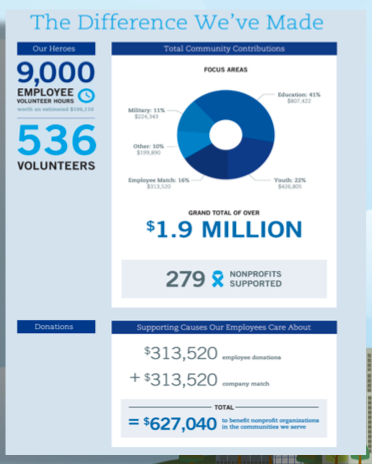
With tremendous uptick in the number of volunteers [over 8,000 volunteers] and donations in the 15 months since the program launched, Michaud highlighted the following keys to the success of Philips Philips caresCares – crucial for those managing relatively new programs or on the verge of launching one:
  • Do your research
  • Have a clear vision
  • Engage leadership
  • Have a volunteer tracking mechanism
  • Align with nonprofit partners
  • Emphasize local champions
  • Have consistent program branding
  • Engage in storytelling
  • Give employees a voice
  • Walk the talk

Setting a Global Strategy With Local Impact

So how does Philips ensure its CSR strategy is global in scope while local enough to support its communities?

That’s something we’re continually challenged with. We’re always tying everything back to our vision and mission of improving lives through innovation. We’re also doing some research now about rolling out a program like Philip Cares globally. In some areas there is greater interest than others and we’re currently working out how that will all work out,” Michaud responded.

One of the questions that came up during the webinar was around the survey Philips uses to seek feedback and make changes to its program. Emphasizing that the survey was a work in progress, Michaud said questions revolved around identifying causes, target audiences, types of volunteering activities as well as a bunch of open-ended questions for more elaborate feedback.

Practice vs. Software: Connecting Volunteerism With Impact

For Jason Burns, CEO of Profits 4 Purpose, the task was to connect Korschun’s research and Michaud’s practical perspective to how companies can best measure and track CSR and employee engagement activities. “We’re focused on helping companies make employee engagement simple, innovative and relational,” he started.

What are the key components to capture their attention? Burns summarized his comments in three neat categories:

  • Inspiring vision with easy execution: “We see a lot of companies starting with the end goal in mind, asking employees to focus on tracking…that’s less than inspiring. As human beings, we desire to be part of something bigger than ourselves so its important we start with a vision.”
  • Measuring impact: “Excel kills impact…how can we launch a strategy and review it for impact in real time and in alignment with employee engagement, mission and partners? Can we solve a specific problem that fits within the mission of a business? Can we cast a ‘what if’ scenario for employees to be motivated, to make a difference and get involved in a real easy and seamless way?”
  • Sharing a compelling story: “You’ve executed the strategy, and achieved great impact but why is it important? The most powerful piece for an employee when they volunteer is being part of that impact firsthand. The next powerful piece for those who might not be on the ground is communication, the story. It goes beyond the numbers.”

While the P4P platform helps companies do all of the above in one centralized place, what stood out was the fact that it also leverages the data into meaningful stories, disclosure commitments and  p4p_webinar_5filings. As Burns explained, “We saw companies that had the vision but were having difficulty making the management seamless with vendors, contractors and excel sheets. Things were duct taped and often a nightmare and we wanted to open that up to make the process productive and inspiring for all involved.”

Connecting The Dots Between Engagement & Shareholder Value…

But Jason’s iteration of execution versus measurement and reporting brought us back to a core question we began the panel with: how are companies like Phillips connecting the dots between volunteerism, engagement, retention and business growth?

“In terms of definitive links all the way to shareholder value, we have research connecting the steps of a CSR program all the way through. There is, however, no one study out there that links the end point with any one of the steps along the way. My research connects job performance with CSR and others have linked that to shareholder value. So while the connections are there, there is no one study that we can point to,” offered Korschun.

For Philips, it’s still to be determined, said Michaud.

“It is still a bit fragmented but we have moved from a theory to a practical emphasis on measurement and tracking. And the research being conducted is definitely encouraging, albeit complex,” added Burns, highlighting a trend we’ve been seeing on CSRwire as well where researchers are now, finally, being able to grab data on voluntary disclosures and link the connections between measurement, the various threads of sustainability and the question of value.

…Regardless of the Economic Climate…

What does the research then say about the impact of CSR programs on shareholder perspective and behavior irrespective of the economic climate? [Audience question]

While Korschun said he wasn’t aware of any studies that have looked at the influence of economic climate on how CSR drives value, “we generally find that for customers, the effects are clearest when CSR and employee engagementmost other product features are at parity. This suggests that CSR might become a little less important for consumers during a recession, when price becomes more critical.”
He added: “However, for employees, the company is a big part of their identity. So as long as a person feels fairly secure in their job, CSR should still have a similar effect. Putting this together, I would conjecture that ROI might drop a bit overall during a recession, but the drop would be uneven across stakeholders.”

…And Company Performance

“The weight of the evidence in academic studies suggests that there is a small positive effect of overall CSR on overall company performance. In my view, each company will have programs that are more and less effective. Since employees can express their commitment to the company in many ways, it is very difficult to put an ROI figure on any single program. The best way to measure it is usually to choose a couple of outcomes that are critical to shareholder value and then examine the link between CSR program(s) and these outcomes,” Korschun offered.

Final word on the erstwhile ROI of social contributions and impact?

For Michaud, this is a toss-up.

“We have some of the basics in place about measurement but I think qualitative measures are as significant. They’re really the next level of ROI. Of course, media stories help as well but we’re this is a discussion that is really ongoing for us.”

“A lot of companies are surveying employees and getting positive results. Now we need to work on finding the stories of impact,” added Burns while Korschun recommended systemic thinking:

I ‘d like to recommend [to companies] that they start with the goals. If one of your business challenges is employee retention, start with that and work backwards. Ask yourselves what is the right program that can have social/environmental impact and create business value at the same time?

Download the slides.

Originally written for and published on CSRwire’s Commentary sectionTalkback on June 25, 2013.

Share this:

  • Tweet
  • Email a link to a friend (Opens in new window) Email
  • Share on Reddit (Opens in new window) Reddit
  • Print (Opens in new window) Print
Like Loading...

#SharedValue & Sustainability: In Conversation with Nestlé Waters North America

09 Wednesday Jul 2014

Posted by Aman Singh in CSR, CSR reporting

≈ Leave a comment

Tags

Brand Management, consumer behavior, CSR, CSR reporting, Disclosure & Transparency, Environment, ethics, Leadership, nestle waters, packaging, recycling, shared value, social media, Stakeholder Engagement, stakeholder engagement, supply chain, Sustainability, sustainability, Twitter, water


A conversation with North America's largest seller of bottled water on how they define Shared Value, their take on what's often critiqued as an "unsustainable business model," their drive for modernizing recycling infrastructure and much more more!

[View the story “#SharedValue: A Chat with Nestle Waters North America” on Storify]

Share this:

  • Tweet
  • Email a link to a friend (Opens in new window) Email
  • Share on Reddit (Opens in new window) Reddit
  • Print (Opens in new window) Print
Like Loading...

Decoding Nestlé Waters North America’s Sustainability Journey: Environmental Villain or Facts vs. Emotions?

09 Wednesday Jul 2014

Posted by Aman Singh in CSR, CSR reporting, CSRwire, ESG

≈ Leave a comment

Tags

aman singh, Brand Management, Business, corporate social responsibility, CSR, CSR reporting, CSRwire, Disclosure & Transparency, environment, Environment, ESG, extended producer responsibility, heidi paul, kim jeffery, nestle waters, nestle waters north america, Net Impact, packaging, Philanthropy, recycling, shared value, Stakeholder Engagement, Supply chain management, Sustainability, sustainability, transparency, water conservation, watershed management


When a company labels its Annual CSR Report as Creating Shared Value, you have to stop and wonder if they’re responding to the latest buzzword in the market or leveraging its potential by truly embedding it into their reporting and cultural framework.

In its third cycle, Nestlé Waters North America’s [NWNA] latest Creating Shared Value Report attempts to accomplish the latter. Among its headlines:

  • What the company is doing to advance recycling in the U.S.
  • The company’s path to achieving a zero-waste future
  • Its continued efforts to be the most efficient user of water within the beverage industry

To gain some firsthand perspective and background on these goals and the accompanying challenges for North America’s largest seller of bottled water, I reached out to EVP for Corporate Affairs Heidi Paul [Join us for a Twitter Chat today, June 18th, at 1:00pm ET to connect with Paul directly at #SharedValue!].

NWNA_2012_CSR_Report_coverAmong my questions: how does the company balance criticism for selling bottled water while promoting healthy choices, what it is doing to shift its supply chain and use of plastic, its  well-acknowledged work in the area of Extended Producer Responsibility, and how her team plans on including consumers in its drive for sustainability.

Defining “Shared Value”

Paul started the conversation by setting the record straight on the company’s definition of what’s quickly gained momentum as a replacement for CSR: Creating Shared Value.

“We define CSV as a strategic way to achieve triple bottom line sustainability. In other words, be financially, environmentally and socially sustainable.  At the end of the day, Nestlé seeks to create shared value in those areas where we can make the most impact and that are material to our business. Globally, that is in the areas of Nutrition, Water and Rural Development. For our bottled water business in North America, our focus is on healthy hydration, packaging responsibility and watershed management.”

Has the terminology helped NWNA’s citizenship team – 28 people strong across the company – integrate its sustainability goals more effectively within its business units?

“It has done wonders. When you’re looking at philanthropy unconnected to business, it is not really sustainable. CSV focuses our engagement on the three critical topics and asks the whole company to see what can be improved for society and ourselves. We get the benefit of input from our supply chain, employee groups, community partners, etc.,” she said.

Coding the Impact of Bottled Water

Let’s get to NWNA’s main product then: bottled water. Does it feel the twinge of irony every time that is said in the same sentence as “shared value”? Paul chose to answer that with some data:

“Seventy percent of what Americans drink – according to the Beverage Marketing Corporation – today comes from a package, not from a cup or the tap. In fact, our research indicates that if people don’t have access to bottled water, 63 percent say they will buy some other beverage from a package instead, often a sugared or caloric drink with a greater environmental impact.”

“We play a key role in increasing Americans’ consumption of water, which is the healthiest beverage choice. As the data indicates, there is a crucial role that bottled water plays in consumer choice. Everywhere there is a high-calorie sugary, packaged drink available; we want to make sure there is water as well,” she emphasized.

Does the company’s sales data support Paul’s emphasis? “The volume sales increase for 2012 for the bottled water industry was 6.2 percent. And per capita consumption reached nearly 31 gallons, up more than 5 percent from 2011. Further, 51 percent of people who stop drinking sugared soft drinks are switching to bottled water. In fact, bottled water is outselling sugared soft drinks in grocery stores in eight major markets across the country,” she supplied.

At the end of the day, Paul believes, the company’s job is to talk about why bottled water is a choice – nestle waters north america brandsan amply available one – and why it should be available anywhere packaged beverages are being sold.
Is Nestlé Waters North America’s Business Model Sustainable?

That brought us to the next obvious thread: the plastic being used to produce the bottles. Recalling a keynote given by former NWNA CEO Kim Jeffery at a Net Impact conference years ago, I asked Paul how the company handles its fiercest critics regarding its use of plastic.

In a jungle of facts, fiction and emotions around environmental issues, Jeffery confronted the audience back in 2009 with a firm and resolute stand: we sell bottled water and we are doing everything we can to make that process sustainable.

Where there was a finality of “take it or leave it” to Jeffery’s remarks four years ago, Paul took a more nuanced approach to respond.

“Limited resources need to be used again and again. We have taken the mantle of becoming part of that solution. The larger point is there are billions of servings of beverages being sold everyday in some sort of package. Some populations are getting most of their calories from bottled drinks. And every time they choose water over a different drink, they’re making a more healthy and environmentally friendly choice,” she said.

And is a goal of reaching 60 percent recycling ambitious enough considering the climate and environmental challenges we face?

“At the time we were setting the goals, the nation was at a 28 percent recycling rate for PET plastic and thought that a goal to double that rate was ambitious and would require big changes. We had a lot to learn. We began to study recycling programs and the patchwork of policies and systems that were in place but were not moving overall recycling rates very much. There are big opportunities for increasing recycling by improving collection in public places, business and industry and in urban residential buildings. Today, however, there is no money going to fund this expansion of infrastructure.”

“There is also the issue of competing systems. Bottle bills for example do raise the recycling rates for bottles and cans, but actually reduce the efficiency of curbside because it is taking the most valuable commodities, which reduce the revenue, potential from curbside. Our goal was to work with others and find the most efficient system with the highest impact,” she emphasized. “

Environmental Villain or a Case of Facts vs. Emotions?

Of course the plastic of the bottled water we consume is bad for the environment. But so is almost every other product and consumer packaging we use in our day-to-day lives as study after study has shown.

Turning the argument on its head though, would we be wasting as much or filling up landfills as quickly as we are if we didn’t have the choice of bottled water to begin with? Where does consumer choice end and producer responsibility kick in?

Identifying that as another area for impact, Paul picked up:

“If bottled water isn’t available, people routinely purchase another packaged drink, one with calories and with a heavier environmental footprint. The availability of bottled water in times of natural disasters, where often tap water can be compromised, also creates a role for bottled water that goes beyond most product categories. Bottled water provides a reliable second source of water in these situations – that’s something everyone in our company is proud of.”

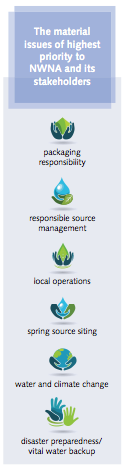
So when your business model is set around selling a product that is healthy and encourages nutrition while understanding and targeting its impacts through a well laid out sustainability strategy NWNA_priorities– as  Jeffery succinctly put it in his exit interview with Greenbiz Publisher Joel Makower earlier this year – is it fair to be labeled an environmental villain?

Perhaps, perhaps not.

The Challenges of Sustainability

As Paul reiterated, the journey of tackling facts vs. reality has been full of challenges and continues to be an uphill task. “Like anything else, our work in the area of recycling, water conservation and reducing our social and environmental footprint has been a constant education,” she said, citing the lack of modern and efficient recycling system as one of the company’s top challenges.

“Not too many people understand the current system in place. There are numerous questions like who is funding what, how does it work, who are the middle men, how do we get to the next stage, where can we build in efficiencies, etc. And if the goal is to accept our responsibility as a producer to recycle efficiently toward a goal of zero waste, then we need answers to these questions.”

“We’ve always said we’re open to options, and so far the option that we have seen with the highest potential to be low-cost and efficient is a well-constructed EPR system, run by industry. What makes this complicated is there are a dozen different ways EPR has been implemented globally. Many of those are not efficient. This uncertainty about the ability to do it “right” makes others in the dialogue want to take more of a “wait and see” approach. Even if you convince people who, done well, EPR in the form being proposed is the best solution, there are doubts about implementation across the board,” she said.

Other challenges?

Consumer vs. Producer Responsibility

Paul cited the potential of collaboration in building more sources for wind and solar energy, as well [“we’re not there yet but this is definitely on our radar”].

There is also a need for collaboration in the area of water stewardship. “Improving watersheds will require collaborations among the various stakeholders within a watershed, be that users, scientists, environmental groups or government. Nestlé Waters North America manages the watershed areas around the 40 springs we use that are overseen by our 10 Natural Resource Managers. We have also made a commitment to collaborate on two watershed projects per year,” Paul said.

And what about NWNA’s consumers? How does the company leverage its brand to shift consumer behavior?

“In the 1970s, recycling meant ‘putting it in the bin.’ Today, this is old news. What motivates people now is when they understand its benefits. If a consumer recycles a water bottle after use, the greenhouse gas impact of that bottle is estimated to be reduced by more than 15 percent.”

“Also, we need to close the loop on what happens to the bottles after they are recycled. They are not trash; they are a resource that can be used again and again. Right now our 50 percent r-pet bottles in our Arrowhead, Deer Park and Resource brands shows consumers what happens when they recycle. It becomes a new bottle. The visibility of this message on our bottles helps us tell the story that we need much better recycling to become a more sustainable world.”

The company’s top challenge moving forward?

“At the end of the day, you want zero impact, but is that possible? Our challenge is to keep finding those ways to improve when it feels like you’ve reduced the impact to the minimum,” she said, finishing with a flourish: “You need to find the next frontier every time – that’s the goal. And the challenge.”

Originally written for and published on CSRwire’s Commentary section Talkback on June 18, 2013.

Share this:

  • Tweet
  • Email a link to a friend (Opens in new window) Email
  • Share on Reddit (Opens in new window) Reddit
  • Print (Opens in new window) Print
Like Loading...

#SustLiving: In Conversation with Unilever’s Chief Sustainability Officer

09 Wednesday Jul 2014

Posted by Aman Singh in CSR reporting, CSRwire, ESG

≈ Leave a comment

Tags

#sustliving, aman singh, Brand Management, Chief sustainability officer, consumption, CSR reporting, CSRwire, Disclosure & Transparency, Environment, ESG, gail klintworth, Leadership, Stakeholder Engagement, stakeholder engagement, supply chain, Supply chain management, Sustainability, triplepundit, Twitter, unilever


A conversation with Unilever’s Chief Sustainability Officer Gail Klintworth on the Sustainable Living Plan’s progress, challenges, what’s necessary to shift global & local consumer mindsets and more: Moderated in partnership with Triple Pundit’s editorial duo Jennifer Boynton and Nick Aster.

[View the story “Unilever’s #SustLiving Trends Worldwide: Goals, Challenges & the Way Forward” on Storify]

Share this:

  • Tweet
  • Email a link to a friend (Opens in new window) Email
  • Share on Reddit (Opens in new window) Reddit
  • Print (Opens in new window) Print
Like Loading...

Connecting the Dots Between Consumers, Consumption & Sustainability: The External Face of Unilever’s Sustainable Living Plan

09 Wednesday Jul 2014

Posted by Aman Singh in CSRwire, ESG

≈ Leave a comment

Tags

Brand Management, Business, cause markeing, cause marketing, CSRwire, employee engagement, Environment, ESG, marketing, packaging, palm oil, PepsiCo, roundtable on sustainable palm oil, sanitation, Stakeholder Engagement, supply chain, Supply chain management, Sustainability, sustainability, unilever, unilever sustainable living plan, waste, water


What role does a consumer-facing sustainability strategy play in an ambitious plan like the Unilever Sustainable Living Plan? That’s where I left off in my interview with Marketing Chief Keith Weed last week in our review of the ambitious Plan two years since launch.

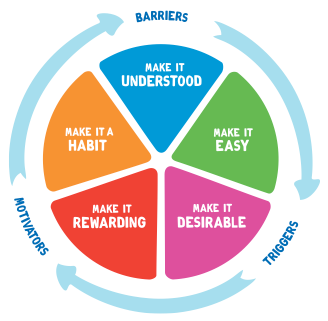
From Desire to Habit: Unilever’s Five Levers for Change

He chose to respond by explaining a framework called the “Five Levers for Change” that his team developed to solve exactly this dilemma. An excerpt:

  1. Make it understood. Sometimes people don’t know about a behavior and why they should do it. This Lever raises awareness and encourages acceptance.
  2. Make it easy. People are likely to take action if it’s easy, but not if it requires extra effort.  This Lever establishes convenience and confidence.
  3. Make it desirable. The new behavior needs to fit with how people like to think of themselves, and how they like others to think of them.  This Lever is about self and society.
  4. Make it rewarding. New behaviors need to articulate the tangible benefits that people care about.  This Lever demonstrates the proof and payoff.
  5. Make it a habit.  Once consumers have changed, it is important to create a strategy to help hold the behavior in place over time. This Lever is about reinforcing and reminding.

“We need to continue to work with others to drive this change. If we achieve the Sustainable Living  Five_Levers_of_Change_unileverPlan, and it doesn’t change business at scale, ultimately that’s a fail. Unilever’s impact is huge but we’re still a drop in the ocean. We need a movement going for businesses to help address this,” he explained.

“We are already working with organizations like the World Toilet Organization, UNICEF and others on sanitation, for example, which is a very important issue for us. Two million children die every year from pneumonia or diarrhoea. In a world where there are more mobile phones than toilets or toothbrushes, our work ahead is sure cut out for us,” he added.

The fact is Unilever cannot do it alone. None of it.

And Weed and team have understood that since launching the Unilever Sustainable Living Plan. While scale is a huge factor, organizations require individual and mass power to change consumer behavior and habits. And that is where the Five Levers for Change along with creative partnerships like the kind Weed referred to can help.

Making Sustainability Personal…

“I was in Brazil recently speaking to a lady in Sao Paulo about the environment and the city’s pollution. For her this meant dust from the nearby construction and the tainted flavor of her water supply. These were her immediate challenges – not deforestation or climate change. People view the world through the prism of my world – family, friends, and community. Our world is a step bigger: the city you live in, the supermarket, the local dump, etc. And the final level, ‘the world’ is the rainforest, the ice melting in the Arctic,” Weed continued.

His point: We need to connect “my world” with “the world” for consumers. “Right now we’re at level one. When I asked the lady what she thought would solve the issues, she suggested stopping the
littering because it would stop the drains from getting clogged and therefore avoid local floods. Level One,” he said.

What companies need to do is create a movement and work with people to drive change. A natural question then: Is Unilever working with other companies on its initiatives or primarily with nonprofits?

… and a Business Driver

One example Weed offered was palm oil.

“We purchase a lot of palm oil but it still makes only for three percent of the world’s palm oil. We started our journey by promising to source 100 percent of our palm oil sustainably by 2020. It’s a clear signal to the entire palm oil supply chain that that is the future we are working toward.”

“But this goal would be impossible to reach across the value chain without working with other purchasers of palm oil. So we work with other businesses and NGOs on the Roundtable on Sustainable Palm Oil to do this collectively.”

In fact, Weed says Unilever managed to reach the 100 percent goal last year because of this collective effort. The next step: To make the supply chain of sustainable palm oil easier and connected by 2020. “Right now procuring sustainable palm oil means weaving through a very complex supply chain,” he added.

Another example: the work of the Consumer Goods Forum, which includes 650 members including manufacturers, competitors, retailers and NGOs, responsible for over $2.5 trillion in sales. And Weed is pretty positive about the goals and work of the Forum: “There are a lot of companies getting behind the need to address the negative impacts of deforestation, and momentum is starting to build,” he said.

While momentum is starting to build – with several companies announcing new initiatives and collaborations – the issue did bring us back full circle to where we started: how do we connect these overarching partnerships with the average consumer?

Subtle Messaging & Cause Marketing

And what role does cause marketing play in Unilever’s 2020 plan? Should we expect more nuanced advertising on the lines of the Dove campaign, for example? Or go full throttle like Patagonia’s Sourcing_unilever“Don’t  Buy This Jacket” campaign?

It’s going to be subtler, says Weed. “For example, for our Tomato soup in Germany or our Ketchup in India, we talk about sourcing tomatoes sustainably. With our Lipton tea, we talk about sourcing all our tea and tea bags sustainably by 2020,” Weed explained.

“Consumers comprehend these messages differently though. When we talk about sourcing our tea sustainably, customers see the Rainforest Alliance logo as a sign of better quality and taste, not necessarily sustainability. With our Hellman’s mayonnaise we discuss cage-free eggs. Consumers perceive that as an indication of better food: animals are better looked after therefore they’re getting better food. However, it’s still early days,” he added.

Work Culture: Participating in Change

Early days also for Unilever’s employees, who are witnessing – and participating – in a significant shift culturally at a company that has left behind decades of “doing things one way” to a more complex ideology. How has the company’s culture evolved since 2010?

According to Weed, the greater purpose espoused by the Sustainable Living Plan has been significant for employees – kind of like Performance with Purpose over at competitor PepsiCo. “The notion that you can work for a business to earn money, build a career and also do it in a better way is significant. We need new ways of doing business in the future – our generation has stolen from our children’s
generation financially and environmentally – so we ‘re going out and saying we want our employees to innovate and encourage new ways of doing business,” Weed said.

In fact, the marketing chief, who also leads internal and external communications for Unilever, says despite the many crises facing our world today engagement levels among employees have gone up consistently every year.

A sentiment that resonated in an email I received this week from Kam Erik Fierstine, a project delivery manager in Unilever Engineering Services at the company’s Henderson, Nev.-based ice cream plant. Here’s what he wrote when I asked him about the culture at his company:

“The Sustainable Living Plan is something that is quite apparent to those of us that live in a desert-like area where we are very conscious of water usage. It has shown our employees that Unilever has the same values that we were raised with. Our employees would not put up with a leaky faucet at home, and now they have the backing of management to proactively fix these simple issues at work.”

“We all agree that we want to leave a healthy planet for future generations and we can help do that by conserving our resources. Our employees see the management team walking the talk and that empowers them to escalate issues and voice new ideas. They will now do small things to make a larger impact like pick up things from the floor or switch off conveyors or equipment when not in use.”

The Henderson, Nev.-based ice cream plant was recently honored by the Innovation Center for U.S. Dairy for its sustainability practices.

“They see us taking on challenges in a positive way and that’s inspiring,” Weed wraps up.

Originally written for and published on CSRwire’s Commentary section Talkback on May 1, 2013.

Share this:

  • Tweet
  • Email a link to a friend (Opens in new window) Email
  • Share on Reddit (Opens in new window) Reddit
  • Print (Opens in new window) Print
Like Loading...

SAP’s 1st Integrated Report: From Sustainability to Integrated Thinking

09 Wednesday Jul 2014

Posted by Aman Singh in CSR, CSR reporting, CSRwire

≈ Leave a comment

Tags

CSR, CSR report, CSR reporting, CSRwire, culture, Disclosure & Transparency, employee engagement, energy, ESG, ghg, governance, health, iirc, integrated reporting, leadership, paul druckman, retention, sap, Stakeholder Engagement, Supply chain management, Sustainability, Sustainability Report, transparency, voluntary disclosure


Using Integrated Reporting as a catalyst for integrated thinking.

That’s how Peter Graf, SAP’s Chief Sustainability Officer expressed the firm’s decision to replace two reports – the annual report mandated by the law and submitted to the SEC indicating the company’s financial performance and the sustainability report , voluntary in nature and showing its non-financial performance– by one Integrated Report for 2012.

While Integrated Reporting is a fairly new trend – The International Integrated Reporting Committee [IIRC] website hosts a total of 41 Integrated Reports since 2011 – it’s not surprising.

As the trend of CSR and sustainability reporting grows – due to multiple factors including a recessionary economy, dwindling resources, emerging conflicts in supply chains and a better connected world – logically, Integrated Reporting is the next step for any organization truly attempting to be as transparent as possible about its financial and non-financial challenges and performance.

Shift in Engagement: From Sustainability to Integrated

At SAP, the impetus for the shift was the realization that “we needed to engage within our organization on a different level” according to Graf. “We have been reporting on our sustainability performance since 2008. The report has grown in sophistication over the years and we even won several awards in the last two years for our report’s interactive nature, etc. So technically, we could have continued on that road,” he added.

Last year, CSRwire collaborated with Graf and his team on a webinar to launch SAP’s new interactive report. Complete with social media buttons, comment sections and multimedia options, the report could be customized and perused in multiple ways depending on your agenda. The report was well received – and in a span of an hour SAP_Integrated_Reportwe received over 30 questions from a very engaged audience.  [Join us for a webinar with Peter Graf, IIRC CEO Paul Druckman and others today at 11am ET]

SAP set a trend last year, so why the shift again?


Connecting the Dots: The Bigger Picture

“We have been measuring key performance indicators [KPI] on the financial and non-financial side for quite a while. But one day, we started to put them all on a white board trying to draw connection lines between them. Before we knew it, the chart was pretty full. We started to do research both internally and externally , to better understand and compute those relationships. Suddenly it became clear, just how interconnected non-financial and financial performance indicators really are,” he explained.

“When I heard about Integrated Reporting for the first time, I got excited. But then I thought: It’s going to be a very long process to achieve the integrated thinking that must be portrayed in the report. I viewed the Integrated Report as an outcome. However, over time our team reached the conclusion that instead of waiting for the right engagement at SAP to happen, we should use the process of producing an integrated report as the forcing function to drive the necessary engagement,” Graf added.

“In its integrated report, SAP lays out the interdependencies between financial and non-financial indicators,” said Graf. Proof points like: an increase or decrease of one percentage of SAP’s retention employee retention at SAPrate saves/costs the company 62 million euros. And since 2007, a peak year for energy consumption at the company, SAP has avoided 220 million euros ($285 million) through energy conservation efforts.

“When these kinds of relations appear between financial and non-financial indicators, they do more than make the business case for sustainability. They serve as the catalysts for an integrated corporate strategy.” said Graf.

While the entire report is available online, a parsed version – “we kept out customer stories but retained all other ESG data and metrics” – is submitted to the Securities & Exchange Commission.

SAP’s 2012 Performance: Key Highlights

So what will you find in the integrated Report this year?

For one, retention was up [94 percent in 2012] as was diversity, i.e., the number of women in management [an increase of one percent from 2011 to 19.4 percent].

The goal: to reach 25 percent by 2017.

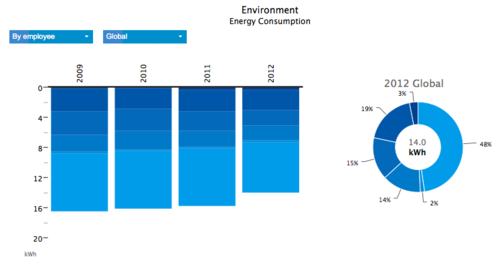
Total energy consumed stayed stable at 2011 numbers while revenue increased by 17 percent and emissions per Euro in revenue and per employee were reduced for the sixth year in a row. Overall emissions were slightly reduced, in spite of the company  adding 9,000 new employees in 2012. Finally, the use of renewable energy increased from 47 percent in 2011 to 60 percent in 2012.

Also intriguing to me was a section, which detailed SAP’s People Strategy.

I asked Graf what the strategy involved – and how did they measure the outcomes besides retention and diversity?

“Having a sound strategy around people is essential in a company that solely relies on its employees to create value. Thus our ability to compete is highly dependent on our human resources and it’s impossible to separate that from our financial performance,” he said.

“First, we want to hire more diverse people. We believe more diverse groups innovate better. Second, we want to nurture our talent through clear development plans, challenging assignments, social media, e-learnings, etc. And finally, we want to leverage employee engagement as a decisive factor. So we measure retention and diversity but also engagement, which is a core and central KPI in driving our overall performance in the future,” Graf added.

Measuring Employee Engagement: Critical to Business Performance

So what contributed to a drop in employee engagement in 2006-2009?

“I believe there are various reasons that led to a decrease in engagement during that time. Most important, however, is how we made it back to the high engagement scores of today: When economic growth came back after the recession, the leadership of the company changed, a compelling innovation strategy for growth was established, the company was given the purpose of helping the  world run better to improve people’s lives and Energy_consumption_SAP_2012overall we enjoyed strong and continuous revenue growth as a result. So, a combination of issues got us into low engagement scores and a combination of things got us back on track.”

SAP also measures a Business Health Culture Index. Does that measure the company’s engagement quotient and connect it with business performance?

“We use this index to measure the health of our employees. There are four times as many stress-related illnesses in the intellectual property industry as compared to other industries. So we use data from eight questions [purpose, leadership, recognition, empowerment, rewards, stress levels, compared to people my age I feel more/less healthy] to understand where we stand and what we need to do to take care of our employees.”

In 2012, SAP’s Health Index stood at 66 percent, a one percent increase since 2011 and significant growth since 2008-2009.

Integrated Reporting: Check. What’s Next for SAP?

With all the data and metrics dancing around in my brain, the only question left to ask was, what’s next?

“On the one side, we recognize that integrated reporting is an early trend and that we certainly have to continue to improve and learn. On the other side, we have the ambition to lead, even if this means that we may make a mistake that followers might be able to avoid,” said Graf.

“The next steps clearly are to continue to move away from just having a sustainability strategy to making our corporate strategy more sustainable. This requires an engagement with leaders across SAP that we have not achieved before moving to integrated reporting,” he added.

His recommendations for companies who might be complacent with limited voluntary disclosure or perhaps hesitant to mix the voluntary with the mandatory?

“As soon as people recognize that  integrated reporting helps companies understand and grow the way how they create value at their core, , it will pick up. More and more people know this intuitively today but when someone connects all the financial and non-financial numbers with each other, then the big picture emerges,” he said.

SAP’s Integrated Report 2012 is available at www.SAPIntegratedReport.com.

Originally written for and published on CSRwire’s Commentary section Talkback on March 25, 2013.

Share this:

  • Tweet
  • Email a link to a friend (Opens in new window) Email
  • Share on Reddit (Opens in new window) Reddit
  • Print (Opens in new window) Print
Like Loading...

Corporate Social Responsibility at Target: Behind the Red Bullseye

07 Monday Jul 2014

Posted by Aman Singh in CSR, CSR reporting, CSRwire, ESG

≈ Leave a comment

Tags

Business, Consumerism, Corporate Governance, CSR, CSR reporting, CSRwire, education, energy efficiency, environment, ESG, ESG goals, packaging, Stakeholder Engagement, supply chain, Sustainability, sustainability, sustainable design, target, transparency, water reduction goals


Target released four new corporate responsibility goals in 2011:

  • Increase sustainable seafood selection
  • Improve owned-brand packaging sustainability
  • Increase diabetes HbA1c testing compliance
  • Increase reading proficiency

Now, Target’s 2011 CSR Report offers pages of graphs measuring the Minneapolis-based retailer’s progress against these goals. While the graphs look promising and underscore the challenges of operating in a competitive market with multiple layers of stakeholders, I wanted to understand the context behind these goals and what the execution would look like.

I sat down with Tim Baer, Executive Vice President, General Counsel and Corporate Secretary with Target, for a conversation about the goals and how his team plans to demystify complicated supply chains and motivate its employees and customers toward healthy and sustainable choices.

Aman Singh: While the PDF of goals and progress gave me a sense of exactly that, i.e., progress, it didn’t give me a sense of Target’s mission/values. Can you elaborate?

Tim Baer: At Target, we’re committed to positively impacting the lives of our guests and team members. Since 1946, our legacy of giving and service has been reflected in a commitment that today totals more than $3 million a week to our communities.

Tim_Baer_TargetAnd at the end of the day, by continuing to  serve our team members and communities, we ensure our future success. As a result of our giving model, we benefit from being a workplace and shopping destination of choice for our team members and guests. Not only do our guests value our commitment to communities and giving, but our team members do as well.

To bring our vision of strong, healthy and safe communities to life — which we can’t do alone — we work with community, business and civic partners who inform and share in our approach. We know we can make a meaningful impact, so we set goals to guide our work in three focus areas — helping to put more U.S. children on the path to graduation, reducing our impact on the environment and helping Target team members live healthy, balanced lives.

Why is education such a big goal for Target?

Education, specifically K-3 literacy, is important to Target for three primary reasons. First, we believe that every child deserves the opportunity to reach his or her full potential. And, we’re compelled to do our part to address the education challenge in America, putting more kids on the path to high school graduation.

Second, based on guest surveys, we know that our guests care about education more than any other social issue, and we’re committed to giving to communities in a way that positively impacts our guests and their families.

Third, we know that reading proficiently by the end of third grade is a significant milestone on the path to graduation. This is the time when a child transitions from learning to read, to reading to learn. A child who cannot read proficiently by the end of third grade is four times more likely to drop out of high school when compared with a child who can.

Ultimately, education is critically important to the success of our children and our economy. By supporting education, we are investing in developing an educated workforce that is prepared for today’s and tomorrow’s challenging work environment. At Target, our team is our competitive advantage, and preparing future team members with a quality education today makes good business sense.

CSR_Education_Target

Your data shows that you were not able to achieve your water reduction goals? Can you give us a sense of the challenges and where improvements need to be made?

To recap the report, Target used 3.45 billion gallons of water, representing a 0.3 percent reduction in water use per square foot from our 2009 baseline. Although our absolute water use exceeded our initial baseline, we also increased our total real estate square footage, which led to a decrease in water use per square foot.

The most significant challenges we faced in 2011 were drought-like conditions in some of our mature markets like Texas, Minnesota and Iowa, where we have a relatively high concentration of stores requiring increased irrigation. This negative impact was modestly softened by our rollout of several water-saving initiatives, which we estimate will contribute a reduction of 1.4 percent annually starting this year.

A few examples of our water-saving initiatives include:

  • Expanded installation of smart irrigation controllers that irrigate based on real-time local weather data in lieu of set times,
  • Use of ultra-low flow urinals and water closets, and
  • Elimination of continuously running dipper wells for ice cream and coffee stations at Target Café and Starbucks locations in our stores.

We’re also in the process of installing real-time water submeters in a number of stores to pinpoint the quantity of water a typical store uses for various operations. This will help improve our evaluation of water-saving opportunities moving forward.

Environment_CSR_Target

You have a goal of reducing owned-brand product packaging for at least 50 product designs by 2016. Is that aggressive enough?

While we’ve targeted 50 packaging designs, these changes will be implemented for a much larger number of items that use the same packaging.

We know environmental stewardship is important to Target guests, and our sustainable packaging designs will let them know that Target’s commitment to reducing our environmental impact begins before our products hit shelves.

Over the next five years, Target will be developing sustainable packaging designs that yield at least a 10 percent improvement in one of several attributes of our existing owned-brand packaging. We’ll do this in several ways, including reducing overall packaging, using more recycled or renewable content, and reducing product waste. We’ll also look to use more recyclable materials in our packaging, Sustainable Packaging at Targetcounting these improvements toward our goal only if the updated packaging is 100 percent recyclable.


The goals indicated regarding packaging are limited to your owned-brand products. Are there any plans to push your suppliers and CPG partners into more responsible, transparent and environmentally friendly actions?

We believe in leading by example and hope that by creating more sustainable packaging for our owned brands, we can inspire our suppliers, CPG partners and peers to implement more sustainable packages in their own products.

The report indicates strong progress toward empowering employees to be more health-conscious. Can you discuss some of the challenges behind the numbers?

For us, 2011 was a year of learning in regards to team member wellbeing.

We recognized goals specific to preventive service utilization rates were difficult to measure consistently and accurately, so we adopted HEDIS [National Committee for Quality Assurance’s Health Effectiveness Data and Information Set] measures. By doing so, we can support our wellbeing efforts by comparing our utilization rates to those of other employers or healthcare entities like medical groups or health plans.

The size and geographic distribution of the Target team member population reaches across 49 states, 1,700 stores, 37 distribution centers and nine domestic headquarters locations. We employ more than 365,000 team members and know they have varying degrees of health engagement, variable disease prevalence and differing perspectives on healthcare services. This is an opportunity for us to develop tailored programs that address these differences, more effectively reaching every team member, regardless of where and how they live and work.

Can you summarize the key highlights of the report?

All of Target’s corporate responsibility objectives ladder up to our larger goal of creating a brighter future for our team members, our communities and the world we live in. Target is here for good. Through all of these initiatives, we’re committed to positively impacting the lives of our guests and team members.

Additionally, Target’s 2011 Corporate Responsibility Report is the most transparent corporate responsibility report we’ve ever released. It represents the first time Target declared a GRI Application Level and obtained a GRI Application Level Check. [For more information, Target’s GRI Application Level/Check Statement from GRI were posted on www.Target.com/hereforgood on July 13, 2012.]

Why bother reporting on this set of internal goals? How do you measure the “success” of your CSR report?

Our commitment to our guest extends far beyond our stores, and we believe truly great service includes supporting the communities where we live and work. In business, Target collaborates and innovates to drive results. Key to that collaboration is transparency when it comes to measuring and reporting progress toward goals, allowing us to grow as a company.

Originally written for and published on CSRwire’s Commentary section Talkback on August  6, 2012.

Share this:

  • Tweet
  • Email a link to a friend (Opens in new window) Email
  • Share on Reddit (Opens in new window) Reddit
  • Print (Opens in new window) Print
Like Loading...

The True Value of CSR Reporting: In Conversation with Campbell Soup’s VP for CSR

07 Monday Jul 2014

Posted by Aman Singh in CSR, CSR reporting, CSRwire, ESG

≈ Leave a comment

Tags

Business, Campbell Soup, CEO Network, community development, corporate governance, CSR, CSR reporting, CSRwire, Dave Stangis, denise morrison, employee engagement, Environment, ESG, Social Media, Stakeholder Engagement, Supply chain management, Sustainability, sustainability, Work culture


The soon-to-be-released report will mark Campbell Soup’s fourth CSR Report. This report comes amidst a CEO change – Denise Morrison took on the chief job at Campbell Soup last year joining a small group of women CEOs in the Fortune 500 – and a period of what Director of Diversity & Inclusion Kevin Carter calls a time of “deep introspection” for the company.

Carter’s note is well taken. With the economy sputtering and flailing, reports continue to suggest that consumer confidence and trust remain low. For a food manufacturer then, this means not only staying ahead of the curve of quickly changing taste preferences but also understanding its unique role in encouraging nutrition across an increasingly complex and fragmented consumer base.

And amid a tepid economy, where does the true value of CSR and sustainability reporting lie? Can these reports and the effort required to produce them extend beyond an exercise in sharing key metrics, the year’s highlights – and a few, incredibly sparse media mentions – to true learning experiences for companies to better their processes and make gains that help them and their communities become more sustainable?

The True Value of CSR Reporting

Dave_Stangis_CSFor VP of Public Affairs and Corporate Responsibility, Dave Stangis – his third report since taking the job at Campbell Soup – the true value of Campbell Soup’s reporting goes far beyond setting the right goals and reporting on the progress.

“The true potential of CSR reporting* is that while companies go through this chronological reporting effort once a year, the organization and business units are executing their strategies and working on metrics year-round. The process of reporting creates an opportunity to build a Campbell Soup Britannica or World Book to work off of and use as a record of the company’s progress,” he said in a recent interview.

“All year-long, we are collecting examples, building the narrative, monitoring our progress and continually evolving materiality assessments,” he continued. Often, great examples of progress emerge that would otherwise never rise to the spotlight in a multinational company.

“As you dig in, you find cross-functional teams working together on strategy, benchmarking, indicators, etc. There are, of course, always things to improve on but the stories and ideas that emerge from this heels dug in reporting exercise are incredibly useful in moving our company forward,” he said.

Connecting the Dots: Recognizing the True CSR Heroes

In recent weeks, CSRwire readers read from a number of top executives at Campbell Soup on their stories and contribution to the 2012 CSR report. Trish Zecca discussed the fine balance between nutrition and taste while Amanda Bauman discussed how the company is tackling hunger and obesity in its communities and Dr. Daniel Sonke gave us an in-depth account of the relationship between agriculture practices and corporate sustainability. Finally, D&I Director Kevin Carter offered his insights on how the company is prioritizing intercultural teams, moving diversity beyond compliance, and tentatively dipping its toes in social media.

For Stangis, these are the true heroes.

“These are the people who are behind the images and stories in the report. They are invested in the business Campbell_Soup_Volunteersand their work and there is a discernible amount of pride and work ethic that goes along with that,” he said.

“For our CSR Communications Manager Niki Kelley – creating this report is her life for six months and I’ve told her, she’s the one who knows more about the entire company than anyone else in the company.”

5 Questions for Campbell Soup’s VP for CSR

What is Stangis most proud of in the latest CSR report?  “It’s the nuances that a lay reader won’t realize but that are critical to the progress we are making,” he said. To explain further, we decided to play five questions:

1. Whose Interested:

“We continue to evolve our understanding of our various audiences [for the CSR report]. We want to connect with our employees on the frontline as well as in the C-suite. We need to impact our neighbors and make the content relevant to our customers and consumers. Most readers are looking for quick snapshots and I want to validate, reinforce and build trust and credibility in that short timeframe.”

2. What’s New:

“We’ve really worked hard on strengthening the wellness and nutrition metrics from a product perspective…we’re not driving a health ultimatum, but we are offering more healthy choices for consumers. Readers that pay closer attention will notice a growing sophistication in our strategies and metrics across the board. This report also includes the first full description of our Healthy Communities Initiative that we’ve launched in Camden, NJ.”

3. What’s Often Hidden:

“We work hard to make sure nothing gets lost in the details, but there is a ton of content that most readers will miss on a casual glance. The CEO Letter can give the readers a sense of how Denise Morrison thinks and interacts with the CSR and sustainability strategy.”

“We’re bridging from an employee engagement (only) mindset to a performance culture that leverages engagement to drive better business results. This isn’t something that is immediately obvious to external readers but it’s a priority for us.”

4. What’s Measured Gets Managed:

“Last year we discussed our community programs but this year the report really talks about these in a strategic and measurable manner. We continue to advance our metric set from product conception to societal impact. We’ve mapped our production sites with the WBCSD Global Water Tool and as we’ve brought our Community and Foundation functions into tighter alignment with our CSR and Sustainability strategies, we are shifting from measuring activity to measuring outcomes.”

5. Uncharted Territory: 

“The big news this year from a sustainability perspective is our traction on renewables. We’ve had smaller efforts in the past but in 2011 we went from dipping our toes in the water to flipping the switch on one of the largest solar installations in the country. This represents a cultural shift for the company. Large scale renewable projects just weren’t in our solution set and now we are evaluating new renewable opportunities across our plant network that reduce our greenhouse gas emissions and save money.”

Solar_Panels_at_Campbell_SoupFor Campbell Soup, a global footprint means a holistic vision of sustainability that encompasses its products, employees, communities and supply chain.

And for Stangis, publishing an annual report is not only a testament to his team’s efforts but also a way to measure what’s not working. Having led CSR at Intel before joining Campbell Soup, Stangis is a veteran in the world of CSR reporting, and has seen firsthand the evolution of the sector.

“What comprehensive reporting does today is set up a process that continues to position the company in the long-term. This wasn’t the case when we started reporting. Now we’re anticipating issues and breaking down communication silos that are inherent in the company,” he explained.

Challenges Ahead: More Data, Clarity of Purpose

Any regrets? “We need to keep pushing ourselves for better data every year, especially for our international footprint. It’s only when you dig in that you realize how much better a fully integrated measurement and reporting system would be,” Stangis confessed.

The journey – as for most companies taking on the responsibility and challenge of reporting on their corporate social responsibility and sustainability efforts – is far from over.

And as a seasoned sustainability executive, Stangis understands the daunting task that lies ahead for Campbell Soup in a crowded market, evolving taste preferences and the continuous challenge of consumer education.

“We still have to plug people into what we are doing, the reason why we are doing it [and make it make sense],” he said, noting that it isn’t just the external stakeholders that need the dots to be continually connected for them.

“We have to do a better job at communicating the strategic intent and shareowner value delivered by a comprehensive CSR program.  Our internal teams, our C-suite – it’s our job to help them understand  the story across the board.”

Originally written for and published on CSRwire’s Commentary section Talkback on May 24, 2012

Share this:

  • Tweet
  • Email a link to a friend (Opens in new window) Email
  • Share on Reddit (Opens in new window) Reddit
  • Print (Opens in new window) Print
Like Loading...

Social Responsibility, Beer & Aliens: Journey to Becoming the Best Beer Company in a Better World

07 Monday Jul 2014

Posted by Aman Singh in CSR, CSRwire

≈ 1 Comment

Tags

ab inbev, Anheuser Busch, Brand Management, Business, carlos brio, carol clark, community, community development, CSR, CSR report, CSRwire, environment, ESG, executive compensation, Social Impact, Social Responsibility, Stakeholder Engagement, supply chain, Sustainability, sustainability, water conservation


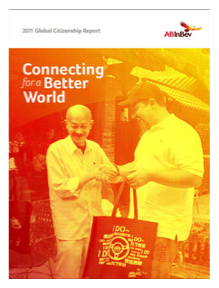
I caught up with Carol Clark, Global VP for Beer and Better World, to drill deeper into Anheuser-Busch InBev’s latest CSR report. Key highlights:

The report is titled Connecting for a Better World. AB InBev makes beer. What’s the connection?

At AB InBev, our dream is to be the Best Beer Company in a Better World. We believe that taking consistent, active measures in our core areas of social responsibility means constantly connecting our business with our stakeholders, especially in the communities where we live and work.

It takes a team effort to address these issues. Through our work to promote responsible drinking, reduce our impact on the environment and support our communities, we work with others who share our collective goal of making a difference.

There’s a quote in the report from Carlos Brito saying “We’re not aliens.” Can you offer some context?

Carol_Clark_AB_InBevWhen Carlos Brito said, “We are not aliens …” he was responding to a question at the Business for Social Responsibility Conference last fall about why AB InBev actively promotes responsible drinking.
AB InBev today has over 116,000 employees operating globally. We live on this planet and share the same concerns as our friends and neighbors. Many of us are parents and understand how important it is to talk with our children to help prevent underage drinking.

Similarly, we don’t want to be on the road with drunk drivers, and we’re committed to supporting prevention efforts such as encouraging the use of designated drivers. We’re committed to addressing these issues not only from a business perspective, but also from a personal perspective.

What is the ROI in producing a comprehensive CSR report such as this one? Media mentions? Retention? Rankings? Anheuser-Busch_CSR_Report

Publishing our CSR report keeps us focused and accountable to our stakeholders and ourselves. The scrutiny that this annual process brings gives us an updated perspective to help us further drive our performance, engage our employees and very importantly, thank them for their great work over the past year.

From an external perspective, we’re satisfying the requests from varied stakeholders for transparency on our social responsibility efforts.

The report is over 80 pages. Who is your primary target audience? And, who would you want to target?

We have a lot of good things to talk about! We use the report to share our progress with diverse audiences – from community stakeholders to investors, to media, to government officials – around the world.

Alex Prud’homme author of The Ripple Effect recently said that “Water is the headlining story of our century.” Are you focusing on sustaining your business by reducing water use, R&D on water replenishment or identifying alternative products altogether?

Water is our primary environmental focus and we aim to reach a water usage rate of 3.5 hectoliters of water for each hectoliter of production by the end of 2012.

We tackle the issue of responsible water use by doing more to conserve both in our operations and in the communities where our breweries are located. Progress requires operational changes and continually applying the most updated technical innovations. It means going further with supply chain and community partners to help conserve water outside our walls. But it also requires reinforcing a mindset that doesn’t take water for granted.

[Anheuser-Busch InBev’s 2011 Global Citizenship Report]

It can be argued that 8.2% reduction in water usage since 2010 is not a lot. Primary challenges in reaching double-digit reduction?

Actually, if you look at the beverage industry, this is a significant achievement. And it’s important to keep in mind that we’ve focused on water and energy efficiency for some time now, so there is very strong year-on-year progress. And we’re also making these reductions while continuing to grow our business. That means that each year, our brewing operations teams find innovative ways to do more with less when it comes to water.

To date, we’ve achieved an average water use of 3.71 hectoliters per hectoliter of production across our global business, which represents a 13.7% reduction against our 2009 baseline.

Our target, which we’ve stated publicly, is to reach 3.5 hectoliters of water per hectoliter of production by end-2012, which will put us on the leading edge of water usage for the brewing industry.

Your report mentions the billions paid in wages and income taxes. Not a lot of reports make these metrics a part of their community development results. Why the emphasis on wages? 

As the leading global brewer, we have operations in 23 countries. We have a significant economic impact on the local communities where we do business through the jobs we create, the wages we pay and the taxes we pay governments at all levels. We feel that it’s important to report on and recognize the value and impact we are bringing to communities where we live and work.

Can you talk to the “ownership culture” of the company?

One of our 10 AB InBev Principles is about ownership: “We are a company of owners. Owners take results personally.”

[Sustainable Beer: Anheuser-Busch InBev’s 2012 Environmental Goals]

We strive to create a culture that encourages responsibility and accountability, and that applies to our work on social responsibility as well. Creating this culture of ownership helps us build those connections and team approach, both internally and externally, to helping make a difference in our communities as we strive to be the Best Beer Company in a Better World.

Originally written for and published on CSRwire’s Commentary sectionTalkback on April 26, 2012.

Share this:

  • Tweet
  • Email a link to a friend (Opens in new window) Email
  • Share on Reddit (Opens in new window) Reddit
  • Print (Opens in new window) Print
Like Loading...
← Older posts
Newer posts →

Let's Talk!

Virtual
732-322-7797
amansinghdas@gmail.com

Blogs I Follow

  • Nonprofit Chronicles
  • Learned On by Andrea Learned
  • Angry African on the Loose™
  • csr-reporting
  • The CSR Blog
  • In Good Company: Singh on CSR

My Cloud

Capitalism 2.0 CSR CSR reporting CSRwire ESG Guest Author HR Stakeholder Engagement Sustainability Uncategorized

Recently written…

  • Rationality is Ruining Us: Mayors, presidents and governors join major businesses in charting way forward on climate change
  • 2015: the year businesses recognize that climate change is real – and 4 other themes
  • Hardcore lessons of sustainability – ’10 Words or Less’
  • Brewing a Better Future [#BaBF] with Heineken: Examining the Many Flavors of Local Sourcing
  • From Conflict to Collaboration: Kimberly-Clark and Greenpeace Participate in LIVE Twitter Chat

What others are reading

aman singh aman singh das Brand Management Business corporate social responsibility CSR CSR reporting CSRwire ESG Leadership Stakeholder Engagement supply chain Sustainability sustainability Work culture

Categories

Most Read

  • None

Create a free website or blog at WordPress.com.

Nonprofit Chronicles

Journalism about foundations, nonprofits and their impact

Learned On by Andrea Learned

Angry African on the Loose™

I have opinions. I am from Africa. I live here now. I blog.

csr-reporting

Connecting the dots between Business, Society & the Environment

The CSR Blog

Connecting the dots between Business, Society & the Environment

In Good Company: Singh on CSR

Connecting the dots between Business, Society & the Environment

Privacy & Cookies: This site uses cookies. By continuing to use this website, you agree to their use.
To find out more, including how to control cookies, see here: Cookie Policy
  • Subscribe Subscribed
    • In Good Company: Singh on CSR
    • Join 119 other subscribers
    • Already have a WordPress.com account? Log in now.
    • In Good Company: Singh on CSR
    • Subscribe Subscribed
    • Sign up
    • Log in
    • Report this content
    • View site in Reader
    • Manage subscriptions
    • Collapse this bar
 

Loading Comments...
 

    %d