• ABOUT THE AUTHOR
  • Sustainability
  • CSR
  • CSR reporting

In Good Company: Singh on CSR

~ Connecting the dots between Business, Society & the Environment

Tag Archives: Ethics

Does Expending Resources on CSR and Sustainability Destroy Economic Value?

13 Tuesday Sep 2011

Posted by Aman Singh in CSR

≈ 11 Comments

Tags

aman singh, aman singh das, Aneel Karnani, BP, brand management, Brand Management, Business, business strategy, Campbell Soup, CEO Network, Commitforum, corporate citizenship, corporate social responsibility, CSR, CSR reporting, CSR strategy, Dave Stangis, Ethics, ethics and compliance, Events, Fenton, Gerry Sullivan, Green, green jobs, Leadership, Management, Paul Herman, risk management, shared value, social enterprise, Social Impact, social responsibility, Social Responsibility, Starbucks, Sustainability, sustainability, sustainable business


Corporate Social Responsibility isn’t about giving money away and adopting the latest cause of activists. CSR and sustainability are approaches to business operation and execution that build employee engagement, improve environmental performance, create positive social impact, enable operational efficiency, reduce cost, foster innovation, strengthen relationships with customers and consumers and ultimately…create business advantage.

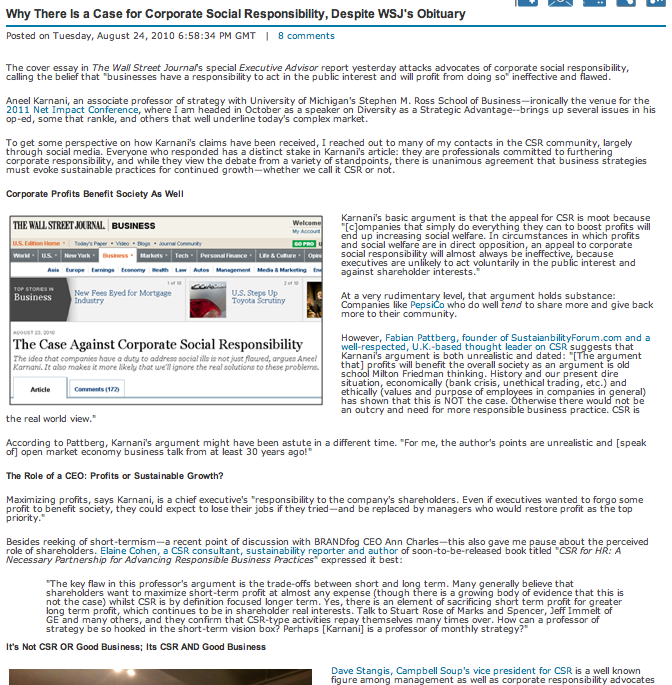
That was Dave Stangis, VP for Corporate Responsibility with Campbell Soup Company responding to University of Michigan Professor Aneel Karnani’s infamous editorial in The Wall Street Journal, “The Case Against Corporate Social Responsibility.”

Then, the argument was “capitalism versus corporate social responsibility, CSR versus profits, and where an idea like CSR fits into a business’ main objective, which is to make profits for its shareholders.”

Despite numerous debates [Fenton’s BIG CSR debate] and as many editorials and reports [Why There Is a Case for Corporate Social Responsibility], the inequity of the idea — or the perception that being responsible will cost a company money and therefore is an expense business doesn’t need — prevails.
But the actual essence of this debate no one can seem to pinpoint. Are we fighting over semantics or strategy?

Is it the misperception that CSR is a cost, a tagged on responsibility, and therefore, unnecessary for companies? Or that CSR is completely estranged from the notions of capitalism as Professor Karnani believes — and is, in fact, the wrong argument?

Since his controversial editorial, Karnani of course has continued to incite criticism for what many call an “extremely shortsighted and narrow view.”

Now, the associate professor of management and strategy for Michigan’s Ross School of Business is headed to New York City to debate his argument in real-time on the occasion of the CR COMMIT! Forum 2011, organized by Corporate Responsibility Magazine and NYSE Euronext [Details below].

Fashioned as an Oxford-style debate [DEBATE: RESOLVED that when companies expend resources on corporate responsibility and sustainability they destroy economic value], Karnani will be joined by Gerry Sullivan, president of the VICE fund, on the pro-markets side.

On the pro-sustainability side will be Paul Herman, CEO of HIP Investor and Dr. Vinay Nair, founding partner of Ada Investments and adjunct associate professor of finance and economics at Columbia Business School.

In a sneak peek, I talked to three of the debaters [Dr. Nair couldn’t make it] on the essence of their arguments as well as: How does each of them define CSR?

Take a read:

Thriving on the Value of Vice

Gerry Sullivan from VICE funds believes in the power of capitalism. His funds select well performing stocks of tobacco, alcohol, gaming and weapons companies because they believe that, “Vice industries tend to thrive regardless of the economy as a whole.” Anyone reminded of the root of the financial collapse?

“I believe in capitalism because it ensures that products and services coming out are tested on the profit mandate and ultimately are good processes because they come through the interaction and the ability to gain profit,” he said.

Fair enough. Historically, companies who do well tend to share more.

Making Too Much of CSR?

“My biggest fear of CSR is that people want to make more of it than it really is. A company’s ability to employ better people and deploy profits is the real goal. Everything else is settled by the market,” he continued.

But clearly there is a differentiator between companies that invest in their community and immediate environment over the long-term and those that focus on short-term yields?

Affirmative, says Paul Herman.

Citing the ever quotable example of BP, he said, “When you look at their track record, BP was not a good corporate citizen and lost 40% of shareholder value in just a few months post the oil spill. Companies are not prepared for the volatility of climate change and its effect on cash flows and natural resources.”

Further, “Research from Wharton School and other academics has shown measurably that companies that help solve social and environmental problems can enjoy a higher shareholder and portfolio value,” he said.

“This decreases risk for business and increases value,” he added.

CSR Cannot Dictate Social Enterprise, But Profits Can

Because it had begun to sound like a battle between two followers of capitalism with opposite operational ideologies, I asked Karnani to step in.

“Companies can maximize profits and social enterprise at the same time, which is why capitalism works well. This is where Paul makes a good argument. Of course companies should do all this,” he said.

“But we don’t need CSR to make this argument. It’s as simple as ‘make the money, help employees.’” he added.

Here is where the caveat comes in however, he said. “This isn’t always true. When markets fail, we cannot appeal to companies to sacrifice profits for CSR and it is naive of anyone to think that all the stakeholders are always aligned in their interests. If this were true, we wouldn’t need the study of economics,” he argued.

His solution? Going back to what he had argued in the WSJ editorial last year: Government regulation.

And this is where my problem with the debate starts: How can government regulate behavioral change, cultural perceptions, and a deteriorating environment? Or are we now talking of CSR as a program, an initiative, a fundraising for charity opportunity?

If so, was Karnani suggesting the route the Indian government took recently by “mandating 2.5% of net operating profits must be spent on CSR” by all publicly traded companies?

Perhaps, although we won’t know till the live debate at the COMMIT! Forum.

Back to Square One: What the heck is CSR?

Clearly, the next question: How are these men defining corporate social responsibility? Intentionally or not, I had hit the nail on its head.

VICE Funds: “CSR is Green, And It Isn’t Generating Green”

According to Sullivan, “CSR is embedded into green and green hasn’t generated green for most companies.” Also blaming the government for supporting “and pumping a ton of money into green jobs,” which many say has been a failed effort at reviving the economy, Sullivan continued:

The internet bubble taught us that having pool tables and kegs doesn’t make the companies money. If the jury is still out on whether good companies will do good things, I say they’re smart enough to treat their employees well. You don’t need CSR for that.”

“I would like the companies I invest in to not be socially responsible but responsible to their shareholders and producing products that the government can use to generate revenue. I certainly hope that these companies think highly of their employees but I’m less inclined to think that they would give up profits over socially responsible activities.

HIP Investor: “CSR is Generating Top Line Growth”

For Paul, the question isn’t about green or management. “You start by asking yourself what social or environmental problem you are solving. Companies who are doing well have a core mission of improving the world in some way and making money while doing so.”

Citing the example of banks, he explained, “Banks were started to help people grow their income and wealth and became more integrated in their communities.”

“Starbucks in the U.S. spends more on the health care of its employees than the coffee beans because they support a better quality of life for employees and a higher labor standard.”

The argument, at least for Herman, isn’t about the validity of CSR anymore. “It’s about generating top-line growth and bottom-line profits. That’s why employees and investor relations teams are key in solving this paradigm,” he concluded.

Karnani: “If CSR is Beyond Making Money, Then It’s Not Making Money”

“CSR is a very confused notion. If you just mean businesses doing good for society, then capitalism is actually good [for society]. If CSR goes beyond ‘making money,’ then it’s not about ‘making money.’ When a company does something socially useful and loses money over it, that’s CSR. And definitionally, CSR loses money,” he concluded.

Confused? Irate? Redeemed?

Want to attend the COMMIT!Forum? Register here or connect with me on Twitter @AmanSinghCSR for a special discount code. The Forum begins on September 26, 2011, at the Javits Center in New York City and offers a full two-day agenda complete with a CSR careers symposium, keynotes and workshops.

And if you cannot make it, stay tuned here for more coverage.
Share this:

  • Tweet
  • Email a link to a friend (Opens in new window) Email
  • Share on Reddit (Opens in new window) Reddit
  • Print (Opens in new window) Print
Like Loading...

Behind Every Responsible Company Is a PR Agency? A Closer Look @ Ruder Finn’s New CSR Practice

30 Tuesday Aug 2011

Posted by Aman Singh in CSR

≈ 10 Comments

Tags

aman singh, aman singh das, brand management, Brand Management, Business, Career advice, careers in CSR, cause marketing, Cone, corporate social responsibility, CRO Magazine, CSR, CSR communications, CSR marketing, CSR programs, CSR strategy, Edelman, employee engagement, Ethics, Golin Harris, Jobs in CSR, jobs in CSR, ketchum, marketing, marketing careers, PR, PR careers, public relations, risk management, Ruder Finn, Sarah Coles, shared value, social responsibility, Social Responsibility, strategic marketing


They say, behind every successful brand, is a PR agency.

How about: Behind every responsible brand, is a PR agency?

Now, what is the first thought that comes to your mind when you hear that a public relations agency has decided to roll its “CSR experience” into a new division offering clients the opportunity to use their PR capabilities and budget more responsibly, more strategically?

  1. You condemn them as a reactionary, out-to-make-money business;
  2. You think: CSR is not PR, how many times do we have to say it?
  3. Wonder how long this will last.
  4. That’s interesting. Yet another way we can help businesses create shared value

That last statement was the main driver behind Ruder Finn’s new CSR practice, which officially launched two months ago, according to Senior Vice President Sarah Coles. “We had already been doing CSR work with clients like Novartis and Gerber. It felt like a natural next step [for the firm],” she says.

The communications industry is abuzz with the notion of creating shared value and the professional services sector especially, is in the center of all the activity.

Of course, Ruder Finn is not the first PR company to offer CSR strategy and solutions. Edelman has a robust CSR and sustainability solutions practice, as do Burson-Marsteller, Ketchum, Golin Harris, Cone, and many others.

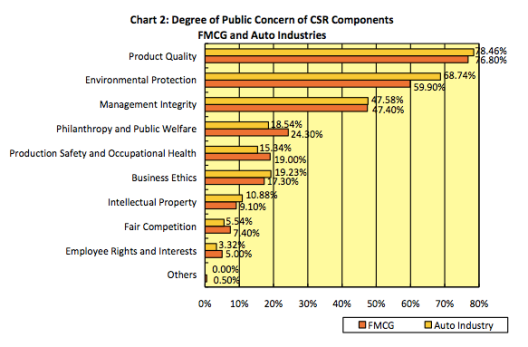
http://www.ruderfinnasia.com/files/csr-index-fmcg-and-auto-in-china-appendix.pdf

In fact, a quick search revealed that CRO Magazine even released a Top 10 list of “Corporate Responsibility PR firms” back in 2008, that placed Ruder Finn at No. 5. But how do you decipher such a ranking? If Ruder Finn was already being lauded for “CSR PR (?)” in 2008, what propelled them to create a new division now three years later?

And the big question: What is the differentiator in this burgeoning industry? 

I turned to Coles who will be leading the new practice and has spent 13 years in PR with the last seven at Ruder Finn, for some answers.

Sarah Coles, SVP, Ruder Finn

“When I started working with clients on CSR strategy, it wasn’t called CSR. Many were doing this without realizing it was called CSR. For example, at Novartis, we didn’t see our work in malaria treatment as CSR per se. It was part of their core mission, part of everyday business.”

“My first contact with CSR was when I started working with Gerber on childhood nutrition and later with Novartis. In the five years that followed, I got the chance to really see the effects of giving back to your community. I got to meet some of the patients and really saw firsthand the challenges that we in the western world would otherwise never understand. The whole experience really changed my impression of what needs to get done.”

The Case For CSR: What were the main motivations behind setting up a new practice focusing on CSR?

“There is a demand today to put together more strategic CSR programs; programs that are distinguished, unique to the company, and meaningful.”

“Consumers are pretty smart these days: They can see when something is reactionary and when it has been a longterm commitment. They trust brands that have longterm missions and whose programs are in sync with brand value.”

“A great example is the latest Tide for Hope campaign. It’s a perfect example of how core competencies can help provide value. This builds way more trust than something thrown together in a short-term cycle.”

“Ruder Finn also strongly believes that this is not only an opportunity to grow our practice but also to help define what the industry means by CSR and educate companies the issue to ensure that it continues to build as a best practice.”

The Nature of PR: Aren’t most programs reactionary in nature at first contact?

“It’s certainly a mix. Some companies who have been doing this for a long time are doing well and CSR contributes to that reputation. They build trust. Others are more reactionary but won’t be sustained or provide strategic value in the long run.”

“There is a real business case for CSR and companies are beginning to see that. Companies that have longterm Initiatives don’t have to resort to crisis management and there is value in that.”

Strategizing CSR: What then is the underlining ethos of the new practice?

“We learned a lot from working with PepsiCo on their Dream Machine recycling program. Today, we see a real opportunity in helping clients with cause marketing initiatives that reinforce their business practices and core competencies.”

“We counsel clients to do corporate social responsibility strategically. To build something that looks inside the company…dig around and see what they are already doing, what they stand for, what their core values are, and then create a campaign that captures all of that.”

Implementing CSR: How is implementing a CSR strategy going to differ from PR campaigns?

“We’re moving into pure strategy now. It’s not about short-term projects anymore. CSR is more about what makes sense for the business. How can I create something that my company stands for and does good for our community at the same time?”

“These programs go to the root of what CSR is all about: Good business sense that also provides value.”

Comments? Thoughts? Leave a comment or connect with me @AmanSinghCSR.

Share this:

  • Tweet
  • Email a link to a friend (Opens in new window) Email
  • Share on Reddit (Opens in new window) Reddit
  • Print (Opens in new window) Print
Like Loading...

The American Credit Downgrade and Accenture’s Sector by Sector Report on Sustainability

06 Saturday Aug 2011

Posted by Aman Singh in CSR

≈ 2 Comments

Tags

Accenture, aman singh, aman singh das, corporate social responsibility, Credit Downgrade, CSR, CSR blogger, CSR communications, CSR strategy, Ethics, ethics and compliance, Leadership, leadership, management, New Era of Sustainability, shared value, social responsibility, Sustainability, sustainability, sustainability benchmarks, sustainable business, sustainable business practices, UNGC


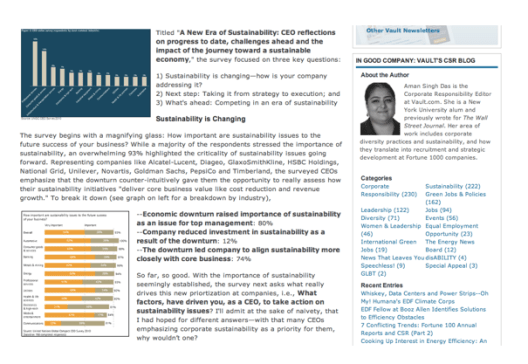
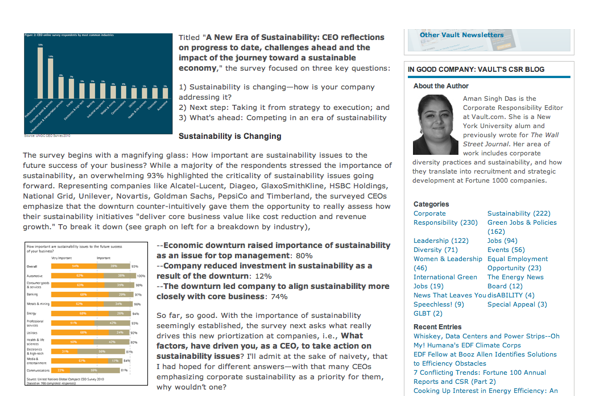
Last year, Accenture co-produced a report with the United Nations Global Compact titled A New Era of Sustainability: CEO reflections on progress to date, challenges ahead and the impact of the journey toward a sustainable economy. The report focused on examining three main questions with 766 CEOs serving as respondents: 1) Sustainability is changing—how is your company addressing it?; 2) Next step: Taking it from strategy to execution; and 3) What’s ahead: Competing in an era of sustainability.

The BIG finding from the report: 93 percent of 766 CEOs surveyed believe that sustainability will be “important” or “very important” to the future success of their company.

CSR Journalist Aman Singh reports on Accenture's New Era of Sustainability Report

Now, Accenture has produced a followup sector by sector report that offers more clarity — and a wide disparity in this percentage — to the overarching aggregated data by doing a deeper dive by industry.

For example, 100 percent of executives in the automotive and consumer products industries see sustainability as critical to their success but only 68 percent of banking executives see sustainability as “very important” to their future success, and 63 percent reporting that “their company is integrating sustainability ‘much more’ than five years ago.”

As for the communications sector, the percentage of executives seeing sustainability as “very important” to future growth drops to a mere 22 percent.

From Sustainability Strategy to Sustainable Business Practices

As the above-mentioned three questions indicate, however, the 2010 report attempted to be forward-looking in its data. Indicating a wide disconnect between the perceived importance of environmental, social and corporate governance for companies, and how these play in business strategy, the report pointed out that “while the belief in the strategic importance of sustainability issues is widespread among CEOs, executives continue to struggle to approach them as part and parcel of core business strategy.”

The new, follow-up report, adds teeth to this initial observation by showing a disparate practice of sustainable business practices across industries.

While 80 percent of utility industries report embedding sustainability metrics to track performance, 83 percent of CEOs in energy and 81 percent in infrastructure say their “company measures both positive and negative impacts of their activities on sustainability outcomes.”

Is sustainability measurement finally becoming accepted standard practice?

While this aggregated data might indicate so, the reality, according to Accenture’s Managing Director for Sustainability Services for Europe, Middle East, Africa and Latin America Peter Lacy, is that there remain “major gaps remain between CEO ambition and execution.” As evidence, the report offers the automotive industry as an example:

“Ninety-five percent of automotive executives believe that companies should invest in enhanced training of managers to integrate sustainability into strategy and operations, but just 52 percent report that their company already does so.”

Analyzing Sustainability Enthusiasm In a Recession

When Accenture’s New Era of Sustainability report
came out in June last year, I chose to go with a positive headline. I titled my detailed analysis as “Sustainability Moves from Discretionary Choice to Corporate Priority.”

Today, as we deal with a downgraded credit rating for the country of everyone’s dreams, a recession that might never have ended, and businesses once again returning to cautious growth, that optimism is hard to replicate. Troubled by debate after debate (subjects varied from accountability to Wal-mart, upstream recycling to upcycling, compensation limits, and much more) during the recent Sustainable Business Practices workshop held at the University of Vermont, several of the students jested that “Sustainability, after all, is a journey.”

I would add that it is also a mindset: A mindset that understands that business goals (profits, profits, profits) cannot be reached without taking into account the society and the environment you operate in and the human capital that helps you succeed. Will the rest of the sectors detailed in Accenture’s report follow through on their CEOs’ ambitions?

In coming months — and years — with America’s long-term sustainability as an economic power in question, all eyes will be on whether American businesses can pull up their socks and return their operating base to trustworthy status by using sustainability as a guiding principle. Where government fails, business steps in, right fellow #csrchat attendees?

Thoughts? Don’t forget to leave a comment or connect with me @AmanSinghCSR.

Next: Gib Bulloch, Executive Director of Accenture Development Partnerships discusses the report in Capabilities for the Convergence Economy.


Share this:

  • Tweet
  • Email a link to a friend (Opens in new window) Email
  • Share on Reddit (Opens in new window) Reddit
  • Print (Opens in new window) Print
Like Loading...

Sustaining Timberland: An Interview with VP of CSR Mark Newton

02 Tuesday Aug 2011

Posted by Aman Singh in CSR, CSR reporting

≈ 7 Comments

Tags

Accountability, aman singh, aman singh das, Apple, consumer education, Consumerism, consumerism, corporate social responsibility, cradle to cradle, CSR, CSR communications, CSR reporting, Dell, Ethics, ethics and compliance, Green, human rights, Jeff Swartz, Leadership, management, Mark Newton, marketing, Motorola, product lifecycle, Social Impact, Social Media, social media, supply chain, Sustainability, sustainability, Timberland CSR communications portal, Timberland VF merger, transparency, VF, Work culture


When one of the country’s few purpose-based and values-driven company announces new sustainability goals, chances are you won’t be as excited as you would be if it was BP, for instance.

Because we expect ambitious and aggressive goals from leaders, and at Timberland, this expectation is part of everyone’s job.

Before the boot maker announced its new set of revised sustainability goals earlier this week, I caught up with Timberland’s new Vice President for CSR Mark Newton on his new role, the goals, as well as their latest efforts at stakeholder engagement: Timberland’s new Communications Portal.

Sustainability: From Apple and Dell to Timberland

Newton, who has spent his entire career working on sustainability at electronics giants like Motorola, Apple, and most recently Dell, understands that the road ahead will be rocky as Timberland completes its merger with VF. VF owns several outdoor brands like The NorthFace, Wrangler, Jansport and Nautica.

We started with the new 2015 goals. What’s new about them?

“Focus,” said Newton. “Moving forward it is very important that we create focus for our companies, including a commitment to innovate from cradle to cradle.”

Timberland’s 2015 Sustainability Goals

Set in four broad categories of Climate, Product, Factories and Service; the goals are ambitious and aggressive, if not new or radically life-changing. I asked Newton the purpose of each category.

Climate: “This is a topical focus for us if not so much a functional one. But we’re not saying we’re going to be singularly focused on climate change but that this affects our customers and decisions and therefore, we must equip them with decisions and the right products.”

Product: “At some point we all want to start creating innovations that have a zero footprint. The idea is to move toward a vision of a closed loop product lifecycle. You can see where we are and where we want to go. It is directionally correct.”

Factories: “We have an obligation that is not just transactional to our suppliers, employees and other stakeholders. The whole idea of sustainability is to stay in business. In perpetuity, we cannot do that without treating our employees well and scaling our business properly.”

Service: “Timberland was founded on the idea of commerce and justice, of giving back and creating value. We offer our employees 40 hours to volunteer every year. Today we are asking what the impact of that workforce is. Where are we going with this, how do we prioritize our efforts and do it well?”

What underlines all of these goals and their success, however, is engaging and changing consumer behavior.

Changing Consumer Behavior: Timberland-style or VF-style?

Earlier this year, at the Annual GreenBiz conference, Timberland CEO Jeff Swartz said that sometimes companies have to lead consumers by taking a stand on what is right. “You cannot always wait for consumer demand to dictate your decisions,” he said.

Now with Timberland becoming a part of the VF family, are dynamics shifting? Will the merger bring a renewed and united effort in the apparel industry to shift consumer behavior or lead to inertia and inaction?

I put the question to Newton, who while new in his role, is a veteran in the consumer products industry. “We are having several conversations around this. We are Timberland and we will always be that. This is the reason people are interested in EarthKeepers and we will continue to move the needle,” he said.

What about Swartz’s inspiring declaration? Newton offered Timberland’s EarthKeepers product line as an example:

“The ultimate goal of every company that is working on sustainability is to be able to drive top line growth because of its sustainability efforts. It’s very rare to see top line growth associated with these things, many companies are running leaner and end up staying within compliance. At Timberland, our EarthKeepers product line is actually doing that with double-digit growth in the first quarter.”

Authentic Communications: Engage the Consumer, not Just Inform

With skepticism already high in the market, there is a fine line between selling more units and ensuring responsible consumerism. EarthKeepers seems to be clearly bucking the trend and providing a new, profitable way of doing business sustainably.

Was this growth the result of consumer education, eco labels, or increased communication?

“Authenticity. We’re finding success because it is authentic. We are intentionally focused on products that are environmentally friendly and socially conscious. And we are committed to continually communicating that. We’re not waiting for everything to become perfect, we’re putting it out there and calibrating it as it evolves,” he said.

Examples? Newton offered the eco-index, which Timberland was instrumental in creating and pushing out. “We are promoting the index so we can create real change and movement. That’s exciting and offers us a chance to drive real, calculable change,” he added.

What VF brings to the table then is scale. “VF has been a partner for years on making the process much more efficient. Now the merger will allow us to collectively drive things that Timberland alone simply cannot do. This bigger opportunity is huge for us,” he emphasized, adding, “It’s also not just forward-looking things and what we can do upstream. VF has a very efficient process in place because of their brands. We have had limited impact there but now we can have much more.”

Timberland’s New Communications Portal: CSR in Real Time

With Timberland already being aggressively visible and vocal in the consumer marketplace, why did Newton and team feel the need to launch a new CSR communications portal?

“We’re segmenting the conversations on our website around products and around topics so everyone has a better sense of clarity. Even though our authenticity ensures that sustainability conversations become natural in all parts of our business and you don’t have to go to the CSR portal to have a CSR conversation, we felt that different stakeholders have different perspectives. You can still go to the products portal and have the same conversation as you would on the CSR portal, because the intentional design, how we conduct business with suppliers and community issues are woven into the product and the product description.”

Why then is the new portal necessary if sustainability is so intricately embedded into the work culture at Timberland?

“We are having conversations with a very vast and diverse spectrum of people, from wholesalers and retailers to direct consumers. They all come with very different demands and perspectives and we want to offer them the opportunity to engage in the language they understand best,” he explained.

Fully integrated with social media tools, the portal is designed for consumers looking for details on green products, interesting stories and much more. Not only can you go to the redesigned portal and discuss Timberland products, you can also discuss the team’s CSR efforts, join ongoing conversations through their Bootmakers blog, and chime in on more topical discussions around the Green index and climate change.

Admittedly, many companies continue to struggle with this balance between preserving the granular stuff and promoting more general conversations around products.

For Timberland, the answer was to lead in both.

“People can go granular as they want or stay as generalist as they’d like. What’s different about the portal is that we are not starting conversations by discussing one of our pillars or metrics but focusing on stories that matter and then getting to the things that are underneath those stories; this marks a fundamental shift for our website,” Newton added.

Being a communications geek, I can definitely attest to Newton’s excitement about this new portal. The ability to throw open your business practices and product lifecycle to your stakeholders takes gumption and a resolute belief in transparency.

The Timberland team knows that this throws the door open to endless questions and scrutiny but Swart’z recruits are used to that and know that open engagement is the only way to maintain authenticity and empower their stakeholders toward sustainability and a zero impact footprint.

This is mission critical for Timberland.

As Newton put it, “Regardless of what happens post-merger, we are all in this together. Our values are integrated into all of us and everyone who works here. Jeff Swartz might be the leader but you can expect to hear the same things from all of us.”

This is Timberland’s — and VF’s — opportunity to drive the apparel industry toward a more sustainable future. The 2015 goals are the means to an end, a future that VF and Timberland can now together impact much more powerfully.

Comments? Leave a comment, email me or connect @AmanSinghCSR.

Share this:

  • Tweet
  • Email a link to a friend (Opens in new window) Email
  • Share on Reddit (Opens in new window) Reddit
  • Print (Opens in new window) Print
Like Loading...

Introducing Singh on CSR: A Journalist With a Purpose..and an Opinion

Featured

Posted by Aman Singh in CSR, CSR reporting, HR, Uncategorized

≈ 7 Comments

Tags

Accountability, aman singh, aman singh das, Career advice, CSR, CSR blogger, CSR reporting, Ethics, Events, Green, HR, In Good Company, Job search, Jobs in CSR, Leadership, Recruitment, Social Media, social media, Sustainability, sustainability, Uncategorized, Work culture


*Updated July, 2014

Most recently the Editorial Director at CSRwire, a digital media platform for the latest news, views and research on CSR and sustainability. Along with leading content distribution, social media strategy and CSR/sustainability reporting services for CSRwire members, I also led Talkback, CSRwire’s aman singh, csrwireCommentary section, with over 250 contributors and increased traffic 35% – 50% year to year.

The channel featured several influencers and thought leaders – John Elkington, Hazel Henderson, Wayne Visser – as well as authors – Frances Moore  Lappé, Bob Willard, Carol Sanford – researchers, activists and CSR/sustainability professionals – AMD’s Tim Mohin, Campbell Soup’s Dave Stangis, Sustainability leader Peter Graf, John Edelman – and served as a platform to push the needle on critical topics, learn from each other and constantly crowdsource new ideas, partnerships and best practices.

While at CSRwire, I’ve had the pleasure of working with numerous Fortune 500 companies as well as the country’s leading nonprofits and academic institutions on creating and implementing communication strategies focused on stakeholder engagement and behavior change, including Unilever, Verizon, Aramark, SAP, Campbell Soup, Nestle Waters North America, McDonald’s, General Mills, HP, Mars, Avon, Sodexo, EarthShare, Points of Light and others.

Our Stakeholder Engagement Campaigns – including live Twitter chats and webinars as well as content series and multimedia – generated millions of impressions, hundreds of participants and provided our members with critical feedback, important partnerships and a pulse of their stakeholders’ concerns.

I’ve also been an active journalist for almost 15 years, including stints at The Wall Street Journal, The Villager, Tehelka.com and Vault.com, where I created, designed and managed the recruitment industry’s first CSR channel aimed exclusively at engaging, debating and discussing corporate social responsibility, sustainable (and unsustainable) business practices, responsible (and irresponsible) leadership, diversity and the lack of it, the role of workplace culture in our lives, social entrepreneurship, the newly-minted term ‘intrapreneurship’ and much, much more.

Careers in CSR and Sustainability

Vault’s CSR Channel

Skepticism is second nature to me and I’m most comfortable asking [mostly the right] questions, facilitating dialogues, editing copious pages of text, refining even the most academic articles into easy-to-read blogs and thrive on the opportunities extended by a new world of social media and access to organizations and change makers.

This is my space – to question, analyze and discuss.

I’ll examine the latest CSR report and debate how we’re faring in our pursuit of materiality and creating a new economy built on wellbeing and shared value. No question is small enough, no development unrelated. And no topic unworthy.

From careers in CSR to the future of GRI reporting, from analyzing the do(s) and don’t(s) of sustainability to the latest in impact investing and our search for materiality; from social media etiquette to transparency in this new hyper-connected world, from work/life balance to gender and age discrimination, from effective communication strategies to the immensely irritating term “greenwashing”; and much much, more, join me for a promising and thought-provoking ride.

-Aman
@AmanSinghCSR

Share this:

  • Tweet
  • Email a link to a friend (Opens in new window) Email
  • Share on Reddit (Opens in new window) Reddit
  • Print (Opens in new window) Print
Like Loading...
Newer posts →

Let's Talk!

Virtual
732-322-7797
amansinghdas@gmail.com

Blogs I Follow

  • Nonprofit Chronicles
  • Learned On by Andrea Learned
  • Angry African on the Loose™
  • csr-reporting
  • The CSR Blog
  • In Good Company: Singh on CSR

My Cloud

Capitalism 2.0 CSR CSR reporting CSRwire ESG Guest Author HR Stakeholder Engagement Sustainability Uncategorized

Recently written…

  • Rationality is Ruining Us: Mayors, presidents and governors join major businesses in charting way forward on climate change
  • 2015: the year businesses recognize that climate change is real – and 4 other themes
  • Hardcore lessons of sustainability – ’10 Words or Less’
  • Brewing a Better Future [#BaBF] with Heineken: Examining the Many Flavors of Local Sourcing
  • From Conflict to Collaboration: Kimberly-Clark and Greenpeace Participate in LIVE Twitter Chat

What others are reading

aman singh aman singh das Brand Management Business corporate social responsibility CSR CSR reporting CSRwire ESG Leadership Stakeholder Engagement supply chain Sustainability sustainability Work culture

Categories

Most Read

  • None

Create a free website or blog at WordPress.com.

Nonprofit Chronicles

Journalism about foundations, nonprofits and their impact

Learned On by Andrea Learned

Angry African on the Loose™

I have opinions. I am from Africa. I live here now. I blog.

csr-reporting

Connecting the dots between Business, Society & the Environment

The CSR Blog

Connecting the dots between Business, Society & the Environment

In Good Company: Singh on CSR

Connecting the dots between Business, Society & the Environment

Privacy & Cookies: This site uses cookies. By continuing to use this website, you agree to their use.
To find out more, including how to control cookies, see here: Cookie Policy
  • Subscribe Subscribed
    • In Good Company: Singh on CSR
    • Join 119 other subscribers
    • Already have a WordPress.com account? Log in now.
    • In Good Company: Singh on CSR
    • Subscribe Subscribed
    • Sign up
    • Log in
    • Report this content
    • View site in Reader
    • Manage subscriptions
    • Collapse this bar
 

Loading Comments...
 

    %d