• ABOUT THE AUTHOR
  • Sustainability
  • CSR
  • CSR reporting

In Good Company: Singh on CSR

~ Connecting the dots between Business, Society & the Environment

Tag Archives: Business

Decoding Nestlé Waters North America’s Sustainability Journey: Environmental Villain or Facts vs. Emotions?

09 Wednesday Jul 2014

Posted by Aman Singh in CSR, CSR reporting, CSRwire, ESG

≈ Leave a comment

Tags

aman singh, Brand Management, Business, corporate social responsibility, CSR, CSR reporting, CSRwire, Disclosure & Transparency, environment, Environment, ESG, extended producer responsibility, heidi paul, kim jeffery, nestle waters, nestle waters north america, Net Impact, packaging, Philanthropy, recycling, shared value, Stakeholder Engagement, Supply chain management, Sustainability, sustainability, transparency, water conservation, watershed management


When a company labels its Annual CSR Report as Creating Shared Value, you have to stop and wonder if they’re responding to the latest buzzword in the market or leveraging its potential by truly embedding it into their reporting and cultural framework.

In its third cycle, Nestlé Waters North America’s [NWNA] latest Creating Shared Value Report attempts to accomplish the latter. Among its headlines:

  • What the company is doing to advance recycling in the U.S.
  • The company’s path to achieving a zero-waste future
  • Its continued efforts to be the most efficient user of water within the beverage industry

To gain some firsthand perspective and background on these goals and the accompanying challenges for North America’s largest seller of bottled water, I reached out to EVP for Corporate Affairs Heidi Paul [Join us for a Twitter Chat today, June 18th, at 1:00pm ET to connect with Paul directly at #SharedValue!].

NWNA_2012_CSR_Report_coverAmong my questions: how does the company balance criticism for selling bottled water while promoting healthy choices, what it is doing to shift its supply chain and use of plastic, its  well-acknowledged work in the area of Extended Producer Responsibility, and how her team plans on including consumers in its drive for sustainability.

Defining “Shared Value”

Paul started the conversation by setting the record straight on the company’s definition of what’s quickly gained momentum as a replacement for CSR: Creating Shared Value.

“We define CSV as a strategic way to achieve triple bottom line sustainability. In other words, be financially, environmentally and socially sustainable.  At the end of the day, Nestlé seeks to create shared value in those areas where we can make the most impact and that are material to our business. Globally, that is in the areas of Nutrition, Water and Rural Development. For our bottled water business in North America, our focus is on healthy hydration, packaging responsibility and watershed management.”

Has the terminology helped NWNA’s citizenship team – 28 people strong across the company – integrate its sustainability goals more effectively within its business units?

“It has done wonders. When you’re looking at philanthropy unconnected to business, it is not really sustainable. CSV focuses our engagement on the three critical topics and asks the whole company to see what can be improved for society and ourselves. We get the benefit of input from our supply chain, employee groups, community partners, etc.,” she said.

Coding the Impact of Bottled Water

Let’s get to NWNA’s main product then: bottled water. Does it feel the twinge of irony every time that is said in the same sentence as “shared value”? Paul chose to answer that with some data:

“Seventy percent of what Americans drink – according to the Beverage Marketing Corporation – today comes from a package, not from a cup or the tap. In fact, our research indicates that if people don’t have access to bottled water, 63 percent say they will buy some other beverage from a package instead, often a sugared or caloric drink with a greater environmental impact.”

“We play a key role in increasing Americans’ consumption of water, which is the healthiest beverage choice. As the data indicates, there is a crucial role that bottled water plays in consumer choice. Everywhere there is a high-calorie sugary, packaged drink available; we want to make sure there is water as well,” she emphasized.

Does the company’s sales data support Paul’s emphasis? “The volume sales increase for 2012 for the bottled water industry was 6.2 percent. And per capita consumption reached nearly 31 gallons, up more than 5 percent from 2011. Further, 51 percent of people who stop drinking sugared soft drinks are switching to bottled water. In fact, bottled water is outselling sugared soft drinks in grocery stores in eight major markets across the country,” she supplied.

At the end of the day, Paul believes, the company’s job is to talk about why bottled water is a choice – nestle waters north america brandsan amply available one – and why it should be available anywhere packaged beverages are being sold.

Is Nestlé Waters North America’s Business Model Sustainable?

That brought us to the next obvious thread: the plastic being used to produce the bottles. Recalling a keynote given by former NWNA CEO Kim Jeffery at a Net Impact conference years ago, I asked Paul how the company handles its fiercest critics regarding its use of plastic.

In a jungle of facts, fiction and emotions around environmental issues, Jeffery confronted the audience back in 2009 with a firm and resolute stand: we sell bottled water and we are doing everything we can to make that process sustainable.

Where there was a finality of “take it or leave it” to Jeffery’s remarks four years ago, Paul took a more nuanced approach to respond.

“Limited resources need to be used again and again. We have taken the mantle of becoming part of that solution. The larger point is there are billions of servings of beverages being sold everyday in some sort of package. Some populations are getting most of their calories from bottled drinks. And every time they choose water over a different drink, they’re making a more healthy and environmentally friendly choice,” she said.

And is a goal of reaching 60 percent recycling ambitious enough considering the climate and environmental challenges we face?

“At the time we were setting the goals, the nation was at a 28 percent recycling rate for PET plastic and thought that a goal to double that rate was ambitious and would require big changes. We had a lot to learn. We began to study recycling programs and the patchwork of policies and systems that were in place but were not moving overall recycling rates very much. There are big opportunities for increasing recycling by improving collection in public places, business and industry and in urban residential buildings. Today, however, there is no money going to fund this expansion of infrastructure.”

“There is also the issue of competing systems. Bottle bills for example do raise the recycling rates for bottles and cans, but actually reduce the efficiency of curbside because it is taking the most valuable commodities, which reduce the revenue, potential from curbside. Our goal was to work with others and find the most efficient system with the highest impact,” she emphasized. “

Environmental Villain or a Case of Facts vs. Emotions?

Of course the plastic of the bottled water we consume is bad for the environment. But so is almost every other product and consumer packaging we use in our day-to-day lives as study after study has shown.

Turning the argument on its head though, would we be wasting as much or filling up landfills as quickly as we are if we didn’t have the choice of bottled water to begin with? Where does consumer choice end and producer responsibility kick in?

Identifying that as another area for impact, Paul picked up:

“If bottled water isn’t available, people routinely purchase another packaged drink, one with calories and with a heavier environmental footprint. The availability of bottled water in times of natural disasters, where often tap water can be compromised, also creates a role for bottled water that goes beyond most product categories. Bottled water provides a reliable second source of water in these situations – that’s something everyone in our company is proud of.”

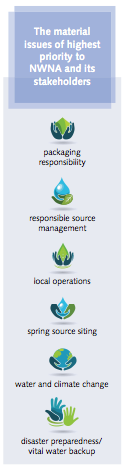
So when your business model is set around selling a product that is healthy and encourages nutrition while understanding and targeting its impacts through a well laid out sustainability strategy NWNA_priorities– as  Jeffery succinctly put it in his exit interview with Greenbiz Publisher Joel Makower earlier this year – is it fair to be labeled an environmental villain?
Perhaps, perhaps not.

The Challenges of Sustainability

As Paul reiterated, the journey of tackling facts vs. reality has been full of challenges and continues to be an uphill task. “Like anything else, our work in the area of recycling, water conservation and reducing our social and environmental footprint has been a constant education,” she said, citing the lack of modern and efficient recycling system as one of the company’s top challenges.

“Not too many people understand the current system in place. There are numerous questions like who is funding what, how does it work, who are the middle men, how do we get to the next stage, where can we build in efficiencies, etc. And if the goal is to accept our responsibility as a producer to recycle efficiently toward a goal of zero waste, then we need answers to these questions.”

“We’ve always said we’re open to options, and so far the option that we have seen with the highest potential to be low-cost and efficient is a well-constructed EPR system, run by industry. What makes this complicated is there are a dozen different ways EPR has been implemented globally. Many of those are not efficient. This uncertainty about the ability to do it “right” makes others in the dialogue want to take more of a “wait and see” approach. Even if you convince people who, done well, EPR in the form being proposed is the best solution, there are doubts about implementation across the board,” she said.

Other challenges?

Consumer vs. Producer Responsibility

Paul cited the potential of collaboration in building more sources for wind and solar energy, as well [“we’re not there yet but this is definitely on our radar”].

There is also a need for collaboration in the area of water stewardship. “Improving watersheds will require collaborations among the various stakeholders within a watershed, be that users, scientists, environmental groups or government. Nestlé Waters North America manages the watershed areas around the 40 springs we use that are overseen by our 10 Natural Resource Managers. We have also made a commitment to collaborate on two watershed projects per year,” Paul said.

And what about NWNA’s consumers? How does the company leverage its brand to shift consumer behavior?

“In the 1970s, recycling meant ‘putting it in the bin.’ Today, this is old news. What motivates people now is when they understand its benefits. If a consumer recycles a water bottle after use, the greenhouse gas impact of that bottle is estimated to be reduced by more than 15 percent.”

“Also, we need to close the loop on what happens to the bottles after they are recycled. They are not trash; they are a resource that can be used again and again. Right now our 50 percent r-pet bottles in our Arrowhead, Deer Park and Resource brands shows consumers what happens when they recycle. It becomes a new bottle. The visibility of this message on our bottles helps us tell the story that we need much better recycling to become a more sustainable world.”

The company’s top challenge moving forward?

“At the end of the day, you want zero impact, but is that possible? Our challenge is to keep finding those ways to improve when it feels like you’ve reduced the impact to the minimum,” she said, finishing with a flourish: “You need to find the next frontier every time – that’s the goal. And the challenge.”

Originally written for and published on CSRwire’s Commentary section Talkback on June 18, 2013.
Share this:

  • Tweet
  • Email a link to a friend (Opens in new window) Email
  • Share on Reddit (Opens in new window) Reddit
  • Print (Opens in new window) Print
Like Loading...

Connecting the Dots Between Consumers, Consumption & Sustainability: The External Face of Unilever’s Sustainable Living Plan

09 Wednesday Jul 2014

Posted by Aman Singh in CSRwire, ESG

≈ Leave a comment

Tags

Brand Management, Business, cause markeing, cause marketing, CSRwire, employee engagement, Environment, ESG, marketing, packaging, palm oil, PepsiCo, roundtable on sustainable palm oil, sanitation, Stakeholder Engagement, supply chain, Supply chain management, Sustainability, sustainability, unilever, unilever sustainable living plan, waste, water


What role does a consumer-facing sustainability strategy play in an ambitious plan like the Unilever Sustainable Living Plan? That’s where I left off in my interview with Marketing Chief Keith Weed last week in our review of the ambitious Plan two years since launch.

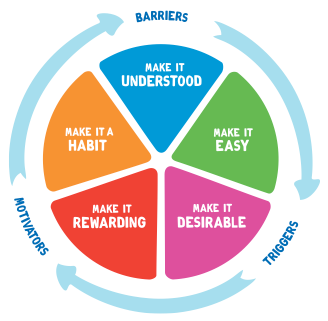
From Desire to Habit: Unilever’s Five Levers for Change

He chose to respond by explaining a framework called the “Five Levers for Change” that his team developed to solve exactly this dilemma. An excerpt:

  1. Make it understood. Sometimes people don’t know about a behavior and why they should do it. This Lever raises awareness and encourages acceptance.
  2. Make it easy. People are likely to take action if it’s easy, but not if it requires extra effort.  This Lever establishes convenience and confidence.
  3. Make it desirable. The new behavior needs to fit with how people like to think of themselves, and how they like others to think of them.  This Lever is about self and society.
  4. Make it rewarding. New behaviors need to articulate the tangible benefits that people care about.  This Lever demonstrates the proof and payoff.
  5. Make it a habit.  Once consumers have changed, it is important to create a strategy to help hold the behavior in place over time. This Lever is about reinforcing and reminding.

“We need to continue to work with others to drive this change. If we achieve the Sustainable Living  Five_Levers_of_Change_unileverPlan, and it doesn’t change business at scale, ultimately that’s a fail. Unilever’s impact is huge but we’re still a drop in the ocean. We need a movement going for businesses to help address this,” he explained.

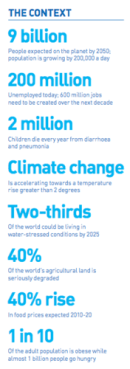
“We are already working with organizations like the World Toilet Organization, UNICEF and others on sanitation, for example, which is a very important issue for us. Two million children die every year from pneumonia or diarrhoea. In a world where there are more mobile phones than toilets or toothbrushes, our work ahead is sure cut out for us,” he added.

The fact is Unilever cannot do it alone. None of it.

And Weed and team have understood that since launching the Unilever Sustainable Living Plan. While scale is a huge factor, organizations require individual and mass power to change consumer behavior and habits. And that is where the Five Levers for Change along with creative partnerships like the kind Weed referred to can help.

Making Sustainability Personal…

“I was in Brazil recently speaking to a lady in Sao Paulo about the environment and the city’s pollution. For her this meant dust from the nearby construction and the tainted flavor of her water supply. These were her immediate challenges – not deforestation or climate change. People view the world through the prism of my world – family, friends, and community. Our world is a step bigger: the city you live in, the supermarket, the local dump, etc. And the final level, ‘the world’ is the rainforest, the ice melting in the Arctic,” Weed continued.

His point: We need to connect “my world” with “the world” for consumers. “Right now we’re at level one. When I asked the lady what she thought would solve the issues, she suggested stopping the
littering because it would stop the drains from getting clogged and therefore avoid local floods. Level One,” he said.

What companies need to do is create a movement and work with people to drive change. A natural question then: Is Unilever working with other companies on its initiatives or primarily with nonprofits?

… and a Business Driver

One example Weed offered was palm oil.

“We purchase a lot of palm oil but it still makes only for three percent of the world’s palm oil. We started our journey by promising to source 100 percent of our palm oil sustainably by 2020. It’s a clear signal to the entire palm oil supply chain that that is the future we are working toward.”

“But this goal would be impossible to reach across the value chain without working with other purchasers of palm oil. So we work with other businesses and NGOs on the Roundtable on Sustainable Palm Oil to do this collectively.”

In fact, Weed says Unilever managed to reach the 100 percent goal last year because of this collective effort. The next step: To make the supply chain of sustainable palm oil easier and connected by 2020. “Right now procuring sustainable palm oil means weaving through a very complex supply chain,” he added.

Another example: the work of the Consumer Goods Forum, which includes 650 members including manufacturers, competitors, retailers and NGOs, responsible for over $2.5 trillion in sales. And Weed is pretty positive about the goals and work of the Forum: “There are a lot of companies getting behind the need to address the negative impacts of deforestation, and momentum is starting to build,” he said.

While momentum is starting to build – with several companies announcing new initiatives and collaborations – the issue did bring us back full circle to where we started: how do we connect these overarching partnerships with the average consumer?

Subtle Messaging & Cause Marketing

And what role does cause marketing play in Unilever’s 2020 plan? Should we expect more nuanced advertising on the lines of the Dove campaign, for example? Or go full throttle like Patagonia’s Sourcing_unilever“Don’t  Buy This Jacket” campaign?

It’s going to be subtler, says Weed. “For example, for our Tomato soup in Germany or our Ketchup in India, we talk about sourcing tomatoes sustainably. With our Lipton tea, we talk about sourcing all our tea and tea bags sustainably by 2020,” Weed explained.

“Consumers comprehend these messages differently though. When we talk about sourcing our tea sustainably, customers see the Rainforest Alliance logo as a sign of better quality and taste, not necessarily sustainability. With our Hellman’s mayonnaise we discuss cage-free eggs. Consumers perceive that as an indication of better food: animals are better looked after therefore they’re getting better food. However, it’s still early days,” he added.

Work Culture: Participating in Change

Early days also for Unilever’s employees, who are witnessing – and participating – in a significant shift culturally at a company that has left behind decades of “doing things one way” to a more complex ideology. How has the company’s culture evolved since 2010?

According to Weed, the greater purpose espoused by the Sustainable Living Plan has been significant for employees – kind of like Performance with Purpose over at competitor PepsiCo. “The notion that you can work for a business to earn money, build a career and also do it in a better way is significant. We need new ways of doing business in the future – our generation has stolen from our children’s
generation financially and environmentally – so we ‘re going out and saying we want our employees to innovate and encourage new ways of doing business,” Weed said.

In fact, the marketing chief, who also leads internal and external communications for Unilever, says despite the many crises facing our world today engagement levels among employees have gone up consistently every year.

A sentiment that resonated in an email I received this week from Kam Erik Fierstine, a project delivery manager in Unilever Engineering Services at the company’s Henderson, Nev.-based ice cream plant. Here’s what he wrote when I asked him about the culture at his company:

“The Sustainable Living Plan is something that is quite apparent to those of us that live in a desert-like area where we are very conscious of water usage. It has shown our employees that Unilever has the same values that we were raised with. Our employees would not put up with a leaky faucet at home, and now they have the backing of management to proactively fix these simple issues at work.”

“We all agree that we want to leave a healthy planet for future generations and we can help do that by conserving our resources. Our employees see the management team walking the talk and that empowers them to escalate issues and voice new ideas. They will now do small things to make a larger impact like pick up things from the floor or switch off conveyors or equipment when not in use.”

The Henderson, Nev.-based ice cream plant was recently honored by the Innovation Center for U.S. Dairy for its sustainability practices.

“They see us taking on challenges in a positive way and that’s inspiring,” Weed wraps up.

Originally written for and published on CSRwire’s Commentary section Talkback on May 1, 2013.

Share this:

  • Tweet
  • Email a link to a friend (Opens in new window) Email
  • Share on Reddit (Opens in new window) Reddit
  • Print (Opens in new window) Print
Like Loading...

Unilever’s Sustainable Living Plan: The Challenges of Being Too Ambitious

09 Wednesday Jul 2014

Posted by Aman Singh in CSR, CSR reporting, CSRwire

≈ 1 Comment

Tags

agriculture, Brand Management, Business, cause marketing, climate change, Consumerism, Corporate Governance, CSR, CSR reporting, CSRwire, disclosure, Disclosure & Transparency, dove, energy, environment, Environment, food, hygiene, Leadership, lifebouy, marketing, nutrition, paul polman, Social Enterprise, supply chain, Supply chain management, Sustainability, sustainability, Sustainability Report, unilever, unilever sustainable living plan, water


Unilever’s Sustainable Living Plan was created and launched amid much fanfare in 2010. It was lauded for its ambitious goals, an exhaustive list of metrics and for its commitment to put sustainable and equitable growth at the heart of its business model.

This week, the consumer products company released its second progress report and it began with a stark statement from CEO Paul Polman:

The world continues to face big challenges. The lack of access of many to food, nutrition, basic hygiene and sanitation, clean drinking water or a decent job should be a concern to all of us. We firmly believe business has a big role to play in striving for more equitable and sustainable growth, but large-scale change will only come about if there is real collaboration between companies, governments and NGOs across all these areas.

Now, the report is impressive, exhaustive and filled with data. So to get beyond the flash, the  avalanche of Keith_Weed_Unilevernumbers and statistics, I reached out to Keith Weed, Chief Marketing & Communications Officer also responsible for the Sustainable Living Plan, to discuss not only the challenges of reaching some of the goals Unilever is striving for by 2020 but also the successes, the unforeseen road bumps and the transformation the company is undergoing culturally because of the Plan.

To get started, here are the three overarching goals Unilever began its Plan with:

  1. Help more than a billion people take action to improve their health and well-being;
  2. Source 100 percent of agricultural raw materials sustainably;
  3. Halve the environmental footprint of its products across the value chain.

Ambition: Sustainability in Perspective

“The report is indicative of what we’re trying to do. We’re trying to do things at scale. This is not a [standalone] CSR project in Africa but something that touches every single element across our value chain,” he began.

It takes a mindset shift to put Unilever’s plan in perspective. As Weed explained, “The idea that it isn’t just about the footprint of your facilities…we have to think all the way through the lifecycle of a  product from consumer to facilities to sourcing to the impact of key productions. The Unilever Sustainable Living Plan guides our direction.”Unilever__Sustainable_Living_Plan

Did his team realize the magnanimity of the goals they were setting? “We knew that we couldn’t achieve all of them but that if we set them like this, we would find solutions along the way by working with others,” he said, adding, “When you get interconnected, solutions and opportunities open up. That was the spirit we started with.”

And the results encapsulated on Unilever’s website and a 53-page PDF download, are in keeping with that spirit. “It’s not about mechanically ticking off the targets and goals. Our Sustainable Living Plan is a movement to get business to move toward socially and environmentally sustainable future,” he clarified.

The Unilever Sustainable Living Plan: Highlights

First of, he reminds me that from the outset, the Plan set out the sustainability goals to be achieved alongside the mission set out in 2009 to double the business. “We serve two billion people a day and another 2.5 billion are expected to be added to the world’s population by 2050. So our goal is to reduce our environmental footprint and increase our social impact while doubling our business.”

The good news: “We have started to drive sustainability into the core of our business and today, our sustainability efforts are helping to drive business growth.” One example is Unilever’s popular Lifebouy  soap, which was rebranded in 2010 with a social purpose alongside:

[We went] from selling soap to encouraging people to wash their hands – and wash them correctly. And our efforts have resulted in double-digit growth over the last three years – and reaching millions with our Handwashing campaign. It’s proving the coherence of our strategy of combining social impact with business growth instead of just a sales goal,” Weed explained.

USLP_ContextOther examples:

  • Laundry cleaner: Unilever increased its market share by 10 percentage points since 2010 to over 25 percent, with its concentrated liquids, which according to Weed carry a much lower carbon footprint in production and use.
  • Dry shampoos: A huge opportunity for the company, right now dry shampoos are mostly sold in the U.S. – where Unilever occupies a 75 percent market share. But as the company enters into more water-restricted countries, Weed predicted an accompanying increase in sales.  The environmental benefit? Compared to heated water, dry shampoo reduces CO2 by 90 percent through lower water usage and less heating of water for the shower. An added benefit for developing countries: water conservation.
  • Dove: The Self Esteem campaign continued to gain momentum with 62 percent of women who know of the campaign now recommending Dove to others. “The campaign started with the idea that we should think differently about how we portray beauty,” said Weed, “Today, it’s a global movement.”
  • Oral hygiene: Unilever’s oral hygiene campaign helped its Signal brand grow by 22 percent in 2012. “People brush their teeth in the morning and evening, which requires more toothpaste, ergo a virtuous circle,” contextualized Weed.

A Twist on Purposeful Cause Marketing?

So cause marketing spelt and implemented differently. By attaching value and impact with its core products, Unilever is addressing a question all consumer products companies continue to struggle with: how do you change consumer behavior to scale a company’s sustainability efforts?

For Unilever, this has meant active pairing of product and messaging with a focus on impact and growth, yet ultimate success is far away.

As Weed explained:

This is a coherent strategy that works – we’re increasing our social impact while growing our business. However, while we’re making good progress, we’re still facing challenges across the value chain, whether it’s with sourcing, food production or disposal.

And each carries with it a nuanced set of challenges, a complex set of solutions and invariably a cobweb of marketing, brand positioning and partnerships.

We have reduced our CO2 emissions, non-hazardous waste to landfill has been reduced in 50 percent of our factory sites, we’re sourcing over a third of our agricultural raw material from sustainable sources, up from 14 percent when we started in 2010…yet we’re miles away from our 2020 target of 100 percent,” he offered.

Scaling Behavior: Easier Ideated than Done

Of course, a key ingredient in Unilever’s Plan is the ability to scale. For the world’s largest tea consumer behaviorproducer, these achievements might mean small metrics today but when scaled are attribution to an entire value chain at work on technological improvements, environmental studies, and more. However, the opportunity is also a challenge:

“The sheer scale of our commitments is tremendous. For example, we want to be able to educate a billion people by 2020 on washing their hands correctly. That’s a lot of people – despite the progress we’ve already made since 2010 –119 million people reached since 2010, of whom 71 million were reached in 2012. Scale has been more challenging than we originally thought,” Weed explained.

Another challenge: encouraging people to adopt new behaviors.

Consumer Behavior: The Toughest Challenge Yet?

“When someone tells you something about hygiene, it’s easy to do it for a couple of days and then switch back to your old habits. Habits are hard to change and we’re seeing this come up in almost every initiative,” he said.

Using the example of laundry, he exemplified:

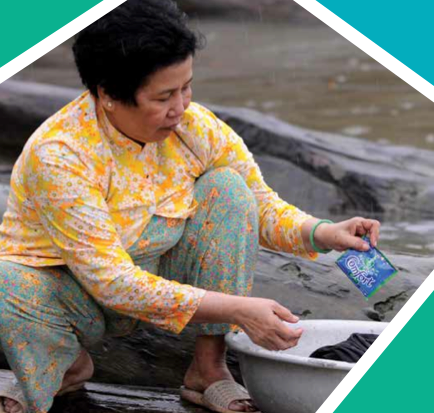
The biggest use of domestic water across households worldwide is for laundry.  Only a few hundred million in North America and Europe use machines. The other billions wash their clothes by hand and usually use four buckets of water to do so: wash in one, rinse in three. Our challenge is to reduce that rinsing from three buckets to one.  So we came up with a product that kills the foam – wash in one bucket and rinse in one bucket. Water used is instantly cut to half. And we expected the product to be a runaway success.

The team found that embedding that behavior change of using one bucket instead of three was  instrumentally Laundry_Unilevertough. Even in water scarce markets where people have to walk long distances for water. “Rinsing is hard work. I thought this would be a rapid victory but we found that it takes time to change habits and we ended up reaching only 29 million households, much lower than anticipated,” he recalled.

When your footprint encompasses billions of culturally diverse populations with very different social and environmental settings, scale becomes an ever-moving target.

Perhaps Weed puts it best again: “If you went to work in a Boeing 747, it wouldn’t make a difference to the planet. If half the planet started doing that, it would make a huge difference. The power of individuals is when you scale them together.”

Its hard work.

And Unilever’s 2012 Progress Report while celebrating the company’s achievements does not undercut the challenges ahead. “We’re breaking new ground every day. We’re showing results. But there are several pieces we are yet to crack,” said Weed.

Originally written for and published on CSRwire’s Commentary section Talkback on April 24, 2013.

Share this:

  • Tweet
  • Email a link to a friend (Opens in new window) Email
  • Share on Reddit (Opens in new window) Reddit
  • Print (Opens in new window) Print
Like Loading...

Shared Success at Verizon: No Silver Bullet for Sustainability, Say CSR & Sustainability Chiefs

09 Wednesday Jul 2014

Posted by Aman Singh in CSR, CSR reporting, CSRwire, ESG

≈ Leave a comment

Tags

Business, carbon, community, Consumerism, CSR, CSR reporting, CSRwire, Disclosure & Transparency, energy, environment, Environment, ESG, ghg, iirc, integrated reporting, Philanthropy, recycling, shared value, supplier responsibility, supply chain, Sustainability, sustainability, technology, verizon


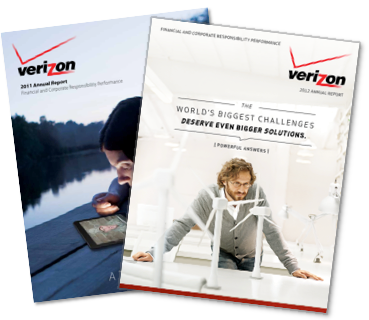
Verizon recently released its second Integrated Report, combining the company’s financial and non-financial data and metrics into one clean look at its overall performance.

While the technology giant has been publishing its environmental, social and governance results for almost a decade, integration with the firm’s financial performance is relatively new. And Verizon saw several significant changes in 2012 to its approach to sustainability and shared value – which Verizon calls “shared success” – including a reformat of its Foundation’s model.

In a recent webinar, I had the opportunity to discuss the report, Verizon’s goals, challenges and a whole host of issues with Verizon’s CSR and sustainability chiefs Kathy Brown and Jim Gowen, along with an engaged audience.

Here are excerpts – and a link to the webinar recording.

Whether you’re eager to learn more about Verizon’s approach to sustainability or what the future holds for integrated reporting and sustainability standards, the webinar will provide you with exemplary context, insights into one company’s efforts to reduce its impact, and how a multinational must pick a strategy that is holistic, focused and measurable.

Shared Success:

Kathy Brown: “When Lowell McAdam became our CEO a year and a half ago, he brought with him a set of principles by which he inspired us to live. It is a value-based approach to our work in the market. We deliver outstanding communication and technology for our communities and country. And we are to share our success with the community. While Michael Porter gets a deep bow for creating Shared Value, these pillars – solutions, service and sustainability – state our mission and our version of shared success.”

Verizon's Shared Success Innovation Process

“We want to achieve measurable social impact. We can do a number of things at one time because our technology is powerful enough for us to find a way to do well for our shareowners and stakeholders, communities and countries in tackling the world’s problems…Specifically, we are focusing on how technology can bring transformational change in education, healthcare and energy management. The platform is our fiber network [and] our wireless network. Through these [networks] we are able to reach millions of users and applications that can literally change the world.”

Setting Aggressive Targets:

Jim Gowen: “Our sustainability program includes aggressive targets, follow-up and our people [who] really do make the difference. In September 2009, when we created the Office of Sustainability, one of the challenges was how were we going to make an impact on a business that [in many areas] is growing exponentially. So we set the Carbon Intensity Metric as the way to grow most efficiently. We set an objective by 2020 to improve our carbon efficiency by 50 percent. Since 2009, we have driven our carbon efficiency 37 percent.”Verizon_networks

“But as I often tell my employees, that was the easy part. Now comes the tougher part. We’ve taken care of all the low hanging fruit. How do you keep that momentum going? For example, e-waste is one of our biggest impacts. We’ve set a goal of collecting more than 2 million pounds of e-waste by 2015. That’s no small feat.
We’re doing that internally as well as externally with our Recycling Rallies.In the last two years, we’ve held 36 of these [across the country]. That objective is very important to Verizon and our customers.”

Environmental Footprint: Setting the Stage

Jim: “Our environmental footprint is quite large. Supporting hundreds of millions of customers takes a lot of work. We operate 42,000 cell towers, 31,000 facilities globally, and [a] 38,000 private fleet of trucks and vans, etc. We had to concentrate on our own resources and see how to become sustainable.”

“We focus on four key areas: making our networks more efficient; expand[ing] our renewable sources of energy; run[ning] our fleets more efficiently; and reduc[ing] the lifecycle cost of ownership of how we operate.  From purchasing to logistics and sustainability – they all match up nicely.”

Highlights from 2012: From Packaging to the “Magic Bus”

Jim: “How do we make our packaging more environmentally-friendly? How do we handle the end of life for that? We asked our OEMs to make their equipment more energy efficient – 30 percent more than legacy equipment. Then we looked at our consumer stores: 131 stores have been LEED certified so far with the U.S. Green Building council, and a pilot is underway to increase that number across our markets.”

“We recently launched our Magic Bus program. The idea was generated by one of our line managers in New York who suggested that, instead of driving our own vans around very congested areas of New York, why couldn’t we drop off our employees with their equipment to provide service to our customers?”

“From that originated a three-month pilot where we used vans that could host eight to 10 technicians with their equipment and inventory on board, and we started driving them around areas of Manhattan. We would pick [up] and drop them [off] and provide service to them throughout the day when they needed it. The benefit was significant – for our customers and our employees. We’ve now started 25 of those Magic Buses in New York and removed 250 of our vans off the roads of New York City.”

No Silver Bullet for Sustainability

Jim: “There is no silver bullet and no magic button. It’s going to take a lot of trial and error and a lot of commitment. While we think and look at our lifecycle approach, we’re still in our immaturity stage,  and the Verizon_reportopportunities ahead of us are so powerful that we can have a significant impact”

From Sustainability to Integrated:

Kathy: “Our Shared Success Council is made up of senior executives across the company – including marketing officers, product managers, general counsel, etc. – who are clearing the strategy for growth and in the process, sharing the idea of Shared Success. The report recognizes these efforts.”

“The process involves a lot of collaboration between executives and the folks on the ground. We focus a lot on our data, and we don’t see this journey as involving any one data point. It’s a journey of doing business, and the report reflects that. We’ve shown enormous efforts and growth, and the information is easy to read and use for our stakeholders across the board.”

Jim: “The report also helps us tell our story concisely. Our customers are asking, as are our investors. They are asking how we’re measuring ourselves? What are our goals – people want to invest in sustainable companies – and how are we incrementally achieving those?”

Technology and Health Care: Powerful Answers

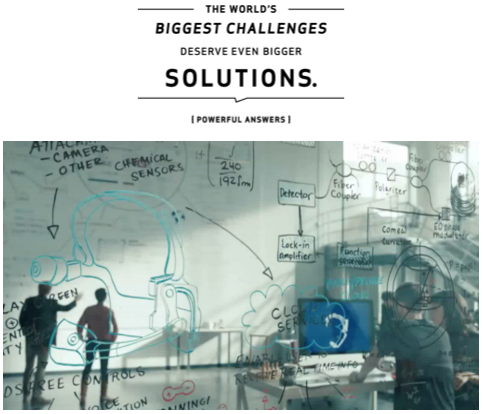
Kathy: “We need to work on reducing costs on factory delivery systems and improv[ing] patient outcomes. Think about what you have on your iPad or phone today. We believe we can, in a more systematic way, think of security and identity issues for patients, fast connections, and [the] ability for patients and doctors to talk to each other in a secure environment through our technology, etc. We call this Powerful Answers.”

Who’s Reading the Report?

Kathy: “Internally, the audience is our employees who can have sense of our values as a company. Externally, people want to do business with companies with a heart but also have the technology and wherewithal to solve their problems. Beyond individuals, this includes communities [and]  governments who take on big ideas about congestion, smarter cars, health care, etc. This report does a good job [of] painting the bigger picture for this audience.”Verizon_Powerful_Answers

Jim: “[The] hip market that will change the world [is] using our technology, and this report helps them see first-hand the choices they have. Sustainability at Verizon is driven by our employees and our communities, not just one executive.”

Supplier Responsibility:

Jim: “Over the last couple of years, we have queried our top 200 suppliers, which represent 80 percent of our total spend, to ask them how they manage their CO2 and greenhouse gas impact. What goes into the products they supply to Verizon? And we were very surprised at the answers we got back and tallied them up and graded them.”

“Whether they’re early adopters or much more mature with their sustainability strategies, we’ve set ourselves a 2015 goal: to operate with over 40 percent of our suppliers that have targets and greenhouse gas emission goals. That impact is significant, and we’ve already seen that through the innovation they’re bringing to us about how they can become more sustainable and continue working with us.”

Evaluating Success:

Kathy: “We get all sorts of consumer indicators of how we’re doing in our community. We know how they use our network, what they think of it, etc. Once we start asking consumers how we’re doing in terms of impact, the responses have been very good. But it has been a challenge to do that in a broad way across many segments.”

For more insights from Verizon, listen to the webcast.

Originally written for and published on CSRwire’s Commentary section Talkback on April 18, 2013.

Share this:

  • Tweet
  • Email a link to a friend (Opens in new window) Email
  • Share on Reddit (Opens in new window) Reddit
  • Print (Opens in new window) Print
Like Loading...

Practicing CSR: Edelman’s 2012 Corporate Citizenship Report Reveals Tough Love

08 Tuesday Jul 2014

Posted by Aman Singh in CSR, CSR reporting, CSRwire

≈ Leave a comment

Tags

Brand Management, Business, CSR, CSR report, CSR reporting, CSRwire, disclosure, diversity, Edelman, human rights, iirc, john edelman, Leadership, marketing, PR, pro bono, supply chain, Sustainability, transparency, voluntary disclosure, volunteerism, work culture


When a PR and marketing firm publishes a corporate citizenship report, there’s a tendency to view the results – and the commitments – with a pinch of salt. After all, they’re traditional masters of spin. Right?

Wrong, says John Edelman, the namesake PR agency’s managing director for global engagement and corporate responsibility. Here’s how Edelman’s press release describes the firm’s commitment to corporate citizenship:

“Some call it corporate social responsibility. Others call it sustainability. For Edelman, global citizenship resonates most as a term describing the larger responsibility business has to society. The firm recognizes its place in the world as global citizens, local offices and individuals.”

“We’re incredibly pleased [that] we were able to provide over $5 million in cash, non-cash (volunteerism) and in-kind giving in FY12 to the communities in which we operate. Giving back has always been a big part of our agency’s heritage and helping our communities is just one of the ways in which we can be responsible global citizens,” John added in a recent conversation over email.

So what does the report detail beyond the private firm’s green commitments and philanthropic donations?

Human Rights & Supply Chain

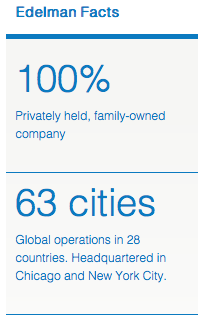
Reminding me that citizenship at Edelman has only been a global function for two years, John pointed to two major accomplishments. Edelman_Facts“The introduction of our human rights policy and our supplier code of  conduct. When I started in this role, we began to see more and more client requests and requests for proposals (RFPs) in regard to our citizenship policies. Our development of these two policies in FY12 is directly related to stakeholder expectations of Edelman as a global company,” he wrote.

The firm also joined the Supplier Ethical Data Exchange (Sedex), a web-based platform and registry where companies report on CSR-related initiatives around business and labor practices, health and safety and the environment.

For the past two years, the firm has used the GRI framework as a baseline for its CSR reporting. In 2011, the firm also became “one of 80 companies to join the International Integrated Reporting (IIRC) pilot program…as part of our commitment, our report reflects elements of the Integrated Reporting framework, such as identifying our capitals and transforming that capital to value.”

Challenges of Setting CSR Goals…

I have often said/written that the challenge of contextualizing what corporate social responsibility means for the service-based industries is uniquely harder than the consumer products sector. Not that the pressure is any less, as evidenced by the increasing numbers of CSR reports publishing in the last two years, but I do believe that B2B firms must dig deeper to identify – and fulfill – their responsibility to society, employees and the environment.

What’s been a unique CSR challenge for a firm that relies on its talent and has an immense global presence?

According to John, “the environmental initiatives and goals have been the most challenging.” He explained:

“The biggest contributor to our carbon footprint is business travel, which accounts for 73 percent of our emissions. Business travel for client-facing projects is a key part of what we do every day. Other industries and companies have more control over Scope 1 and Scope 2 emissions and can achieve reductions through direct actions. Given that we need to travel to service our clients, it’s harder for us to control our Scope 3 emissions. While we understand this challenge, we still need to work towards reducing our GHG emissions.”

“To that end, we are working individually with each hub office on setting a greenhouse gas reduction target and implementing practices such as increasing usage of video-conference facilities and purchasing 50 percent recycled paper.”

And it’s not just setting the goal that’s been hard.

…And Implementing CSR Programs

Implementing new programs across the firm’s markets has been a challenge as well, he said. “We Edelman's CSR Report 2012want to be a guiding force without being too prescriptive. We want to empower our employees around the world to implement and take part in citizenship initiatives with the understanding that they need to balance these with their regular workload,” he added.

John points out the inherent paradox that organizations like Edelman must tackle: how do you compel employees to volunteer and donate their time, money and skills while expecting them to manage a full workload and often, as is common in the PR world, 60-80 hour work weeks?

Ultimately it comes down to the committed few, driven by their passion and subjective understanding of their society and environment.

Disclosure: Led by Demand for Transparency

Since inception, Edelman has been a proudly private company. So why bother reporting on its non-financial goals? Especially when their service/product is often perceived in the market as spin?

It all comes down to being transparent, says the veteran marketing executive.

“Transparency has never been more important and we strongly believe that whether you’re a private or public company, you must be accountable for everything you do. Being transparent is part of how we operate and it’s necessary for us to report on the progress and challenges of our citizenship journey.”

As an example he pointed me to a section of the report, which highlights that the firm’s carbon footprint at “15,518 metric tons CO2e [had] actually increased since our last footprint period.” “We provide explanations for that increase, such as improved data-capture practices and control data quality, particularly on business air travel,” he said.

CSR: Business Opportunity?

© Copyright 2010 CorbisCorporationWhich leads to another question: As a PR agency, what was the motivation behind launching the Business + Social Purpose division – led by the legendary Carol Cone – beyond the obvious business  opportunity with companies evolving from cause marketing initiatives into more robust CSR strategies?

“It was clear that we wanted to ‘walk the talk.’ Working with clients on sustainability and citizenship is certainly a business opportunity, but beyond that, we needed to evolve and integrate our own practices. This is what we tell our clients: sustainability and citizenship should be integrated into the overall business,” he said.

Has the client-driven practice impacted cultural behavior and the firm’s organizational hierarchy?

“We have partnered with our Business + Social Purpose (B+SP) team members since we established Global Citizenship as a functional department. This partnership was important because citizenship was a new function, and we wanted to access the expertise of our people to evolve our own Global Citizenship capability.”

“As an example, we involved our B+SP team in our materiality analysis to prioritize our FY12 report topics. Through this analysis, we added an entire section on engaging with our clients, as a result of the dialogue with our B+SP members.”

Walking the talk? That at least is the objective, he said.

“We talk about the importance of the inside matching the outside, and the idea that your employees are your best ambassadors. Citizenship is an integrated part of our overall corporate strategy and having a unified message and integrated approach to it is imperative for effective impacts on our business and society, rather than having a siloed approach where citizenship sits on the periphery of the company’s strategy and operations.”

CSR Reporting: The Ultimate Reward

The ultimate reward of having a CSR strategy is when you can use the reporting function as a reflection on your organizational practices and improve them incrementally. As Edelman helps other organizations weave their way through and inculcate CSR into business strategy, it is important that the firm use the same philosophy internally.

“In the long-term, citizenship needs to be further integrated into our overall management systems. We Edelman Offices That Offer Culture and Work/Life Benefithave been making incremental progress year to year….During year one, we established a foundation; during year two, we have established some goals. In year three, we hope to develop metrics around CSR performance and eventually, we hope to create a citizenship scorecard that can be integrated into our management systems,” informed John.


How does the firm measure the impact it is driving with its clients?

“We believe it is important to measure impact of citizenship by looking at internal and external measurements. In addition to contributions to the bottom line, such as money saved by reducing greenhouse gas emissions and hours and value of volunteerism, it is important to measure employee engagement, such as employee recruitment and retention.”

“Now that we have established goals in some of these areas, we will next develop metrics to assess employee engagement and impact. In an effort to drive a deeper level of employee engagement, we created the Community Investment Grant program, which provides any full-time employee around the network with the opportunity to apply for funding to support a nonprofit organization where they volunteer or serve on the board.”

And let’s not forget the external piece, he reminded me.

“Any citizenship initiative must be tied to producing public engagement behavior outcomes which are at the core of Edelman’s business strategy such as building deeper communities, building trust, adding commercial value, and changing behavior.”

Holistic CSR goals, got it.

Originally written for and published on CSRwire’s Commentary section Talkback on September 21, 2012. 

Share this:

  • Tweet
  • Email a link to a friend (Opens in new window) Email
  • Share on Reddit (Opens in new window) Reddit
  • Print (Opens in new window) Print
Like Loading...

Corporate Social Responsibility at Target: Behind the Red Bullseye

07 Monday Jul 2014

Posted by Aman Singh in CSR, CSR reporting, CSRwire, ESG

≈ Leave a comment

Tags

Business, Consumerism, Corporate Governance, CSR, CSR reporting, CSRwire, education, energy efficiency, environment, ESG, ESG goals, packaging, Stakeholder Engagement, supply chain, Sustainability, sustainability, sustainable design, target, transparency, water reduction goals


Target released four new corporate responsibility goals in 2011:

  • Increase sustainable seafood selection
  • Improve owned-brand packaging sustainability
  • Increase diabetes HbA1c testing compliance
  • Increase reading proficiency

Now, Target’s 2011 CSR Report offers pages of graphs measuring the Minneapolis-based retailer’s progress against these goals. While the graphs look promising and underscore the challenges of operating in a competitive market with multiple layers of stakeholders, I wanted to understand the context behind these goals and what the execution would look like.

I sat down with Tim Baer, Executive Vice President, General Counsel and Corporate Secretary with Target, for a conversation about the goals and how his team plans to demystify complicated supply chains and motivate its employees and customers toward healthy and sustainable choices.

Aman Singh: While the PDF of goals and progress gave me a sense of exactly that, i.e., progress, it didn’t give me a sense of Target’s mission/values. Can you elaborate?

Tim Baer: At Target, we’re committed to positively impacting the lives of our guests and team members. Since 1946, our legacy of giving and service has been reflected in a commitment that today totals more than $3 million a week to our communities.

Tim_Baer_TargetAnd at the end of the day, by continuing to  serve our team members and communities, we ensure our future success. As a result of our giving model, we benefit from being a workplace and shopping destination of choice for our team members and guests. Not only do our guests value our commitment to communities and giving, but our team members do as well.

To bring our vision of strong, healthy and safe communities to life — which we can’t do alone — we work with community, business and civic partners who inform and share in our approach. We know we can make a meaningful impact, so we set goals to guide our work in three focus areas — helping to put more U.S. children on the path to graduation, reducing our impact on the environment and helping Target team members live healthy, balanced lives.

Why is education such a big goal for Target?

Education, specifically K-3 literacy, is important to Target for three primary reasons. First, we believe that every child deserves the opportunity to reach his or her full potential. And, we’re compelled to do our part to address the education challenge in America, putting more kids on the path to high school graduation.

Second, based on guest surveys, we know that our guests care about education more than any other social issue, and we’re committed to giving to communities in a way that positively impacts our guests and their families.

Third, we know that reading proficiently by the end of third grade is a significant milestone on the path to graduation. This is the time when a child transitions from learning to read, to reading to learn. A child who cannot read proficiently by the end of third grade is four times more likely to drop out of high school when compared with a child who can.

Ultimately, education is critically important to the success of our children and our economy. By supporting education, we are investing in developing an educated workforce that is prepared for today’s and tomorrow’s challenging work environment. At Target, our team is our competitive advantage, and preparing future team members with a quality education today makes good business sense.

CSR_Education_Target

Your data shows that you were not able to achieve your water reduction goals? Can you give us a sense of the challenges and where improvements need to be made?

To recap the report, Target used 3.45 billion gallons of water, representing a 0.3 percent reduction in water use per square foot from our 2009 baseline. Although our absolute water use exceeded our initial baseline, we also increased our total real estate square footage, which led to a decrease in water use per square foot.

The most significant challenges we faced in 2011 were drought-like conditions in some of our mature markets like Texas, Minnesota and Iowa, where we have a relatively high concentration of stores requiring increased irrigation. This negative impact was modestly softened by our rollout of several water-saving initiatives, which we estimate will contribute a reduction of 1.4 percent annually starting this year.

A few examples of our water-saving initiatives include:

  • Expanded installation of smart irrigation controllers that irrigate based on real-time local weather data in lieu of set times,
  • Use of ultra-low flow urinals and water closets, and
  • Elimination of continuously running dipper wells for ice cream and coffee stations at Target Café and Starbucks locations in our stores.

We’re also in the process of installing real-time water submeters in a number of stores to pinpoint the quantity of water a typical store uses for various operations. This will help improve our evaluation of water-saving opportunities moving forward.

Environment_CSR_Target

You have a goal of reducing owned-brand product packaging for at least 50 product designs by 2016. Is that aggressive enough?

While we’ve targeted 50 packaging designs, these changes will be implemented for a much larger number of items that use the same packaging.

We know environmental stewardship is important to Target guests, and our sustainable packaging designs will let them know that Target’s commitment to reducing our environmental impact begins before our products hit shelves.

Over the next five years, Target will be developing sustainable packaging designs that yield at least a 10 percent improvement in one of several attributes of our existing owned-brand packaging. We’ll do this in several ways, including reducing overall packaging, using more recycled or renewable content, and reducing product waste. We’ll also look to use more recyclable materials in our packaging, Sustainable Packaging at Targetcounting these improvements toward our goal only if the updated packaging is 100 percent recyclable.

The goals indicated regarding packaging are limited to your owned-brand products. Are there any plans to push your suppliers and CPG partners into more responsible, transparent and environmentally friendly actions?

We believe in leading by example and hope that by creating more sustainable packaging for our owned brands, we can inspire our suppliers, CPG partners and peers to implement more sustainable packages in their own products.

The report indicates strong progress toward empowering employees to be more health-conscious. Can you discuss some of the challenges behind the numbers?

For us, 2011 was a year of learning in regards to team member wellbeing.

We recognized goals specific to preventive service utilization rates were difficult to measure consistently and accurately, so we adopted HEDIS [National Committee for Quality Assurance’s Health Effectiveness Data and Information Set] measures. By doing so, we can support our wellbeing efforts by comparing our utilization rates to those of other employers or healthcare entities like medical groups or health plans.

The size and geographic distribution of the Target team member population reaches across 49 states, 1,700 stores, 37 distribution centers and nine domestic headquarters locations. We employ more than 365,000 team members and know they have varying degrees of health engagement, variable disease prevalence and differing perspectives on healthcare services. This is an opportunity for us to develop tailored programs that address these differences, more effectively reaching every team member, regardless of where and how they live and work.

Can you summarize the key highlights of the report?

All of Target’s corporate responsibility objectives ladder up to our larger goal of creating a brighter future for our team members, our communities and the world we live in. Target is here for good. Through all of these initiatives, we’re committed to positively impacting the lives of our guests and team members.

Additionally, Target’s 2011 Corporate Responsibility Report is the most transparent corporate responsibility report we’ve ever released. It represents the first time Target declared a GRI Application Level and obtained a GRI Application Level Check. [For more information, Target’s GRI Application Level/Check Statement from GRI were posted on www.Target.com/hereforgood on July 13, 2012.]

Why bother reporting on this set of internal goals? How do you measure the “success” of your CSR report?

Our commitment to our guest extends far beyond our stores, and we believe truly great service includes supporting the communities where we live and work. In business, Target collaborates and innovates to drive results. Key to that collaboration is transparency when it comes to measuring and reporting progress toward goals, allowing us to grow as a company.

Originally written for and published on CSRwire’s Commentary section Talkback on August  6, 2012.

Share this:

  • Tweet
  • Email a link to a friend (Opens in new window) Email
  • Share on Reddit (Opens in new window) Reddit
  • Print (Opens in new window) Print
Like Loading...

Examining Humana’s 2011 CSR Report: Targeting Well-being, Increasing Focus on Supply Chain

07 Monday Jul 2014

Posted by Aman Singh in CSR, CSR reporting, CSRwire, ESG

≈ Leave a comment

Tags

Business, CSR, CSR reporting, CSRwire, diversity, ESG, green initiatives, GRI, gri report, health, humana, kaboom!, Sustainability, sustainability


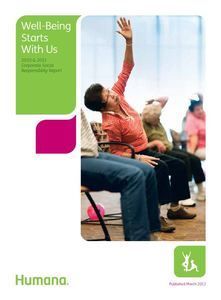
Humana_2010-2011_CSR_ReportHumana recently released its 2010 and 2011 CSR report. What’s news about that?

For one, with this report, the health insurer became the first in its sector to follow GRI guidelines. Second, it lays down the foundation for upcoming efforts in building a sustainable supply chain and consciously partnering with NGOs and nonprofits in furthering well-being for all.

I sat down with Jim Turner, Humana’s Director for Media and Public Relations and Catherine McGlown, Humana’s CSR Lead to discuss the report — and what’s ahead for their teams.

How does Humana define CSR?

Turner: “Humana defines CSR as our dedication to making business decisions that reflect our commitment to improving the health and well-being of our members, our associates, the communities we serve, and our planet. Our CSR platform – Healthy People, Healthy Planet, Healthy Performance – represents that.”

What’s the significance of being the first company to issue a GRI report in the health insurance industry?

McGlown: “We’re excited about it, as you might expect. We won’t be surprised to see other insurers at least seriously consider following suit. As stakeholders demand increasing transparency and accountability, reporting with a recognized framework is one way our industry can continue to build trust with our members, associates, shareholders, regulators and the community at large.

“The publication of Humana’s 2010 & 2011 CSR Report using GRI guidelines (self-declared at a level C) shows that Humana is leading the health insurance industry in the larger trend of reporting out on environmental, social and governance data. CSR reporting is growing, both internationally and nationally. GRI estimates the number of North American reports with a GRI index increased by 35 percent between 2010 and 2011; we are proud to be a part of that growth.”

What metrics are discussed within the report?

  • Humana’s pledge to reduce building energy consumption, greenhouse gas emissions and annual energy expenses by 10 percent each, over the course of 2012, from a 2009 baseline.
  • Formation of Humana’s Network Resource Groups for African-American associates; Hispanic associates; caregivers; and gay, lesbian, bisexual and transgender associates. Since the report publication, Humana has launched another group for military veterans.
  • Humana’s report also discusses the company’s plan to hire 1,000 or more veterans and/or their spouses for a variety of roles across the company, as part of the Humana Veterans Initiative. Humana has hired more than 400 military veterans and military spouses since the initiative began in August 2011. Military Times EDGE named Humana Military Healthcare Services as one of its 2012 “Best for Vets” employers. On this year’s list, Humana achieved the highest ranking of any health care company.

What have been some of the challenges of CSR reporting in a highly regulated industry?

Turner: “We’re used to being very careful about how we handle people’s health and well-being information. We have to be. This was no different as we compiled information and data for this year’s CSR Report. We wanted to be extra sensitive to how our associates and external stakeholders would view the report and how we frame sometimes-sensitive issues.”

Does Humana have community engagement initiatives only in the markets you do business?

McGlown: “Through our Medicare operations, Humana does business in all 50 U.S. states, so the answer is yes. That said, we certainly consider markets where we do business and where our associates live and work when evaluating community engagement initiatives, but those are not the only qualifying criteria. Humana’s dream is to help people achieve lifelong well-being – regardless of where they live. As Humana is now a national company, we’re working hard to become good corporate citizens in all of the communities where we do business.”

A few examples:

  • Humana has partnered with the nonprofit KaBOOM! to build multigenerational playgrounds across the country – with the most recent build in Marion, Iowa – they have built a total of 11.
  • The Humana Well-Being Tour is travelling the country for eight months, stopping in different communities and meeting people where they live to give them a fresh perspective on healthy living. This national mobile health initiative includes pedometer distribution, biometrics stations and virtual games focused on health.
  • If enrolled in a Humana health plan, Humana associates and their families can participate in an incentive-based program called HumanaVitalitySM. Rooted in science, this program encourages individuals to create a goals-based health plan and rewards individuals for healthy choices—such as losing weight, staying active and eating better—by awarding points redeemable for purchases. In addition to benefiting Humana associates, this program enables Humana to build the business case for workplace wellbeing and encourage other companies to invest in employee health.
  • Humana’s Signature Program Team Up 4 Health, located in Eastern Kentucky, uses the power of personal relationships to influence people’s behaviors towards better health and lifelong well-being. Its mission is to curb chronic diseases—such as diabetes, cardiovascular disease and obesity—which are among the most common, preventable and costly health problems in the United States. This two-year pilot is a partnership with Microclinic International, Citizen Effect and community partners.

How do you see the company’s commitment to community engagement helping Humana’s long-term sustenance?

McGlown: “Well-being is much like CSR in that it is a journey, not a destination. We prioritize walking alongside people in their journey, and one of the ways through which we can continue to drive wellbeing is through community engagement. Meeting people where they are and encouraging them to make changes in their lives that yield lifelong well-being (purpose, belonging, health and security) is a win-win.”

What CSR initiatives will Humana focus on in the next two to three years?

McGlown: “Humana will spend the next two to three years building upon the foundation we have set. One area of focus for Humana is its supply chain. Humana is identifying ways to deepen its sustainable procurement efforts, as follow-up to a supplier assessment conducted in 2011, as well as ways to increase its spend with diverse suppliers.”

Turner: “In terms of environmental work, in addition to our energy-savings targets, Humana is working on a green real estate project. For our owned facilities, we’re developing a scorecard to determine the highest-impact locations for green retrofits. For potential new properties, we’re integrating consideration of LEED potential into our RFPs and site searches.

“We have also made a multi-year commitment to continue our work with KaBOOM! Over the next three years, we will build more than 40 multi-generational playgrounds in high-need communities to encourage well-being through play.”

What do you hope to get out of your CSR report?

Turner: “The establishment of our formal CSR efforts began with both senior-leader support and organic associate activities – our CSR platform of Healthy People, Healthy Planet, Healthy Performance reflects who we are. Humana’s stakeholders – including our members, employees, and the communities in which we do business – expect a certain level of transparency from us¸ and we aimed to provide them with that through our CSR Report.”

McGlown: “This first GRI report was a tremendous learning experience. Going forward, we’re looking for ways to deepen our reporting, including possibly striving to report at the B- level in our next report.”

Originally written for and published on CSRwire’s Commentary section Talkback on June 28, 2012.

Share this:

  • Tweet
  • Email a link to a friend (Opens in new window) Email
  • Share on Reddit (Opens in new window) Reddit
  • Print (Opens in new window) Print
Like Loading...

Bagels With the Tall Guy: In Conversation with Green Mountain Energy

07 Monday Jul 2014

Posted by Aman Singh in CSR, CSRwire

≈ Leave a comment

Tags

alternative energy, Brand Management, Business, carbon offsets, CEO Network, CSR, CSRwire, employee engagement, entrepreneurship, ghg emissions, green energy, green mountain energy, Leadership, Management, public policy, recycling, renewable energy, Sustainability, sustainability


Green Mountain Energy, founded in 1997, is the longest selling retailer of carbon offsets in the country with a lofty mission: To change our dependence on power generation from coal and nuclear energy to renewable sources.

With a clear environmental mission and a dedicated consumer base, why would a company like Green Mountain Energy [GME] bother publishing an annual sustainability report?

“The [sustainability] report gives us an opportunity to write about everything we are doing. When you build a company of people who are passionate about the environment, the report becomes a forum to talk about everything we are doing,” says former President Paul Thomas.

The day of our interview, Thomas was still President of the company he has led since 2000. Two days later, news of his stepping down was delivered to my inbox along with a quote:

“I am extraordinarily proud of what we have collectively accomplished at Green Mountain and know that the potential for driving meaningful change is nearly limitless if businesses, like ours, can put market forces to work to solve societal problems.”

Thomas is referring to the recent acquisition of GME by New Jersey-based NRG Energy.

Merging Two Cultures & Winning Over the Skeptics

Paul_Thoms_GMEHow did the company overcome hesitance from employees, customers and investors alike about the acquisition?

“Our society is transforming as a whole from being oil-driven to something very different driven by renewable sources and technology. The question is how do we get from here to there as a society? NRG is a good example [of a company addressing] this dilemma. They are the largest investors in solar production in the country. Now, Green Mountain is a part of their initiative to make NRG a cleaner company – their activities are genuine and we fit well,” he explains.

What about shifting work cultures?

Thomas says the company has undergone several shifts since the 1990s. “We started with a lot of environmental enthusiasts with a low level of business skills. It would have been a lot of hot air if we didn’t drive value to customers. Today we are also a good sales organization, a customer-service driven company,” he says, transitioning from being an environmental company to a good business.

Sustainability Performance

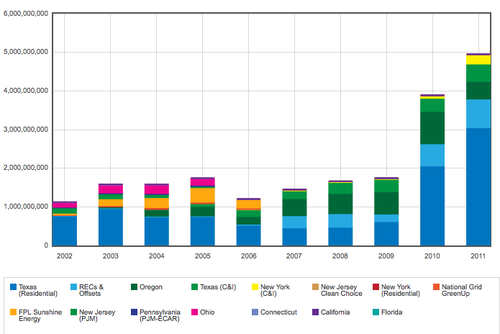
But back to the 2011 sustainability report, which follows several other companies’ lead in shutting off downloadable PDFs in favor of an interactive all-you-can-consume website. The company has come a long way from its formation in the 1990s. According to the report, GME contributed to avoiding 4.5 billion pounds of CO2 emissions, which is “equivalent to not driving a car for six billion miles or planting 6.5 million trees.”

“Remember that in 1997, this was just an idea,” reminds Thomas. “We’ve also increased recycling and all our material now is made from 100% post-consumer recycled content,” he added.

Green_Mountain_Energy_CO2

GME also expanded its innovative Sun Club, which asks customers to pay an additional $5 a month to help the company invest in solar projects. The money donated is then distributed to fund solar projects nationwide in coordination with nonprofits. 2011 marked the biggest year yet in contributions.

But what is sustainability without employee engagement?

Transparency in Action: “Bagels with the Tall Guy”

GME encourages its employees to bike, bus or take the subway in its New York office and participants in 2011 doubled past years’ numbers, according to the report. The report also makes public GME’s paper and publishing standards as well as its contributions and partnerships with organizations like EarthShare.

Green Mountain Energy’s answer to town halls is what the staff quirkily call “Bagels with the Tall Guy.” Thomas explains:

“I’m 6’6” tall. My predecessor was bald so it used to be called “Bagels with the Bald Guy.” It is just an informal communication forum for employees to ask me anything that is on their mind. Nothing is off the table and the conversation is purposely unstructured.”

While all is fair game, Thomas admitted that not everyone attends every month. But what it does is allow “us to be transparent. I believe that employees are effective when they have more context of their job and how they are contributing. Their role makes more sense and there is less doubt about how they fit in and how they can make a difference,” he added.

Public Policy & Sustainability

GME_ProductsWith the Rio+20 Summit coming up, I asked Thomas what the government and public policy makers can do to help support the growth of businesses like GME.

Pointing to a fundamental disconnect, he said, “The public is ahead of policy makers because there is a fundamental misunderstanding between individuals who are concerned about the environmental and their willingness to make purchasing decisions.”

“In the last 10 years, we have seen a sea change in the public’s attitude. But policy makers have not caught up with that,” he continues, adding:

“Green Mountain can focus on market changes by aligning ourselves with the social and environmental benefits of our product. That’s a powerful combination. We’ve proven that green business works, that there is a market for us, and that we can drive a lot of societal benefit while providing good jobs and careers for individuals, and meaningful returns for investors.”

Thomas also cautioned activists and skeptics to keep in mind the regulatory barriers in the market for green energy. “Every state has its own approach ranging from Texas that is competitive and has an open market for electricity to states where the old monopolistic system is still there. We are not allowed to compete in those states!” he emphasized before adding, “We cannot sell green electricity without having permission to enter the states and compete first and foremost.”

A significant barrier but one that hasn’t stopped Green Mountain Energy from scaling the heights and pursuing its mission. His advice for aspiring social and environmental entrepreneurs? “Keep at it, we’ve done it and shown that green businesses can thrive. It’s possible.”

Originally written for and published on CSRwire’s Commentary section Talkback on June 1, 2011.

Share this:

  • Tweet
  • Email a link to a friend (Opens in new window) Email
  • Share on Reddit (Opens in new window) Reddit
  • Print (Opens in new window) Print
Like Loading...

The True Value of CSR Reporting: In Conversation with Campbell Soup’s VP for CSR

07 Monday Jul 2014

Posted by Aman Singh in CSR, CSR reporting, CSRwire, ESG

≈ Leave a comment

Tags

Business, Campbell Soup, CEO Network, community development, corporate governance, CSR, CSR reporting, CSRwire, Dave Stangis, denise morrison, employee engagement, Environment, ESG, Social Media, Stakeholder Engagement, Supply chain management, Sustainability, sustainability, Work culture


The soon-to-be-released report will mark Campbell Soup’s fourth CSR Report. This report comes amidst a CEO change – Denise Morrison took on the chief job at Campbell Soup last year joining a small group of women CEOs in the Fortune 500 – and a period of what Director of Diversity & Inclusion Kevin Carter calls a time of “deep introspection” for the company.

Carter’s note is well taken. With the economy sputtering and flailing, reports continue to suggest that consumer confidence and trust remain low. For a food manufacturer then, this means not only staying ahead of the curve of quickly changing taste preferences but also understanding its unique role in encouraging nutrition across an increasingly complex and fragmented consumer base.

And amid a tepid economy, where does the true value of CSR and sustainability reporting lie? Can these reports and the effort required to produce them extend beyond an exercise in sharing key metrics, the year’s highlights – and a few, incredibly sparse media mentions – to true learning experiences for companies to better their processes and make gains that help them and their communities become more sustainable?

The True Value of CSR Reporting

Dave_Stangis_CSFor VP of Public Affairs and Corporate Responsibility, Dave Stangis – his third report since taking the job at Campbell Soup – the true value of Campbell Soup’s reporting goes far beyond setting the right goals and reporting on the progress.

“The true potential of CSR reporting* is that while companies go through this chronological reporting effort once a year, the organization and business units are executing their strategies and working on metrics year-round. The process of reporting creates an opportunity to build a Campbell Soup Britannica or World Book to work off of and use as a record of the company’s progress,” he said in a recent interview.

“All year-long, we are collecting examples, building the narrative, monitoring our progress and continually evolving materiality assessments,” he continued. Often, great examples of progress emerge that would otherwise never rise to the spotlight in a multinational company.

“As you dig in, you find cross-functional teams working together on strategy, benchmarking, indicators, etc. There are, of course, always things to improve on but the stories and ideas that emerge from this heels dug in reporting exercise are incredibly useful in moving our company forward,” he said.

Connecting the Dots: Recognizing the True CSR Heroes

In recent weeks, CSRwire readers read from a number of top executives at Campbell Soup on their stories and contribution to the 2012 CSR report. Trish Zecca discussed the fine balance between nutrition and taste while Amanda Bauman discussed how the company is tackling hunger and obesity in its communities and Dr. Daniel Sonke gave us an in-depth account of the relationship between agriculture practices and corporate sustainability. Finally, D&I Director Kevin Carter offered his insights on how the company is prioritizing intercultural teams, moving diversity beyond compliance, and tentatively dipping its toes in social media.

For Stangis, these are the true heroes.

“These are the people who are behind the images and stories in the report. They are invested in the business Campbell_Soup_Volunteersand their work and there is a discernible amount of pride and work ethic that goes along with that,” he said.

“For our CSR Communications Manager Niki Kelley – creating this report is her life for six months and I’ve told her, she’s the one who knows more about the entire company than anyone else in the company.”

5 Questions for Campbell Soup’s VP for CSR

What is Stangis most proud of in the latest CSR report?  “It’s the nuances that a lay reader won’t realize but that are critical to the progress we are making,” he said. To explain further, we decided to play five questions:

1. Whose Interested:

“We continue to evolve our understanding of our various audiences [for the CSR report]. We want to connect with our employees on the frontline as well as in the C-suite. We need to impact our neighbors and make the content relevant to our customers and consumers. Most readers are looking for quick snapshots and I want to validate, reinforce and build trust and credibility in that short timeframe.”

2. What’s New:

“We’ve really worked hard on strengthening the wellness and nutrition metrics from a product perspective…we’re not driving a health ultimatum, but we are offering more healthy choices for consumers. Readers that pay closer attention will notice a growing sophistication in our strategies and metrics across the board. This report also includes the first full description of our Healthy Communities Initiative that we’ve launched in Camden, NJ.”

3. What’s Often Hidden:

“We work hard to make sure nothing gets lost in the details, but there is a ton of content that most readers will miss on a casual glance. The CEO Letter can give the readers a sense of how Denise Morrison thinks and interacts with the CSR and sustainability strategy.”

“We’re bridging from an employee engagement (only) mindset to a performance culture that leverages engagement to drive better business results. This isn’t something that is immediately obvious to external readers but it’s a priority for us.”

4. What’s Measured Gets Managed:

“Last year we discussed our community programs but this year the report really talks about these in a strategic and measurable manner. We continue to advance our metric set from product conception to societal impact. We’ve mapped our production sites with the WBCSD Global Water Tool and as we’ve brought our Community and Foundation functions into tighter alignment with our CSR and Sustainability strategies, we are shifting from measuring activity to measuring outcomes.”

5. Uncharted Territory: 

“The big news this year from a sustainability perspective is our traction on renewables. We’ve had smaller efforts in the past but in 2011 we went from dipping our toes in the water to flipping the switch on one of the largest solar installations in the country. This represents a cultural shift for the company. Large scale renewable projects just weren’t in our solution set and now we are evaluating new renewable opportunities across our plant network that reduce our greenhouse gas emissions and save money.”

Solar_Panels_at_Campbell_SoupFor Campbell Soup, a global footprint means a holistic vision of sustainability that encompasses its products, employees, communities and supply chain.

And for Stangis, publishing an annual report is not only a testament to his team’s efforts but also a way to measure what’s not working. Having led CSR at Intel before joining Campbell Soup, Stangis is a veteran in the world of CSR reporting, and has seen firsthand the evolution of the sector.

“What comprehensive reporting does today is set up a process that continues to position the company in the long-term. This wasn’t the case when we started reporting. Now we’re anticipating issues and breaking down communication silos that are inherent in the company,” he explained.

Challenges Ahead: More Data, Clarity of Purpose

Any regrets? “We need to keep pushing ourselves for better data every year, especially for our international footprint. It’s only when you dig in that you realize how much better a fully integrated measurement and reporting system would be,” Stangis confessed.

The journey – as for most companies taking on the responsibility and challenge of reporting on their corporate social responsibility and sustainability efforts – is far from over.

And as a seasoned sustainability executive, Stangis understands the daunting task that lies ahead for Campbell Soup in a crowded market, evolving taste preferences and the continuous challenge of consumer education.

“We still have to plug people into what we are doing, the reason why we are doing it [and make it make sense],” he said, noting that it isn’t just the external stakeholders that need the dots to be continually connected for them.

“We have to do a better job at communicating the strategic intent and shareowner value delivered by a comprehensive CSR program.  Our internal teams, our C-suite – it’s our job to help them understand  the story across the board.”

Originally written for and published on CSRwire’s Commentary section Talkback on May 24, 2012

Share this:

  • Tweet
  • Email a link to a friend (Opens in new window) Email
  • Share on Reddit (Opens in new window) Reddit
  • Print (Opens in new window) Print
Like Loading...

Social Responsibility, Beer & Aliens: Journey to Becoming the Best Beer Company in a Better World

07 Monday Jul 2014

Posted by Aman Singh in CSR, CSRwire

≈ 1 Comment

Tags

ab inbev, Anheuser Busch, Brand Management, Business, carlos brio, carol clark, community, community development, CSR, CSR report, CSRwire, environment, ESG, executive compensation, Social Impact, Social Responsibility, Stakeholder Engagement, supply chain, Sustainability, sustainability, water conservation


I caught up with Carol Clark, Global VP for Beer and Better World, to drill deeper into Anheuser-Busch InBev’s latest CSR report. Key highlights:

The report is titled Connecting for a Better World. AB InBev makes beer. What’s the connection?

At AB InBev, our dream is to be the Best Beer Company in a Better World. We believe that taking consistent, active measures in our core areas of social responsibility means constantly connecting our business with our stakeholders, especially in the communities where we live and work.

It takes a team effort to address these issues. Through our work to promote responsible drinking, reduce our impact on the environment and support our communities, we work with others who share our collective goal of making a difference.

There’s a quote in the report from Carlos Brito saying “We’re not aliens.” Can you offer some context?

Carol_Clark_AB_InBevWhen Carlos Brito said, “We are not aliens …” he was responding to a question at the Business for Social Responsibility Conference last fall about why AB InBev actively promotes responsible drinking.
AB InBev today has over 116,000 employees operating globally. We live on this planet and share the same concerns as our friends and neighbors. Many of us are parents and understand how important it is to talk with our children to help prevent underage drinking.

Similarly, we don’t want to be on the road with drunk drivers, and we’re committed to supporting prevention efforts such as encouraging the use of designated drivers. We’re committed to addressing these issues not only from a business perspective, but also from a personal perspective.

What is the ROI in producing a comprehensive CSR report such as this one? Media mentions? Retention? Rankings? Anheuser-Busch_CSR_Report

Publishing our CSR report keeps us focused and accountable to our stakeholders and ourselves. The scrutiny that this annual process brings gives us an updated perspective to help us further drive our performance, engage our employees and very importantly, thank them for their great work over the past year.

From an external perspective, we’re satisfying the requests from varied stakeholders for transparency on our social responsibility efforts.

The report is over 80 pages. Who is your primary target audience? And, who would you want to target?

We have a lot of good things to talk about! We use the report to share our progress with diverse audiences – from community stakeholders to investors, to media, to government officials – around the world.

Alex Prud’homme author of The Ripple Effect recently said that “Water is the headlining story of our century.” Are you focusing on sustaining your business by reducing water use, R&D on water replenishment or identifying alternative products altogether?

Water is our primary environmental focus and we aim to reach a water usage rate of 3.5 hectoliters of water for each hectoliter of production by the end of 2012.

We tackle the issue of responsible water use by doing more to conserve both in our operations and in the communities where our breweries are located. Progress requires operational changes and continually applying the most updated technical innovations. It means going further with supply chain and community partners to help conserve water outside our walls. But it also requires reinforcing a mindset that doesn’t take water for granted.

[Anheuser-Busch InBev’s 2011 Global Citizenship Report]

It can be argued that 8.2% reduction in water usage since 2010 is not a lot. Primary challenges in reaching double-digit reduction?

Actually, if you look at the beverage industry, this is a significant achievement. And it’s important to keep in mind that we’ve focused on water and energy efficiency for some time now, so there is very strong year-on-year progress. And we’re also making these reductions while continuing to grow our business. That means that each year, our brewing operations teams find innovative ways to do more with less when it comes to water.

To date, we’ve achieved an average water use of 3.71 hectoliters per hectoliter of production across our global business, which represents a 13.7% reduction against our 2009 baseline.

Our target, which we’ve stated publicly, is to reach 3.5 hectoliters of water per hectoliter of production by end-2012, which will put us on the leading edge of water usage for the brewing industry.

Your report mentions the billions paid in wages and income taxes. Not a lot of reports make these metrics a part of their community development results. Why the emphasis on wages? 

As the leading global brewer, we have operations in 23 countries. We have a significant economic impact on the local communities where we do business through the jobs we create, the wages we pay and the taxes we pay governments at all levels. We feel that it’s important to report on and recognize the value and impact we are bringing to communities where we live and work.

Can you talk to the “ownership culture” of the company?

One of our 10 AB InBev Principles is about ownership: “We are a company of owners. Owners take results personally.”

[Sustainable Beer: Anheuser-Busch InBev’s 2012 Environmental Goals]

We strive to create a culture that encourages responsibility and accountability, and that applies to our work on social responsibility as well. Creating this culture of ownership helps us build those connections and team approach, both internally and externally, to helping make a difference in our communities as we strive to be the Best Beer Company in a Better World.

Originally written for and published on CSRwire’s Commentary sectionTalkback on April 26, 2012.

Share this:

  • Tweet
  • Email a link to a friend (Opens in new window) Email
  • Share on Reddit (Opens in new window) Reddit
  • Print (Opens in new window) Print
Like Loading...
← Older posts
Newer posts →

Let's Talk!

Virtual
732-322-7797
amansinghdas@gmail.com

Blogs I Follow

  • Nonprofit Chronicles
  • Learned On by Andrea Learned
  • Angry African on the Loose™
  • csr-reporting
  • The CSR Blog
  • In Good Company: Singh on CSR

My Cloud

Capitalism 2.0 CSR CSR reporting CSRwire ESG Guest Author HR Stakeholder Engagement Sustainability Uncategorized

Recently written…

  • Rationality is Ruining Us: Mayors, presidents and governors join major businesses in charting way forward on climate change
  • 2015: the year businesses recognize that climate change is real – and 4 other themes
  • Hardcore lessons of sustainability – ’10 Words or Less’
  • Brewing a Better Future [#BaBF] with Heineken: Examining the Many Flavors of Local Sourcing
  • From Conflict to Collaboration: Kimberly-Clark and Greenpeace Participate in LIVE Twitter Chat

What others are reading

aman singh aman singh das Brand Management Business corporate social responsibility CSR CSR reporting CSRwire ESG Leadership Stakeholder Engagement supply chain Sustainability sustainability Work culture

Categories

Most Read

  • None

Create a free website or blog at WordPress.com.

Nonprofit Chronicles

Journalism about foundations, nonprofits and their impact

Learned On by Andrea Learned

Angry African on the Loose™

I have opinions. I am from Africa. I live here now. I blog.

csr-reporting

Connecting the dots between Business, Society & the Environment

The CSR Blog

Connecting the dots between Business, Society & the Environment

In Good Company: Singh on CSR

Connecting the dots between Business, Society & the Environment

Privacy & Cookies: This site uses cookies. By continuing to use this website, you agree to their use.
To find out more, including how to control cookies, see here: Cookie Policy
  • Subscribe Subscribed
    • In Good Company: Singh on CSR
    • Join 119 other subscribers
    • Already have a WordPress.com account? Log in now.
    • In Good Company: Singh on CSR
    • Subscribe Subscribed
    • Sign up
    • Log in
    • Report this content
    • View site in Reader
    • Manage subscriptions
    • Collapse this bar
 

Loading Comments...
 

    %d