• ABOUT THE AUTHOR
  • Sustainability
  • CSR
  • CSR reporting

In Good Company: Singh on CSR

~ Connecting the dots between Business, Society & the Environment

Tag Archives: climate change

Life Technologies: When the Search for Sustainability Becomes a Radical Overhaul

09 Wednesday Jul 2014

Posted by Aman Singh in CSR, CSR reporting, CSRwire, ESG

≈ Leave a comment

Tags

agriculture, Brand Management, climate change, cristina amorim, cso, CSR, CSR reporting, CSRwire, Disclosure & Transparency, energy, environment, Environment, ESG, genetic sequencing, ghg, kimberly-clark, life technologies, lifecycle analysis, oil, packaging, recycling, supply chain, Supply chain management, Sustainability, sustainability, terracycle, thermo fisher scientific, zero waste


For Cristina Amorim, sustainability has been an evolutionary journey.

Having spent almost a decade with Life Technologies – a life sciences company that produces a wide range of medical and research science products – which quadrupled in size through a series of mergers and acquisitions in that time, the company’s chief sustainability officer has seen multiple renditions of sustainability evolving to the next level.

“I’ve spent a decade looking at opportunities and getting sustainability initiatives off the ground that engage every employee, from the copy room to the board room,” she says. On the heels of the announcement that Thermo Fisher Scientific, a giant in life sciences research, is acquiring Life Technologies, I caught up with Amorim on what the past decade has taught her – and her employer – about setting a sustainability strategy that is evolutionary—moving from being good to being smart business.

Evaluating Sustainability: Asking the Right Question

From 2008 to 2012, the company cut energy use by 22 percent, water use by 52 percent, hazardous waste by 13 percent and CO2 emissions by 21 percent, according to its latest sustainability report. With greater growth on the horizon, can Life Technologies continue its sustainability march?

According to Amorim, that’s the wrong question.

“We’re well positioned to harvest the smart business prophecies of sustainability. There is a lot to do to reach a closed loop system and position ourselves in the circular economy. The question is: when do you know you’ve gotten there?”

“I think this is a continuous spiral with no particular end point, but constantly looking for the new frontier that the sustainability lens brings. This is not about creeping incrementalism; it’s about radical change. It’s about turning a moment into a movement, and fostering multiple movements to effect real change”

“Five years ago, no one was talking about zero waste. The economy has changed, allowing zero waste to be a financially viable undertaking. We now have five certified zero waste sites, and the movement goes on. And what would come next?” she continued. “After zero waste, we would envision a zero emissions site—one that has no emissions to air, water, or landfill.”

Now in her fifth year of sustainability reporting, Amorim has spent the better part of the last decade in an environment, health and safety role and understands the complex dynamics of Life Technologies’ Cristina Amorimmainstream products. Acknowledging that her journey has been more about challenging the status quo, she explains:

“We constantly ask questions to challenge what we have been doing. For example, can we source raw materials that are less toxic? That would create a less permitted and safer operational environment with less waste to dispose of. This in turn leads to products that are simpler and cheaper to ship, as they require less packaging, less regulated storage and fewer transportation fees. As a result, our customers will have less packaging and hazardous waste to deal with, reducing their total cost of ownership.”

When Complex Challenges of the 21st Century Meet Genetic Sequencing

So how did Amorim, who was recognized by Ethical Corporation in 2012 as Sustainability Executive of the Year and is Life Technologies’ first CSO, initiate a sustainability strategy that leverages the company’s technology in the markets it serves?

“As I see it, the entire company is the epitome of sustainability. Our genetic sequencing technology has the potential to address some of the world’s most pressing challenges. Just like in the 20th century, computing science turned a mainframe computer into an iPhone, in this century, life sciences is increasingly putting more DNA sequencing power into smaller devices at a lower cost – making it accessible to every scientist in the world. As sequencing is becoming democratized, scientists increasingly have the tools to transform life as we know it.”

In a world where 70 percent of available freshwater is used for agricultural irrigation, Life Technologies products have the potential to transform food economics. By re-engineering seeds, scientists can create higher-yield and drought-resistant crops.

Amorim continues, “As scientists leverage DNA sequencing technology to harvest oil from algae, biofuels will free us from extracting petroleum from the earth and tackle climate change
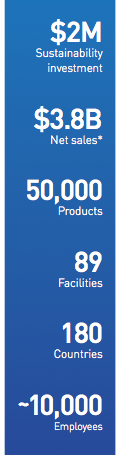
simultaneously. The significantly decreasing cost of sequencing the genome hastens theLifeTech_2012 development of more effective medicines, vaccines and clinical solutions that alleviate the health and economic burdens on society.”
Embedding a Cultural Shift: A Decade in the Making

As a biotechnology company, Life Technologies manufactures temperature-sensitive products requiring storage and shipment conditions ranging from -80° Celsius to ambient. Cold shipping requires expanded polystyrene (EPS) coolers and refrigerants like dry ice and gel packs, to maintain specific conditions during transport.

As the U.S.’ largest shipper of dry ice with FedEx, each year we ship 800,000 EPS coolers (equivalent to 105 truckloads) and consume 4500 metric tons of dry ice, costing $15 million in packing, refrigerant and freight. Given the poor recyclability of EPS, energy intensity of refrigerants and package weight, this represents our largest environmental impact and opportunity.

How is Life Technologies turning this challenge into an opportunity? Amorim explains, “Our strategy includes eliminating the need for coolers by converting products from cold to ambient shipping, piloting cooler reuse options, and investigating alternative materials to expanded polystyrene.”

Through a robust stability testing program, we have proven that some of our products can safely withstand ambient transport conditions. Just like transporting ice cream from the supermarket to your home freezer– we don’t carry a cooler or dry ice in our trunk.

“So far we’ve converted genetic analysis, sequencing, cell culture and molecular biology reagents, top-selling capillary electrophoresis and transfection reagents. The impact has been significant—each year, we now ship 250,000 fewer EPS coolers (33 fewer truckloads), use 2400 fewer metric tons of refrigerant, and save $4 million in operational costs globally. Most importantly, we know our packaging becomes our customers’ waste. These product conversions help us leave less branded garbage in their hallways.

Of course, the effort requires engagement across multiple functions. “From R&D to distribution and sales & marketing, everyone has a part to play. We tapped into natural leaders across these functions to become ambassadors for these initiatives. It provided them with visibility and career growth opportunities. They are delivering cost savings, protecting the environment and feeling good about it,” she added.

The Externalities: Collaborating with Suppliers

While these examples prove a significant point about how sustainability thinking can shift mindsets on profit, purpose and business value across organizations, what about Life Technologies’ external supply chain? With over 50,000 products and complex transportation cycles, how is the company addressing sustainability in its supply chain?

“I have a hard time understanding the traditional concept of ‘greening the supply chain.’ Asking hundreds of suppliers to fill out forms and check boxes provides no tangible value. We could never understand how to take action on that supplier data,” Amorim explained. “Instead, we find more value in partnering with key suppliers.”

One example is Kimberly-Clark. On the path to zero waste, Amorim and her team went dumpster diving one morning to understand their waste streams. What they found was a sea of blue and
purple  latex gloves.

We approached the glove supplier, Kimberly-Clark, who partnered with us to implement a glove take-back program. It started in one location and has today expanded to five. We segregate the gloves at the point of use and Kimberly-Clark sends them to TerraCycle, who turn them into purple park benches. This partnership provides true value—glove take-back helped us achieve our zero waste goal and helped Kimberly-Clark increase their revenue by becoming our sole glove supplier globally.

Take Back: Turning Obligation into Opportunity

The circular economy has arrived. That is what excites Amorim, one of very few female CSOs in the private sector. “The regulatory environment is also helping us close the loop. The WEEE [Waste Electric Electronic Equipment] legislation in Europe is one example,” says Amorim.

WEEE institutionalizes the cradle-to-cradle concept as a means of keeping electronic equipment containing heavy metals out of landfills. “Wouldn’t you like it if Maytag removed your dishwasher at the end of its life? I can’t move it and it doesn’t fit in my trashcan. In Europe, we now have to set up a take-back scheme for all of our instruments. How can this be done profitably?”

“We realized that by taking instruments back only to recycle the parts was a cost burden. Instead we bring them back to refurbish certain product lines for resale, harvest high-value parts to be used on service calls, and responsibly recycle what’s left.”

For Life Technologies and other companies, refurbished instruments open up an entire new market. At a lower price point, instruments such as DNA sequencers are more accessible to more scientists. And with increased revenue, the WEEE obligation becomes an opportunity.

While issues like cold chain shipment, waste, and regulatory compliance present thorns on the way to the gilded goal of a closed-loop model for Life Technologies, triangular connections in its supply chain and their appetite for cutting-edge innovation leads one to believe the opportunities are endless for Amorim and her team.

As the exuberant sustainability chief concludes, “We’re aiming for radical.”

Originally written for and published on CSRwire’s Commentary section Talkback on July 22, 2013.

Share this:

  • Tweet
  • Email a link to a friend (Opens in new window) Email
  • Share on Reddit (Opens in new window) Reddit
  • Print (Opens in new window) Print
Like Loading...

Unilever’s Sustainable Living Plan: The Challenges of Being Too Ambitious

09 Wednesday Jul 2014

Posted by Aman Singh in CSR, CSR reporting, CSRwire

≈ 1 Comment

Tags

agriculture, Brand Management, Business, cause marketing, climate change, Consumerism, Corporate Governance, CSR, CSR reporting, CSRwire, disclosure, Disclosure & Transparency, dove, energy, environment, Environment, food, hygiene, Leadership, lifebouy, marketing, nutrition, paul polman, Social Enterprise, supply chain, Supply chain management, Sustainability, sustainability, Sustainability Report, unilever, unilever sustainable living plan, water


Unilever’s Sustainable Living Plan was created and launched amid much fanfare in 2010. It was lauded for its ambitious goals, an exhaustive list of metrics and for its commitment to put sustainable and equitable growth at the heart of its business model.

This week, the consumer products company released its second progress report and it began with a stark statement from CEO Paul Polman:

The world continues to face big challenges. The lack of access of many to food, nutrition, basic hygiene and sanitation, clean drinking water or a decent job should be a concern to all of us. We firmly believe business has a big role to play in striving for more equitable and sustainable growth, but large-scale change will only come about if there is real collaboration between companies, governments and NGOs across all these areas.

Now, the report is impressive, exhaustive and filled with data. So to get beyond the flash, the  avalanche of Keith_Weed_Unilevernumbers and statistics, I reached out to Keith Weed, Chief Marketing & Communications Officer also responsible for the Sustainable Living Plan, to discuss not only the challenges of reaching some of the goals Unilever is striving for by 2020 but also the successes, the unforeseen road bumps and the transformation the company is undergoing culturally because of the Plan.

To get started, here are the three overarching goals Unilever began its Plan with:

  1. Help more than a billion people take action to improve their health and well-being;
  2. Source 100 percent of agricultural raw materials sustainably;
  3. Halve the environmental footprint of its products across the value chain.

Ambition: Sustainability in Perspective

“The report is indicative of what we’re trying to do. We’re trying to do things at scale. This is not a [standalone] CSR project in Africa but something that touches every single element across our value chain,” he began.

It takes a mindset shift to put Unilever’s plan in perspective. As Weed explained, “The idea that it isn’t just about the footprint of your facilities…we have to think all the way through the lifecycle of a  product from consumer to facilities to sourcing to the impact of key productions. The Unilever Sustainable Living Plan guides our direction.”Unilever__Sustainable_Living_Plan

Did his team realize the magnanimity of the goals they were setting? “We knew that we couldn’t achieve all of them but that if we set them like this, we would find solutions along the way by working with others,” he said, adding, “When you get interconnected, solutions and opportunities open up. That was the spirit we started with.”

And the results encapsulated on Unilever’s website and a 53-page PDF download, are in keeping with that spirit. “It’s not about mechanically ticking off the targets and goals. Our Sustainable Living Plan is a movement to get business to move toward socially and environmentally sustainable future,” he clarified.

The Unilever Sustainable Living Plan: Highlights

First of, he reminds me that from the outset, the Plan set out the sustainability goals to be achieved alongside the mission set out in 2009 to double the business. “We serve two billion people a day and another 2.5 billion are expected to be added to the world’s population by 2050. So our goal is to reduce our environmental footprint and increase our social impact while doubling our business.”

The good news: “We have started to drive sustainability into the core of our business and today, our sustainability efforts are helping to drive business growth.” One example is Unilever’s popular Lifebouy  soap, which was rebranded in 2010 with a social purpose alongside:

[We went] from selling soap to encouraging people to wash their hands – and wash them correctly. And our efforts have resulted in double-digit growth over the last three years – and reaching millions with our Handwashing campaign. It’s proving the coherence of our strategy of combining social impact with business growth instead of just a sales goal,” Weed explained.

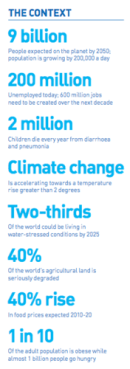
USLP_ContextOther examples:

  • Laundry cleaner: Unilever increased its market share by 10 percentage points since 2010 to over 25 percent, with its concentrated liquids, which according to Weed carry a much lower carbon footprint in production and use.
  • Dry shampoos: A huge opportunity for the company, right now dry shampoos are mostly sold in the U.S. – where Unilever occupies a 75 percent market share. But as the company enters into more water-restricted countries, Weed predicted an accompanying increase in sales.  The environmental benefit? Compared to heated water, dry shampoo reduces CO2 by 90 percent through lower water usage and less heating of water for the shower. An added benefit for developing countries: water conservation.
  • Dove: The Self Esteem campaign continued to gain momentum with 62 percent of women who know of the campaign now recommending Dove to others. “The campaign started with the idea that we should think differently about how we portray beauty,” said Weed, “Today, it’s a global movement.”
  • Oral hygiene: Unilever’s oral hygiene campaign helped its Signal brand grow by 22 percent in 2012. “People brush their teeth in the morning and evening, which requires more toothpaste, ergo a virtuous circle,” contextualized Weed.

A Twist on Purposeful Cause Marketing?

So cause marketing spelt and implemented differently. By attaching value and impact with its core products, Unilever is addressing a question all consumer products companies continue to struggle with: how do you change consumer behavior to scale a company’s sustainability efforts?

For Unilever, this has meant active pairing of product and messaging with a focus on impact and growth, yet ultimate success is far away.

As Weed explained:

This is a coherent strategy that works – we’re increasing our social impact while growing our business. However, while we’re making good progress, we’re still facing challenges across the value chain, whether it’s with sourcing, food production or disposal.

And each carries with it a nuanced set of challenges, a complex set of solutions and invariably a cobweb of marketing, brand positioning and partnerships.

We have reduced our CO2 emissions, non-hazardous waste to landfill has been reduced in 50 percent of our factory sites, we’re sourcing over a third of our agricultural raw material from sustainable sources, up from 14 percent when we started in 2010…yet we’re miles away from our 2020 target of 100 percent,” he offered.

Scaling Behavior: Easier Ideated than Done

Of course, a key ingredient in Unilever’s Plan is the ability to scale. For the world’s largest tea consumer behaviorproducer, these achievements might mean small metrics today but when scaled are attribution to an entire value chain at work on technological improvements, environmental studies, and more. However, the opportunity is also a challenge:
“The sheer scale of our commitments is tremendous. For example, we want to be able to educate a billion people by 2020 on washing their hands correctly. That’s a lot of people – despite the progress we’ve already made since 2010 –119 million people reached since 2010, of whom 71 million were reached in 2012. Scale has been more challenging than we originally thought,” Weed explained.

Another challenge: encouraging people to adopt new behaviors.

Consumer Behavior: The Toughest Challenge Yet?

“When someone tells you something about hygiene, it’s easy to do it for a couple of days and then switch back to your old habits. Habits are hard to change and we’re seeing this come up in almost every initiative,” he said.

Using the example of laundry, he exemplified:

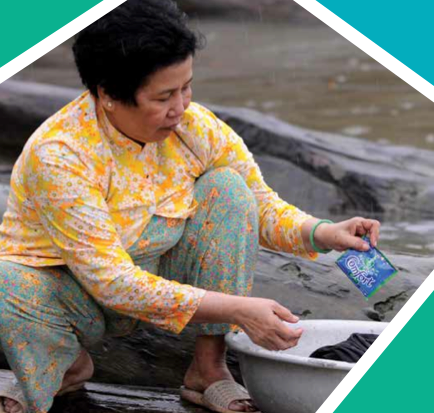
The biggest use of domestic water across households worldwide is for laundry.  Only a few hundred million in North America and Europe use machines. The other billions wash their clothes by hand and usually use four buckets of water to do so: wash in one, rinse in three. Our challenge is to reduce that rinsing from three buckets to one.  So we came up with a product that kills the foam – wash in one bucket and rinse in one bucket. Water used is instantly cut to half. And we expected the product to be a runaway success.

The team found that embedding that behavior change of using one bucket instead of three was  instrumentally Laundry_Unilevertough. Even in water scarce markets where people have to walk long distances for water. “Rinsing is hard work. I thought this would be a rapid victory but we found that it takes time to change habits and we ended up reaching only 29 million households, much lower than anticipated,” he recalled.

When your footprint encompasses billions of culturally diverse populations with very different social and environmental settings, scale becomes an ever-moving target.

Perhaps Weed puts it best again: “If you went to work in a Boeing 747, it wouldn’t make a difference to the planet. If half the planet started doing that, it would make a huge difference. The power of individuals is when you scale them together.”

Its hard work.

And Unilever’s 2012 Progress Report while celebrating the company’s achievements does not undercut the challenges ahead. “We’re breaking new ground every day. We’re showing results. But there are several pieces we are yet to crack,” said Weed.

Originally written for and published on CSRwire’s Commentary section Talkback on April 24, 2013.

Share this:

  • Tweet
  • Email a link to a friend (Opens in new window) Email
  • Share on Reddit (Opens in new window) Reddit
  • Print (Opens in new window) Print
Like Loading...

Ceres Investor Summit 2012: 5 Trends Not to Bet Against

03 Thursday Jul 2014

Posted by Aman Singh in CSR, CSRwire

≈ Leave a comment

Tags

bank of america, bill gates, Brand Management, Business, carbon, carol sanford, CEO Network, ceres, chad holliday, climate change, CSR, CSRwire, dupont, energy, ESG, Events, investor relations, Leadership, Management, Social Responsibility, stem, Sustainability, sustainability


Last week, Ceres and the United Nations came together to host the 2012 Investor Summit on Climate Risk & Energy Solutions in New York City. With several announcements marking the day—a record $260 billion was invested in clean energy in 2011—it was Bank of America Chairman Chad Holliday’s pre-lunch presentation that stood out for its aspirational message.

I had the opportunity to host Holliday last year for a keynote on responsible business practices. The occasion: The release of Carol Sanford‘s book The Responsible Business, for which Holliday provided an articulate Foreword.

This time around too, Holliday chose to focus on lessons learned from his years leading DuPont, which saw record growth, transition from a chemical company to a science-based products company, as well as the country’s first chief sustainability officer appointment.

“As you listen, make sure you’re not inadvertently betting against something,” he cautioned adding, “Whether you want to own it or not is merely situational. But listen.”

Here then are Holliday’s five things to not bet against:

1. Don’t Bet Against Breakthroughs

“Don’t bet against a major breakthrough or a series of breakthroughs that create clean, cheap energy.” Holliday followed this warning by a reminder that “the price of natural gas in the Middle East” used to be our prime concern.

“No one was talking about shale energy, tidal [energy] 10 years ago. Somehow we missed that,” he added. Holliday also alluded to the American Energy Innovation Council he set up when at DuPont that counts Bill Gates, Xerox CEO Ursula Burns, GE’s Jeff Immelt and others as members: “We
really felt that such a breakthrough was probable so don’t discount the power of innovation.”

2. Don’t Bet Against America

“Particularly American engineers and research universities,” he continued. “Thirty five of the 50 top research institutions worldwide are located in the U.S. Seventeen of the top 20 are in the U.S.,” he said

Bank of America Chairman Chad Holliday Admission rates in Science, Technology, Engineering and Mathematics (STEM) have been declining for years in the U.S., and several sectors are ramping up their community development and research dollars to invest in STEM initiatives and academic institutions. While it is true that graduates from Asian countries have increasingly filled STEM jobs—and have an incredible presence in Silicon Valley—in recent years, Holliday was quite right to point out that “it will require other countries to grow awfully fast to catch up with us.”

“What we see in the press is that China is overtaking us in engineering. In fact, there is no question that China is indeed leading us in the number of graduating engineers. But when it comes to quality and diversity—biotechnology, nanotechnology, quality control, systems engineering—we are hands down champions,” Holliday said.

3. Don’t Bet Against Sustainable Energy For All

“One of the three commitments of the United Nations General Secretary was to provide electricity to the 1.3 billion people globally who still don’t have access to electricity,” said Holliday. “Now let’s discuss the 1.3 billion-strong population of China: How productive would they be without access to electricity?”

His message: That’s opportunity to deliver value for business, investors and entrepreneurs.

4. Don’t Bet Against Dramatic Events Driving Dramatic Government Action

“One nuclear fallout after the tsunami that struck Japan was enough to compel Germany to take the decision to go completely nuclear-free for their energy supply,” he said.

Emphasizing that one must increasingly view business and investment in the context of their social and environmental setting, Holliday offered a glimpse into his role on Shell’s CR committee: “I regularly meet with NGO groups and investors to understand what they are thinking. I then coordinate with Shell’s corporate responsibility committee to visit sites to really check and see if they are doing what they commit to. Then it makes a difference,” he said, adding, “We cannot measure growth and success from afar because that’s just PR.”

5. Don’t Bet Against People in This Room

Putting the onus on the over 500 investors in attendance, Holliday said: “You’re here today because you think private money can make a difference in this sector. You’ve made a good decision.”

Indicating to his recent appointment as Bank of America’s chairman, he continued:

“I joined Bank of America in the time of a recession. I didn’t have much time to do any due diligence so I decided to find out what they were doing on sustainability. And I’m proud to say that I was impressed. They have already made an 18 percent deduction in greenhouse gases (GHG), made a $20 million commitment to loans for sustainable projects and nurture a working culture that prioritizes sustainability.”

Many other firms in the room could probably tell similar stories, he added, warning: “But don’t bet against each other.”

Emphasizing the need for public private partnerships, he concluded: “Working with the public sector and other stakeholders is going to be key in our goal of sustainable energy for all.” There too, he had the same warning: “Don’t bet against each other.”

Originally written for and published on CSRwire’s Commentary section Talkback on January 18, 2012.

Share this:

  • Tweet
  • Email a link to a friend (Opens in new window) Email
  • Share on Reddit (Opens in new window) Reddit
  • Print (Opens in new window) Print
Like Loading...
Newer posts →

Let's Talk!

Virtual
732-322-7797
amansinghdas@gmail.com

Blogs I Follow

  • Nonprofit Chronicles
  • Learned On by Andrea Learned
  • Angry African on the Loose™
  • csr-reporting
  • The CSR Blog
  • In Good Company: Singh on CSR

My Cloud

Capitalism 2.0 CSR CSR reporting CSRwire ESG Guest Author HR Stakeholder Engagement Sustainability Uncategorized

Recently written…

  • Rationality is Ruining Us: Mayors, presidents and governors join major businesses in charting way forward on climate change
  • 2015: the year businesses recognize that climate change is real – and 4 other themes
  • Hardcore lessons of sustainability – ’10 Words or Less’
  • Brewing a Better Future [#BaBF] with Heineken: Examining the Many Flavors of Local Sourcing
  • From Conflict to Collaboration: Kimberly-Clark and Greenpeace Participate in LIVE Twitter Chat

What others are reading

aman singh aman singh das Brand Management Business corporate social responsibility CSR CSR reporting CSRwire ESG Leadership Stakeholder Engagement supply chain Sustainability sustainability Work culture

Categories

Most Read

  • None

Blog at WordPress.com.

Nonprofit Chronicles

Journalism about foundations, nonprofits and their impact

Learned On by Andrea Learned

Angry African on the Loose™

I have opinions. I am from Africa. I live here now. I blog.

csr-reporting

Connecting the dots between Business, Society & the Environment

The CSR Blog

Connecting the dots between Business, Society & the Environment

In Good Company: Singh on CSR

Connecting the dots between Business, Society & the Environment

Privacy & Cookies: This site uses cookies. By continuing to use this website, you agree to their use.
To find out more, including how to control cookies, see here: Cookie Policy
  • Subscribe Subscribed
    • In Good Company: Singh on CSR
    • Join 119 other subscribers
    • Already have a WordPress.com account? Log in now.
    • In Good Company: Singh on CSR
    • Subscribe Subscribed
    • Sign up
    • Log in
    • Report this content
    • View site in Reader
    • Manage subscriptions
    • Collapse this bar
 

Loading Comments...
 

    %d