• ABOUT THE AUTHOR
  • Sustainability
  • CSR
  • CSR reporting

In Good Company: Singh on CSR

~ Connecting the dots between Business, Society & the Environment

Tag Archives: aman singh

11 Challenges for Corporate Sustainability: A Review

24 Saturday Sep 2011

Posted by Aman Singh in CSR, CSR reporting

≈ 5 Comments

Tags

Accountability, aman singh, aman singh das, benchmarking sustainability, brand management, Brand Management, Business, conference board, corporate citizenship, corporate social responsibility, CSR, CSR events, CSR reporting, CSR strategy, ethics and compliance, Events, global reporting initiative, GRI, innovation, integrated reporting, Leadership, leadership, Management, risk management, social media, Social Responsibility, Stakeholder Engagement, supply chain, Sustainability, sustainability, sustainability reporting


Early this year, at the Global Reporting Initiative’s official launch in North America, Director of the Conference Board’s Center for Sustainability David Vidal asked a room full of senior CSR and sustainability executives:

What are the top three reasons for your company’s reluctance to embrace sustainability—and adopt sustainability reporting?

Now, as I prepare my keynote presentation for the Center’s annual summit next week on Innovation, Sustainability & Social Media, the answers to David’s question six months ago remind me of how quickly some businesses — and the sustainability space — are evolving.

Here’s what I wrote then on Vault’s CSR blog:

——————————–

The responses that came from an audience representing the glitterati of the corporate social responsibility world might surprise.

Keep in mind that a majority of them (I’m almost tempted to say all) don’t need another lecture on the business case for CSR or sustainability, are active advocates, and represent companies that–for a multitude of reasons–recognize the link to their bottom lines.

What these responses point to, however, is the continued sense of reluctance across senior leadership toward combining the social and environmental with corporate. The path to effective CSR isn’t a linear process by any means and these responses should help those who continue to struggle with mental and ideological barriers within their companies.

Because knowing the challenge is half the battle.

As you go through these, make an elementary checklist. Which of these sound familiar? How did you tackle them? Do any seem/remain insurmountable in the current corporate reality of thrift and inflexibility? Share your perspectives by leaving a comment or connecting with me @AmanSinghCSR.

And, without further ado, and in no particular order:

  1. Doubt
  2. Liabilities
  3. Denial
  4. Resources
  5. Causality
  6. Lack of Global Standards
  7. Benchmarking
  8. Lack of comparative credibility
  9. Uncertainty
  10. Fear of the unknown
  11. Fear of the known

——————————–

My estimation is that this list continues to evolve depending on the industry, the chief in charge, and even by which quarter we are in.

In coming days, I will review these challenges  — after hearing from some of business’ most eminent executives at the Annual Summit —  and hopefully shed some light on how some businesses’ have indeed managed to overcome them, and found advantage in doing so.

Stay tuned!

Share this:

  • Tweet
  • Email a link to a friend (Opens in new window) Email
  • Share on Reddit (Opens in new window) Reddit
  • Print (Opens in new window) Print
Like Loading...

VIDEO: 2degrees Launches Sustainability Quarterly in New York

21 Wednesday Sep 2011

Posted by Aman Singh in Uncategorized

≈ 2 Comments

Tags

2degrees, aman singh, aman singh das, brand management, corporate social responsibility, CSR, diageo, Events, Green, Mark Serwinowski, marketing, metavu, PR, roberta barbieri, Social Media, social media, social media and sustainability, Stakeholder Engagement, supply chain, Sustainability, sustainability, Uncategorized


I was recently invited by U.K.-based 2degrees (an online community of over 16,000 sustainability professionals) to participate in their inaugural Sustainability Quarterly in New York City. It was a great panel (co panelists: Mark Serwinowski from Metavu and Roberta Barbieri from Diageo) and my role was to discuss the increasing importance of social media. Not only did I have an interesting task, considering most in the audience did not have a Twitter or Facebook account, they also had some outstanding questions for me.

Take a look:

If you are in the New York area, I highly recommend attending their next quarterly on September 27, 2011. Their working groups methodology and nuts and bolts approach is effective, engaging and immensely productive.

You won’t be disappointed.

Share this:

  • Tweet
  • Email a link to a friend (Opens in new window) Email
  • Share on Reddit (Opens in new window) Reddit
  • Print (Opens in new window) Print
Like Loading...

Does Expending Resources on CSR and Sustainability Destroy Economic Value?

13 Tuesday Sep 2011

Posted by Aman Singh in CSR

≈ 11 Comments

Tags

aman singh, aman singh das, Aneel Karnani, BP, brand management, Brand Management, Business, business strategy, Campbell Soup, CEO Network, Commitforum, corporate citizenship, corporate social responsibility, CSR, CSR reporting, CSR strategy, Dave Stangis, Ethics, ethics and compliance, Events, Fenton, Gerry Sullivan, Green, green jobs, Leadership, Management, Paul Herman, risk management, shared value, social enterprise, Social Impact, social responsibility, Social Responsibility, Starbucks, Sustainability, sustainability, sustainable business


Corporate Social Responsibility isn’t about giving money away and adopting the latest cause of activists. CSR and sustainability are approaches to business operation and execution that build employee engagement, improve environmental performance, create positive social impact, enable operational efficiency, reduce cost, foster innovation, strengthen relationships with customers and consumers and ultimately…create business advantage.

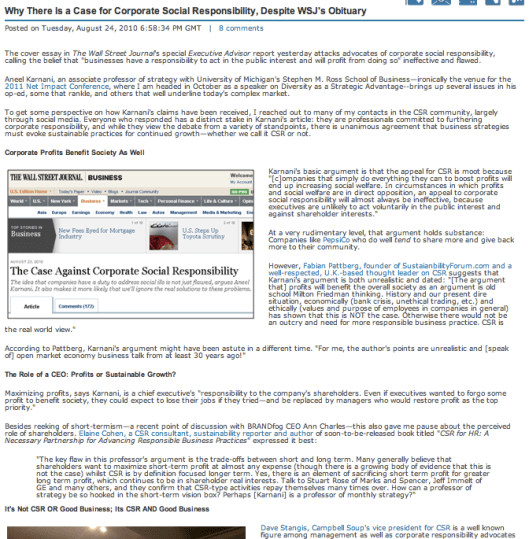
That was Dave Stangis, VP for Corporate Responsibility with Campbell Soup Company responding to University of Michigan Professor Aneel Karnani’s infamous editorial in The Wall Street Journal, “The Case Against Corporate Social Responsibility.”

Then, the argument was “capitalism versus corporate social responsibility, CSR versus profits, and where an idea like CSR fits into a business’ main objective, which is to make profits for its shareholders.”

Despite numerous debates [Fenton’s BIG CSR debate] and as many editorials and reports [Why There Is a Case for Corporate Social Responsibility], the inequity of the idea — or the perception that being responsible will cost a company money and therefore is an expense business doesn’t need — prevails.
But the actual essence of this debate no one can seem to pinpoint. Are we fighting over semantics or strategy?

Is it the misperception that CSR is a cost, a tagged on responsibility, and therefore, unnecessary for companies? Or that CSR is completely estranged from the notions of capitalism as Professor Karnani believes — and is, in fact, the wrong argument?

Since his controversial editorial, Karnani of course has continued to incite criticism for what many call an “extremely shortsighted and narrow view.”

Now, the associate professor of management and strategy for Michigan’s Ross School of Business is headed to New York City to debate his argument in real-time on the occasion of the CR COMMIT! Forum 2011, organized by Corporate Responsibility Magazine and NYSE Euronext [Details below].

Fashioned as an Oxford-style debate [DEBATE: RESOLVED that when companies expend resources on corporate responsibility and sustainability they destroy economic value], Karnani will be joined by Gerry Sullivan, president of the VICE fund, on the pro-markets side.

On the pro-sustainability side will be Paul Herman, CEO of HIP Investor and Dr. Vinay Nair, founding partner of Ada Investments and adjunct associate professor of finance and economics at Columbia Business School.

In a sneak peek, I talked to three of the debaters [Dr. Nair couldn’t make it] on the essence of their arguments as well as: How does each of them define CSR?

Take a read:

Thriving on the Value of Vice

Gerry Sullivan from VICE funds believes in the power of capitalism. His funds select well performing stocks of tobacco, alcohol, gaming and weapons companies because they believe that, “Vice industries tend to thrive regardless of the economy as a whole.” Anyone reminded of the root of the financial collapse?

“I believe in capitalism because it ensures that products and services coming out are tested on the profit mandate and ultimately are good processes because they come through the interaction and the ability to gain profit,” he said.

Fair enough. Historically, companies who do well tend to share more.

Making Too Much of CSR?

“My biggest fear of CSR is that people want to make more of it than it really is. A company’s ability to employ better people and deploy profits is the real goal. Everything else is settled by the market,” he continued.

But clearly there is a differentiator between companies that invest in their community and immediate environment over the long-term and those that focus on short-term yields?

Affirmative, says Paul Herman.

Citing the ever quotable example of BP, he said, “When you look at their track record, BP was not a good corporate citizen and lost 40% of shareholder value in just a few months post the oil spill. Companies are not prepared for the volatility of climate change and its effect on cash flows and natural resources.”

Further, “Research from Wharton School and other academics has shown measurably that companies that help solve social and environmental problems can enjoy a higher shareholder and portfolio value,” he said.

“This decreases risk for business and increases value,” he added.

CSR Cannot Dictate Social Enterprise, But Profits Can

Because it had begun to sound like a battle between two followers of capitalism with opposite operational ideologies, I asked Karnani to step in.

“Companies can maximize profits and social enterprise at the same time, which is why capitalism works well. This is where Paul makes a good argument. Of course companies should do all this,” he said.

“But we don’t need CSR to make this argument. It’s as simple as ‘make the money, help employees.’” he added.

Here is where the caveat comes in however, he said. “This isn’t always true. When markets fail, we cannot appeal to companies to sacrifice profits for CSR and it is naive of anyone to think that all the stakeholders are always aligned in their interests. If this were true, we wouldn’t need the study of economics,” he argued.
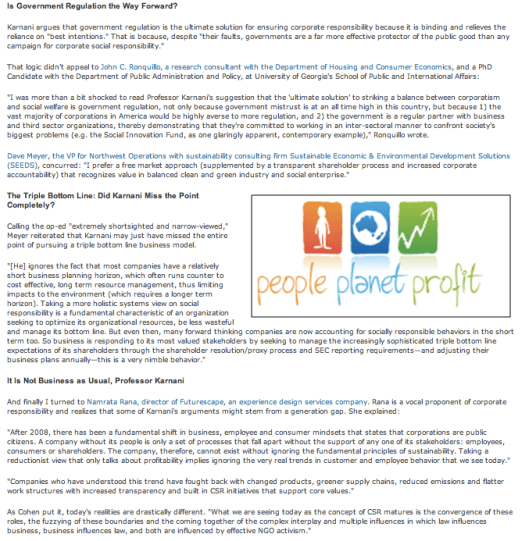
His solution? Going back to what he had argued in the WSJ editorial last year: Government regulation.

And this is where my problem with the debate starts: How can government regulate behavioral change, cultural perceptions, and a deteriorating environment? Or are we now talking of CSR as a program, an initiative, a fundraising for charity opportunity?

If so, was Karnani suggesting the route the Indian government took recently by “mandating 2.5% of net operating profits must be spent on CSR” by all publicly traded companies?

Perhaps, although we won’t know till the live debate at the COMMIT! Forum.

Back to Square One: What the heck is CSR?

Clearly, the next question: How are these men defining corporate social responsibility? Intentionally or not, I had hit the nail on its head.

VICE Funds: “CSR is Green, And It Isn’t Generating Green”

According to Sullivan, “CSR is embedded into green and green hasn’t generated green for most companies.” Also blaming the government for supporting “and pumping a ton of money into green jobs,” which many say has been a failed effort at reviving the economy, Sullivan continued:

The internet bubble taught us that having pool tables and kegs doesn’t make the companies money. If the jury is still out on whether good companies will do good things, I say they’re smart enough to treat their employees well. You don’t need CSR for that.”

“I would like the companies I invest in to not be socially responsible but responsible to their shareholders and producing products that the government can use to generate revenue. I certainly hope that these companies think highly of their employees but I’m less inclined to think that they would give up profits over socially responsible activities.

HIP Investor: “CSR is Generating Top Line Growth”

For Paul, the question isn’t about green or management. “You start by asking yourself what social or environmental problem you are solving. Companies who are doing well have a core mission of improving the world in some way and making money while doing so.”

Citing the example of banks, he explained, “Banks were started to help people grow their income and wealth and became more integrated in their communities.”

“Starbucks in the U.S. spends more on the health care of its employees than the coffee beans because they support a better quality of life for employees and a higher labor standard.”

The argument, at least for Herman, isn’t about the validity of CSR anymore. “It’s about generating top-line growth and bottom-line profits. That’s why employees and investor relations teams are key in solving this paradigm,” he concluded.

Karnani: “If CSR is Beyond Making Money, Then It’s Not Making Money”

“CSR is a very confused notion. If you just mean businesses doing good for society, then capitalism is actually good [for society]. If CSR goes beyond ‘making money,’ then it’s not about ‘making money.’ When a company does something socially useful and loses money over it, that’s CSR. And definitionally, CSR loses money,” he concluded.

Confused? Irate? Redeemed?

Want to attend the COMMIT!Forum? Register here or connect with me on Twitter @AmanSinghCSR for a special discount code. The Forum begins on September 26, 2011, at the Javits Center in New York City and offers a full two-day agenda complete with a CSR careers symposium, keynotes and workshops.

And if you cannot make it, stay tuned here for more coverage.
Share this:

  • Tweet
  • Email a link to a friend (Opens in new window) Email
  • Share on Reddit (Opens in new window) Reddit
  • Print (Opens in new window) Print
Like Loading...

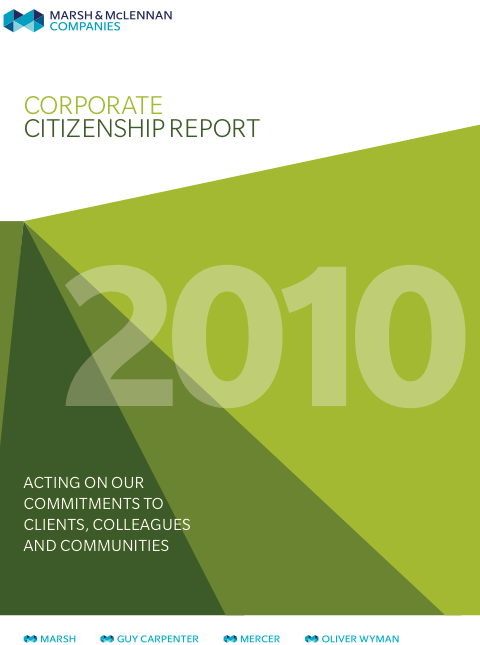
Marsh & McLennan’s 2010 CSR Report: Holistic, Aspirational, But Lean on Data

07 Wednesday Sep 2011

Posted by Aman Singh in CSR, CSR reporting, HR

≈ 2 Comments

Tags

Accountability, aman singh, aman singh das, brand management, Brand Management, Business, Business Ethics, Chief Diversity Officer, Chief sustainability officer, Christine Salerno, corporate citizenship, corporate social responsibility, CSR, CSR communications, CSR reporting, CSR strategy, Elizabeth Barry, guy carpenter, HR, Kathryn Komsa, Leadership, management, Management, marsh, mercer consulting, Michael Connor, oliver wyman, shared value, Silvia Davi, social responsibility, Social Responsibility, Stakeholder Engagement, supply chain, Sustainability, sustainability, Work culture


“Our corporate social responsibility is our best kept secret.”

What compels a company with 52,000 employees and with over 140 years of systems in place to publish a CSR report?

For professional services giant Marsh & McLennan, as CSR Director Christine Salerno put it, there was an urgency “to put a stake in the ground.” The company, following shortly on the footsteps of a rebranding initiative [from Marsh to Marsh & McLennan], released its first CSR report, complete with a press briefing at its New York headquarters, late last month.

At first — and second — glance, the Marsh CSR report is 21 pages of text and very little data. What the executives present at the briefing, however, had to say, was far more enlightening and worth noting.

After Silvia Davi, head of corporate communications and brand introduced the panel — an all-women team of Chief Sustainability Officer Elizabeth Barry, Chief Diversity Officer Kathryn Komsa and Salerno — Barry started off with some forward-looking statements.

1. Sustainability

“We were doing a lot [in sustainability] but we needed structure. Now we can gain much more from the same efforts by implementing them as part of a long term strategy,” she said, adding that, “This is not about today, this is about tomorrow.”

Our work in CSR is our best kept secret. Now we have decided to collaborate and communicate our successes and challenges because colleague education and engagement are key to the success of our sustainability strategy.

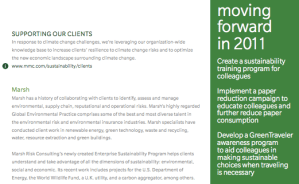
Pointing to a slide that charted key accomplishments since 2010, Barry noted that a majority of the data points were yet to occur. For example, the company is set to launch an internal “Green Traveler” program aimed at helping employees’ cut down their carbon footprint by educating them on telecommunication alternatives, etc. Also to follow later in the year: A “Paper Reduction Campaign” as well as a “Sustainability 101 Training Program.”

“I want everyone in the company to know that they are committing to a longterm strategy,” she emphasized. “Sustainability starts with people and our behavior and if every colleague made one tiny change, the impact collectively can be huge. It’s not a quick process but it is truly more sustainable.”

2. Diversity & Inclusion

The mission for CDO Komsa, who started in her current role in 2009, was “to create an enterprise-wide diversity and inclusion strategy.” “Our challenges are finding the right talent, resources, and the right market share in a multicultural world,” she said, adding a common refrain among the B2B sector, “Our raw material is our people and a diversity platform becomes a great way of creating shared value.”

Komsa also touched on an issue that has had insurance companies scratching their heads in recent years: How do you make a career in insurance sexy and attractive?

Noting that this is a big challenge and opportunity for Marsh, Komsa emphasized that her, “Team’s leading initiatives in coming months will be to tie in the four companies [Oliver Wyman, Marsh, Guy Carpenter and Mercer] and rebrand the insurance industry by emphasizing how we source our talent.”

3. Community Relations, Volunteerism, Philanthropy

Marsh and McLennan's 2010 CSR ReportSalerno who is an ex-investment banker chose to begin with a review of past challenges: “This is something that has always been done. What has been missing is the communications piece. There has been no cross collaboration internally within the units.”

“Our business case is to make sure that our CSR activities are creating impact in the communities we operate in and for our employees,” she added, noting that, “An engaged employee wants to stay. We want to make sure we are attracting the right people.”

The connection between CSR and recruitment is an increasingly acute problem for recruiters, especially in the B2B sector, where the commodity for sale isn’t so much a physical unit but organizational culture, intellectual growth and innovation. How do you leverage CSR as a recruitment strategy? [Join me at one of eight breakfast sessions on analyzing this very question starting next month.]

“Students coming out of college want to work for companies that are doing the right thing. Our strength is our people. So how do we use our biggest assets to create maximum impact?” Salerno responded.

4: Climate Change

In response to Business Ethics Publisher and veteran journalist Michael Connor’s question about setting goals on climate change, Barry pointed to the unique challenges of operating in cities like New York, where most companies don’t own their real estate. “Goals are hard for a professional services company. And when you add a lease to the equation, it becomes even harder. In most cases, we are in the middle of 10-year leases so in the interim, we are finding other ways to set goals, like how to reduce our real estate portfolio altogether.”

5: What Does Successful CSR Look Like for a Fortune 250 Company?

Employee engagement has always been a huge component of my blogs in the past because I truly believe that getting your employees on your side is half the battle for most companies struggling with reputation issues. They can be your best brand ambassadors and I asked the Marsh team what success looked like for all their CSR and sustainability efforts: A significant decrease in air travel, a certain number of LEED certifications, an internally set women and minority retention rate, or something else?

Repeating that they launched the CSR report as a way of putting a stake in the ground, Salerno emphasized that, “Employee engagement is a crucial piece and trying to quantify our efforts and rolling out a system to measure our activities has them talking.”

“We’re getting the information out there and they are discussing it,” she said, to which Komsa added that, “piles of resumes have been pouring in because the work we do aligns with someone’s values. That means our employees are talking, which is a huge win for us.”

Barry, however, might have put it best:

“This report doesn’t have as many foundations but it is an important story to tell. We don’t have all the answers but we do want to get started on finding them.”

At the end of the day, Marsh isn’t looking to solve the water crisis or achieve a zero carbon footprint. Their goals are moderate and their CSR report reflects a forward-looking attitude that is encouraging.

That they have a team in place approaching CSR strategically — and a lot more holistically than many other companies — is the right start.

Share this:

  • Tweet
  • Email a link to a friend (Opens in new window) Email
  • Share on Reddit (Opens in new window) Reddit
  • Print (Opens in new window) Print
Like Loading...

Revisiting the PR Take on CSR: “Corporate Responsibility is Not Public Relations”

30 Tuesday Aug 2011

Posted by Aman Singh in CSR

≈ 1 Comment

Tags

aman singh, aman singh das, Better Business Bureau, brand management, Brand Management, Business, Career advice, careers in CSR, cause marketing, consumer education, corporate citizenship, corporate social responsibility, corporate values, CSR, CSR blogger, CSR communications, CSR strategy, Edelman, employee engagement, Events, Green practices, Jobs in CSR, Leadership, leadership, management, Management, Michael Holland, philanthropy, PR, shared value, social responsibility, Social Responsibility, Stakeholder Engagement, sustainability, what is CSR?


Last year, the Better Business Bureau hosted an event titled Good Business 2010, where the day-long agenda was to analyze the increasing confluence of public relations (PR) and corporate social responsibility (CSR). Here’s what I wrote then on Vault’s CSR blog:

A Belief System For Your Company

Edelman’s EVP for CSR-New York, Michael Holland while highlighting his firm’s approach, emphasized that corporate responsibility was emerging increasingly as an indelible part of brand management for companies, although North American companies, while initially slow to embrace it, were quickly getting on board.

Defining CR as “A belief system for a company” he broke its significance for companies into three segments: 1) the social and legal aspect; 2) its immersion into the operational model; and 3) how to leverage it for competitive share in the marketplace.

What is the ROI for corporate responsibility?

Citing a recent survey conducted by McKinsey, Holland said that the business case for corporate responsibility had never been clearer for companies. “Companies that paid attention to CSR in the last three years reported an increase in their share price of 43% against a 12% increase for those who didn’t.” At the same time, profits for the first segment of companies increased by 16% versus 7%. I’ve often noted that metrics and numbers speak louder than words. These then, need no further explanation. See more results from the McKinsey survey.

Noting that the pressure for accountability was no longer the voice of a few dedicated advocates and had shifted to mainstream demands from all stakeholders for a company, Holland stressed that the tipping point was already here: “CR cannot be ignored any longer. Shareholders, employees and clients are demanding it.”

What is corporate responsibility all about?

Holland, interestingly, chose to answer this by focusing on the key misconceptions about corporate responsibility. Funnily enough his counter-intuitive tactic worked, bringing up several questions from the audience. He put it like this:

CSR ≠ Green
CSR ≠ Strategic Philanthropy
CSR ≠ Public Relations

CSR isn’t PR, it’s About Your Business Strategy

I have discussed in the past the huge difference between conducting brand management and reputation-building and immersing CR as a culture of change into your company’s strategy. I asked Holland how he advises clients to walk that fine line.

“First of all, it needs to start from the top. Secondly, it needs to part of a company’s communication strategy. And finally you need to define what it means to track the progress of your corporate responsibility. The problem is that the marketplace believes that CSR is cause marketing and philanthropy. Our task is to overrule that and teach them that actually it’s about business strategy.”

——————————–

Now, with several communications firms announcing CSR practices, where are we headed with the confluence of PR, brand management and CSR? I turned to the latest entrant in the field, Ruder Finn. Take a read.

Share this:

  • Tweet
  • Email a link to a friend (Opens in new window) Email
  • Share on Reddit (Opens in new window) Reddit
  • Print (Opens in new window) Print
Like Loading...

Behind Every Responsible Company Is a PR Agency? A Closer Look @ Ruder Finn’s New CSR Practice

30 Tuesday Aug 2011

Posted by Aman Singh in CSR

≈ 10 Comments

Tags

aman singh, aman singh das, brand management, Brand Management, Business, Career advice, careers in CSR, cause marketing, Cone, corporate social responsibility, CRO Magazine, CSR, CSR communications, CSR marketing, CSR programs, CSR strategy, Edelman, employee engagement, Ethics, Golin Harris, Jobs in CSR, jobs in CSR, ketchum, marketing, marketing careers, PR, PR careers, public relations, risk management, Ruder Finn, Sarah Coles, shared value, social responsibility, Social Responsibility, strategic marketing


They say, behind every successful brand, is a PR agency.

How about: Behind every responsible brand, is a PR agency?

Now, what is the first thought that comes to your mind when you hear that a public relations agency has decided to roll its “CSR experience” into a new division offering clients the opportunity to use their PR capabilities and budget more responsibly, more strategically?

  1. You condemn them as a reactionary, out-to-make-money business;
  2. You think: CSR is not PR, how many times do we have to say it?
  3. Wonder how long this will last.
  4. That’s interesting. Yet another way we can help businesses create shared value

That last statement was the main driver behind Ruder Finn’s new CSR practice, which officially launched two months ago, according to Senior Vice President Sarah Coles. “We had already been doing CSR work with clients like Novartis and Gerber. It felt like a natural next step [for the firm],” she says.

The communications industry is abuzz with the notion of creating shared value and the professional services sector especially, is in the center of all the activity.

Of course, Ruder Finn is not the first PR company to offer CSR strategy and solutions. Edelman has a robust CSR and sustainability solutions practice, as do Burson-Marsteller, Ketchum, Golin Harris, Cone, and many others.

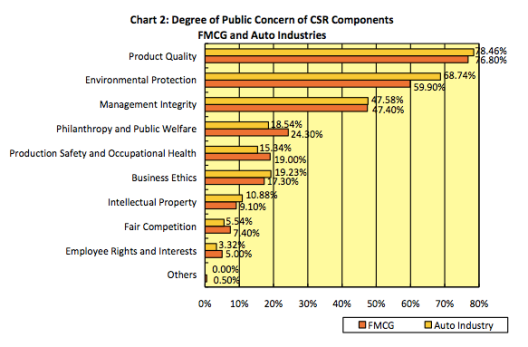
http://www.ruderfinnasia.com/files/csr-index-fmcg-and-auto-in-china-appendix.pdf

In fact, a quick search revealed that CRO Magazine even released a Top 10 list of “Corporate Responsibility PR firms” back in 2008, that placed Ruder Finn at No. 5. But how do you decipher such a ranking? If Ruder Finn was already being lauded for “CSR PR (?)” in 2008, what propelled them to create a new division now three years later?

And the big question: What is the differentiator in this burgeoning industry? 

I turned to Coles who will be leading the new practice and has spent 13 years in PR with the last seven at Ruder Finn, for some answers.

Sarah Coles, SVP, Ruder Finn

“When I started working with clients on CSR strategy, it wasn’t called CSR. Many were doing this without realizing it was called CSR. For example, at Novartis, we didn’t see our work in malaria treatment as CSR per se. It was part of their core mission, part of everyday business.”

“My first contact with CSR was when I started working with Gerber on childhood nutrition and later with Novartis. In the five years that followed, I got the chance to really see the effects of giving back to your community. I got to meet some of the patients and really saw firsthand the challenges that we in the western world would otherwise never understand. The whole experience really changed my impression of what needs to get done.”

The Case For CSR: What were the main motivations behind setting up a new practice focusing on CSR?

“There is a demand today to put together more strategic CSR programs; programs that are distinguished, unique to the company, and meaningful.”

“Consumers are pretty smart these days: They can see when something is reactionary and when it has been a longterm commitment. They trust brands that have longterm missions and whose programs are in sync with brand value.”

“A great example is the latest Tide for Hope campaign. It’s a perfect example of how core competencies can help provide value. This builds way more trust than something thrown together in a short-term cycle.”

“Ruder Finn also strongly believes that this is not only an opportunity to grow our practice but also to help define what the industry means by CSR and educate companies the issue to ensure that it continues to build as a best practice.”

The Nature of PR: Aren’t most programs reactionary in nature at first contact?

“It’s certainly a mix. Some companies who have been doing this for a long time are doing well and CSR contributes to that reputation. They build trust. Others are more reactionary but won’t be sustained or provide strategic value in the long run.”

“There is a real business case for CSR and companies are beginning to see that. Companies that have longterm Initiatives don’t have to resort to crisis management and there is value in that.”

Strategizing CSR: What then is the underlining ethos of the new practice?

“We learned a lot from working with PepsiCo on their Dream Machine recycling program. Today, we see a real opportunity in helping clients with cause marketing initiatives that reinforce their business practices and core competencies.”

“We counsel clients to do corporate social responsibility strategically. To build something that looks inside the company…dig around and see what they are already doing, what they stand for, what their core values are, and then create a campaign that captures all of that.”

Implementing CSR: How is implementing a CSR strategy going to differ from PR campaigns?

“We’re moving into pure strategy now. It’s not about short-term projects anymore. CSR is more about what makes sense for the business. How can I create something that my company stands for and does good for our community at the same time?”

“These programs go to the root of what CSR is all about: Good business sense that also provides value.”

Comments? Thoughts? Leave a comment or connect with me @AmanSinghCSR.

Share this:

  • Tweet
  • Email a link to a friend (Opens in new window) Email
  • Share on Reddit (Opens in new window) Reddit
  • Print (Opens in new window) Print
Like Loading...

For Most, Day 1 of College = Excitement, Opportunity. Not for This Teen in Foster Care

30 Tuesday Aug 2011

Posted by Aman Singh in Uncategorized

≈ 3 Comments

Tags

aman singh, aman singh das, division of youth and family services, human rights, mentoring, Social Impact, social impact, social responsibility, Social Responsibility


This is unusual for me.

Writing and reporting on CSR and sustainability issues, I have always preferred to keep personal stories out of my writing. However, this once I’d like to talk about an incident that has me rattled. And like everything else I write, I’d like to share it with you and hopefully together, help make someone’s life a bit easier.

There is a girl who recently started working at this store I frequent in my neighborhood. Yesterday, as I stood in her checkout line, she seemed flustered, stressed, worn out.

Was it the recent storm? No, she said. “It’s my life.”

The girl, 19 years old, was clearly upset and I asked her manager to give her a 10 minute break so we could chat.

She is one of thousands of abandoned children in New Jersey. Her father is in prison. Her mother, who remarried, abandoned her and she was placed in one of the state’s foster homes.

Then, she was in school.

Yesterday, however, was her first day of college thanks to New Jersey’s Foster and Adoptive Family Services (FAFS) program. Instead of the usual excitement, however, she was scared. Here’s why:

Her foster home parents, from the Division of Youth and Family Services agency (DYFS), have encouraged her to study and work at the same time. What makes it harder for her is that unlike the other kids in the house, she doesn’t have a car.

So she ends up spending hours everyday taking the NJ Transit bus from home to school, school to home, and then home to work, and back home. The problem: NJ Transit buses run every hour or so with limited runs after 10pm. Her shift at work doesn’t end till 10pm so she has to wait for the next bus, which doesn’t run till 11:58pm.

Here’s how her day goes, she explained:

5:00am: Wake up, rush for college

6:30am-1:00pm: Classes

1:00pm-2:30pm: Bus, lunch at home

3:00pm: Back on the road heading to work (shift starts at 4pm). She only lives 15 minutes away but is dependent on the bus schedule

4:00pm-10:00pm: Work

10:00pm-11:58pm: Wait for the bus

12:30am-2:00am: Finish homework and complete weekly assigned house chore

2:00am-5:00am: Sleep

She doesn’t have a case officer anymore, she says, because her father got sentenced and that’s when the case closed. Her mother doesn’t support her and the DYFS workers receive half of her bi-weekly paycheck, which doesn’t leave much for her to save between food and textbooks.

She also told me that those funds are “supposed to be used toward weekend trips and expenses like a bus pass for the kids,” but that in reality, none of those trips take place.

Can she report this to someone? She doesn’t think so. After all, they are helping finance her college education. And she doesn’t have an assigned case officer.

She is also thankful for “having a roof on her head and health insurance.” She realizes that leaving the home would mean financial instability and she certainly cannot afford independent health insurance.

But why work that exact shift at work? Perhaps an earlier shift can help get her home sooner, giving her more time for homework and sleep?

The DYFS staff insist she work in the evening to support her expenses.

Clearly, she has a complex mix of logistical and puritanical policies to deal with. How does she want to move forward?

Take a year off of school to save enough money to buy a car and afford rent so she can get out of foster care.

The hitch? She says, the DYFS folks insist that she go to college; that it is part of the arrangement of living in foster care.

All through her narration, I’m thinking, there has to be two sides to the coin. DYFS after all is a social services agency built to protect such children. Surely, she is biased and simply stressed with trying to balance work with studies? Most adults have a hard time juggling work and home, she’s just a teen at her first job.

But at the same time I was also thinking more on lines of how I could help.

Regardless of whether she is biased, simply venting or stating the honest truth, can I help improve her life in any way? What can I do to help her cope with life and believe in herself?

Mobility is clearly her biggest obstacle. Would a car be the solution?

Or financial help?

Or something else?

Living in the country of “everyone’s dreams,” makes it easier for us to forget people who are worse off. Growing up in India, poverty, destitution and neglect were visible, right there for everyone to see. The jhuggis (straw huts) coexisted with the brick and granite mansions on the streets of Delhi. The Mumbai slums–now that everyone is familiar with them thanks to Slumdog Millionaire–are in your face, there everyday, alive and naked.

Here though, in one of the most expensive states of the country, girls like her are invisible — and stories like these so much more shocking.

So, what should I do? What would you do?

Connect with me @AmanSinghCSR or leave a comment.

Share this:

  • Tweet
  • Email a link to a friend (Opens in new window) Email
  • Share on Reddit (Opens in new window) Reddit
  • Print (Opens in new window) Print
Like Loading...

As Steve Jobs Departs, A Review of Our Love-Hate Relationship With Apple…and Sustainability

24 Wednesday Aug 2011

Posted by Aman Singh in CSR

≈ 1 Comment

Tags

aman singh, aman singh das, Apple, brand management, brands with purpose, BSR Conference, Business, Carol Cone, cause marketing, CEO Network, consumer education, consumerism, corporate social responsibility, CSR, Edelman, Good Purpose Study, Green, In Good Company, Leadership, Management, Matthew Bishop, Performance with Purpose, Steve Jobs, Sustainability, sustainability, sustainable business, sustainable technology, technology, Work culture


As we slowly recover from the stupor of the not completely unexpected news that Steve Jobs has stepped down as Apple’s CEO, here’s a post from recent months that’s worth a retake.

Context: At Business for Social Responsibility’s (BSR) annual conference last year, Edelman’s Managing Director for Corporate Citizenship Carol Cone released the 2010 Good Purpose Study with a dramatic declaration: “Cause marketing is dead.”

The main overarching finding of the study, as regular readers will recall, was this:

87 percent of consumers worldwide believe that business needs to equate at least equal weight on society’s interests as on business interests.

Accompanying Cone at the release were panelists from Levi Strauss, PepsiCo and a personal favorite: The Economist‘s Matthew Bishop, who amid the hype and hoopla of the report, quietly asked: “Are we really going to stop buying Apple because of its crappy environmental policies?”

An excerpt, originally published on Vault’s CSR blog: In Good Company:

The GoodPurpose study by Edelman

“Cause marketing is dead”

That controversial statement is how Cone opened the panel, adding, “That [cause marketing] world is way over. Purpose has replaced cause marketing and branding.” Companies aren’t building marketing plans around a cause anymore, she argued. Rather, “they are infusing their very strategy and business model with purposeful corporate citizenship.”

Defining real purpose

Picking up where Cone left off, the always-entertaining Matthew Bishop began with a prediction: “If we continue the current road toward demanding transparency and corporate social responsibility, within the next five to 10 years, we will begin to see corporate board meetings being live streamed to select people.”

Chuckling about the ambitiousness of his own statement, he went on to note, “Likewise, the real question is how much of this data [in the Good Purpose study] is picking up on aspirations rather than real choices [of consumers].”

PepsiCo: Performance with Purpose

Alleging that PepsiCo’s latest mantra of “Performance with Purpose” was indeed a verification of this shift from cause marketing to purposeful corporate citizenship at companies, Communications Director for PepsiCo Americas Beverages Melisa Tezanos gave high points to CEO Indra Nooyi for pushing for a company-wide cultural change that today drives all their business functions.

[READ: Pepsi Takes Performance with Purpose to Heart: An Interview with Chief Personnel Officer Cynthia Trudell]

“However, Nooyi is completely unapologetic about giving ‘performance’ as much importance as the ‘purpose’ part and she makes no bones about it,” said Tezanos, adding that this helps everyone across the company stay committed to a culture of profitability with purpose. Explaining the drivers behind PepsiCo’s highly successful Refresh project, she further stated, “For millennials, social responsibility is huge. We’ve seen through research again and again that their purchase intent goes up significantly when the brand is associated with a good cause.”

And finally, referring to the findings of the Edelman study—and Cone’s earlier comment, she said, “Marketing used to be blamed for being short-termism. Today, marketers are the biggest defenders of long-termism.”

But would you give up Cola…or Apple?

Bringing the conversation back to a level plain field, Bishop concluded with a sobering thought, “But what is real and what is fake with purpose? Will Pepsi ever move beyond the heart of its products, i.e., increasing obesity? Are we really going to stop buying Apple [products] because they have crappy environmental policies?”

———————————–

Just some food for thought as we go on a whirlwind ride with the media in coming days on the history, the present, and the future of America’s favorite company, Apple. Don’t forget to add your perspective by leaving a comment or connecting with me @AmanSinghCSR.

And if you haven’t already, share your opinion on whether social media engagement make better brands or more effective leaders by taking this new BRANDfog survey on social media and leadership.

More on Edelman’s Good Purpose study: Encompassing 7,259 respondents in 13 countries, the study was conducted by consulting firm StrategyOne with the objective of analyzing whether—and how much—purpose plays into purchase decisions worldwide, and further, how these transform into consumer activism via social media.

Share this:

  • Tweet
  • Email a link to a friend (Opens in new window) Email
  • Share on Reddit (Opens in new window) Reddit
  • Print (Opens in new window) Print
Like Loading...

CSR and Sustainability in Mainstream Media: Citizen Journalism Or Simply Shared Value?

18 Thursday Aug 2011

Posted by Aman Singh in CSR

≈ 16 Comments

Tags

alberto andreu, aman singh, aman singh das, Business, Career advice, cause marketing, corporate governance, corporate social responsibility, creating shared value, CSR, CSR communications, CSR reporting, examples of CSR, henk campher, jobs in CSR, journalism best practices, Leadership, philanthropy, reporting standards, risk management, shared value, Social Media, social media, social responsibility, Stakeholder Engagement, Sustainability, sustainability, sustainability jobs, sustainable business, Work culture


One of my most common complaints, after “Why Don’t Executives ‘GET’ CSR?” is why mainstream media hasn’t been giving due diligence to sustainability, corporate governance, employee engagement, social responsibility, the confluence of business, society and the environment, and everything else that connotes CSR.

2010: Professor Aneel Karnani’s Case Against CSR and Michael Porter’s Creating Shared Value

In 2010, there were a few noteworthy attempts. Aneel Karnani’s editorial in The Wall Street Journal on The Case Against Corporate Social Responsibility, which evoked numerous blogs, response pieces, live panels and tremendous conversations.

[READ: Why There Is a Case for Corporate Social Responsibility, Despite WSJ’s Obituary]

Then came Michael Porter’s piece on Creating Shared Value in Harvard Business Review. Not only did Porter start a flurry of debates, white papers and panels, the report even introduced new hashtags for Twitter users: #CSV and #sharedvalue; and a new hangtag for consultants.

Everyone understood shared value, they could contextualize the term, even measure it, and therefore, make a better case for business and social responsibility.

Debating Semantics: CSR vs. Sustainability

At Vault and more recently at Forbes, my effort has always been to highlight issues that needed addressing, questioning, cajoling, and analyzing. Soon after Porter’s piece, I asked two experts in the field to take on the debate, which often gets lost as semantics: Henk Campher, SVP for CSR and Sustainability with Edelman, and Alberto Andreu, Chief Reputation and Sustainability Officer with Telefonica accepted the challenge.

Campher took us through the evolution of the term “CSR,” concluding that corporate social responsibility, does indeed, fit best.

Here’s an excerpt:

We should look at the description of CSR itself. Why do we use these very specific three words to describe what we do? I would argue that the concept is actually a very good description of what we do today. Here’s why:

Corporate implies that this is about business.

  • It not only describes that we are busy with a discipline involving business but goes deeper.
  • It is about profits – how we make them and how we can make more of them today and tomorrow.
  • It is not about charity.
  • It is about building a sustainable business model that will continue to deliver business results for stakeholders – especially shareholders.

Social tells us this is about society.

  • It is about the impact business has on society and how we can manage this impact to ensure both business and societal benefit.
  • Even the environmental part of CSR is about society – how we can minimize environmental impact to benefit society in the end of the day.
  • The new developments in CSR – sustainability – further continue to prove that CSR is about a mutually beneficial relationship between product and service development, and societal value chains.

Responsibility reveals that business does carry a responsibility in this world–to do business in a way that benefits both business and society. Further, this responsibility gives business the opportunity to create new solutions to the needs of society. I would even argue that it is their responsibility to develop these new solutions and benefit by capturing new avenues of sustainable profit.

All three concepts—Corporate, Social and Responsibility—tell us exactly what we do today. CSR is also the perfect reminder of the relationship between business and society, and the responsibility they have towards each other. None of the other concepts proposed today actually tell us what we are doing and what we should be doing.

Andreu on the other hand, prefers sustainability over CSR. His key points:

Using CSR as an expression is not an academic problem but one that has very tangible consequences for companies.

Organizational: The classic case of the left hand not knowing what the right is doing. Most of the time, the rest of the company doesn’t know what the CSR team/executives do.

Defined functional areas don’t suffer from the same vagueness. HR is dedicated to people, the finance team crunches numbers, the operations team is in charge of systems and back up, etc. But how do you identify the team dedicated to such a vast array of duties, i.e., diversity and inclusion, environmental management, climate change, ethics, corporate volunteer management, social sponsorships, entrepreneurship, multistakeholder engagement, transparency, SRI, reputation, and human rights?

What we get instead is a big mess.

Structural: If CSR is about philanthropy, management will accordingly participate in sponsorship, PR and communications exercises because their objective is maximizing the return of investment in reputation building, not responsible and ethical business. For most companies, in fact, it is common practice for the CSR manager not be associated with evaluating social and environmental risk.

Budgetary: Let’s be honest. We all know that it is much easier to ask for a budget to implement philanthropic programs than for mapping out a business’ core environmental risks, or implementing an ethics code, or auditing the supply chain. Even in the best case scenarios, other areas of an organization will manage these issues as part of their day-to-day work but the reality is that when something is difficult to communicate, resource allocation becomes a much harder task.

Management: It’s easy to measure the impact your donations are having by stringing out the appropriate key performance indicators (KPI) for any given year. But what KPI efficiently summarizes responsible behavior? The resulting scorecard is usually so large and convoluted that even the most dedicated executives give it up because of its sheer confusion and lack of focus.

His conclusion:

The concept of CSR has been exhausted, we have to expand it for effective impact, and for that, we have to adopt sustainability. And that’s why I say, “It’s sustainability, stupid!”

The reason these debates work is because they compel people to chime in, share from their own experiences and research, and crowd-source solutions that everyone can agree on. While the debate elicited several comments on Vault, the tweets, comments, advice and feedback continued to pour in for weeks after publication.

Citizen Journalism Or Simply Responsible?

At the end of the day, media — and journalists — have a responsibility to business, to society, and to a global audience as well. Back in India when I was making the leap from kindergarten to first grade, it was The Times of India and other newspapers that became my primary sources of reading, grammar, comprehension and GK (a common monicker for ‘general knowledge’ used by school kids, at least in those days!).

Today, journalists are expected to inform and engage a vocal audience of readers. Bring in social media tools and you have a vocal and ready consumer base willing and confident to discuss, debate and make choices in real time with you. And this is where the CSR debate with Campher and Andreu did well.

For me, as a journalist and a resolute CSR practitioner, it is indeed heartening to see that those small, infrequent attempts are now becoming frequent analogies and commentaries within the circles of mainstream media.

In fact, here are three reports in recent weeks that came to my attention:

  • Sustainability Jobs Get Green Light At Large Firms: by WSJ’s Careers Reporter Joe Light
  • Doing Good to do Bad? by WSJ‘s Justin Lahart
  • ‘Shared Value’ Gains in Corporate Responsibility Efforts: by NY Times‘ Steve Lohr

While I give kudos to Light, Lahart and Lohr for highlighting these, we — the journalistic community — must evolve to a state of journalism where good and bad business practices and sustainability are part of everyday reporting and dialogue.

The incredible work of Alice Korngold and Ann Charles on Fast Company, my fabulous co-contributors on Forbes’ CSR blog, and Marc Gunther at Fortune must become more commonplace, much more grassroots, more mainstream.

Some call it citizen journalism. For me, it’s just plain professional responsibility. We owe it to our organizations, the economy, future generations, our planet, and at the end of the day, to ourselves.

More:

The 2011 CSR Debate: CSR is an Evolution, Not a Revolution
The 2011 CSR Debate: “It’s Sustainability, Stupid!”

Share this:

  • Tweet
  • Email a link to a friend (Opens in new window) Email
  • Share on Reddit (Opens in new window) Reddit
  • Print (Opens in new window) Print
Like Loading...

Social Media and Leadership: Are Twitter and Facebook 21st Century Necessities?

12 Friday Aug 2011

Posted by Aman Singh in CSR

≈ Leave a comment

Tags

Accountability, aman singh, aman singh das, brand loyalty, brand management, Business, corporate citizenship, corporate governance, corporate social responsibility, CSR, CSR communications, CSR strategy, employee engagement, Facebook, Google+, human resources, innovation, job hunting on social media, Job search, Leadership, leadership, management, Management, marketing, PR, Quora, Recruitment, recruitment, reddit, Social Media, social media, Stakeholder Engagement, stumbleupon, Sustainability, sustainability, transparency, Twitter, Work culture


There is a lot of love for social media among many in the corporate social responsibility (CSR) and sustainability community. [Take this short survey and have your say: Useful, necessary engagement tool or hate it and a complete hassle?]

Lucy Marcus, founder of Marcus Venture Consulting, for example, posted a blog today on Harvard Business Review, that talks about a particular Groupon deal that annoyed her enough to tweet about it and how that rose several eyebrows and an eventual resolution.

David Connor recently wrote about his love for Twitter, calling it a fascination and being constantly impressed by the simplicity of engagement and the tangible sense of community the platform provides. In his post, he alluded to a recent confession of mine, simply titled: In Defense of Twitter: 5 Reasons Why I am a Mad Tweeter, which was a response to an alternatively headlined Wall Street Journal article.

_________________________________

For those interested, here is a recount of my top five:

1) Community: Twitter has provided me with a very diverse community of individuals who are eager to engage, argue and collaborate.

2) Soundboard: Without the 20 odd tweets I send out every day, I wouldn’t get any work done. Sounds counter-intuitive, I know—but it’s true. You’ve got to go where your audience is. They have a voice and they like to use it—and as a blogger, hearing what’s working and what’s not is inarguably essential.

3) Collaborations: And of course, without Twitter, I wouldn’t have made HR Examiner‘s Top 25 HR Digital Influencers for 2011 or named among the Top 100 Thought Leaders by Trust Across America. Nor would I have been able to successfully put together the recent panel on responsible business with Carol Sanford, Jeffrey Hollender, Sarah Murray and Bank of America, or been able to interview thought leaders like Campbell Soup’s Dave Stangis, PwC’s Shannon Schuyler, EMC’s Kathrin Winkler and many others while at Vault—and collaborated with enterprising students like Ashley Jablow, Catherine Chong, entrepreneurs like Myles Lutheran and the EDF Climate Corp fellows, or published the much-referred to series on job hunting in CSR.

4) News: Believe it or not, Twitter has become a significant source of my daily news. With the help of coordinated lists, I can scan the morning news in one stream all at one source.

5) Innovation: How many times have you read an 800-word article in one the mainstream newspapers and thought “Wow, that’s interesting, I wonder how I could learn more” or “I’d love to get involved” but haven’t known what to do next? Well, because it’s so easy to connect with others on Twitter without having to jot down strenuous emails or phone calls, now you can!

_________________________________

But Connor also brought up transparency and corporate accountability.

And here is where most companies struggle with the plethora of choices available today under the domain of social media: Facebook, Twitter, LinkedIn, Quora, Digg, StumbleUpon, Reddit, and the new kids on the block BranchOut and Google+, to name just a few.

So, how helpful are these channels? BRANDfog, a social media and CSR consulting firm launched a survey last week that begins to dig deeper into some of these questions.

Social Media and Leadership:

Should CEOs be engaging on Twitter for example? Does that help gain trust with customers, loyalty with employees, or raise the bar on transparency?

Recruitment Decisions:

Has social media become a benchmarking tool for prospective candidates in their recruitment decisions?

CSR and Sustainability:

And does a presence on social media help companies illustrate their brand values, mission and corporate citizenship?

What do you think? Take this short survey and have your say. Is social media emerging as the differentiator in today’s crowded market of jobs, business, and consumer loyalty?

Share this:

  • Tweet
  • Email a link to a friend (Opens in new window) Email
  • Share on Reddit (Opens in new window) Reddit
  • Print (Opens in new window) Print
Like Loading...
← Older posts
Newer posts →

Let's Talk!

Virtual
732-322-7797
amansinghdas@gmail.com

Blogs I Follow

  • Nonprofit Chronicles
  • Learned On by Andrea Learned
  • Angry African on the Loose™
  • csr-reporting
  • The CSR Blog
  • In Good Company: Singh on CSR

My Cloud

Capitalism 2.0 CSR CSR reporting CSRwire ESG Guest Author HR Stakeholder Engagement Sustainability Uncategorized

Recently written…

  • Rationality is Ruining Us: Mayors, presidents and governors join major businesses in charting way forward on climate change
  • 2015: the year businesses recognize that climate change is real – and 4 other themes
  • Hardcore lessons of sustainability – ’10 Words or Less’
  • Brewing a Better Future [#BaBF] with Heineken: Examining the Many Flavors of Local Sourcing
  • From Conflict to Collaboration: Kimberly-Clark and Greenpeace Participate in LIVE Twitter Chat

What others are reading

aman singh aman singh das Brand Management Business corporate social responsibility CSR CSR reporting CSRwire ESG Leadership Stakeholder Engagement supply chain Sustainability sustainability Work culture

Categories

Most Read

  • None

Create a free website or blog at WordPress.com.

Nonprofit Chronicles

Journalism about foundations, nonprofits and their impact

Learned On by Andrea Learned

Angry African on the Loose™

I have opinions. I am from Africa. I live here now. I blog.

csr-reporting

Connecting the dots between Business, Society & the Environment

The CSR Blog

Connecting the dots between Business, Society & the Environment

In Good Company: Singh on CSR

Connecting the dots between Business, Society & the Environment

Privacy & Cookies: This site uses cookies. By continuing to use this website, you agree to their use.
To find out more, including how to control cookies, see here: Cookie Policy
  • Subscribe Subscribed
    • In Good Company: Singh on CSR
    • Join 119 other subscribers
    • Already have a WordPress.com account? Log in now.
    • In Good Company: Singh on CSR
    • Subscribe Subscribed
    • Sign up
    • Log in
    • Report this content
    • View site in Reader
    • Manage subscriptions
    • Collapse this bar
 

Loading Comments...
 

    %d